
10.12804/revistas.urosario.edu.co/empresa/a.15889
ARTÍCULO DE REVISIÓN
Iván Miguel García López 1
Jessica Nájera Ochoa 2
1 Universidad La Salle (México).
 0000-0001-9219-4970
 ivan-garcia@lasallistas.org.mx
2 Universidad La Salle (México).
0009-0009-0241-7460
jessica.na@lasallistas.org.mx
Reception date: October 13, 2025
Acceptance date: May 26, 2026
To cite this article: García López, I. M., & Nájera Ochoa, J. (2026). Algorithmic governance and strategic value of open large language models in university administrative decision-making: A systematic review (2019-2025). Universidad y Empresa, 28(51 esp.), 1-27. https://doi.org/10.12804/revistas.urosario.edu.co/empresa/a.15889
Abstract
Objective: This study systematically
examines recent literature (2019-2025) to identify the patterns, benefits,
challenges, and trust factors associated with the adoption of Open Large
Language Models (OLLMS) in
university administrative decision-making.
Methodology: A PRISMA-based Systematic
Literature Review (SLR) was
conducted using 183 peer-reviewed articles indexed in Scopus and Web of
Science.
Key findings: It was found that OLLMS are used primarily to improve
operational efficiency and automate administrative processes, while strategic
and governance-oriented uses remain less developed. The main barriers
identified are the digital skills gap and the limited development of regulatory
and governance frameworks, both of which constrain organizational trust in AI-supported
decisions.
Conclusions: The study concludes that
the effective integration of OLLMS in
higher education requires algorithmic
governance, leadership training, and administrative digital maturity in order
to strengthen institutional trust, decision-making quality, and innovation
capacity.
Keywords: generative artificial intelligence; open large language models; algorithmic governance; organizational trust; digital competence; higher education.
Resumen
Objetivo: este estudio examina de forma sistemática la bibliografía reciente (2019-2025) para identificar los patrones, las ventajas, los retos y los factores de confianza asociados a la adopción de modelos de lenguaje abierto a gran escala (OLLM) en la toma de decisiones administrativas en las universidades.
Metodología: se llevó a cabo una revisión sistemática de la literatura (SLR) basada en la estrategia PRISMAutilizando 183 artículos revisados por pares e indexados en Scopus y Web of Science.
Resultados principales: se observó que los OLLMse
utilizan principalmente para mejorar la eficiencia operativa y automatizar los
procesos administrativos, mientras que los usos estratégicos y orientados a la
gobernanza siguen estando menos desarrollados. Las principales barreras
identificadas son la brecha de competencias digitales y el desarrollo limitado
de los marcos normativos y de gobernanza, lo que limita la confianza de las
organizaciones en las decisiones respaldadas por la inteligencia artificial.
Conclusiones: El estudio concluye que
la integración efectiva de los OLLMen
la educación superior requiere gobernanza algorítmica, formación en liderazgo y
madurez digital administrativa para reforzar la confianza institucional, la
calidad de la toma de decisiones y la capacidad de innovación.
Palabras clave: inteligencia artificial generativa; modelos de lenguaje abierto a gran escala; gobernanza algorítmica; confianza organizativa; competencia digital; educación superior.
Resumo
Objetivo: este estudo revisa sistematicamente a literatura recente (2019-2025) para identificar padrões, benefícios, desafios e fatores de confiança associados à adoção de Open Large Language Models (OLLM) na tomada de decisões administrativas universitárias.
Metodologia: utilizando uma abordagem de Revisão Sistemática de Literatura (SLR)baseada em PRISMA,foram analisados 183 artigos revisados por pares indexados no Scopus e Web of Science.
Resultados principais: indicam que os OLLMS são usados principalmente para aumentar a eficiência operacional e automatizar
processos administrativos, enquanto as aplicações estratégicas e de governança
permanecem subdesenvolvidas. As principais barreiras incluem a lacuna de
competência digital e a falta de estruturas regulatórias, que restringem a
confiança organizacional na inteligência artificial. O estudo articula três
construtos explicativos — governança algorítmica, competência digital e valor estratégico — para interpretar a maturidade
institucional da adoção de OLLM.
Conclusiones: e a integração efetiva dessas tecnologias requer políticas de transparência, treinamento de liderança e
mecanismos de auditoria algorítmica para fortalecer a legitimidade e a
qualidade da tomada de decisão em instituições de ensino superior.
Palavras-chave: inteligência artificial generativa; modelos de linguagem de grande escala abertos; governação algorítmica; confiança organizacional; competência digital; ensino superior.
Introduction
The adoption of OLLMS in universities has emerged as a phenomenon that is transforming the management of academic and administrative processes, generating both opportunities and new institutional challenges (Wirtz et al., 2022). Recent studies indicate that these systems can improve operational efficiency, support scenario prediction, and strengthen university administrative decision-making processes, thereby contributing to institutional quality (Kovari, 2024). However, their integration into university decision-making also raises important questions regarding governance, trust, and digital competencies, all of which require systematic analysis in higher education contexts (Pan et al., 2025). Despite the growing literature on ai in education, there is still limited integrated evidence on how OLLM affect the quality of university administrative decision-making in higher education institutions.
The aim of this study is to systematically examine the recent literature (2019-2025) in order to identify the patterns, benefits, challenges, and trust factors associated with the adoption of OLLM in university administrative decision-making, and to contrast them with three explanatory constructs: algorithmic governance, digital competencies, organizational trust, and strategic value for efficiency and planning. The main contribution of the study lies in articulating a comprehensive analysis that links the technical, organizational, and strategic dimensions of OLLM, going beyond previous approaches that focus exclusively on model performance, user perception, or institutional adoption policies (Jin et al., 2025; Kovari, 2024; Pan et al., 2025). In addition, the study provides categorized empirical evidence (RQ1-RQ5) that makes it possible not only to map current trends, but also to identify areas of opportunity for strengthening university governance, leadership digital literacy, and the strategic use of ai in higher education institutions (Afroogh et al., 2024).
SDG Relevance Statement
This review is aligned with SDG 4 (Quality Education), especially target 4.3 and indicator 4.3.1, by examining how OLLMS can improve equitable access to quality tertiary education through better administrative decision-making, and target 4.4 and indicator 4.4.1, by emphasizing ai and digital competencies among university managers. It also contributes to SDG 9 (Industry, Innovation, and Infrastructure), target 9.5 and indicators 9.5.1-9.5.2, by framing OLLMS as responsible innovation capabilities that strengthen technological capacity, research management, and university-business linkages. Finally, it supports SDG 16, target 16.6, and indicator 16.6.2, through algorithmic governance, transparency, traceability, and accountability in institutional services, and SDG 17, target 17.17, and indicator 17.17.1, by promoting effective public-private-academic partnerships (United Nations Statistics Division, 2025).
Theoretical Framework
Algorithmic Decision Governance in Universities
Algorithmic decision governance refers to the set of rules, practices, and processes that guide the use of ai to support university administrative decision-making (Wirtz et al., 2022). This construct emphasizes that the integration of OLLMS in university governing bodies must be accompanied by mechanisms that guarantee transparency, explainability, and human supervision, in order to avoid bias and maintain the legitimacy of decisions (Cheong, 2024). Recent studies have indicated that trust in ai systems in organizations depends on the ability to audit the models and the involvement of key human actors in the final review (Khan et al., 2021).
Evidence from ai governance literature indicates that algorithmic rules, human oversight, impact assessment, and third-party auditability are necessary to align Ai-supported decisions with institutional values and to reduce legitimacy risks (Metcalf et al., 2021; Raji et al., 2022; Wirtz et al., 2022). This principle explains why the reviewed categories such as "Risk Management and Compliance" (rq4) and "Strategic Value" (rq1) should be interpreted not only as technical benefits, but also as governance conditions that require policies, appeal mechanisms, traceability, and fact-checking structures (Barus et al., 2025; Cheong, 2024).
These findings reflect that the effective adoption of OLLMS requires a balanced interaction between algorithmic design and institutional practices that promote legitimacy and trust.
Digital Competencies and Organizational Trust in the Use of OLLMS
This construct focuses on the role of human capabilities in facilitating the adoption of OLLMS in university administration. The literature indicates that digital literacy and continuous training of leaders and administrative staff are determining factors for ai technologies to be perceived as reliable and useful (Börekci & Çelik, 2024). The absence of these competencies tends to reinforce technological dependency and perceptions of opacity, which negatively affects trust in Ai-assisted decisions (Pan et al., 2025).
The ranking results show that the "Digital Skills Gap" (RQ3) and "Proven Track Record of Performance" (RQ4) are dominant categories (Afroogh et al., 2024). This suggests that organizational trust comes not only from the technical quality of the models, but from the preparation of managers to interpret and use Ai-generated recommendations (Shamim et al., 2023). This construct explains the need for training and governance programs that link human competence with the explainability and historical performance of models (Yu et al., 2023).
Strategic Value of AI for University Efficiency and Planning
The third construct highlights the role of OLLMS as strategic assets to improve operational efficiency and support data-driven planning in universities (Khairullah et al., 2025). Numerous studies have documented that ai can optimize administrative processes, allocate resources more effectively, and offer predictive scenarios that facilitate long-term decisions (Khan et al., 2025; Kovari, 2024). In addition, its adoption can contribute to strengthening institutional reputation and projecting leadership in educational innovation when it is aligned with governance and responsible strategic leadership (Antonopoulou et al., 2023; Khairullah et al., 2025).
The ranking reflects that the "Operational Efficiency" (RQ1) and "Administrative Process Automation" (RQ5) categories are the most prevalent, indicating that the impact of OLLMS on university administrative decision-making is perceived primarily in terms of operational performance and speed in decision cycles (Khairullah et al., 2025; Khan et al., 2025). This construct provides a framework for interpreting how the use of OLLMS can contribute to the achievement of strategic objectives, while also allowing us to contrast the promise of efficiency with the governance and trust challenges we identified in the other constructs (Kovari, 2024; Wirtz et al., 2022).
Method
This study adopted a Systematic Literature Review (SLR) approach to identify, analyze, and interpret the evidence on the impact of OLLMS on university administrative decision-making during the 2019-2025 period.
An SLR is appropriate for synthesizing knowledge in domains characterized by rapid technological evolution and dispersed findings, because it combines structured stages of literature search and screening with interpretative phases of pattern analysis and thematic classification (Kitchenham et al., 2010). This approach is also consistent with management-oriented SLR protocols that emphasize transparent search decisions, explicit inclusion criteria, and reproducible synthesis procedures (Sauer & Seuring, 2023).
The review followed PRISMA 2020 guidelines to ensure traceability, transparency, and reproducibility (Page et al., 2021).
Phase 1. Formulating Research Questions
Based on a preliminary review of the literature on GenAi, university governance, and educational administration, five research questions (RQS) were formulated to guide the search, classification, and synthesis processes. Each question was designed to capture a specific dimension of the phenomenon under study and was associated with possible classifications derived from the specialized literature (see Table 1).
Table 1. Research Questions (RQ) and Thematic Classifications
RQ |
Research Question |
Identified classifications |
RQ1 |
How do OLLMS influence the quality of university administrative decisions? |
Operational efficiency (Khairullah et al., 2025); Accuracy and consistency (Kovari, 2024); Strategic value (Wirtz et al., 2022); Mitigating Human Bias (Mehrabi et al., 2022); Strategic planning (Beñalet et al., 2023) |
RQ 2 |
What benefits do universities perceive from adopting OLLMS in administrative management? |
Interdepartmental Communication (Makarius et al., 2020); Cost optimization (Khan et al., 2025); Evidence-based decisions (Kovari, 2024); Reputation and innovation (Cai et al., 2020); Transparency and traceability (Floridi, 2023; Cheong, 2024) |
RQ 3 |
What are the main challenges for the adoption of OLLMS in university administrative decision-making? |
Digital skills gaps (Sánchez-Prieto et al., 2024); Ethical concerns and privacy (Baque Guerra et al., 2024); Cultural resistance to change (Makarius et al., 2020); Lack of regulatory policies (Phillips, 2021); Technological dependence and opacity (Yu et al., 2023) |
RQ 4 |
What factors condition the confidence of university leaders in the decisions supported by OLLMS? |
Proven track record of performance (Bach et al., 2024); Transparency and explainability (Cheong, 2024); Risk Management & Compliance (Wirtz et al., 2022); Alignment with strategic goals (Khairullah et al., 2025); Human Participation in Final Review (Raji et al., 2022) |
RQ 5 |
What are the main applications of OLLMS in university administrative management? |
Automation of administrative processes (Khairullah et al., 2025); Education policy support (Jin et al., 2025); Student Performance Monitoring (Khairullah et al., 2025); Support Systems for University Leaders (Kovari, 2024); Other emerging uses |
Font: Own elaboration.
The definition of these RQS made it possible to guide both the database search and the subsequent coding of the articles, ensuring consistency between the research objective and the empirical analysis.
Phase 2. Search Process
The search was conducted on September 22, 2025, using the Scopus and Web of Science (WoS) databases, as both are widely recognized for their broad coverage of studies in educational technology and university administration (see Table 2).
Table 2. Search Strings
Scopus Chain |
Web of Science Chain |
TITLE-ABS-KEY ( "open large language model*" OR "LLMS*" OR "generative AI" OR "artificial intelligence" ) AND TITLE-ABS-KEY ( "decision making" OR "administrative decision*" OR "strategic decision*" ) AND TITLE-ABS-KEY ( "higher education" OR universit* OR "educational institution*" ) AND TITLE-ABS-KEY ( quality or efficiency OR effectiveness or governance ) AND PUBYEAR > 2019 AND PUBYEAR < 2026 AND ( LIMIT-TO ( DOCTYPE, "ar" ) ) |
TS=("open large language model*" OR "LLMS*" OR "generative ai" or "artificial intelligence") AND TS =("decision making" OR "administrative decision*" OR "strategic decision*") AND TS=("higher education" OR universit* OR "educational institution*") AND TS=(quality OR efficiency or effectiveness or governance) |
Note: The search yielded 274 articles in Scopus and 238 in Web of Science, resulting in a total of 512 records.
Font: Own elaboration.
Phase 3. Inclusion and Exclusion Criteria
Inclusion and exclusion criteria were established to ensure thematic relevance and methodological consistency. The inclusion criteria comprised: (a) research articles published between 2019 and 2025; (b) studies whose title, abstract, or keywords explicitly referred to OLLMS or GenAi in relation to university administrative decision-making; and (c) publications in peer-reviewed academic journals.
The exclusion criteria were defined as delimitation filters intended to preserve the conceptual specificity of the review. Accordingly, records were excluded when they: (a) focused primarily on teaching and learning processes without a clear connection to university administrative decision-making; (b) examined ai applications in sectors other than higher education and did not provide findings transferable to university administration; (c) addressed ai from a purely technical, computational, or engineering perspective without organizational, governance, or university administrative decision-making implications; (d) corresponded to publication formats that did not provide original, peer-reviewed research evidence, such as editorials, book chapters, conference proceedings, or review papers; (e) were outside the 2019-2025 time frame; or (f) were duplicate records identified across databases.
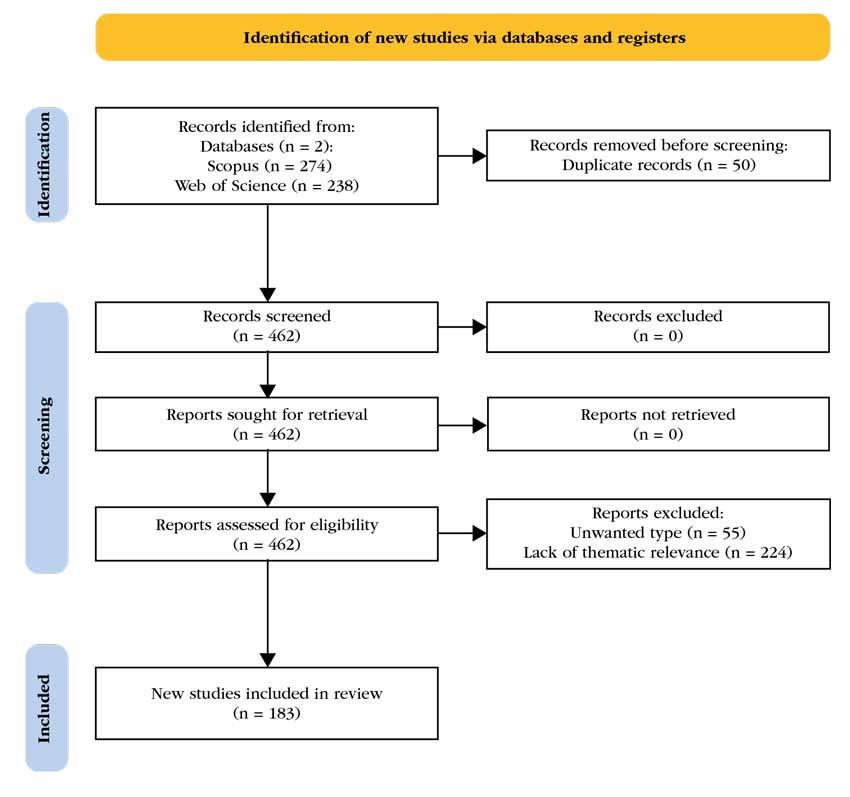
Figure 1. Study Selection Process
Font: Authors' elaboration based on the PRISMA 2020 framework (Page et al., 2021) and the reviewed corpus.
A total of 50 duplicate records were removed. Subsequently, 55 records were excluded because they did not correspond to journal articles, and 224 additional records were excluded due to lack of thematic relevance. As a result, a final sample of 183 articles was retained for the study, including 97 from Scopus and 86 from Web of Science. The extraction and coding process involved three stages:
1. Excel coding: A database was created with columns for metadata (DOI, year, country, authors, title, journal, abstract, and keywords), as well as additional columns to record the classifications assigned to each RQ. Each article was individually reviewed based on its abstract, keywords, and, when necessary, its results section in order to assign the corresponding category to each research question.
2. Manual screening and verification: The researchers reviewed each record to confirm its relevance. In cases of ambiguity, the classification was discussed jointly by the research team.
3. Data analysis with Python: The Excel database was exported to Python to generate frequency tables and bar graphs for each RQ, thereby facilitating interpretation and comparison with the theoretical constructs.
This approach combined a structured mechanical procedure with an interpretative content review process, in line with the recommendations of Kitchenham et al. (2010).
Phase 5. Data Synthesis
The classified data were analyzed in order to answer each RQ and were contrasted with the three explanatory constructs guiding the study:
1. Algorithmic Decision Governance
2. Digital Competencies and Organizational Trust
3. Strategic Value of ai for University Efficiency and Planning
The combination of quantitative analysis (frequencies) and qualitative analysis (thematic patterns) made it possible to identify trends, challenges, and opportunities, which are discussed in the following sections.
Results
RQ1. Influence of OLLMS on the Quality of Strategic Decisions in Universities
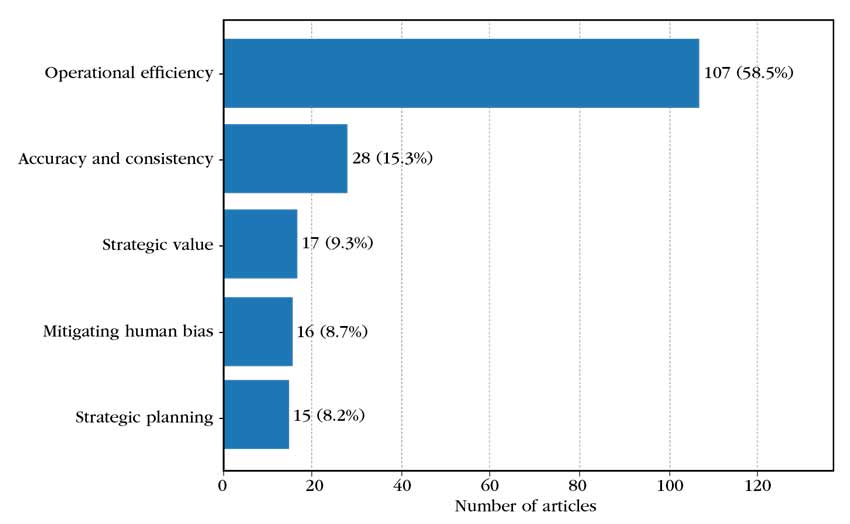
An analysis of all 183 papers shows that operational efficiency is the most prominent dimension, with 107 studies reporting how OLLMS and other ai applications optimize administrative processes and accelerate university administrative decision-making. This is followed by the categories of accuracy and consistency (28 articles), which highlight the role of AI in delivering more consistent data-driven decisions, and those of strategic value (17) and mitigation of human bias (16), which reflect an emerging interest in the impact of OLLMS on strengthening governance and equity in university administrative decision-making. Only 15 papers explicitly focused on the use of OLLMS for strategic planning, indicating that this field is still in development. Figure 2 makes visible the strong concentration of the literature around operational efficiency, which clearly exceeds the frequency of all other categories associated with the quality of university administrative decision-making.
Figure 2. Influence of OLLMS on the Quality of University Administrative Decisions
Font: Authors' elaboration based on the reviewed corpus (n = 183).
Figure 2 presents the absolute frequency and percentage distribution of the categories identified for rq1. Operational efficiency was the most frequently reported dimension (107 articles; 58.5%), followed by accuracy and consistency (28; 15.3%), strategic value (17; 9.3%), mitigating human bias (16; 8.7%), and strategic planning (15; 8.2%).
The prevalence of efficiency suggests that universities view OLLMS primarily as tools to streamline routine and operational processes, rather than still using them as integrated systems to support high-level decisions (Khairullah et al., 2025). This is consistent with evidence reported in the external literature highlighting the early adoption of ai in operational optimization tasks before addressing more complex institutional planning and policy challenges (Bick et al., 2024). This finding will serve as a basis for contrasting the gap between efficiency-focused applications and the aspirations of university governance frameworks in the discussion (Jin et al., 2025).
RQ2. Benefits Perceived by University Leaders from Adopting OLLMS in Administrative Management
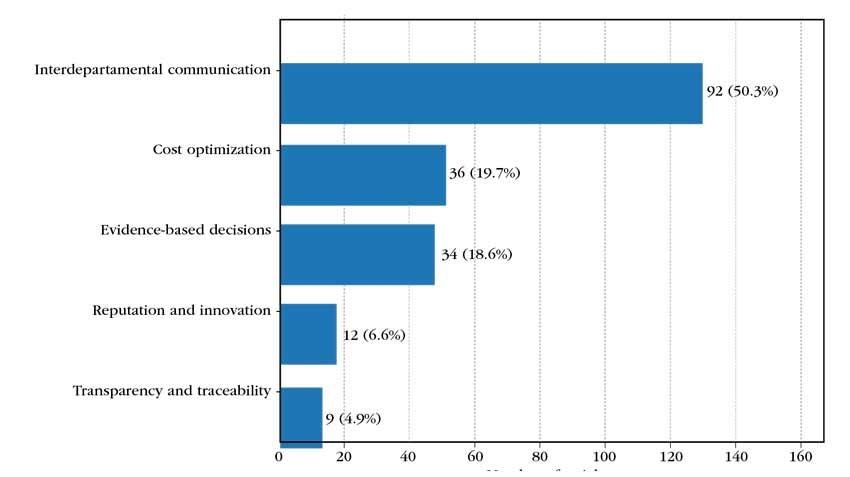
In this dimension, the results show that interdepartmental communication is the most cited benefit, with 92 articles reporting the role of OLLMS as mediators to improve coordination between academic and administrative areas. This finding is followed by the cost optimization (36) and evidence-based decisions (34) categories, which reveal the attractiveness of these technologies to support decisions with reliable data and reduce operating expenses. To a lesser extent, benefits associated with reputation and innovation (12) and transparency and traceability (9) are reported, showing that aspects of institutional legitimacy have not yet become a central priority. Figure 3 makes visible the strong concentration of perceived benefits around interdepartmental communication, which clearly outweighs the other reported categories, especially those associated with transparency, traceability, and institutional reputation.
Figure 3. Benefits Perceived by University Leaders from Adopting OLLMS In Administrative Management
Font: Authors' elaboration based on the reviewed corpus (n = 183).
Figure 3 shows the absolute frequency and percentage distribution of the categories identified for rq2. Interdepartmental communication was the most frequently reported perceived benefit (92 articles; 50.3%), followed by cost optimization (36; 19.7%), evidence-based decisions (34; 18.6%), reputation and innovation (12; 6.6%), and transparency and traceability (9; 4.9%).
This distribution indicates that universities primarily value OLLMS for their ability to improve internal collaboration and generate resource efficiencies, rather than for their contribution to accountability or improved institutional reputation (Antonopoulou et al., 2023). This coincides with the observations of Feng et al. (2025), who highlight that tangible short-term benefits such as costs and efficiency tend to motivate the early stages of technology adoption. This trend suggests that current organizational incentives favor immediate results over long-term institutional transformations (Rana et al., 2024).
RQ3. Challenges Higher Education Institutions Face in Integrating OLLMS into University Administrative Decision-Making
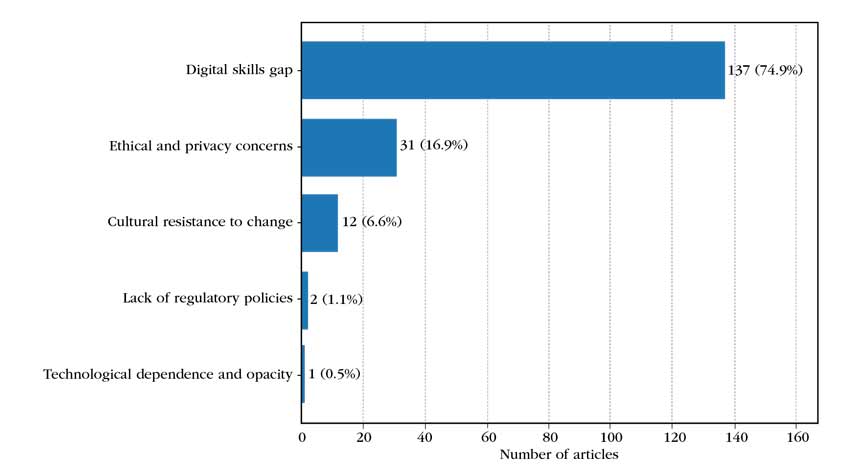
The challenges are clearly concentrated in the digital skills gap, mentioned in 137 articles as the main obstacle to the effective adoption of OLLMS. At some distance are ethical and privacy concerns (31) and cultural resistance to change (12), while very few studies address the lack of regulatory policies (2) or technological dependence and opacity (1). These results show that the most immediate barriers are human and organisational, rather than strictly regulatory or technological. Figure 4 makes visible the overwhelming concentration of the literature around the digital skills gap, which clearly exceeds all other reported challenges and confirms that current barriers are perceived primarily as human and organizational rather than regulatory or technological.
Figure 4. Challenges Higher Education Institutions Face in Integrating OLLMS into University Administrative Decision-Making
Font: Authors' elaboration based on the reviewed corpus (n = 183).
Figure 4 shows the absolute frequency and percentage distribution of the categories identified for rq3. The digital skills gap was the predominant challenge (137 articles; 74.9%), followed by ethical and privacy concerns (31; 16.9%), cultural resistance to change (12; 6.6%), lack of regulatory policies (2; 1.1%), and technological dependence and opacity (1; 0.5%).
The predominance of digital skills as a challenge indicates that universities recognize the need to strengthen the capacities of leaders and administrative staff to interpret and apply ai (Viberg et al., 2025). This pattern is consistent with the findings of Bach et al. (2024), who stress that the confidence and effectiveness of ai systems in educational contexts depend on the preparation of those who use them. The limited attention to regulations suggests that there is not yet a sufficiently debated regulatory framework in the literature to guide the responsible use of OLLMS in university governance (Afroogh et al., 2024).
RQ4. Factors that Determine University Managers' Confidence in Ai-Supported Decisions
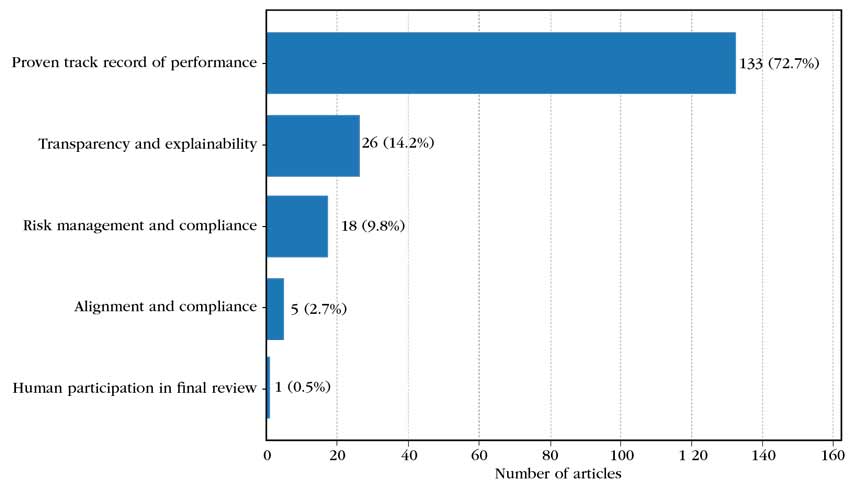
In this dimension, most of the articles analyzed emphasize proven performance history (133) as a critical factor for trusting Ai-supported decisions. To a lesser extent, the categories of transparency and explainability (26) and risk management and compliance (18) appear, while mentions of alignment with strategic goals (5) and human participation in the final review (1) are scarce. This distribution reveals that organizational trust is based more on evidence of previous practical results than on the technical transparency of models or governance frameworks. Figure 5 makes visible the strong predominance of performance-based trust over other dimensions such as explainability, compliance, strategic alignment, and especially human participation in final review.
Figure 5. Factors determining university managers' confidence in Ai-supported decisions
Font: Authors' elaboration based on the reviewed corpus (n = 183).
The figure shows the absolute frequency and percentage distribution of the categories identified for rq4. Proven track record of performance was the most frequently reported trust factor (133 articles; 72.7%), followed by transparency and explainability (26; 14.2%), risk management and compliance (18; 9.8%), alignment with strategic goals (5; 2.7%), and human participation in final review (1; 0.5%).
The low attention to human participation and alignment with strategic objectives suggests that the literature still tends to frame Ai adoption instrumentally, giving greater weight to observable performance than to governance design, stakeholder participation, or deliberative accountability (Bach et al., 2024; Metcalf et al., 2021). This pattern raises the need to reinforce explainability and human supervision as essential components of trust, an aspect that will be contrasted with the construct of Algorithmic Decision Governance in the discussion (Raji et al., 2022; Wirtz et al., 2022).
RQ5. OLLMS Applications that Generate Greater Value for University Management
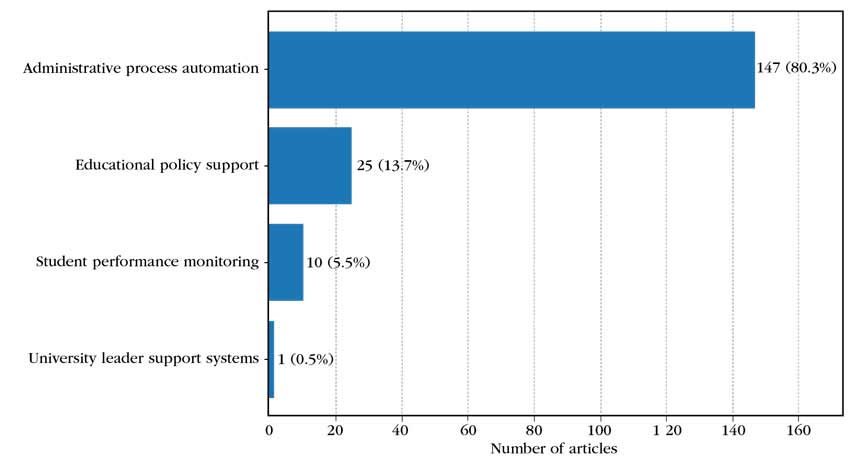
The analysis shows that the automation of administrative processes is, by far, the most prominent application, reported in 147 articles as the main driver for the modernization of university management. The other categories appear to a lesser extent: support in educational policies (25), monitoring of student performance (10), and support systems for university leaders (1). This reflects a clear pattern of adoption focused on optimizing routine operations and processes, while strategic applications are still nascent. Figure 6 makes visible the strong concentration of OLLMS applications in administrative process automation, while applications associated with policy support, monitoring, and direct support for university leaders remain clearly underrepresented in the reviewed literature.
Figure 6. OLLMS Applications Generating Greater Value for University Management
Font: Authors' elaboration based on the reviewed corpus (n = 183).
The figure shows the absolute frequency and percentage distribution of the categories identified for rq5. Administrative process automation was the most prevalent application (147 articles; 80.3%), followed by educational policy support (25; 13.7%), student performance monitoring (10; 5.5%), and university leader support systems (1; 0.5%).
These findings reinforce the conclusion that the perceived value of OLLMS in the university setting is primarily associated with efficiency, workload reduction, and administrative modernization (Khairullah et al., 2025; Khan et al., 2025). The low presence of categories linked to strategic leadership indicates an underutilized potential of ai to support high-level university administrative decision-making and policymaking, a gap that can be explored as a future line of institutional development (Antonopoulou et al., 2023; Jin et al., 2025).
Discussion
RQ1. Influence of OLLMS on the Quality of Strategic Decisions
The results show that OLLMS are predominantly used for operational efficiency (107 articles), with less attention to strategic planning or value for university governance (Khairullah et al., 2025; Khan et al., 2025). This finding aligns with Construct 3 (Strategic Value of AI for Efficiency and Planning), which recognizes the ability of OLLMS to streamline processes, but contrasts with Construct 1 (Algorithmic Governance), which posits that Ai systems should support high-level, human-supervised decisions (Jin et al., 2025; Pan et al., 2025). The gap between operational uses and strategic potential is evidence of an early stage of Ai adoption in university governance (Acosta-Enriquez et al., 2025).
This trend reveals an area of opportunity: moving from instrumental use for efficiency to transformative use for strategic and governance decisions (Feng et al., 2025). This requires clear regulatory frameworks, algorithm auditing, and best practices involving human leaders in university administrative decision-making. The literature suggests that the deployment of OLLMS in strategic advisory roles will only be legitimate if it is accompanied by transparent policies and strengthened human explainability and oversight (Bach et al., 2024).
RQ2. Benefits Perceived by University Leaders
The predominance of benefits associated with interdepartmental communication (92 articles) and cost optimization (36) indicates that leaders perceive Ai as a tool for internal improvement in efficiency and collaboration, rather than as a means to strengthen institutional accountability or legitimacy (Duran-Seguel & Gallegos Rivera, 2020). This partially aligns with Construct 2 (Digital Competencies and Organizational Trust), which highlights the need for human capabilities to interpret and leverage these tools, but shows that organizational incentives are guided by short-term goals (Metcalf et al., 2021).
The scant attention to benefits such as transparency and traceability (9 articles) suggests a gap in the perception of ai as a support for legitimacy and governance (Virkar et al., 2022). This represents a challenge and opportunity: to redirect efforts towards building organizational trust, which depends not only on immediate results in costs and productivity, but also on strengthening the explainability of systems and interdisciplinary collaboration in university governing bodies (Raji et al., 2022).
RQ3. Challenges in OLLMS Integration
The results reveal that the main obstacle is the digital skills gap (137 articles), followed by ethical and privacy concerns (31), while regulatory frameworks are marginally mentioned (2) (Jin et al., 2025; Pan et al., 2025). This reinforces the perspective of Construct 2 (Digital Competencies and Organizational Trust), underlining that today's challenges are more human and organizational than technological or normative (Phillips, 2021). The limited attention to regulation contrasts with the caveats of Construct 1 (Algorithmic Governance), which calls for creating clear policies for the safe adoption of Ai (Wirtz et al., 2022).
Beyond identifying the digital skills gap as the most frequently reported barrier, the findings also suggest that universities need to address this challenge through concrete leadership development strategies. In practical terms, overcoming this gap requires targeted training programs for university managers and administrative leaders in at least four areas: ai literacy for decision-making, interpretation of Ai-generated outputs, ethical and regulatory implications of ai use, and organizational integration of human oversight mechanisms (Shamim et al., 2023). Rather than treating digital competence as a purely technical matter, universities should frame it as an institutional leadership capability that directly affects the legitimacy, quality, and strategic usefulness of Ai-supported decisions (Duran-Seguel & Gallegos Rivera, 2020). This implies that administrative digital maturity must be cultivated through continuous professional development, interdisciplinary support teams, and governance-oriented training pathways capable of preparing leaders not only to use OLLMS efficiently, but also to evaluate their implications critically and responsibly.
RQ4. Factors that Determine Trust in AI Decisions
The finding that trust is based on proven track record of performance (133 articles), rather than on transparency and explainability (26) or human participation (1), shows an imbalance in the understanding of organizational trust (Bach et al., 2024; Pan et al., 2025). This contrasts with the proposals of Construct 1 (Algorithmic Governance) and Construct 2 (Digital Competencies and Trust), which emphasize the importance of explainability, human control, and strategic alignment (Cheong, 2024; Wirtz et al., 2022).
This gap represents a critical challenge: to move from trust based only on technical results to institutional trust based on ethical frameworks, oversight mechanisms, and evidence of explainable performance aligned with university goals (Afroogh et al., 2024; Yu et al., 2023). This change would involve incorporating practices such as continuous audits, transparency reports, algorithmic impact assessments, and human committees that review and validate OLLMS-generated recommendations (Metcalf et al., 2021; Raji et al., 2022). In this sense, strengthening the digital competencies of university leaders is not only a matter of technical adaptation, but also a prerequisite for building institutional trust in Ai-supported decisions and for enabling a more informed and responsible use of OLLMS in administrative governance.
RQ5. Applications of OLLMS in University Management
The predominance of administrative process automation (147 articles) reveals that ai is being adopted above all as an operational optimization tool in higher education, while more strategic applications such as educational policy support (25) or decision-support systems for university leaders (1) remain underdeveloped (Khairullah et al., 2025; Khan et al., 2025). This is in line with Construct 3 (Strategic Value of Ai), which recognizes the initial impact on efficiency, but highlights the challenge of expanding applications to the strategic plane (Antonopoulou et al., 2023; Jin et al., 2025).
This trend opens up an area of opportunity to evolve from operational automation to systems that support academic leadership and university policymaking (Khairullah et al., 2025; Kovari, 2024). The literature suggests that the true potential of OLLMS to transform university governance lies in their ability to offer predictive analytics, strategic scenarios, and assistance in collegial deliberation, which is still little explored in practice (Jin et al., 2025; Wirtz et al., 2022).
The comparison of the results with the constructs reveals that the use of OLLMS in universities remains in an operational phase, with clear advances in efficiency, but lags in human competencies, organizational trust, and strategic governance. From a broader institutional perspective, these findings suggest that OLLMS should not be framed only as tools for operational optimization, but also as dynamic institutional capabilities that can strengthen the university's Third Mission. In higher education, the Third Mission has been associated with knowledge transfer, external engagement, innovation ecosystems, and the university's contribution to social and productive development beyond its traditional teaching and research functions (Cai et al., 2020; Stolze & Sailer, 2022). Under this perspective, a digitally mature university administration can act as a catalyst for more agile and effective university-business linkages, since it is better equipped to coordinate information flows, support evidence-based strategic decisions, accelerate collaborative processes, and articulate internal governance with external innovation demands (Evans et al., 2023; Khairullah et al., 2025). Thus, the strategic value of OLLMS lies not only in automating administrative tasks, but in enabling universities to develop more adaptive, connected, and outward-facing administrative capabilities that support innovation ecosystems and productive engagement.
Dynamic Capabilities and Ai Governance
The findings of this review suggest that the adoption of OLLMS in university administration should be interpreted not only as a process of operational optimization, but also as the development of dynamic institutional capabilities. From this perspective, digitally mature administrative structures are better positioned to sense technological opportunities, seize them through organizational adaptation, and transform internal processes in ways that strengthen strategic governance (Antonopoulou et al., 2023; Stolze & Sailer, 2022). In higher education institutions, this dynamic capability perspective is especially relevant because administrative digital maturity affects not only efficiency, but also the institution's capacity to coordinate complex decisions, align governance mechanisms, and support long-term innovation trajectories.
This interpretation also broadens the institutional meaning of OLLMS in relation to the university's Third Mission. A technologically mature university administration can serve as a catalyst for more agile and effective university-business linkages by improving information management, accelerating evidence-based coordination, and supporting strategic interaction with external stakeholders. In this sense, the value of OLLMS extends beyond internal administrative efficiency: it contributes to the orchestration of innovation ecosystems in which the university interacts more effectively with productive sectors, social actors, and external partners (Cai et al., 2020; Evans et al., 2023). Thus, ai governance al., 2023). Thus, ai governance should be understood not only as a mechanism of control, but also as an enabling condition for institutional adaptability, knowledge transfer, and external engagement.
In practical terms, this means that the integration of OLLMS requires a core set of managerial competencies that go beyond technical use. Based on the reviewed literature, ten critical competencies can be proposed for university managers: (1) ai literacy for administrative decision-making; (2) interpretation of Ai-generated outputs; (3) understanding of algorithmic risks and limitations; (4) ethical and regulatory judgment; (5) human oversight and accountability design; (6) strategic alignment of Ai initiatives with institutional objectives; (7) interdisciplinary coordination across academic and administrative units; (8) digital change management and organizational communication; (9) data governance and traceability awareness; and (10) ecosystem-oriented leadership capable of linking internal digital transformation with external innovation and productive collaboration (Jin et al., 2025; Khairullah et al., 2025; Pan et al., 2025; Wirtz et al., 2022). Together, these competencies define a more mature model of ai governance in universities, in which administrative leadership is not merely reactive to technological change, but capable of directing it strategically.
Conclusion
From a theoretical perspective, the study broadens current debates on Ai in universities by showing that the adoption of OLLMS should not be understood only in terms of technical deployment or short-term gains in efficiency and cost reduction. Instead, the findings suggest that administrative digital maturity constitutes a precondition for the responsible and strategic integration of OLLMS, because it determines whether universities are capable of combining governance mechanisms, leadership competencies, organizational trust, and institutional learning in Ai-supported decision-making.
From a practical perspective, the results indicate that universities need to move from an instrumental use of Ai toward a governance-oriented and ecosystem-oriented use, in which OLLMS support not only administrative automation, but also strategic coordination, external engagement, and innovation capacity. In this sense, digitally mature administrative structures are better positioned to orchestrate innovation ecosystems, strengthen university-business linkages, and contribute more effectively to the university's Third Mission. This argument also reinforces the manuscript's trajectory of impact toward the SDGS, particularly by linking better administrative governance of ai with institutional quality, inclusive innovation, and more robust knowledge-transfer capacities.
Looking ahead, the findings raise the importance of aligning technological advances with robust ethical and regulatory frameworks, promoting digital literacy initiatives for decision-makers, and developing algorithmic governance and auditing systems that increase the legitimacy and acceptance of OLLMS in universities. In addition, the identification of a predominant efficiency-oriented use suggests that the next frontier of research should focus on strategic and deliberative applications of OLLMS, evaluating not only their technical performance, but also their contribution to strengthening quality, transparency, and fairness in university decisions. Therefore, the strategic contribution of OLLMS in higher education lies not only in improving administrative efficiency, but in enabling universities to become more adaptive, connected, and innovation-oriented institutions.
Contributor Role Taxonomy (CRediT)
Iván Miguel García López: conceptualization, data curation, formal analysis, investigation, methodology, project administration, validation, visualization, writing (original draft, review & editing).
Jessica Nájera Ochoa: data curation, investigation, methodology, validation, writing (review & editing).
Statement on the use of Large Language Models (LLMS)
The preparation of this manuscript involved the partial assistance of large language models (LLMS specifically ChatGPT (OpenAI), for support in drafting refinement, syntax improvement, coherence review, and editorial polishing of the text. The LLM was not used as a source of evidence, nor did it replace the authors' analytical, interpretive, or scholarly judgment. All final decisions regarding the content, structure, argumentation, and conclusions of the manuscript were made exclusively by the authors, who assume full responsibility for the integrity and originality of the work presented.
References
Acosta-Enriquez, B. G., Ballesteros, M. A. A., De Los Angeles Guzman Valle, M., Angaspilco, J. E. M., Blanco-García, L. E., Ventura, G. C., Requejo, J. D. C., & Torre, M. C. (2025). Determinants of ai use in university teachers: The role of leadership, teaching concerns, and constructivist pedagogical beliefs. Human Behavior and Emerging Technologies, 2025(1), 4834893. https://doi.org/10.1155/hbe2/4834893
Afroogh, S., Akbari, A., Malone, E., Kargar, M., & Alambeigi, H. (2024). Trust in ai: Progress, challenges, and future directions (Version 3). arXiv. https://doi.org/10.1057/s41599-024-04044-8
Antonopoulou, K., Begkos, C., & Zhu, Z. (2023). Staying afloat amidst extreme uncertainty: A case study of digital transformation in higher education. Technological Forecasting and Social Change, 192, 122603. https://doi.org/10.1016/j.techfore.2023.122603
Bach, T. A., Khan, A., Hallock, H., Beltrão, G., & Sousa, S. (2024). A systematic literature review of user trust in AI-enabled systems: An HCI perspective. International Journal of Human-Computer Interaction, 40(5), 1251-1266. https://doi.org/10.1080/10447318.2022.2138826
Bannister, P., Alcalde Peñalver, E., & Santamaría Urbieta, A. (2023). Transnational higher education cultures and generative AI: A nominal group study for policy development in English medium instruction. Journal for Multicultural Education, https://doi.org/10.1108/JME-10-2023-0102
Baque Guerra, V. E., Zavala O'Brien, M. I., Mendoza Bajaña, V. P., Recalde Villacrés, E. B., Nevares Pacheco, M. D. J., Castillo Rodríguez, N. E., & Barreto Zúñiga, W. W. (2024). Percepciones y experiencias de docentes universitarios sobre la inteligencia artificial: Transformación, ética y desafíos en el uso académico por estudiantes. latam Revista Latinoamericana de Ciencias Sociales y Humanidades, 5(6). https://doi.org/10.56712/latam.v5i6.3204
Barus, O. P., Hidayanto, A. N., Handri, E. Y., Sensuse, D. I., & Yaiprasert, C. (2025). Shaping generative AI governance in higher education: Insights from student perception. InternationalJournal of Educational Research Open, 8, 100452. https://doi.org/10.1016/j.ijedro.2025.100452
Beñalet, C. E. C., Jr., M. E. P., Baldezamo, R. C., Vicente, R. S., Reomero, J. I., & Junsay, M. D. (2023). A systematic review on educational strategic management. International Journal of Research and Innovation in Social Science, VII(X), 2371-2383. https://doi.org/10.47772/IJRISS.2023.701177
Bick, A., Blandin, A., & Deming, D. (2024). The rapid adoption of generative AI NBER Working Paper No. 32966). National Bureau of Economic Research. https://doi.org/10.3386/w32966
Börekci, C., & Çelik, Ö. (2024). Exploring the role of digital literacy in university students' engagement with ai through the Technology Acceptance Model. Sakarya University Journal of Education, 14(Special Issue-AI in Education), 228-249. https://doi.org/10.19126/suje.1468866
Cai, Y., Ma, J., & Chen, Q. (2020). Higher education in innovation ecosystems. Sustainability, 12(11), 4376. https://doi.org/10.3390/su12114376
Cheong, B. C. (2024). Transparency and accountability in AI systems: Safeguarding wellbeing in the age of algorithmic decision-making. Frontiers in Human Dynamics, 6, 1421273. https://doi.org/10.3389/fhumd.2024.1421273
Duran-Seguel, I., & Gallegos Rivera, M. (2020). Análisis de las decisiones estratégicas que facilitaron la implementación de un nuevo modelo de gestión universitaria. Universidad Santo Tomás. Universidad Santo Tomás. https://doi.org/10.15332/dt.inv.2020.01566
Evans, N., Miklosik, A., & Du, J. T. (2023). University-industry collaboration as a driver of digital transformation: Types, benefits and enablers. Heliyon, 9(10), e21017. https://doi.org/10.1016/j.heliyon.2023.e21017
Feng, J., Yu, B., Tan, W. H., Dai, Z., & Li, Z. (2025). Key factors influencing educational technology adoption in higher education: A systematic review. PLOS Digital Health, 4(4), e0000764. https://doi.org/10.1371/journal.pdig.0000764
Ferk Savec, V., & Jedrinovic, S. (2025). The role of ai implementation in higher education in achieving the Sustainable Development Goals: A case study from Slovenia. Sustainability, 17(1), 183. https://doi.org/10.3390/su17010183
Floridi, L. (2023). The ethics of artificial intelligence: Principles, challenges, and opportunities. Oxford University Press. https://doi.org/10.1093/oso/9780198883098.001.0001
Jin, Y., Yan, L., Echeverria, V., Gasevic, D., & Martinez-Maldonado, R. (2025). Generative ai in higher education: A global perspective of institutional adoption policies and guidelines. Computers and Education: Artificial Intelligence, 8, 100348. https://doi.org/10.1016/j.caeai.2024.100348
Khairullah, S. A., Harris, S., Hadi, H. J., Sandhu, R. A., Ahmad, N., & Alshara, M. A. (2025). Implementing artificial intelligence in academic and administrative processes through responsible strategic leadership in higher education institutions. Frontiers in Education, 10, 1548104. https://doi.org/10.3389/feduc.2025.1548104
Khan, A. A., Badshah, S., Liang, P., Khan, B., Waseem, M., Niazi, M., & Akbar, M. A. (2021). Ethics of ai: A systematic literature review of principles and challenges (Version 1). arXiv. https://doi.org/10.48550/ARXIV.2109.07906
Khan, S., Mazhar, T., Shahzad, T., Khan, M. A., Rehman, A. U., Saeed, M. M., & Hamam, H. (2025). Harnessing ai for sustainable higher education: Ethical considerations, operational efficiency, and future directions. Discover Sustainability, 6(1), 23. https://doi.org/10.1007/s43621-025-00809-6
Kitchenham, B., Pretorius, R., Budgen, D., Pearl Brereton, O., Turner, M., Niazi, M., & Linkman, S. (2010). Systematic literature reviews in software engineering - A tertiary study. Information and Software Technology, 52(8), 792-805. https://doi.org/10.1016/j.infsof.2010.03.006
Kovari, A. (2024). AI for decision support: Balancing accuracy, transparency, and trust across sectors. Information, 15(11), 725. https://doi.org/10.3390/info15110725
Makarius, E. E., Mukherjee, D., Fox, J. D., & Fox, A. K. (2020). Rising with the machines: A sociotechnical framework for bringing artificial intelligence into the organization. Journal of Business Research, 120, 262-273. https://doi.org/10.1016/j.jbusres.2020.07.045
Martínez-Silva, F.-C., & Cobos-Lozada, C.-A. (2024). Revisión sistemática de las herramientas de inteligencia artificial explicable usadas en métodos de ensamble. Revista Facultad de Ingeniería, 33(70), e18078. https://doi.org/10.19053/uptc.01211129.v33.n70.2024.18078
Mehrabi, N., Morstatter, F., Saxena, N., Lerman, K., & Galstyan, A. (2022). A survey on bias and fairness in machine learning. ACM Computing Surveys, 54(6), 1-35. https://doi.org/10.1145/3457607
Metcalf, J., Moss, E., Watkins, E. A., Singh, R., & Elish, M. C. (2021). Algorithmic impact assessments and accountability: The co-construction of impacts. In Proceedings of the 2021 ACM Conference on Fairness, Accountability, and Transparency (pp. 735-746). Association for Computing Machinery. https://doi.org/10.1145/3442188.3445935
Page, M. J., McKenzie, J. E., Bossuyt, P. M., Boutron, I., Hoffmann, T. C., Mulrow, C. D., Shamseer, L., Tetzlaff, J. M., Akl, E. A., Brennan, S. E., Chou, R., Glanville, J., Grimshaw, J. M., Hróbjartsson, A., Lalu, M. M., Li, T., Loder, E. W., Mayo-Wilson, E., McDonald, S., et al. (2021). Declaración PRISMA 2020: Una guía actualizada para la publicación de revisiones sistemáticas. Revista Española de Cardiología, 74(9), 790-799. https://doi.org/10.1016/j.recesp.2021.06.016
Pan, Z., Moore, O. A., Papadimitriou, A., & Zhu, J. (2025). AI literacy and trust: A multi-method study of Human-GAI team collaboration. Computers in Human Behavior: Artificial Humans, 4, 100162. https://doi.org/10.1016/j.chbah.2025.100162
Phillips, B. (2021). UK further education sector journey to compliance with the General Data Protection Regulation and the Data Protection Act 2018. Computer Law & Security Review, 42, 105586. https://doi.org/10.1016/j.clsr.2021.105586
Raji, I. D., Xu, P., Honigsberg, C., & Ho, D. E. (2022). Outsider oversight: Designing a third-party audit ecosystem for AI governance (Version 1). arXiv. ht https://doi.org/10.1145/3514094.3534181
Rana, M. M., Siddiqee, M. S., Sakib, M. N., & Ahamed, M. R. (2024). Assessing ai adoption in developing country academia: A trust and privacy-augmented UTAUT framework. Heliyon, 10(18), e37569. https://doi.org/10.1016/j.heliyon.2024.e37569
Sánchez-Prieto, J. C., Izquierdo-Álvarez, V., Del Moral-Marcos, M. T., & Martínez-Abad, F. (2024). Inteligencia artificial generativa para autoaprendizaje en educación superior: Diseño y validación de una máquina de ejemplos. MED-Revista Iberoamericana de Educación a Distancia, 28(1). https://doi.org/10.5944/ried.28.1.41548
Sauer, P. C., & Seuring, S. (2023). How to conduct systematic literature reviews in management research: A guide in 6 steps and 14 decisions. Review of Managerial Science, 17(5), 1899-1933. https://doi.org/10.1007/s11846-023-00668-3
Shamim, S., Yang, Y., Ul Zia, N., Khan, Z., & Shariq, S. M. (2023). Mechanisms of cognitive trust development in artificial intelligence among front line employees: An empirical examination from a developing economy. Journal of Business Research, 167, 114168. https://doi.org/10.1016/j.jbusres.2023.114168
Stolze, A., & Sailer, K. (2022). Advancing heis' third-mission through dynamic capabilities: The role of leadership and agreement on vision and goals. The Journal of Technology Transfer, 47, 580-604. https://doi.org/10.1007/s10961-021-09850-9
United Nations Statistics Division. (2025). SDG indicators metadata repository. https://unstats.un.org/sdgs/metadata/
Viberg, O., Cukurova, M., Feldman-Maggor, Y., Alexandron, G., Shirai, S., Kanemune, S., Wasson, B., T0mte, C., Spikol, D., Milrad, M., Coelho, R., & Kizilcec, R. F. (2025). What explains teachers' trust in ai in education across six countries? International Journal of Artificial Intelligence in Education, 35(3), 1288-1316. https://doi.org/10.1007/s40593-024-00433-x
Virkar, S., Alexopoulos, C., Tsekeridou, S., & Novak, A.-S. (2022). A user-centred analysis of decision support requirements in legal informatics. Government Information Quarterly, 39(3), 101713. https://doi.org/10.1016/j.giq.2022.101713
Wirtz, B. W., Weyerer, J. C., & Kehl, I. (2022). Governance of artificial intelligence: A risk and guideline-based integrative framework. Government Information Quarterly, 39(4), 101685. https://doi.org/10.1016/j.giq.2022.101685
Yu, L., Li, Y., & Fan, F. (2023). Employees' appraisals and trust of artificial intelligences' transparency and opacity. Behavioral Sciences, 13(4), 344. https://doi.org/10.3390/bs13040344