
10.12804/revistas.urosario.edu.co/empresa/a.15056
ARTÍCULO DE REVISIÓN
Doris Rosero-García1
Luz Alexandra Montoya-Restrepo2
1 Corporación Universitaria Minuto de Dios - Uniminuto (Bogotá, Colombia).
 0000-0002-8950-6862
 doris.rosero@uniminuto.edu
2 Universidad Nacional de Colombia (sede Medellín, Colombia).
0000-0002-4896-1615
lamontoyar@unal.edu.co
Reception date: November 22, 2024
Acceptance date: October 16, 2025
To cite this article: Rosero-García, D., & Montoya-Restrepo, L. A. (2026). Biological metaphors in project management in Colombia: Systematic review. Universidad y Empresa, 28(50), 1-43. 10.12804/revistas.urosario.edu.co/empresa/a.15056
Abstract
Colombia
is a pioneer country in applying biological metaphors to organizational
management, and the first study was published in 1982. Since that time, several
publications have been released.
Objective
and methodology: A comprehensive literature search was carried out, and criteria for
inclusion and exclusion were implemented, resulting in 75 investigations.
Key findings: It was observed that 2015 had the highest number of publications in
Colombia. Moreover, 86 biological metaphors applied to organizations were
found.
Conclusions: Biological metaphors in project management in Colombia have facilitated inter-business cooperation, the creation of organizational ecosystems, the development of new
organizational forms, the promotion of social responsibility, and adaptation to
a dynamic environment, thus contributing to the competitiveness and
sustainability of small businesses.
Keywords: biological metaphor; project management; Colombia.
Resumen
Colombia es un país pionero en la aplicación de metáforas biológicas a la gestión organizacional, y el primer estudio se publicó en 1982. Desde entonces, se han difundido varias publicaciones.
Metodología: se realizó una búsqueda exhaustiva de la literatura y se aplicaron criterios de inclusión y exclusión, lo que resultó en 75 investigaciones.
Resultados principales: se observó que 2015 fue el año con el mayor número de publicaciones en
Colombia. Además, se identificaron 86 metáforas biológicas aplicadas a las organizaciones.
Conclusiones: las metáforas biológicas en la gestión de proyectos en Colombia han
facilitado la cooperación interempresarial, la creación de ecosistemas
organizacionales, el desarrollo de nuevas formas organizacionales, la promoción
de la responsabilidad social y la adaptación a un entorno dinámico,
contribuyendo así a la competitividad y sostenibilidad de las pequeñas
empresas.
Palabras clave: metáfora biológica; gestión de proyectos; Colombia.
Resumo
A Colômbia é um país pioneiro na aplicação de metáforas biológicas na gestão organizacional, e o primeiro estudo foi publicado em 1982. Desde então, diversas publicações têm sido realizadas.
Metodologia: Foi realizada uma busca abrangente da
literatura e aplicados critérios de inclusão e exclusão para selecionar 75 pesquisas.
Principais resultados: constatou-se que o ano de 2015 foi o que apresentou o maior número de publicações na Colômbia. Além disso, foram identificadas 86 metáforas biológicas com
aplicações nas organizações.
Conclusões: as metáforas biológicas na
gestão de projetos na Colômbia têm permitido a cooperação interorganizacional,
a criação de responsabilidade social e a adaptação às dinâmicas ambientais,
contribuindo para a competitividade e a sustentabilidade das pequenas empresas.
Palavras-chave: metáfora biológica; gestão de projetos; Colômbia.
Introduction
Project management plays a crucial role in fostering the sustainable advancement of organizations and society (Magano et al., 2021). In a society characterized by intense competition and rapid technological advancements, managers must seek strategies that enhance their ability to effectively oversee operations, equipping them with the essential resources needed to increase the likelihood of success (Pascucci et al., 2023). This may generate the need to include management models that can be sophisticated and complex, with features focused on customer satisfaction (Piñuela-Espín & Quito-Godoy, 2020). Metaphors are an integral part of language and thought, and they appear in everyday conversations, even without being consciously noticed (Robayo-Acuña et al., 2011). Metaphors are adept at assimilating concepts from one field of knowledge to another (Kiseleva & Trofimova, 2017). The language of natural sciences, especially biology, has considerable value in helping us understanding the phenomena of social and economic sciences (Robinson et al., 2019). Biological metaphors can provide resources to address this problem, they offer sufficient flexibility in their approaches (Montoya-Restrepo et al., 2022). Furthermore, biological metaphors are valuable tools for understanding and predicting the conditions that shape and influence organizational systems (Mars et al., 2012).
Historically, classic, and modern authors in economic sciences have used biological metaphors in their postulates (Garcia-Callejas, 2007). Marshall, in 1890, compared the firm's economic growth to the trees in the forest. McGuire, in 1963, developed the Organicist Theory through an analogy with biology based on the cycle of life (Montoya-Restrepo & Montoya-Restrepo, 2003; Valle-Flórez, 2011c). Gareth Morgan employs biological metaphors to explain different organizational forms such as machines, organisms, brains, cultures, political systems, psychic prisons, instruments of nomination, flow of change, and transformation (Morgan, 1991). The management practices prevailing in the 19th century and part of the 20th century corresponded to what Morgan (1991) referred to as the metaphor of the organization as a machine. However, conceiving organizations like machines are becoming extinct. Therefore, it is more convenient to think about organizations in terms of a biological metaphor, where the company is a living being or exhibits life subject to constant processes of evolution. This will, on the one hand, provide explanations that better align with complex realities and, on the other, guide companies in their processes of co-evolution with their stakeholders (Gil-Bolívar, 2016). Likewise, the studies by Illera (1982) are well known. He develops the metaphor using concepts specific to human biology, anatomy, and physiology, extrapolating them to organizations in terms of their structure and functioning within a systemic framework that unites nutrition, growth, and development. It even proposes a series of pathological elements referred to as structural and organic deficiencies resulting from the non-observance of one or some of the elementary principles of the organization (Illera, 1982).
In Colombia, Montoya's doctoral thesis (2010) shows how biological metaphors can be used to propose new alternatives for managing information systems in business integration since— just as in nature—species that work together co-evolve in order persist and operate more efficiently (Montoya-Restrepo, 2010). Furthermore, some authors have compiled 32 to 55 biological metaphors applied to organizations (Montoya-Restrepo et al., 2022; Robayo-Acuña et al., 2011). In addition, research has been published on the use of metaphors in specific sectors, such as tourism (Montoya-Restrepo et al., 2022) and the dairy industry (Suárez-Pineda, 2013). Historically, regarding biological metaphors in Colombia and their applications to organizations, it appears that several publications have addressed this topic (Montoya-Restrepo et al., 2010, 2020, 2022; Montoya-Restrepo & Montoya-Restrepo, 2012a; Ochoa-Carreño & Montoya-Restrepo, 2010; Robayo-Acuña et al., 2011). Moreover, the application of biological metaphors to organizations has been recognized as a robust creation device in science, where the emergence of a new scientific or philosophical theory is often grounded in a novel generative metaphor (Martínez-Bernal et al., 2017; Montoya-Restrepo, Montoya-Restrepo and Rojas Berrio, 2019). Therefore, there is a need to compile research by applying biological metaphors in organizations. This article seeks to conduct an exhaustive search of publications on the applicability of biological metaphors in Colombia. This aims to update and analyze how biology can contribute to organizational management.
Materials and Methods
Studies from Dialnet, Redalyc, SciELO, ScienceDirect, and Scopus were chosen. We also searched Google Scholar for peer-reviewed articles and theses. The following terms were defined in Spanish (metáfora biológica, Colombia, gestión) and English (biological metaphors, Colombia, management). Several permutations of the final keywords were used in the comprehensive search to obtain a substantial number of publications. The entire literature search was conducted from March to May 2024. The PRISMA standards were used for publication identification, screening, and eligibility to choose and include papers appropriate for analysis (Page et al., 2021). The types of studies (theses, reflection papers, and articles), the location (Colombia), the focus on management in various sectors, and the language (Spanish and English) were established as inclusion criteria. Articles concerning research conducted outside of Colombia, as well as studies using metaphors that were not biological, were excluded from the literature search because they did not fit the established criteria. Using Microsoft® Excel 365, the analytical findings of the gathered studies were tabulated based on the following criteria: author, study type, year of publication, biological metaphors used, organizational sector, setting, and principal conclusion. Furthermore, an examination was conducted to find Colombian behavior and interest in biological metaphor research.
Results
The exhaustive search yielded 2590 documents, 1608 of which were published in Spanish and 982 in English (Table 1).
Table 1. General statistical information for the documents containing biological metaphors in Colombia (until May 2024)
Databases |
Keywords (Spanish) |
Results |
Keywords |
Results |
Dialnet |
Metáfora biológica AND Colombia |
10 |
Biological AND metaphors AND Colombia |
2 |
Redalyc |
Metáfora AND biológica AND Colombia AND gestión |
1001 |
Biological AND metaphors AND Colombia AND management |
26 |
SciELO |
Metáfora biológica |
17 |
Biological metaphors |
15 |
ScienceDirect |
Metáfora biológica AND Colombia AND gestión |
5 |
Biological AND metaphors AND Colombia AND management |
177 |
Scopus |
Metáfora AND biológica |
5 |
Biological AND metaphors AND Colombia |
2 |
Google Scholar |
Metáfora biológica AND Colombia AND gestión |
570 |
Biological AND metaphors AND Colombia AND management |
760 |
Total |
1680 |
Total |
982 |
Font: Own elaboration.
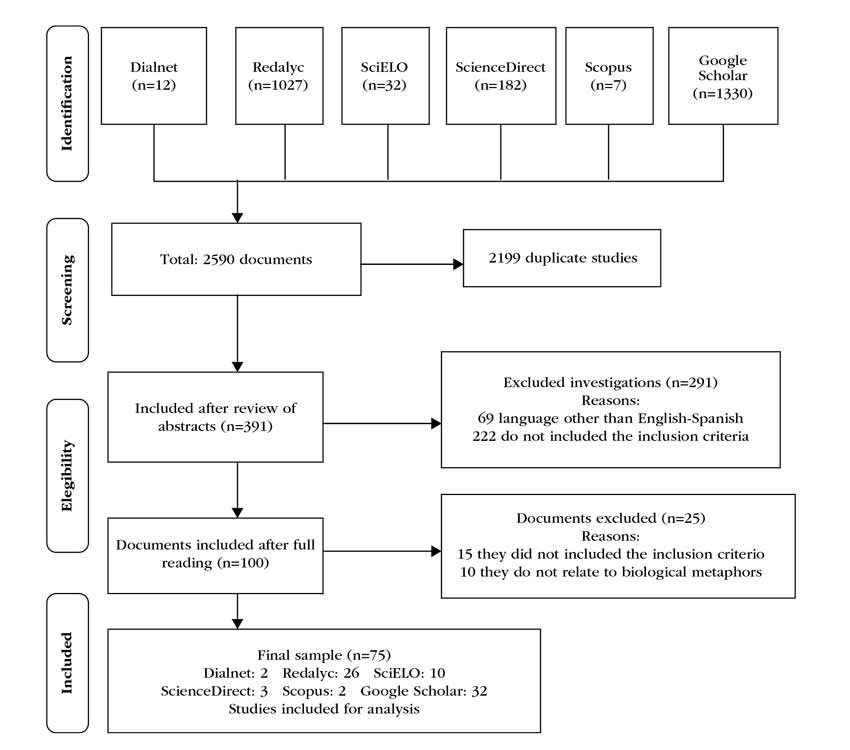
After removing duplicate articles and applying the PRISMA and inclusion criteria, 75 publications were obtained (Figure 1). From the analysis of the 75 selected publications, it was observed that research on biological metaphors in Colombia was conducted between 1982 and 2023, with a high number of studies published in 2015. No publications were found between 1983 and 1998, in 2000, 2005, and 2006.
Figure 1. PRISMA flowchart showing the selection of research documents on biological metaphors in Colombia
Font: Own elaboration.
After 1982, Montoya-Restrepo (1999) conducted research in a master's thesis in administration that focused on applying a genetic metaphor to family businesses and small and medium-sized enterprises (SMEs). The last investigations published were three research papers in 2023 (Marquínez-Gruezoi & Álvarez-López, 2023; Montoya-Restrepo & Montoya-Restrepo, 2023; Valencia-Martínez & Suárez-Rojas, 2023). Remarkably, through the review of the 75 studies, a total of 86 biological metaphors with applications in management were identified (Table 2).
Table 2. Biological metaphors with application in managing different organizations (until May, 2024)
Number |
Author |
Biological metaphors |
1 |
Marshall (1890) |
Organizations as tress* |
2 |
Parsons (1951) |
Exchange model (adaptation)* |
3 |
Rosenblant (1959) |
Artificial neural networks* |
4 |
McGuirre (1963) |
Lifecycle* |
5 |
Bateson (1972) |
Systemic thinking |
6 |
Beer (1974, 1977) |
Relationship with other sciences: A. Acoustics, B. Biology, C. Cybernetics, D. Demography, E. Engineering, F. Fluids, G. Genetics |
7 |
Morgan (1980) |
Organizational ecosystems* |
8 |
Human structure |
|
9 |
Nelson & Winter (1982); Hodgson (1998); Hodgson & Knudsen (2004) |
Natural selection* |
10 |
Martínez (1986) |
Bioeconomy |
11 |
Lessem (1990) |
Knowledge tree |
12 |
Maturana & Varela (1990) |
Cognitive process |
13 |
Sheldrake (1990) |
Morphogenetic fields and colonies |
14 |
Organization as a machine (classical theory)* |
|
15 |
Morgan (1991), Capra (1998) |
Organization as an organism (contemporary theory)* |
16 |
Ashby (1958) Brigs & Peat (1989) Morgan (1991) |
Organization as a brain (cybernetics) |
17 |
Organization as cultures |
|
18 |
Organization as political systems |
|
19 |
Organization as a psychic prison |
|
20 |
Organization as dialectical-autopoietic systems |
|
21 |
Organization as subjects of domination |
|
22 |
Hannan y Freeman (1977); Hannan & Carroll (1992) |
Ecosystems organizational and niche |
23 |
Prigogine (1967, 1993) |
The organizations as networks autopoietic |
24 |
Morin (1988, 1995, 2000) |
Organizations as complex systems* |
25 |
Wheatley (1996) |
Self-organization |
26 |
Branderburger & Nalebuff (1996); Shapiro & Varian (1998) |
Coo-petition |
27 |
Pauli (1997, 1999); Senge (1998); Valle (2011) |
Organizations an immune system |
28 |
Beer (1997) |
As nervous system* |
29 |
Porter (1998) |
Cluster |
30 |
Gell- Mann (1999); Holland (2004) |
Complexity Adaptative Systems |
31 |
Tinaut & Ruano (1999) |
Organizational parasitism |
32 |
Torres (1999) |
Evolutionary algorithms* |
33 |
Paracer & Ahmadjian (2000) |
Symbiosis* |
34 |
Lima (2001) |
Evolutionary management model |
35 |
Castellanos & Montoya (2002) |
Biomanagement* |
36 |
Rivas Tovar (2002) |
Organization cell |
37 |
Neilson & Pasternack (2003) |
Organizational dna |
38 |
Nooteboom (2003) |
Integration models with an evolutionary approach |
39 |
Kauffman (2003) |
Autonomous agents, adaptive reliefs |
40 |
Andrade (2003) |
Evolution* |
41 |
Thompson (2003) |
Evolutionary models* |
42 |
Hannan-Freeman (1977, 2003); Hannan y Carroll (1992); Freeman 2005 |
Organizational ecosystems and niches* |
43 |
Córtes & Coello (2004) |
Artificial immune system* |
44 |
García et al. (2004) |
Business cooperation asbiological system. Organizational coevolutionary models |
45 |
Montoya (1999); Montoya et al. (2004) |
Genetic management: Biomanagement |
46 |
Pech & Oakley (2005) |
Organizational hormesis |
47 |
Rodríguez et al. (2005) |
Organizational evolution: socio-biological induction for the understanding of the metaphor* |
48 |
Moore (1993, 1996, 2005) |
Business ecosystem |
49 |
Farrelly & Quester (2005) |
Relationships as comarketing alliances |
50 |
Vujnovic & Kruckeberg (2005) |
Organizations as living beings |
51 |
Hatch & Cunliffe (1997); Becker (2007) |
Organizational ecology |
52 |
Gouillart & Kelly (2007) |
Bioengineering |
53 |
Plummer y Fennell (2007); Rammel (2007) |
Co- management, altruism, and sociobiology |
54 |
Fischer-Kowalski (2007) |
Socioeconomic metabolism* |
55 |
Zimmer (2007); Pereira et al. (2008) |
Swarm Intelligence |
56 |
Tynan (2008) |
Metaphors and marketing |
57 |
Iñiguez & Barrio (2009) |
Coevolution in social networks |
58 |
Montoya (2010, 2011) |
Ecosystems Organizational* |
59 |
Ochoa et al. (2011) |
Microbial Consortia |
60 |
Isenberg (2010); Field (2012) |
Entrepreneurship ecosystems* |
61 |
Montoya & Montoya 2012 |
Inter-business cooperation |
62 |
Organizational autism |
|
63 |
Castro & Noguera (2014) |
Organizational predation* |
64 |
Ferreira et al. 2014 |
Assembly of systems symbiotic |
65 |
De Lorenzo (2014) |
Synthetic biology |
66 |
Nowak (2011); Li & Yong (2015); Rossignoli & Ricciardi (2015); Kurzban et al (2015); Simpson & Willer (2015) |
Supercooperators* |
67 |
Alburquenque & Cisternas (2015); Olivares (2015) |
Management model knowledge based on cellular functioning |
68 |
Organization as brain: neuromanagement* |
|
69 |
Rodríguez et al. (2015) |
Metáfora del desarrollo ontogenético de una organización destacada |
70 |
Riosvelasco et al. (2016) |
Applications for green industry |
71 |
Rumiguano Landa (2016) |
Perspectives associative |
72 |
Pulgarín & Cardona (2016) |
An approximation from the exaptations and diversity |
73 |
Noguera & Castro (2016) |
The autonomous agent and construction of a biosphere in the organizations social |
74 |
Cruz (2016) |
A look at change in culture organizational from the theory of Sheldrake |
75 |
Suárez (2016) |
Application of the autopoiesis at organizations business |
76 |
Gómez (2016) |
The system immunological in the companies |
77 |
Martínez et al. (2017) |
Innovation ecosystem* |
78 |
Ivantsiv (2018) |
Models metaphorical |
79 |
Kharchenkova (2018) |
The market metaphors |
80 |
Prayag (2018) |
Understand the resilience |
81 |
Penn & Liu (2018) |
Relations coevolutionary and symbiotic |
82 |
O'Malley (2018) |
Metaphors in the speech of marketing |
83 |
Martínez (2018) |
Contributions of biology to reflection on the model's economic alter-natives |
84 |
Montoya & Montoya (2022) |
Ecological restoration* |
85 |
Symbiotic marketing |
|
86 |
Marquínez & Alvarez 2023 |
Tree rhizome (mangle)* |
*No included by Montoya et al. (2022).
Font: Own elaboration.
In other publications contained in books (Montoya-Restrepo et al., 2016, 2022; Montoya-Restrepo & Montoya-Restrepo, 2012b), articles (Montoya-Restrepo et al., 2010; Montoya-Restrepo & Montoya-Restrepo, 2003; Robayo-Acuña et al., 2011; Valle-Flórez, 2011c), and theses (Montoya-Restrepo, 2010; Ramírez-Medina, 2016), between 12 and 55 biological metaphors were addressed (Table 3).
Authors (Year) |
Publication |
Biological metaphors |
Organizational sector |
Context |
Main conclusion |
Reflection article |
Tree rhizome (mangle) |
Education |
National |
A metaphor is built based on the organization of a rural curriculum as a bio-pedagogical expression of a mangrove ecosystem, analogous to the rhizomatic thinking proposed by Deleuze and Guattari (2002). |
|
Article |
Organization as brain: neuromanagement |
Does not specify |
National |
Neurosciences also contribute to organizations through their human talent management, in topics as specific as the diagnosis and treatment of burnout syndrome, business or sports coaching (with motivation, reward, and leadership mechanisms), and the perception of reality. |
|
Systematic Review |
Organization as brain: neuromanagement |
Organizational management |
International |
The emergence of neuromanagement is closely tied to the use of neuroscience in the preexisting field of neuroeconomics. Moreover, varying levels of progress in this area were observed among the countries analyzed: North American nations have implemented neuro- management practices, European countries have undertaken extensive research on the subject, and Latin American scholars have primarily produced literature reviews. |
|
Systematic Review |
Entrepreneurship ecosystems |
Does not specify |
International |
The current state of the art on the concept of entrepreneurship ecosystem is presented. The company is not an isolated element but part of an "ecosystem business." |
|
Reflection article |
Coevolution and mutualism |
Agricultural |
National |
Coevolutionary models and mutualism provide a framework that elucidates the evolutionary benefits of interspecific cooperation. Within ecosystems, such arrange show greater evolutionary success and stability than competitive mechanisms. |
|
Reflection article |
Ecological restoration |
SMEs |
National |
Restoration organization is a process that must be considered when organizational structures are in danger and do not autonomously reach regeneration processes. Goods-producing organizations—whether basic, primary, or even SMEs with simple and not-very-diversified products—are equally valuable, as they enable capabilities that primarily support ecosystem restoration. |
|
Book |
55 biology metaphors |
Marketing |
National |
Biological metaphors applied to organizations are presented as an alternative to traditional understandings and pedagogies that enable interaction mechanisms and the possibility of intervention to find biological applications to strengthen organizations with multiple economic, environmental, political, social, and human approaches. |
|
Reflection article |
Symbiotic marketing |
Agricultural |
National |
Based on the impact of coviD-19 as a truncating element of traditional producers' deliberate actions, an emerging symbiotic mutualistic marketing strategy brought the producers to their consumers, eliminating intermediaries, and thus saved not only the crops but also the economies of the producers. |
|
Article |
Natural selection |
Does not specify |
National |
The organization is approached as a system that cannot be controlled, with changing dynamics that adapt to changing conditions. |
|
Master Thesis |
Organization as brain: neuromanagement |
Hotels |
National: Ocaña municipality, Santander department, Colombia |
Managers in the hotel sector in the city of Ocaña are interested in neuromanagement and its influence on their ability to perform their work effectively . |
|
Article |
Organization as brain: neuromanagement |
Administration in the digital transformation |
International |
The above documentary is evidence of specific contributions that neuroscience has made to administration and some of its most important dimensions, such as human resource management, leadership, and decision-making. Thus, neuroscience tools and techniques can improve company processes in addition to traditional methods. |
|
Article |
Symbiosis metaphor |
Education |
International |
Biological metaphorical models are applicable in managing universities' interspecific relationships with their interest groups. They enable universities to develop management practices that are more dynamic and appropriate because they are based on clearly identifying the potential symbiotic relationships established with stakeholders. |
|
Reflection article |
Symbiosis metaphor |
Tourism |
National: Meta department |
The authors apply the symbiotic metaphor "to understand the processes of associativity and cooperation between the different links in the nature tourism chain," with results that show how this model enables innovative coevolutionary processes. |
|
Book chapter |
44 biology methaphors |
Does not specify |
National |
Relevant contributions from the biological model were analyzed in business theory, presupposing the company as a complex and adaptive system and describing the main elements that must be considered in a proposal for collaboration between organizations. |
|
Review article |
Exchange model (adaptation) |
Education |
International |
Use the Theory of Evolution as a reference to understand adaptation. Returns to the three levels of biological adaptation to describe social adaptations: morphological level (structural), physiological level (functional), and ethological level (behavioral). |
|
Article |
Symbiosis metaphor |
SMEs |
International |
The authors' contributions led to the establishment of the concept of symbiotic marketing. This involves a marketing process that is carried out in coordination with other organizations so that they can have synergistic advantages. Almost all business relationships are symbiotic, since both parties obtain a benefit. |
|
Master Thesis |
Innovation ecosystem |
Education |
National |
It is essential to recognize and analyze the specificities of the regions for the consolidation of innovation ecosystems and to understand how this type of initiative can be an opportunity for territorial development from the institutional framework. |
|
Bachelor thesis |
Knowledge tree |
Textile industry |
National: Uniformes Nacionales S.A.S. Antioquia department |
It became evident how each part of the tree of knowledge is related to strategic direction, which is described across six levels. |
|
Article |
Organizational DNA |
Education |
National |
Just as in biology, the organizational dna molecule is held together by the bonds that link pairs of its four essential elements —decision-making, information flow, motivation, and structure. The sequence of these elements explains the precise instructions required to create a unique organism. In this sense, the DNA of a living organization is described as a unit composed of four bases which, combined in infinite ways, define the distinctive traits of an organization. |
|
Article |
Symbiosis metaphor |
Does not specify |
National |
It presents innovation as an evolutionary process and analyzes the possibility of understanding it as a process of symbiogenesis, an alternative conceptual and cooperative approach to facilitating its management and promotion within the organizational environment. |
|
Master Thesis |
Self-organization |
Software development |
National |
A model is proposed for designing business organizations as autonomous systems that are more agile and responsive to change. |
|
Reflection article |
Organization as an organism |
Cultural public intervention project |
National |
The organization that executed the Living Laboratories Project as a living entity was responsible for formulating the project and implementing the model royalties that the Colombian State determined. |
|
Article |
Innovation ecosystem |
Does not specify |
National |
Innovation ecosystems are consolidated as unique organizational spaces, like sophisticated environments of actors, assets, and links generated through collaborative activities. |
|
Reflection article |
Self-organization |
Does not specify |
International |
We sought to understand how and why a system becomes more complex and how it self-organizes. |
|
Article |
Organization as a machine, self-organization |
Does not specify |
International |
Advances in designing and implementing self-organized business organizations without central controller systems are in the early stages. |
|
Reflection article |
Morgan's eight metaphors |
Does not specify |
National |
Organizations can no longer be seen as machines. Still, they must adapt to a business management model that responds to successive changes in the environment, limitations to survival, and permanent improvement of company performance. |
|
Book |
35 biology metaphors |
Does not specify |
National |
Different perspectives on the application possibilities of biological metaphors in business cooperation and organizational interpretation are presented. |
|
Bachelor thesis |
13 biology metaphors |
Does not specify |
International |
An analysis of the literature published over the last decade was performed. Nine biological metaphors were found that can be applied in an organizational context. |
|
Article |
Natural selection |
Does not specify |
International |
In administrative science, it is valid to apply evolutionary concepts that resemble, in form, those that are prevalent in administrative discourse. |
|
Article |
Complexity Adaptative Systems, self-organization |
Does not specify |
International |
Nonlinear complex systems are studied in the fields of organizational cybernetics, complexity, and cas. The self-organization of complex systems is their main characteristic. |
|
Doctoral Thesis |
Evolution |
Technology management |
National |
Analysis from evolutionary biology allows us to consider the temporal dimension, which implies continuous change. This differs from the traditional view of the universe as static and invariant, associated with determinism. |
|
Article |
Complexity Adaptive Systems, Autonomous agents, adaptive reliefs, evolution |
Does not specify |
International |
Contributions from three authors related to the emergency problem in organizations are presented. |
|
Book chapter |
Business Ecosystem |
Does not specify |
National |
Moore approaches the concept of business ecosystems within the framework of the metaphor that he equates with biological ecosystems. |
|
Review article |
Organization as brain: neuromanagement |
Does not specify |
International |
Morgan's metaphor is updated and related to neuro management. |
|
Book |
Organizational autism |
Health |
National |
Through metaphor, the authors identify similarities between the pathology of autism and some organizational problems. Therefore, the managerial issues identified become visible and can be addressed similarly to those used for autism. |
|
Review article |
Entrepreneurship ecosystems |
Does not specify |
International |
In general terms, it is concluded that the ecosystem concept must be fully applied in creating or identifying entrepreneurship ecosystems. |
|
Article |
Organizational predation |
Does not specify |
National |
Just as it occurs in the natural ecosystem, predation in the organization aims to ensure the survival of both the agent (at the micro-organizational level) and the organization itself (at the macro organizational level). |
|
Doctoral Thesis |
Self-organization and symbiosis metaphor |
Ecological |
National: Fúquene Lagoon and La Tota Lagoon, Cundinamarca and Boyacá departments |
To understand how self-organization can be facilitated within the network of organizations in two socio-ecological systems to improve their management in the face of the impact of environmental change. |
|
Reflection article |
Autopoiesis, cybernetics |
Sheep and goat production systems |
National |
Biological metaphors allow the management of sheep and goat systems in Colombia. |
|
Article |
As nervous system |
Education |
National: Quindío department |
Based on the characteristics of the nervous system, an integrative, guiding, and empowering proposal called TIE—Interaction Fabric School—alludes to the relevance and understanding of school interaction. |
|
Article |
Complexity Adaptative Systems |
Does not specify |
International |
Complex Adaptive Systems, such as business organizations, can be understood through the lens of emergence, self-organization, and evolution. |
|
Master Thesis |
Organization as an organism |
Technology management |
National |
The biological contribution in technological management is established by providing an organizational structure that, in its functional characteristics, allows it to house the main attributes and needs raised in adaptive organizations supported by technology. |
|
Reflection article |
Autonomous agents, adaptive reliefs |
Does not specify |
International |
Organizations that exhibit adaptive landscapes that can be explored through processes analogous to those carried out by living organisms will persist over time. Complementary entities can be combined to create value, whereas substitutes tend to replace on another. An autonomous entity is an open thermodynamic system driven by external sources of matter and energy, which prevent the system from moving into equilibrium. |
|
Master Thesis |
Organizational autism |
Health |
National |
The main characteristics of autistic pathology have been identified. The theoretical production in this regard is reviewed, and its integrating elements in the organization are identified, grouping them into units of analysis for each component that characterizes autism. |
|
Reflection article |
Organization as an organism |
Does not specify |
Does not specify |
Organizations share many similarities with living systems and their characteristics: they are born, they die, they reproduce, they become ill, they interact with one another within higher-level structures, they evolve, and, above all, they adapt. |
|
Reflection article |
Organizational coevolutionary ecosystem |
Dairy industry |
National: Boyacá department |
The biological metaphor proposes an articulation between the dairy chain, business networks, academia, financial organizations, and related sectors. It suggests that the outputs of one area become inputs for another, and that these can be then integrated to enhance competitiveness. |
|
Article |
Swarm intelligence |
Education |
National University of Colombia |
Swarm intelligence can be applied metaphorically to build a research community with more excellent development opportunities. |
|
Book chapter |
Organizational coevolutionary models |
Agricultural |
National |
An ecosystem alternative is developed by applying the biological metaphor to solve the problems of the fique production chain. |
|
Reflection article |
Inter-business cooperation |
SMEs |
National |
The biological metaphor allows us to transfer concepts of cooperation and integration to organizations, demonstrating that when organizations are vulnerable due to their size, condition, or market, a group working together can correct them and, in this way, create a superorganism (within the ecosystem) that provides advantages that are not only coevolutionary but also supportive and protective. |
|
Book |
34 biology metaphors |
Does not specify |
National |
The book is divided into five major areas of biological approach: cooperation and co-management processes, coevolution, eusociality, metaphors applied to social responsibility, and metaphors used in the territory by guest professors from the Faculty of Agronomy from the National University. |
|
Review article |
32 biology metaphors |
Does not specify |
International |
A search strategy was developed to select publications that relate the biological concept to management. The authors implemented search equations for three axes: biological concepts, attributes of life, and integration concepts. The results allow researchers in organizational theory to visualize the opportunities that the application of biological metaphors presents. |
|
Review article |
Organization as political systems |
Does not specify |
National |
To survive, organizations take any political action that benefits them. In the political metaphor, organizations are seen as broad networks of people with divergent interests who come together for convenience and cooperation. |
|
Review article |
18 biology metaphors |
Does not specify |
National |
A review of 18 metaphors applied to organizational management is presented. Among them is the cluster metaphor, an image associated with an emerging form of production organization through value chains. This refers to interconnected companies within a specific field, linked by shared characteristics and complementarities, together with specialized suppliers, service providers, and companies in related sectors. |
|
Article |
Cluster |
Textile industry |
National |
This research represents a segment of the findings stemming from the doctoral research conducted by the author on this specific Cluster. The focus here is to illustrate the Cluster's emergence through the organizational structure of production and to explain the methodology employed in interpreting metaphoric encounters. |
|
Doctoral Thesis |
Cluster |
Textile industry |
National: Antioquia department |
A cluster is made with orientational metaphors with positive cultural connotations, such as "good," "better," and "above." It is said that the cluster settles like a social, positive, and desirable manufacturing. |
|
Master Thesis |
Morgan's eight metaphors |
Does not specify |
Does not specify |
The machine and organism metaphors are the two most widely metaphors in the literature. The systems metaphor aligns with the current paradigm that spans multiple scientific fields. This research proposes a methodology for assessing organizational metaphors through modeling tools, contributing to greater alignment between the demands of the metaphors and the possibilities offered by simulatoin tools. |
|
Article |
Microbial consortia |
Agricultural |
Does not specify |
This metaphor clarifies fundamental principles for consolidating an efficient and sustainable associative model. |
|
Article |
Complexity Adaptative Systems, co-evolution |
SMEs |
National |
To assimilate, understand, and fully experience the concept of competitive chain by the participating organizations, it is necessary to admit the conceptual support of this analogy that comes from biology, since what is really at stake. It is the capacity of adaptation and co-evolution of companies within the context of association. |
|
Article |
31 biology metaphors |
Does not specify |
Does not specify |
They addressed 31 metaphors in studying organizations, especially those with a biological approach. |
|
Doctoral Thesis |
32 biology metaphors |
Does not specify |
National |
Just as species in nature coevolve to stay and perform more efficiently when working together, so too can species that work together in business systems. |
|
Article |
Cluster |
Textile industry |
National: Antioquia department |
In the metaphor, the intended contextual implication is that of naming it an organizational system with senses through which he "sees," "speaks," and "feels." With this metaphor, a cluster sharpens the senses to capture and analyze: "the environment," "the competition," "yourself themselves, the market," "the goals," "the client," and the "consumer culture." |
|
Systematic Review |
Genetic metaphor |
Technology management |
International |
The main themes of the analyzed articles revolve around the application of biological concepts and techniques called intelligence in manufacturing goods, which includes the employment of procedures and models such as genetic algorithms and artificial neural networks in manufacturing processes. |
|
Book |
Morgan's eight metaphors |
Technology management |
National |
The biological contribution to organizational management is conceptual, whereas technological management is instrumental. |
|
Article |
Genetic metaphor |
Biotechnology |
National |
Working in conglomerates through networks and cooperating with others who have different strengths and experiences is advisable, as flexibility is greater, and risk is lower. |
|
Article |
Organization as an organism |
Does not specify |
International |
They used scient metrics to identify the main trends in the international and Latin American context. They developed three categories with the main fields in which the incidence of bio-sciences can be observed: a) biological concepts in technological management, b) attributes of life applied to technological management, and c) intelligent information processing. |
|
Review article |
Indeterminated |
Does not specify |
International |
A historical analysis of authors who have used biological metaphors in economics is presented. Metaphors addressed by Montoya et al. are not mentioned. |
|
Article |
Cybernetic organization |
Health |
National |
The Colombian Health System can be conceived as a cybernetic organism, and no longer as a simple metaphor. |
|
Reflection article |
Genetic metaphor |
Biotechnology |
National |
The metaphor of genetic management is pointed out as a model that, by simulating nature process, allows for the development of business practices to achieve more competitive and productive innovative companies, especially in biotechnology. |
|
Article |
Knowledge tree |
Does not specify |
National |
For the generation of new products, the core competencies are the roots, and the final products, processes, and/or services are the leaves, flowers, and fruits. The most appropriate level of analysis and investment is not the product or the market but the core competencies. |
|
Academic essay |
Organization as a psychic prison |
Does not specify |
National |
This metaphor provides a basis for critically understanding the organization as a social and human phenomenon, not just an economic instrument. It facilitates the diagnosis of self-caused organizational problems, among other things. |
|
Review article |
12 biology metaphors |
Does not specify |
International |
The authors contribute with a conceptual compilation of the origins and background of the metaphor, as well as its relationship with administration and organizations. They determine metaphors proposed by Stanford Beer based on the ABC method, Ronnie Lessen's metaphor supported by the tree of knowledge theory, and Morgan's metaphors. |
|
Master Thesis |
Morgan's eight metaphors |
Does not specify |
National |
In the brain metaphor, an organization of any kind is considered viable if it fulfills five functions: operation, coordination, control, innovation, and direction. |
|
Review article |
Cybernetics, immunological management, genetic metaphor |
Biotechnology |
International |
In the biotechnology sector, management should be a competitive factor. Competitive strategies should be proposed based on acquiring biologically active ingredients, followed by the formulation and commercial tactics based on differentiation methods. |
|
Master Thesis |
Genetic metaphor |
SMEs |
National |
The importance of the genetic biological metaphor lies in its potential to generate a change within organizational culture, moving from paternalistic and dominant approaches to participatory, motivating, and more efficient approaches. |
|
Book |
Human structure |
Does not specify |
National |
Organizations are like living beings and ecosystems that can be studied using systems theory, which has a hierarchy that can be found in nature. |
Font: Own elaboration.
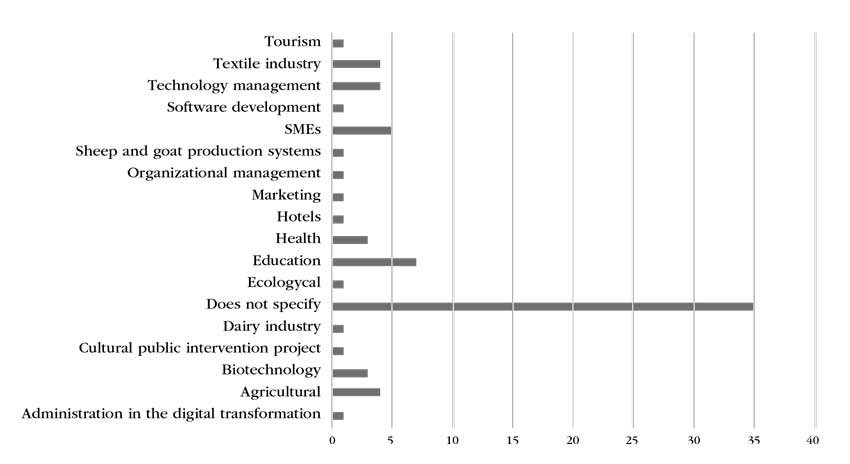
Most selected publications do not mention the organizational sector (Figure 2). Education contains the most significant number of publications in the documents in which the sector was identified, with seven articles (Barrera-Rodríguez et al., 2020; Marquínez-Gruezoi & Álvarez-López, 2023; Molina-Medina & Romero-Silva, 2018; Montoya-Restrepo et al., 2012; Roncancio-Roncancio, 2020; Sepúlveda Méndez et al., 2014; Tello-Clavijo, 2019). Next, five publications applied biological metaphors for SMEs (Lozano-Monroy, 2010; L. Montoya-Restrepo, 1999; L. Montoya-Restrepo et al., 2019; Montoya-Restrepo & Montoya-Restrepo, 2012a, 2022a). In the agricultural (Castellanos and Montoya, 2001; Montoya-Restrepo,Montoya-Restrepo and Rojas, 2012; Montoya et al., 2022; Ochoa-Carreño and Montoya-Restrepo, 2010), technology management (Castellanos-Domínguez, 2008; Jiménez-Hernández, 2015; Jiménez-Hernández et al., 2009; León-López, 2013), and textile industries (Hernández-Barragan et al., 2018; Valle-Flórez, 2010; Valle-Flórez, 2011a, 2011b), four publications were found, while for health (Aceros-Gualdrón, 2004; Pérez-Martínez, 2013; Pérez-Martínez & Rodríguez-Romero, 2015), and biotechnology (Castellanos & Montoya, 2001; Hernández, 2008; Montoya-Restrepo et al., 2004), three studies were conducted using biology metaphors.
Figure 2. Organizational sectors where the biological metaphor was applied
Font: Own elaboration.
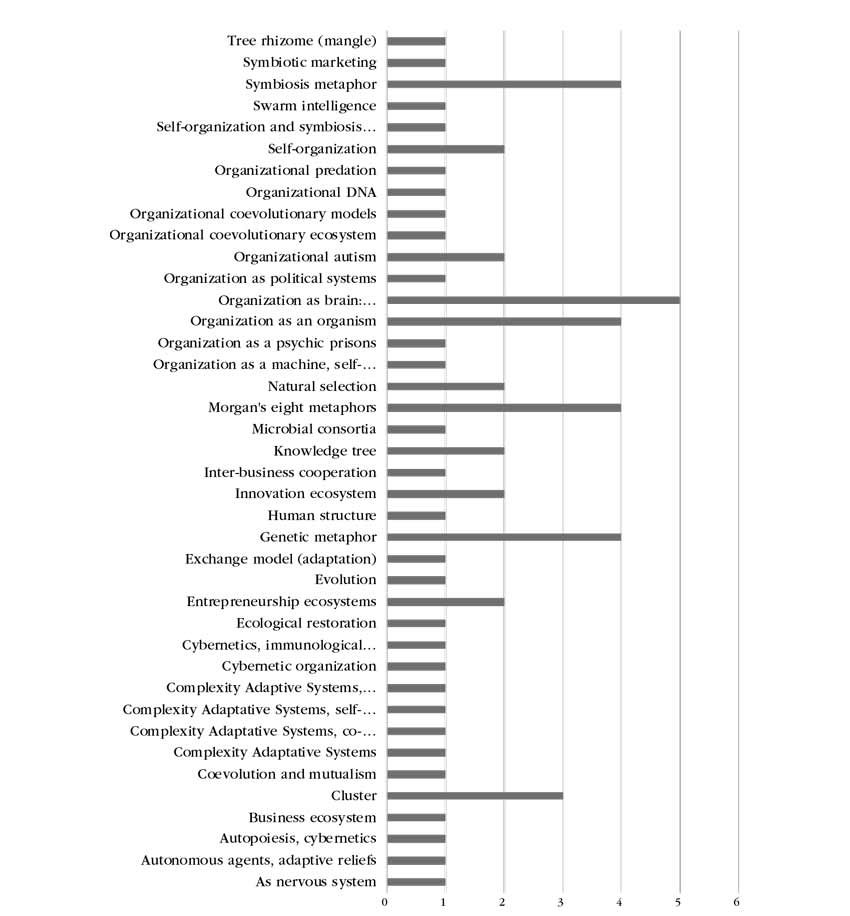
Of the 86 biological metaphors applicable to management, 64 were found to have been applied in the 75 studies analyzed (Figure 3). The most frequent was the organization as a brain, applied in five publications. This metaphor underscores the significance of examining management and decision-making processes from cognitive and neuroscientific perspectives. Several metaphors are mentioned only once, making them the least frequent. These include "Tree rhizome," "Organizational predation," "Organizational DNA," "Ecological restoration," "Nervous system," and "Autopoiesis, cybernetics." This low prevalence suggests that, although they are relevant in specific contexts, their application is limited or emerging in the literature.
Figure 3. Description of biological metaphors applied in 75 publications
Font: Own elaboration.
Discussion
This systematic review aimed to provide the most comprehensive and current list of Colombian studies on the application of biological sciences in management. A book chapter was recently published analyzing the importance of microbiology as a biological metaphor for project management (Rosero-García, 2025). However, this study is original because it compiles 75 research projects related to biological metaphors applied across various economic sectors in Colombia. Furthermore, it consolidates 86 biological metaphors applied in the business context. Garcia (2007) noted that Adam Smith, Alfred Marshall, Stanley Jevons, Karl Marx, Francois Quesnay, and Joseph Schumpeter share a commonality in utilizing biological metaphors in their economic discourse (Garcia-Callejas, 2007). However, their publication did not explicitly reference the 86 metaphors examined in the current study. These metaphors suggest that the different actors involved in a project, such as companies, communities, and government entities, must interact symbiotically, as in nature, to achieve sustainable development. Results indicate that some Colombian companies have already incorporated biological metaphors into their organizational structures, while others show potential for adopting them. Moreover, biological metaphors have been widely accepted and applied in project management in Colombia, as they offer a valuable perspective on understanding and improving the management of organizations and their environments. Colombia is a pioneering country in systematically applying metaphors in research projects and academic publications. A notable example is the application of these biological metaphors in the Colombian educational sector, which has seven publications. Roncancio (2020) concludes that the field of research on the relationships between the administration of higher education institutions, even with the use of biological metaphors, is under construction (Roncancio-Roncancio, 2020). However, a biological concept that has been applied to the management of educational institutions is the ecosystem, defined as a biological system comprising a community of living organisms and the physical environment where they live and interact (Tsujimoto et al., 2018). Furthermore, Marquínez et al. (Marquínez-Gruezoi & Álvarez-López, 2023) take a metaphorical approach to the curriculum as a mangrove ecosystem based on what Deleuze and Guattari proposed (Deleuze & Guattari, 2002). In this way, the management of educational projects can be metaphorically compared to a mangrove ecosystem, where relationships exist among all components, functioning as a thermodynamically open living system (Marquínez-Gruezoi & Álvarez-López, 2023). Likewise, Tello proposes the concept of a regional innovation ecosystem and concludes that educational institutions have a fundamental role in structuring these ecosystems. For this reason, in Colombia, there are different examples of regional innovation ecosystem initiatives and educational networks (Tello-Clavijo, 2019). In addition, other studies proposed that interspecific relationships within educational institutions could be explored through the symbiotic (Barrera-Rodríguez et al., 2020) and swarm intelligence metaphor (Montoya-Restrepo et al., 2012). Barrera et al. concluded that mutualism, defined biologically as the biological interaction where two organisms obtain a benefit, can be applied in managing relationships between the University and students, the University and teachers, the University and administrative officials, and the University and the private and public sector (Barrera-Rodríguez et al., 2020). Biological metaphors applied to the administration of the Colombian education sector show a pattern of conceiving institutions as living and dynamic systems, primarily through the ecosystem, which reflects the complexity and interdependence of diverse actors (Marquínez-Gruezoi & Álvarez-López, 2023). However, Roncancio (2020) points out that this area of study is still under development, questioning its practical applicability. Concepts such as symbiosis and swarm intelligence demonstrate the need to foster collaborative and adaptive relationships between educational and socioeconomic actors (Barrera-Rodríguez et al., 2020). These metaphors offer a systemic and dynamic theoretical framework for administration in Colombia, broadening the scope to encompass regional innovation (Tello-Clavijo, 2019). However, the challenge is to overcome structural and political barriers to convert these metaphors into effective administrative practices that drive sustainability and social transformation in the country.
Organizational DNA is another biological concept applied in the management of public sector universities. Molina and Romero mentioned that thanks to Organizational DNA, it is possible to diagnose problems, discover opportunities, detect weaknesses, evaluate strengths, and take actions that favor the company's behavior (Molina-Medina & Romero-Silva, 2018). It is considered that the DNA of a company or organization refers to those characteristic features that define the way an organization operates, its objectives, and the means to achieve them. Biologically, DNA is a molecule that contains the genetic information necessary for the development and functioning of an organism. Therefore, an organization's DNA makes it easier to produce it in different places or situations without the need for external oversight. Public universities are responsible for developing relevant knowledge for a general domain of political, social, cultural, humanistic, and productive issues from the perspective of an organization with an ethically responsible government (Tello-Clavijo, 2019). Similarly, Sepúlveda et al. propose that the characteristics of the nervous system are the basis for constructing an integrative, guiding, and empowering proposal called TIE (Interaction Fabric School, Sepúlveda Méndez et al., 2014). The metaphors of ecosystems and biological networks could be applied to better understand the interactions and collaboration dynamics between various actors in the educational community, consisting of students, teachers, administrators, families, etc. This could improve relationship management and coordination between these groups. Although the articles collected in this study address general aspects of biological metaphors in education, more in-depth research would be necessary to understand how biological metaphors have been or could be applied specifically in educational management.
Applying the biological metaphor of coevolution and mutualism can help us better understand inclusive agricultural businesses. For Molina and Romero, inclusive companies must not only exist among vulnerable producers but must also recognize the skills, knowledge, and capabilities they can share and leverage in support of the integration model (Montoya-Restrepo & Montoya-Restrepo, 2022b). On the other hand, Ochoa et al. propose that the metaphor of microbial consortia allows us to understand the fundamental principles for consolidating an efficient and sustainable associative model in the value chain, just as it occurs in nature (Ochoa-Carreño & Montoya-Restrepo, 2010). Other biological metaphors used in the agricultural sector are symbiotic marketing (Montoya et al., 2022) and organizational coevolutionary models (Montoya-Restrepo, Montoya-Restrepo and Rojas, 2012), which offer a conceptual framework so that small agro-industrial companies can associate, better adapt to their environment, innovate, and develop inclusive business models, taking advantage of the synergies and diversity of the value chain. Co-evolution is used to understand how companies can cooperate and integrate effectively to achieve common goals. This process involves interaction and mutual adaptation between companies to achieve greater efficiency and competitiveness (Montoya-Restrepo, Montoya-Restrepo and Rojas, 2012). Biological metaphors offer a valuable conceptual framework for understanding and managing relationships, innovation, and integration in agro-industrial value chains. Moreover, this study found that integrating biological metaphors into dairy industry management can improve collaboration and innovation, contributing to more sustainable and resilient production. The organizational coevolutionary ecosystem offers a conceptual framework to guide industry actors toward more effective and adaptive practices (Suárez-Pineda, 2013). The analyzed publications reflect a consistent pattern of using biological metaphors to explain and guide management and cooperation in the Colombian agro-industrial sector, highlighting the concept of microbial consortia as an efficient and sustainable associative model. However, despite their conceptual value, the question arises as to how these models, inspired by nature, can be effectively translated into real-life practices that overcome the sector's structural and economic limitations. Biological metaphors open a promising field that can revolutionize administrative paradigms, provided they are adapted to the social and economic realities of the agricultural sector.
Remarkably, biological metaphors can be integrated into biotechnology management in several ways. The genetic management proposed by Montoya (1999) is a biological metaphor used to manage processes in biotechnology (Montoya-Restrepo, 1999). In the three selected publications, this management model is based on natural principles and simulates information transmission, codification, and storage in social organisms. Features of genetic management include:
• Information transmission: Similar to the transmission of genes in nature, genetic management focuses on the transfer of knowledge and skills within organizations.
• Information coding: Just as information is encoded in biological systems, management systems also require effective coding of information to facilitate improved communication and decision-making.
• Information storage: Genetic management focuses on the efficient storage of information, similar to how biological organisms store their genetic information (Castellanos & Montoya, 2001; Hernández, 2008; L. Montoya-Restrepo et al., 2004).
In Colombia, biological metaphors can be a valuable tool for biotechnology management, allowing companies to better understand how to adapt, innovate, and collaborate in a competitive and changing environment. Theoretically, these findings support a vision of management that emphasizes flexibility, continuous learning, and evolutionary adaptation—principles crucial for competitiveness in innovative sectors, such as biotechnology, in Colombia. However, the realistic applicability of this metaphor in organizational contexts with structural, technological, or cultural limitations must be questioned. For genetic management to be effective, it is essential to develop robust knowledge management and communication systems that truly reflect symbolic biological processes. Therefore, this perspective offers a valuable conceptual framework that could transform traditional management into more organic, interactive, and resilient models if it can overcome the practical barriers inherent in the Colombian business environment.
Another sector where biological metaphors are applied is the health sector. In the analogy with autism, the biological metaphor allows us to compare the characteristics of autism with organizational dysfunctions. For example, similarities can be identified in communication, socialization, learning, and organizational behavior, among individuals with autism. Organizational autism as a metaphor provides a framework for identifying and analyzing "pathologies" within an organization, such as ineffective communication, resistance to change, and difficulty adapting to new situations. These dysfunctions can be seen as analogous to the symptoms of autism, where lack of interaction and adaptation can lead to suboptimal performance (Pérez-Martínez, 2013; Pérez-Martínez & Rodríguez-Romero, 2015). The biological metaphor provides a valuable framework for analyzing and improving the dynamics within organizations, enabling them to identify and address dysfunctions that may limit their effectiveness. By applying autism concepts to the organization, interventions can be developed that foster a culture of communication and collaboration, thereby improving organizational performance.
In Colombia, biological metaphors offer a valuable conceptual framework to improve cooperation and sustainability in tourism, allowing different actors in the sector to adapt and thrive in a constantly changing environment. The symbiosis model is based on the relationship of mutualism, where various entities in the tourism value chain benefit mutually. For example, in La Macarena, Meta, a symbiotic cooperation model has been implemented that has proven to be successful in economic, social, and environmental terms, promoting the conservation of ecosystems and the development of ecotourism (Montoya-Restrepo et al., 2020). Moreover, neuromanagement, a modified concept of the organization-as-brain metaphor, has proven to be helpful in the management of hotels in Ocaña, Santander (Mejía-Peñaranda, 2021). Symbiosis highlights how diverse actors can collaborate for mutual benefit, reflecting interdependent relationships that foster not only economic development but also environmental conservation, as is the case in La Macarena. Still, it remains to be seen whether these symbiotic models can be sustained in the long term without a strong institutional framework and precise governance mechanisms. Furthermore, the incorporation of neuromanagement in hotels indicates that biological metaphors can also guide internal management toward more adaptive and intelligent processes.
Biological metaphors have been implemented in SMEs primarily through inter-firm cooperation and the development of organizational forms that foster integration and adaptability. The metaphor of symbiosis has been used to illustrate how small businesses can mutually benefit from collaborating. This approach allows companies to share resources, knowledge, and networks, leading to increased competitiveness and sustainability. For example, small businesses may form strategic alliances to access broader markets or share marketing and distribution costs (Montoya-Restrepo et al., 2019). Ecological restoration is applied as a metaphor in small companies to promote business adaptation and integration. This approach is based on the idea that, just like in nature, small businesses can adapt and evolve in response to changing market conditions and interactions with other actors in the business ecosystem (Montoya-Restrepo & Montoya-Restrepo, 2022a). Another biological metaphor applied in SMEs is Inter-business cooperation, which fosters organizational learning, allowing small businesses to learn from each other through collaboration. This learning is crucial for the adaptation and evolution of companies in a changing market environment (Montoya-Restrepo & Montoya-Restrepo, 2012a). In small and medium-sized businesses, the application of biological metaphors in management models appears to be dependent on a still-nascent culture of collaboration in Colombia, which limits their effectiveness. Theoretically, these metaphors prompt us to reconsider management not only as the administration of resources, but as a dynamic system that learns, adapts, and evolves within a network.
There are several business sectors that utilize biological metaphors. For other studies compiled, the specific industry is not mentioned because different metaphors with various applications are addressed. However, applying biological metaphors in project management in Colombia has emerged as an innovative strategy to improve adaptation and cooperation between companies. This methodology is based on observing natural processes and their analogy with organizational dynamics, thus promoting new forms of business integration. Based on the identified knowledge gaps, we propose further exploring management models that simulate the transmission, encoding, and storage of information, inspired by genetic processes, to strengthen innovation and adaptation in Colombian biotechnology companies. Future research may explore efficient and sustainable associative models in agricultural production chains, formalizing microbial metaphors to improve cooperation, competitiveness, and sustainability in the farming sector. Additionally, it would be beneficial to expand studies on neuromanagement in various service sectors, particularly in small and medium-sized enterprises, to enhance management processes through biological concepts related to brain function. These prospects for future research are based on the relevance of biological metaphors for innovating management models, improving competitiveness, and promoting sustainability in various productive and academic sectors in Colombia, thereby contributing to adaptive and cooperative organizational development.
Conclusions
A literature search yielded 2590 documents on biological metaphors in Colombia. After applying the inclusion criteria, 75 published studies were identified between 1999 and 2023. Most publications were from 2015, and 86 biological metaphors were identified. Integrating biological metaphors into project management in Colombia represents a promising way to improve the competitiveness and resilience of companies. By adopting nature-inspired principles of cooperation and co-evolution, organizations can develop more effective strategies to meet the challenges of today's business environment. This approach not only enriches the field of business management but also contributes to sustainable development and innovation in the country. Finally, although there is a solid theoretical foundation and widespread application in sectors such as education, agriculture, and biotechnology, structural and cultural barriers must still be overcome in order to translate these models into effective practices that foster social and organizational transformation in the country.
Contributor Role Taxonomy (CRediT)
Doris Rosero-García: Conceptualization; Formal analysis; Investigation; Methodology; Visualization; Writing (original draft).
Luz Alexandra Montoya-Restrepo: Investigation; Supervision; Writing (review & editing)
Statement on the use of language models (LLM)
Grammarly, Inc., in the pro version, was used for English review and editing. However, all final decisions regarding the content, structure, and argumentation of the manuscript were made by its authors, who assume full responsibility for the integrity and originality of the work presented.
References
Aceros-Gualdrón, J. (2004). Organismos y organizaciones cibernéticas: Análisis del sistema de salud colombiano como caso. Scripta Nova, 8(170), 1-10. https://revistes.ub.edu/index. php/ScriptaNova/article/view/839
Barrera-Rodríguez, A., Vieira-Salazar, J., & Duque-Oliva, E. (2020). Las relaciones interespecíficas de las universidades con sus grupos de interés: Metáfora biológica. Información Tecnológica, 31(4), 211-220. https://doi.org/10.4067/S0718-07642020000400211
Bohorquez, L. (2013). La organización empresarial como sistema adaptativo complejo. Estudios Gerenciales, 29, 258-265. https://doi.org/10.1016Zj.estger.2013.05.014
Bohórquez, L. (2016a). La comprensión de las organizaciones empresariales y su ambiente como sistemas de complejidad creciente: Rasgos e implicaciones. Revista Ingeniería, 21(3), 363-377. https://doi.org/10.14483/udistrital.jour.reving.2016.3.a07
Bohórquez, L. (2016b). The absence of response of organizations to changing business environment conditions: A complex management problem. Pensamiento y Gestión, 41, 13-35. https://www.redalyc.org/journal/646/64650087002/html/
Bohórquez, L., & Espinosa, A. (2015). Theoretical approaches to managing complexity in organizations: A comparative analysis. Estudios Gerenciales, 31 (134), 20-29. https://doi.org/10.1016/j.estger.2014.10.001
Cadavid, L. (2010). Propuesta para la medición del ajuste entre las metáforas organizacionales y las herramientas de modelado [tesis de maestría, Universidad Nacional de Colombia]. Repositorio Institucional UNAL. https://repositorio.unal.edu.co/handle/unal/3485
Carrillo, J. (2003). Analogía y metáfora en el análisis organizacional, un ejemplo: La organización como cárcel. Revista Colombiana de Psicología, 12, 108-113.
Castellanos-Domínguez, O. (2008). Retos y nuevos enfoques en la gestión de la tecnología y del conocimiento. Universidad Nacional de Colombia. https://repositorio.unal.edu.co/handle/unal/69955?show=full
Castellanos, O., & Montoya, A. (2001). Biogestión. Innovar, Revista de Ciencias Administrativas y Sociales, 1(18), 55-70. https://www.redalyc.org/articulo.oa?id=81801806
Castro-Ríos, G., & Noguera-Hidalgo, A. (2014). Depredación organizacional: Las consecuencias del uso del poder en la organización. Estudios Gerenciales, 30, 233-242. https://doi.org/10.1016/j.estger.2014.03.001
Deleuze, G., & Guattari, F. (2002). Mil mesetas: Capitalismo y esquizofrenia (5th ed.). Pre-textos. https://aisthesis2017.files.wordpress.com/2018/10/deleuze-guattari-mil-mesetas.pdf
Garcia-Callejas, D. (2007). Biology and economics: Metaphors that economists usually take from biology. Ecos de Economía, 11 (24), 153-164. https://www.redalyc.org/pdf/3290/329027260007.pdf
Gil-Bolívar, F. (2016). ¿Cómo preparase para el futuro en la gestión empresarial? Cuadernos Latinoamericanos de Administración, 12(23), 29-38. https://doi.org/10.18270/cuaderlam.v12i23.2113
Guzmán-Vásquez, D. (2014). Auto-organización en sistemas socio-ecológicos para la gestión del cambio ambiental-lineamientos metodológicos y aplicaciones [tesis de docturado, Universidad de los Andes]. http://hdl.handle.net/1992/7833
Hernández-Barragan, C., Marín-Uribe, M., & Muñoz-Herrera, O. (2018). Metáforas biológicas: Un modelo para evaluar el direccionamiento estratégico de la compañía Uniformes Nacionales S.A.S. de la ciudad de Medellín [tesis de grado, Corporación Universitaria Minuto de Dios-Uniminuto]. https://repository.uniminuto.edu/handle/10656/7001
Hernández, M. C. (2008). Propuesta de apoyo para una gestión eficiente de la biotecnología. Revista Escuela de Administración de Negocios, 62, 5-25. https://www.redalyc.org/articulo.oa?id=20611457002
Illera, L. (1982). Anatomía y fisiología de la organización. Universidad de La Salle.
Jiménez-Hernández, C. (2015). Propuesta para la valoración tecnológica desde la perspectiva de la síntesis evolutiva moderna [tesis de doctorado, Universidad Nacional de Colombia]. https://repositorio.unal.edu.co/handle/unal/57105
Jiménez-Hernández, C., Castellanos-Domínguez, O., & Montoya-Restrepo, L. (2009). Manufactura biológica e inteligente: Atributos de la vida aplicados al desarrollo tecnológico. Ingeniería e Investigación, 29(2), 127-134. http://www.redalyc.org/articulo.oa?id=64311752021
Jiménez Hernández, C. N., & Castellanos Domínguez, Ó. F. (2008). Perspectivas y consideraciones sobre el aporte biológico al desarrollo de la gestión de tecnología. Innovar. Revista de Ciencias Administrativas y Sociales, 18(32), 47-64. https://www.redalyc.org/articulo.oa?id=81803204
Kiseleva, S., & Trofimova, N. (2017). Metaphor as a device for understanding cognitive concepts. Revista de Lenguas para Fines Específicos, 23(2), 226-246.
Lara-Rodríguez, J., Rojas-Contreras, C., & Martínez-Buitrago, A. (2015). Evolución organizacional: Inducción socio-biológica para el entendimiento de la metáfora. AD-Minister, 26, 101-122. http://www.scielo.org.co/scielo.php?script=sci_arttext&pid=S1692-02792015000100005
León-López, A. (2013). Aporte biológico a la gestión de los recursos y las capacidades tecnológicas [tesis de maestría, Universidad Nacional de Colombia]. https://repositorio.unal.edu.co/handle/unal/51748
Lozano-Monroy, F. D. (2010). La asociatividad como modelo de gestión para promover las exportaciones en las pequeñas y medianas empresas en Colombia. Revista de Relaciones Internacionales, Estrategia y Seguridad, 5(2), 161-191. https://www.redalyc.org/articulo.oa?id=92720314006
Magano, J., Silvius, G., Silva, C. S. e, & Leite, Â. (2021). The contribution of project management to a more sustainable society: Exploring the perception of project managers. Project Leadership and Society, 2, 100020. https://doi.org/https://doi.org/10.1016/j.plas.2021.100020
Marín Cardona, P., & Cuartas Torres, C. (2022). Ecosistemas de emprendimiento: Hacia una reflexión práctica y conceptual. Revista Universidad y Empresa, 24(43), 1-38. https://doi.org/10.12804/revistas.urosario
Marquínez-Gruezoi, H., & Álvarez-López, M. (2023). Una visión arbórea del currículo rural desde la perspectiva de la metáfora del rizoma de Deleuze y Guattari. Revista Guillermo de Ockham, 21(2), 607-623. https://doi.org/10.21500/22563202.5954
Mars, M., Bronstein, J., & Lusch, R. (2012). The value of a metaphor: Organizations and ecosystems. Organizational Dynamics, 41, 271-280. https://doi.org/10.1016/j.orgdyn.2012.08.002
Martínez-Bernal, M., Serrano-Amado, A., Montoya-Restrepo, A., & Montoya-Restrepo, I. (2017). La metáfora biológica como metodología de aprendizaje organizacional: El caso de los ecosistemas de innovación. Revista Espacios, 38(43), 18. https://www.revistaespacios.com/a17v38n43/a17v38n43p18.pdf
Mejía-Peñaranda, A. (2021). La neurogerencia como herramienta para fortalecer las habilidades de los directivos del sector hotelero del municipio de Ocaña, Norte de Santander [tesis de maestría, Universidad Nacional Abierta y a Distancia]. https://repository.unad.edu.co/handle/10596/42068
Molina-Medina, B., & Romero-Silva, M. (2018). ADN organizacional para la calidad de servicio en las universidades de gestión pública colombianas. Revista de Ciencias Sociales (Ve), 24(4), 70-79. https://www.redalyc.org/journal/280/28059581006/28059581006.pdf
Montoya-Restrepo, LA Montoya-Restrepo, I. (2020). Aplicación de la metáfora biológica en la creación de nuevos conglomerados organizacionales. In Los estudios organizacionales en Colombia aproximaciones, diversidad y desarrollo (p. 44). Editorial Universidad del Rosario; Editorial EAFIT.
Montoya-Restrepo, LA Montoya-Restrepo, I., & Rojas, S. (2012). Fortalecimiento de cadenas productivas a partir de la sociobiología: El enfoque ecosistémico. In Conceptualización colectiva de la asociatividad empresarial: Posiciones diversas y nuevos planteamientos (p. 177). Universidad EAN. https://doi.org/10.21158/9789567561753
Montoya-Restrepo, I., & León-Medina, E. (2004). Los ciclos de generación de competencias y su aplicación en las organizaciones. Innovar. Revista de Ciencias Administrativas y Sociales, 24, 9-27.
Montoya-Restrepo, I., & Montoya-Restrepo, L. (2013). La formación de estrategias deliberadas y emergentes una propuesta a partir de definiciones básicas de una metodología de sistemas suaves. Revista de La Facultad de Ciencias Económicas: Investigación y Reflexión, 21(2), 67-95. https://dialnet.unirioja.es/servlet/articulo?codigo=4733004
Montoya-Restrepo, I., & Montoya-Restrepo, L. (2015). Comprensión del concepto de emergencia, desde el aporte de Holland, Kauffman y Andrade. Innovar, Revista de Ciencias Administrativas y Sociales, 25(57), 27-44. https://doi.org/10.15446/innovar. v25n57.50325.
Montoya-Restrepo, I., & Montoya-Restrepo, L. (2023). Perspectivas de las neurociencias y sus aplicaciones en las organizaciones. DYNA, 90(230), 29-37. https://doi.org/10.15446/dyna.v90n230.111697
Montoya-Restrepo, I., Montoya-Restrepo, L., & Rojas-Berrio, S. (2012). Oportunidades de desarrollo de comunidades de investigación mediante la aplicación de la metáfora biológica. Punto de Vista, 3(4), 123-132. https://doi.org/10.15765/pdv.v3i4.94
Montoya-Restrepo, L. (1999). Gerencia genética: Una nueva perspectiva para la organización [tesis de maestría, Universidad Nacional de Colombia]. https://www.researchgate.net/publication/316660539_GERENCIA_GENETICA_Una_nueva_perspectiva_para_la_organizacion
Montoya-Restrepo, L. (2010). Gestión de sistemas de integración empresarial desde una perspectiva biológica [tesis de doctorado, Universidad Nacional de Colombia]. https://repositorio.unal.edu.co/handle/unal/70007
Montoya-Restrepo, L., Castellanos-Domínguez, O., & Montoya-Restrepo, I. (2022). Metáforas biológicas aplicadas a las organizaciones ni. Editorial Universidad Nacional de Colombia. https://acortar.link/TbP5X4
Montoya-Restrepo, L., Castellanos-Domínguez, O., & Montoya-Restrepo, L. (2004). La gerencia genética: Una metáfora biológica aplicada a la gestión de la biotecnologia. Innovar. Revista de Ciencias Administrativas y Sociales, 24, 93-104.
Montoya-Restrepo, L., & Montoya-Restrepo, I. (2003). Las organizaciones y los métodos de su entendimiento. Innovar, Revista de Ciencias Administrativas y Sociales, 13(22), 63-72. https://acortar.link/893u4n
Montoya-Restrepo, L., & Montoya-Restrepo, I. (2012a). Aplicación de la metáfora biológica para el desarrollo de formas organizativas en la integración empresarial. Revista de la Facultad de Ciencias Económicas: Investigación y Reflexión, 20(2), 43-54. http://www.scielo.org.co/pdf/rfce/v20n2/v20n2a03.pdf
Montoya-Restrepo, L., & Montoya-Restrepo, I. (2012b). Metáforas biológicas aplicadas a las organizaciones.
Montoya-Restrepo, L., & Montoya-Restrepo, I. (2022a). La restauración organizacional, estrategia emergente como metáfora para la adaptación de los ecosistemas empresariales. Criterio Libre, 20(36), 1-23. https://doi.org/10.18041/1900-0642/criteriolibre.2022v20n36.9084
Montoya-Restrepo, L., & Montoya-Restrepo, I. (2022b). Negocios inclusivos: Un modelo de metáfora biológica para el sector agropecuario. Revista de Ciencias de La Administración y Economía, 12(23), 25-44. https://doi.org/10.17163/ret.n23.2022.02
Montoya-Restrepo, L., Montoya-Restrepo, I., & Castellanos-Domínguez, O. (2010). La metáfora organizacional: Alternativa de entendimiento procedente de otras ciencias. Revista de la Facultad de Ciencias Económicas: Investigación y Reflexión, 18(1), 75-86. https://www.redalyc.org/pdf/909/90920479004.pdf
Montoya-Restrepo, L., Montoya-Restrepo, I., & Rojas-Berrío, S. (2020). Modelo de simbiosis para el turismo en La Macarena, Colombia: Impacto de la paz en Caño Cristales. Revista Logos Ciencia & Tecnología, 12(2), 113-130. https://doi.org/10.22335/rlct.v12i2.1132
Montoya-Restrepo, L., Montoya-Restrepo, I., & Rojas Berrio, S. (2019). Innovación organizacional como un proceso de simbiogénesis. NOVUM, Revista de Ciencias Sociales Aplicadas, 1 (9), 124-142. https://revistas.unal.edu.co/index.php/novum/article/view/74227
Montoya-Restrepo, L., Montoya-Restrepo, I., & Valencia, J. (2016). Metáforas biológicas aplicadas a las organizaciones (II): Ensayos escogidos. https://www.researchgate.net/publication/307579034_Metaforas_biologicas_aplicadas_a_las_organizaciones_II_Ensayos_escogidos
Montoya-Restrepo, L., Sánchez-Torres, J., & Montoya-Restrepo, I. (2019). Marketing simbiótico. Una aproximación al concepto desde una revisión teórica. Semestre Económico, 22(53), 103-126. https://doi.org/10.22395//seec.v22n53a5
Montoya, L., Hernández, J., & Montoya, I. (2022). Marketing mutualista como estrategia emergente: Caso de la papa durante la pandemia de Covid en 2019. Revista Latinoamericana de Investigación En Organizaciones, Ambiente y Sociedad, 13(20), 149-170. https://doi.org/10.33571/teuken.v13n20a8
Morgan, G. (1991). Imágenes de la organización. Alfaomega Ra-Ma.
Noguera-Hidalgo, A., & Castro-Ríos, G. (2022). La relación organización-entorno, aportes desde la ontología y la economía evolutiva de Kurt Dopfer: La organización como un sistema de reglas. Cuadernos de Economía, 41 (87), 409-426. https://doi.org/10.15446/cuad.econ.v41n87.95102
Ochoa-Carreño, D., & Montoya-Restrepo, L. (2010). Consorcios microbianos: Una metáfora biológica aplicada a la asociatividad empresarial en cadenas productivas agropecuarias. Revista de La Facultad de Ciencias Económicas: Investigación y Reflexión, 18(2), 55-74. http://www.scielo.org.co/pdf/rfce/v18n2/v18n2a04.pdf
Ortíz-Pabón, E. (2015). Ecosistemas de negocios y emprendimiento sostenible. En Gestión de la sostenibilidad en el marco de las organizaciones (p. 22). Universidad EAN.
Ospina, O., Montoya-Restrepo, L., Montoya-Restrepo, I., & Grajales, H. (2014). Reflexiones sobre la gestión de conocimiento y los sistemas de producción ovina y caprina en Colombia. Veterinaria y Zootecnia, 8(2), 1-14. https://doi.org/10.17151/vetzo.2014.8.2.1
Page, M., McKenzie, J., Bossuyt, P., Boutron, I., Hoffmann, T., Mulrow, C., Shamseer, L., Tetzlaff, J., & Moher, D. (2021). Updating guidance for reporting systematic reviews: Development of the PRISMA 2020 statement. Journal of Clinical Epidemiology, 134, 103-112. https://doi.org/10.1016/j.jclinepi.2021.02.003
Parra-Acosta, Y. (2015). Neuromanagement: Actualización de la metáfora "organización como cerebro" de Gareth Morgan (1986). Innovación En La Gestión, 13(33), 9-25. https://repository.unipiloto.edu.co/handle/20.500.12277/8026
Pascucci, F., Savelli, E., & Gistri, G. (2023). How digital technologies reshape marketing: Evidence from a qualitative investigation. Italian Journal of Marketing, 2023(1), 27-58. https://doi.org/10.1007/s43039-023-00063-6
Perea-Sandoval, J. (2011). Las organizaciones como sistemas biológicos: La metáfora política. Tecciencia, 5(10), 18-21. https://dialnet.unirioja.es/servlet/articulo?codigo=5113348
Pérez-Martínez, R. (2013). La patología autista en la organización: Una interpretación a partir de la metáfora biológica [tesis de maestría, Universidad Nacional de Colombia]. https:/repositorio.unal.edu.co/handle/unal/51771
Pérez-Martínez, R., & Rodríguez-Romero, C. (2015). Autismo y organización: Una interpretación a partir de la metáfora biológica. Editorial UPTC.
Piñuela-Espín, J., & Quito-Godoy, C. (2020). Los desafíos de la gestión por procesos en la era digital. Estudios de La Gestión, 8, 131-148. https://doi.org/10.32719/25506641.2020.8.1
Posada-Pinzón, J. (2018). La auto-organización empresarial como alternativa para incrementar la agilidad organizacional: Una comparación de escenarios de simulación multi-agente [tesis de maestría, Universidad Distrital Francisco José De Caldas]. https://repository. udistrital.edu.co/handle/11349/13507?mode=full
Pulgarín, S. (2013). De las organizaciones: Reflexiones y aproximaciones desde la biología y la complejidad. Criterio Libre, 11(18), 195-216. https://repository.urosario.edu.co/items/98268447-8bfc-486b-b297-34c60d011fd7
Ramírez-Castañeda, L., Londoño-Vanegas, D., Osorio-Flórez, J., & Cárdenas-Aguirre, D. (2015). Vacíos en la aplicación de la metáfora biológica ecosistema: Caso ecosistemas de emprendimiento. Sinapsis, 7, 44-52. https://dialnet.unirioja.es/servlet/articulo?codigo=5279080
Ramírez-Medina, L. (2016). Impacto de la biología en los modelos de gestión y control organizacional [artículo de revisión, Universidad del Rosario]. https://repository.urosario.edu.co/bitstreams/a8f4cdee-9a88-4db3-83df-48ce1198d0a7/download
Robayo-Acuña, P., Montoya-Restrepo, A., & Castellanos-Domínguez, O. (2011). Aportes desde las ciencias biológicas a la teoría de la gestión. Revista de La Facultad de Ciencias Económicas: Investigación y Reflexión, 19(1), 175-192. https://www.redalyc.org/articulo.oa?id=90922732011
Robinson, R. N. S., Baum, T., Golubovskaya, M., Solnet, D. J., & Callan, V. (2019). Applying endosymbiosis theory: Tourism and its young workers. Annals of Tourism Research, 78, 102751. https://doi.org/https://doi.org/10.1016/j.annals.2019.102751
Roncancio-Roncancio, P. (2020). La adaptación y las instituciones de educación superior: conceptos y desafíos. Revista Iberoamericana de Educación Superior, 11 (32), 198-214. https://doi.org/10.22201/iisue.20072872e.2020.32.822
Rosero-García, D. (2025). Capítulo 12. Importancia de la microbiología como metáfora biológica para la gestión de proyectos en Colombia: Revisión sistemática. In Investigación en Educación y Humanidades: Nuevas Rutas hacia el aprendizaje (p. 368). Aula Magna; McGraw-Hill Interamericana de España. https://acortar.link/epXK1y
Sepúlveda Méndez, J., Soto Rivas, M., & Ramírez Aristizabal, B. (2014). El tejido de interacción escolar como potenciador de la gestión directiva en la política de inclusión. Plumilla Educativa, 14(2), 274-294. https://doi.org/10.30554/plumillaedu.14.767.2014
Suárez-Pineda, L. (2013). Comportamiento del sector lechero en el departamento de Boyacá: una aproximación desde la metáfora biológica. Punto de Vista, 4(7), 149-167. https://doi.org/10.15765/pdv.v4i7.451
Tello-Clavijo, L. (2019). Propuesta para la estructuración de ecosistemas regionales de innovación a partir del rol de instituciones educativas con base en el enfoque de gestión por competencias [tesis de maestría, Universidad Nacional de Colombia]. https://repositorio.unal.edu.co/handle/unal/75992
Tsujimoto, M., Kajikawa, Y., Tomita, J., & Matsumoto, Y. (2018). A review of the ecosystem concept — Towards coherent ecosystem design. Technological Forecasting and Social Change, 136, 49-58. https://doi.org/https://doi.org/10.1016/j.techfore.2017.06.032
Valencia-Martínez, L., & Suárez-Rojas, M. (2023). Neuromanagement: implementación alternativa en la gestión organizacional. Revista CEA, 9(21), e2600. https://doi.org/10.22430/24223182.2600
Valle-Flórez, M. (2010). Metáfora de la moda y de la percepción en la construcción social y cultural del cluster textil/ confección, diseño y moda en Antioquia. Revista Politécnica, 6(11), 38-45.
Valle-Flórez, M. (2011a). Análisis metafórico del Cluster textil /confección, diseño y moda de Antioquia [tesis de doctorado, Instituto Tecnológico y de Estudios Superiores de Occidente]. http://hdl.handle.net/11117/1263
Valle-Flórez, M. (2011b). Metáfora de la guerra en la construcción sociocultural del clúster textil/confección, diseño y moda de Antioquia. Signo y Pensamiento, 30(58), 280-296. http://www.scielo.org.co/scielo.php?script=sci_arttext&pid=S0120-48232011000100018
Valle-Flórez, M. (2011c). Metáforas con las que se han nombrado, explicado y descrito las organizaciones. Poliantea, 7(13), 173-186. https://doi.org/10.15765/plnt.v7i13.145
Varón-Sandoval, A., & Zapata-Castillo, L. (2021). A theoretical approach to neuroscience technologies' contributions to administration in the digital transformation context. Cuadernos de Administración, 37(69), 1-14. https://doi.org/10.25100/cdea.v37i69.10691
Zuluaga-Ramírez, A. (2002). Aproximación sistémica al estudio de la organización y gestión ambiental rural municipal [tesis de maestría, Universidad de los Andes]. https://repositorio.uniandes.edu.co/entities/publication/2dd6dbcc-9264-48aa-bc21-5694172aee29
Zúñiga, M. (2018). Complejidad organizada: los laboratorios vivos de innovación y cultura como metáfora de un organismo vivo. Revista Investigium IRE: Ciencias Sociales y Humanas, 68-81. https://doi.org/10.15658/INVESTIGIUMIRE.180901.06