
10.12804/revistas.urosario.edu.co/empresa/a.14895
ARTÍCULO DE REVISIÓN
Ana López-González 1
Eugenia Babiloni 2
Lourdes Canós-Darós3
1 Universitat Politécnica de Valencia (España).
 0000-0002-2599-5425
 anlogon2@doctor.upv.es
2 Universitat Politècnica de València (España).
0000-0002-7949-3703
mabagri@doe.upv.es
3 Universitat Politècnica de València (España).
https://orcid.org/0000-0002-9609-2880
loucada@omp.upv.es
Reception date: October 4, 2024
Acceptance date: October 6, 2025
To cite this article: López-González, A., Babiloni, E., & Canós-Darós, L. (2026). Multicriteria decision-making methods applied to personnel selection: A systematic literature review. Universidad y Empresa, 28(50), 1-40. https://doi.org/10.12804/revistas.urosario.edu.co/empresa/a.14895
Abstract
Personnel selection has become a complex strategic problem for organizations where choosing the right employees is crucial for success. This study presents a systematic literature review of the research on multi-criteria decision-making methods applied to selection processes. This review aims to identify those ranking candidates according to best fit and those determining their distance from the ideal profile for the job position and the organization. The methodology is based on the Preferred Reporting Items for Systematic Reviews and Meta-Analyses. After the screening phase 51 publications were selected. The results reveal that applying multi-criteria decision-making methods in personnel selection reduces uncertainty by transforming subjective linguistic judgements of decision-makers into objective numerical representations, thus providing transparency and agility. This is particularly important for managerial positions that directly influence the organization's performance. In the analysed publications, the Technique for Order Preference by Similarity to an Ideal Solution and its variants was used in half of the publications to solve personnel selection challenges, followed by the Analytic Hierarchy Process. However, many studies combine multiple methods.
Keywords: systematic literature review; personnel selection; multi-criteria decision-making methods; managerial positions.
Resumen
La selección de personal se ha convertido en un problema estratégico y complejo en las organizaciones, en las que elegir a los empleados adecuados resulta imprescindible para el éxito. Este estudio presenta una revisión sistemática de la literatura sobre los métodos multicriterio para la toma de decisiones en procesos de selección de personas. El objetivo fue identificar tanto los enfoques orientados elaborar listas de candidatos de mayor a menor ajuste con las necesidades del puesto como aquellos que determinan la distancia de cada candidato respecto al perfil ideal para el cargo y la organización. La metodología se basa en Preferred Reporting Items for Systematic Reviews and Meta-Analyses. Tras la fase de cribado se seleccionaron 51 publicaciones. Los resultados evidencian que la aplicación de métodos multicriterio en selección de personal reduce la incertidumbre al transformar los juicios lingüísticos subjetivos de los expertos en representaciones numéricas objetivas, que aportan transparencia y agilidad en el proceso. Esto es relevante en los puestos directivos, que influyen de manera directa en el desempeño organizacional. De las publicaciones analizadas se puede concluir que Technique for Order Preference by Similarity to an Ideal Solution y sus variantes se emplean en la mitad de las investigaciones, seguida por Analytic Hierarchy Process.Sin embargo, numerosos trabajos combinan múltiples métodos.
Palabras clave: revisión sistemática de la literatura; selección de personal; métodos de decisión multicriterio; puestos directivos.
Resumo
A seleção de pessoal tornou-se um problema estratégico e complexo nas organizações, nas quais escolher os colaboradores adequados é imprescindível para o sucesso. Este estudo apresenta uma revisão sistemática da literatura sobre métodos multicritério de apoio à decisão aplicados aos processos de seleção de pessoas. O objetivo da revisão foi identificar tanto as abordagens orientadas à ordenação de candidatos conforme seu grau de adequação às exigências do cargo, quanto aquelas que determinam a distância de cada candidato em relação ao perfil ideal para a função e para a organização. A metodologia baseia-se nas Preferred Reporting Items for Systematic Reviews and Meta-Analyses(PRISMA). Após a fase de triagem, foram selecionadas 51 publicações. Os resultados evidenciam que a aplicação de métodos multicritério na seleção de pessoal reduz a incerteza ao transformar os julgamentos linguísticos subjetivos dos especialistas em representações numéricas objetivas, proporcionando transparência e agilidade ao processo. Isso é relevante nos cargos de direção, que influenciam diretamente o desempenho organizacional. Nas publicações analisadas, observa-sé que a Technique for Order Preference by Similarity to an Ideal Solution (TOPSIS) e suas variantes foram utilizadas em metade dos estudos, seguida pelo Analytic Hierarchy Process(AHP). Contudo, diversos trabalhos combinam múltiplos métodos.
Palavras-chave: revisão sistemática da literatura; seleção de pessoal; métodos de decisão multicritério; cargos de direção.
Introduction
Human capital continues to be a crucial factor in organizational success and a source of competitiveness for businesses (Jurík & Sakál, 2014). According to Espinosa Robert et al. (2022), the human resources (HR) department plays a vital role in contributing to the growth and development of an organization with a philosophy focused on well-being and people-first sustainability (Qamar et al., 2023). Jurík and Sakál (2014) state that competency-based HR management is considered the most advanced system for promoting healthy organizational development, with the aim to create a competitive company led by competent individuals. In order to design a competency-based model, it is necessary to define the essential competencies that differentiate the institution, based on the mission, vision, and strategy of the organization (Nardes et al., 2021). A competency profile outlines the essential knowledge, skills, and abilities required for job performance and is typically integrated into competency-based models and used by companies in employee selection (Jurík & Sakál, 2014).
Within their strategic role, the HR department must implement an effective personnel selection (PS) policy. This term is defined as the process of hiring individuals for a specific position within an organization. According to Espinosa Robert et al. (2022), PS includes all the phases of the process such as recruitment, selection, hiring, or onboarding. Recruitment and selection are closely related. Recruitment aims to attract qualified candidates who fulfil the requirements of the vacancy, while selection involves conducting a more refined screening to choose the best candidate fit for the organization. Therefore, as emphasized by Evertz and Siifê (2017), organizations must focus not only on efficient hiring tactics but also on reaching the individuals they aim to target. Selecting the ideal candidate for a job position can be an expensive and time-consuming process. Additionally, certain profiles, such as those related to Information Technologies (IT) and managerial roles, are highly in demand in the job market, leading to serious difficulties in finding suitable candidates.
According to Çelikbilek (2018), the PS process is complex for several reasons, including the need to integrate group decision-making, subjective judgments, various inputs from different sources and large-scale data to avoid bias or error. Additionally, interviewers' personality traits may increase the risk of introducing bias into the selection process (Wingate et al., 2024). When assessing a candidate in a PS process, there are numerous qualitative and quantitative judgments or factors to consider. Therefore, it is commonly considered as a Multi-Criteria Decision-Making (MCDM) problem (Afshari et al., 2013; Ding et al., 2019; Li et al., 2022; Mallick & Mukhopadhyay, 2023; Tuana, 2018) or a Multi-Actor Multi-Criteria Analysis (MAMCA) problem due to the opinions of the decision-makers. MCDM methods in the PS process help reduce subjectivity and enhance the robustness of the decision-making process, making it easier for decision-makers to identify the optimal candidate for the vacancy (Jasemi & Ahmadi, 2017; Romero et al., 2015; Zulfikar et al., 2018).
A literature review on fuzzy logic for decision-making was conducted by Ruvalcaba Coyaso and Vermonden (2015). The review focuses on how fuzzy logic enhances certainty in the decision-making process and the transition from PS processes to mathematical models. However, this review cannot be considered systematic for several reasons. It does not address specific research questions, lacks a clear selection protocol explaining inclusion or exclusion criteria, and only briefly mentions two inclusion criteria. Moreover, it uses the keywords "personnel selection," "fuzzy logic," and "fuzzy sets" without providing a defined search strategy or equation. In summary, this study provides a general overview of fuzzy logic in PS processes, rather than analysing the various MCDM methods applied to ps. Ahmed et al. (2020) conducted a Systematic Literature Review (SLR) on leadership competencies for a managerial position, particularly with a specific focus on the project manager role, based on empirical research studies. The authors aimed to identify the most prevalent leadership competencies required for this managerial position. Their study reveals that effective communication and developing teams are the most crucial competencies for managing engineering projects. Furthermore, this research highlights that competencies such as goal achieving, critical analysis, empowerment, and strategic planning improve the probability of project success. This contribution provides valuable insights into the leadership competencies required for this managerial position, which could aid in the PS of this profile.
The current study conducts a SLR, which is a scientific research method that analyses relevant literature on a specific topic through a clear and objective question to aim for valid and objective conclusions from the available evidence on the topic (Sánchez-Meca, 2010). The principal purpose of this SLR is to analyse how multi-criteria decision-making methods are applied in PS, focusing on their use in managerial positions, identifying which methods are used to rank candidates to determine the best fit, and which are used to assess each candidate's distance from the ideal profile, and subsequently to develop a further agenda based on the identified gaps.
Section 2 focuses on the methodology, aiming to identify studies related to PS that apply MCDM methods to improve the decision-making in these processes. We propose a general research question and two secondary questions. The secondary questions aim to narrow down the focus to managerial positions, which are of particular interest, and to concentrate on methods involving candidate ranking. The methodology is based on the Preferred Reporting Items for Systematic Reviews and Meta-Analyses (PRISMA) framework, which establishes a protocol as indicated by García-Peñalvo (2022). The protocol defines inclusion and exclusion criteria, search strategies for the selected databases, and a unique identifying code for the screening phase. Additionally, we include the PRISMA flow diagram, which provides a graphic representation of the selection phases of the review.
Section 3 presents the results of the selected publications in our SLR. Firstly, the analysis covers findings such as the distribution of research across the years studied and the countries of origin of the authors. The ranking of the most cited publications in the two databases used specifies the country of origin of the corresponding author and determines the relative contribution of each country based on citations counts. Secondly, the findings are provided in relation to the formulated research questions, along with other data of interest for the research. The discussion in Section 4 addresses the research questions based on the synthesis of data obtained from the selected publications, all of which are empirical studies.
According to the conclusions and future agenda presented in Section 5, this SLR addresses both research questions: it identifies gaps in the literature and sets directions for future work, including practical recommendations for practitioners and researchers. It concludes that the application of MCDM methods in PS helps to reduce uncertainty by transforming subjective judgments into numerical representations, thus providing transparency and efficiency in the decision-making process. The Technique for Order Preference by Similarity to an Ideal Solution (TOPSIS) and its variations are among the most widely applied methods in PS, as they assess the distance of each candidate from the ideal profile for a specific position and rank them to determine the optimal individual. The Analytic Hierarchy Process (AHP) is the second most used approach for candidate ranking. In addition, this study highlights the critical role of PS in managerial positions within private organizations, given the strategic importance of the decision-making process, which affects both revenues and competitive advantage.
Methodology
As the introduction points out, the aim of this paper is to explore the gaps in the literature concerning ps, with a specific emphasis on the application of multi-criteria approaches for decision-making within selection processes. It also outlines a further agenda including practical recommendations for practitioners and researchers. The proposed methodology is a SLR based on the PRISMA framework (Moher et al., 2010), which is the most commonly used framework in SLR articles. It improves the information of reviews and critically evaluates those already published (García-Peñalvo, 2022). The research questions that the SLR aims to answer must be specific and concise in order to define the scope of the review (García-Peñalvo, 2022). Therefore, we define one main question, along with two secondary questions:
• RQ1: What multi-criteria methods are applied in personnel selection?
• RQ 1.1: How do multi-criteria methods help the decision-making in personnel selection, particularly for managerial positions?
• RQ 1.2: Which multi-criteria methods involve ranking candidates to determine the best fit for the position, and which methods determine the distance of each candidate from the ideal profile?
The rigor and reliability of SLR rely on previous planning and documentation of methodology. Hence, a systematic review protocol is essential for several reasons: (i) it enables careful planning and anticipation of potential problems; (ii) it provides transparent documentation of planned methods, prevents the use of subjective decision-making in determining inclusion criteria and extracting data; and (iii) can reduce duplicated work (Shamseer et al., 2015). For these reasons, a systematic review protocol is required and should include, at a minimum, the finalized research questions, the scope of the review, the timeframe, the inclusion and exclusion criteria, the quality assessment criteria, the data sources, the search terms, and the search equation (García-Peñalvo, 2022). Our SLR protocol employed the following criteria:
Inclusion Criteria
• Publications indexed in Web of Science (WoS) and Scopus.
• Timeframe: 2013-2023.
• Language: English, Spanish, and Portuguese. These three languages have been selected as they are the languages in which the authors are competent.
• Publications related to personnel selection that apply MCDM methods in public and private organizations. These studies must be empirical, that is, they should implement a model in organizations related to a specific job position.
Exclusion Criteria
• Exclusion criteria 1: Research that apply MCDM methods to another human resources field distinct from personnel selection. For instance, areas such as personnel success factors, succession planning, training or employee satisfaction, among others.
• Exclusion criteria 2: Publications that employ MCDM methods in a context other than human resources, such as student selection in educational institutions, healthcare, general management, and other.
• Exclusion criteria 3: Theoretical or empirical studies that do not implement a MCDM method in personnel selection within organizations.
The PRISMA statement for conducting a systematic review outlines a four-phase process (Moher et al., 2010). Phase 1: Identification, it involves searching databases and removing duplicates. Phase 2: Screening, it entails the initial screening based on reading the title and abstract. Phase 3: Eligibility, it consists of reviewing the full text of the publications selected in the previous step. Finally, Phase 4: Inclusion, is dedicated to the final selection of publications to be analysed in the review.
Phase 1 consisted of identifying the initial exploratory searches conducted using the WoS database. On September 17, 2023, the following searches were performed using individual keywords or search terms enclosed in quotation marks to get the exact term based on the research questions in the topic section: "recruitment," "manager recruitment," "personnel selection," "competency-based," "job profile," "management," "selection," or "assessment techniques," "multi-criteria," "multi criteria," "multicriteria," " MCDM," "multiple-criteria decision-making." Once we obtained results by including each search term, we combined the keywords using Boolean operators to create equations. These equations were entered into the advanced search function of the WoS database, with filters applied for the timeframe from 2013 to 2023 and for English, Spanish, and Portuguese. We selected "Web of Science Core Collection" option to ensure the inclusion of sources that adhere to the highest standards and are peer-reviewed. The initial search strategy entered into the advanced search of WoS was as follows: TS = ("competency-based"AND ("jobprofile" OR "recruitment" OR "management" OR "selection" OR "assessment techniques")) AND RS = ("multi-criteria" OR "multi criteria"OR "multicriteria" OR "MCDM"OR "multiple-criteria decision-making"). After applying the year and language filters, we obtained 7 results.
To make the equation less restrictive and to provide a greater number of results, we removed the term "competency-based", the preceding AND operator, and the phrases "job profile," "selection," and "assessment techniques." The term "personnel recruitment" is added to better reflect the topic, and "management" has been replaced by "manager recruitment." As for the multi-criteria terms, we included synonyms and abbreviations "multi-actor multicriteria analysis," "MAMCA," as used by Alvarez and Maheut (2022) in their systematic literature review of such techniques. The most commonly used methods in personnel selection have been included, which according to Afshari et al. (2011) are "AHP," "TOPSIS," "FUZZY AHP-TOPSIS," since excluding these methods resulted in fewer search results. We removed the less specific terms multi-criteria, "multi criteria" and "multicriteria," resulting in the second search strategy as follows: (TS = ("recruitment" OR "personnel recruitment" OR "manager recruitment")) AND TS =("MCDM" OR "multiple-criteria decision-making" OR "multi-actor multicriteria analysis" OR "AHP" OR "TOPSIS" OR "FUZZY AHP-TOPSIS" OR "MAMCA"). This combination was entered into WoS database, applying the year and language filters. The search returned 82 results.
The second combination represented a greater volume of bibliographic data, making the search more suitable for our analysis. However, since some of the reviewed publications contain the terms "personnel selection" and "hiring," we decided to add these words to the equation to verify if additional results were obtained. Indeed, the third search combination gave 205 results, but after applying the same filters, the publications were more in line with the topic. The final equation selected was the following: (TS = ("recruitment" OR "personnel recruitment" OR "manager recruitment" or "personnel selection" or "hiring")) AND TS = ("MCDM"OR "multiple-criteria decision-making" OR "multi-actor multicriteria analysis" OR "AHP"OR "TOPSIS"OR "FUZZY AHP-TOPSIS"OR "MAMCA"). As mentioned above, OR SLR also included publications indexed in the Scopus databased. The searches were performed using the same terms, operators, and filters. Table 1 details the search queries in both databases and the results obtained.
Table 1. The search queries used in the WoS and Scopus and records obtained.
Database |
Search equation selected |
Records |
WoS |
((TS =
("recruitment" or "personnel
recruitment" OR "manager
recruitment" or "personnel
selection" OR "hiring")) AND TS = ("MCDM" OR "multiple-criteria
decision-making" OR "multi-actor
multicriteria analysis" OR
"AHP" OR "TOPSIS" OR "FUZZY AHP-TOPSIS" OR
"MAMCA")) AND PY = (2013-2023) |
205 before screening |
Scopus |
(TITLE-ABS-KEY ( "recruitment" or "personnel recruitment" OR "manager recruitment" OR "personnel selection" OR "hiring" ) ) AND TITLE-ABS-KEY ( "MCDM" OR "multiple-criteria decision-making" OR "multi-actor multicriteria analysis" OR "AHP" OR "TOPSIS" OR "FUZZY AHP-TOPSIS" OR "MAMCA" ) AND ( LIMIT-TO ( PUBYEAR, 2023 ) OR LIMIT-TO ( PUBYEAR, 2022 ) OR LIMIT-TO ( PUBYEAR, 2021 ) OR LIMIT-TO ( PUBYEAR, 2020 ) OR LIMIT-TO ( PUBYEAR, 2019 ) OR LIMIT-TO ( PUBYEAR, 2018 ) OR LIMIT-TO ( PUBYEAR, 2017 ) OR LIMIT-TO ( PUBYEAR, 2016 ) OR LIMIT-TO ( PUBYEAR, 2015 ) OR LIMIT-TO ( PUBYEAR, 2014 ) OR LIMIT-TO ( PUBYEAR, 2013 ) ) AND ( LIMIT-TO ( LANGUAGE, "English" ) OR LIMIT-TO ( LANGUAGE, "Portuguese" ) ) |
210 before screening and removing duplicates |
Font: Own elaboration.
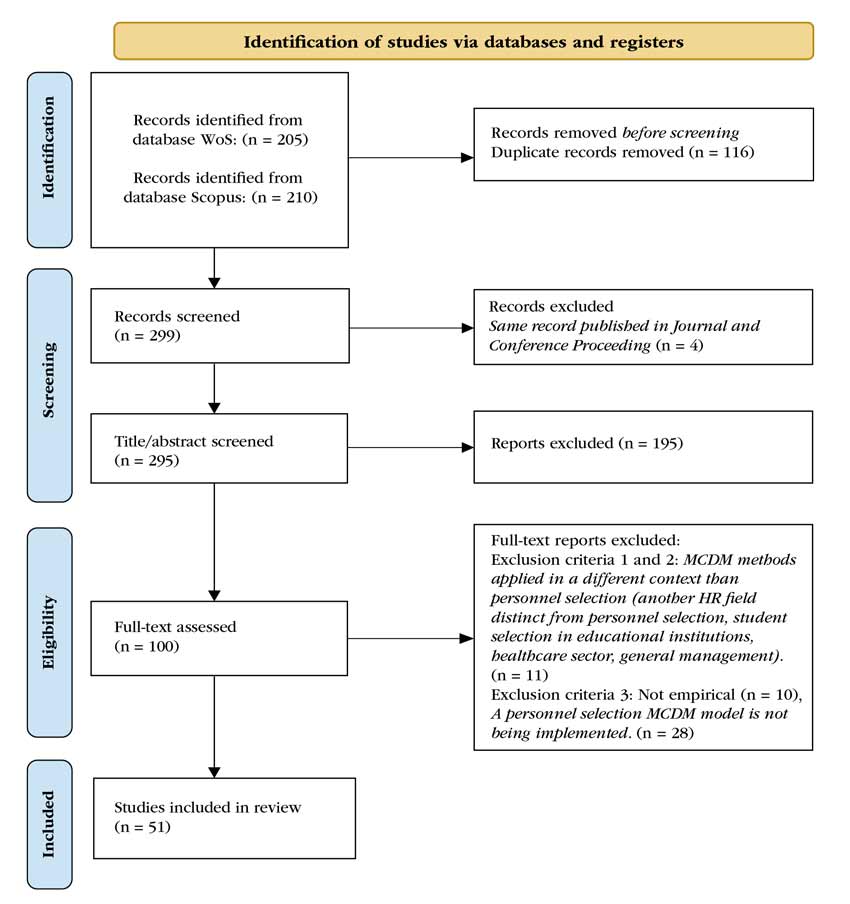
According to the PRISMA flowchart (Moher et al., 2010), we removed duplicate records after the identification. Records were considered duplicates if they refer to the same report, e.g., the same journal article (Page et al., 2021). To identify the duplicates, we downloaded references from both databases into Excel and sorted alphabetically by publication title. The process yielded a total of 415 records from WoS and Scopus, of which 116 were removed as duplicates.
To proceed with the Phase 2: Screening, and following the classification protocols proposed by Marin-Garcia et al. (2015) and Martinez-Tomas and Marin-Garcia (2019), an identification code was developed to classify each record as "selected," "discarded," "questionable," or "unavailable." The publications were discarded if they met any of the exclusion criteria after reviewing the title and abstract. Records with uncertainty about inclusion were classified as "questionable" for a comprehensive review of the entire publication. Documents with no access were classified as "unavailable." Table 2 presents an example from each classification.
Table 2. Classification of screening phase
Classification |
Definition |
When is it used? |
Action |
Example |
S. Selected |
The title and abstract suggest that they are related to the research objectives. |
When the publication meets the inclusion criteria and does not affect the exclusion criteria. |
Include the publication in the refence list for individual study. |
Abdel-Basset et al. (2020) A bipolar neutrosophic multi-criteria decision-making framework for professional selection. Applied Sciences, 10(4), 1202. https://doi.org/10.3390/app10041202 |
D. Discarded |
The title and abstract are not related to the research objectives. |
When the publication meets the exclusion criteria. |
Exclude the publication from the reference list. |
Rahimi et al. (2019) An Analytical Mobile App for Shared Decision Making About Prenatal Screening: Protocol for a Mixed Methods Study. JMIR Research Protocols, 8(10), e13321. https://doi.org/10.2196/13321 |
Q. Questionable |
The title and abstract are not clearly related to the research objectives. |
When it is not clear from the abstract whether the publication aligns with the inclusion criteria, but it seems to be related to the research objectives. |
Analyze the full text to determine whether it should be included in the list of references. |
Hadadian et al. (2020) Selecting an Effective Leader: A Competency-Based Grey Relational Analysis Model. En M. H. Bilgin, H. Danis, E. Demir, and A. F. Aysan (Eds.), Eurasian Business Perspectives (pp. 77-89). Springer International Publishing. https://doi.org/10.1007/978-3-030-40160-3_5 |
U. Unavailable |
The full text of the publication is not openly available. |
Unable to access the full text of the publication for use in the research analysis. |
Exclude the publication from the reference list. |
Shaygan (2022) Proposing an Application Model for Personnel Recruitment by Using a Multi Criteria Decision-Making (MCDM) Approach: A Case of Blue-Collar Cashier Personnel Recruitment. En The Routledge Companion to Technology Management. Routledge. |
Font: Own elaboration.
Based on the definitions described in Table 2, we made a preliminary classification after reviewing the titles and abstracts in the screening phase. We selected 56 publications, discarded 192 because they met one or more exclusion criteria, and considered 44 questionable. Additionally, we excluded 3 publications because their abstracts were not available for reading. Consequently, as shown in the PRISMA diagram in Figure 1, we reviewed the full text of 100 publications in the next phase.
Figure 1. PRISMA flow diagram for identification, screening, eligibility, and inclusion of studies
Font: Own elaboration.
In phase 3: Eligibility, after reading the full text of the publications, 28 items were rejected since the MCDM model for personnel selection was not actually implemented; additionally 11 articles were discarded for being out of scope, as they applied MCDM methods in contexts other than PS, such as other HR management areas, student selection in educational institutions, the health sector, or general management. Ten articles were literature reviews or not empirical studies. Finally in Phase 4: Inclusion, 51 publications were selected in the list of references for the systematic review. Table 3 lists the selected publications that address the research questions formulated in this protocol.
Table 3. Selected references in alphabetical order
Fon: Own elaboration.
Results
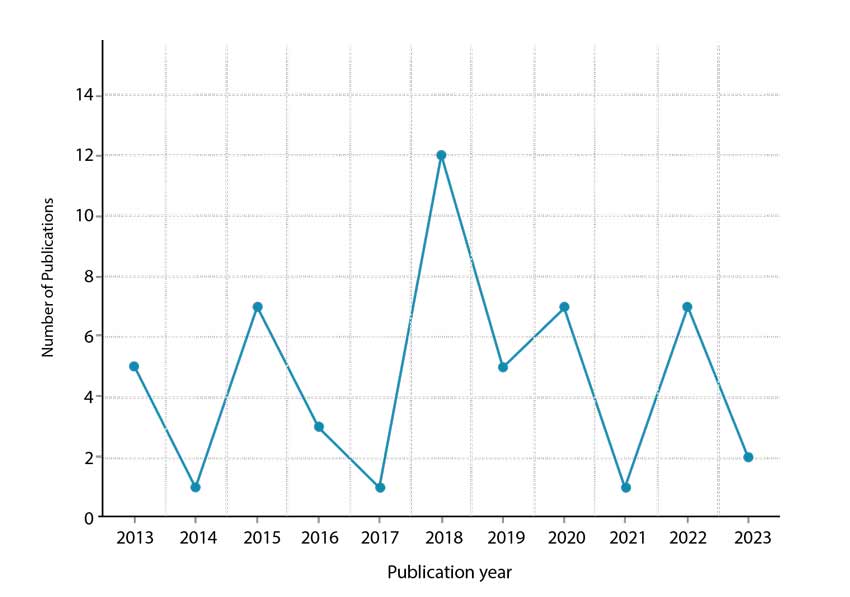
According to Figure 2, scientific production fluctuates over the analysed years, although publications are consistently observed each year. The results of the SLR, based on the selected publications, reveal that 23.54% of the studies are concentrated in 2018, with 10 articles, 1 conference paper, and 1 proceedings paper. Following this peak, production decreases steadily until 2022, when an increase is observed, reaching 7 publications. Between 2018 and 2023, 66.67% of the scientific works were focused on this period, representing a significantly higher proportion than in the previous five years of the analysed period. Hence, an upward trend is observed over the last six years. Therefore, it can be concluded that research on the topic of multicriteria methods applied to personnel selection continues every year, reflecting the importance of this topic, with the most notable years being 2018 and 2022.
Figure 2. Distribution of articles by year of publication
Font: Own elaboration.
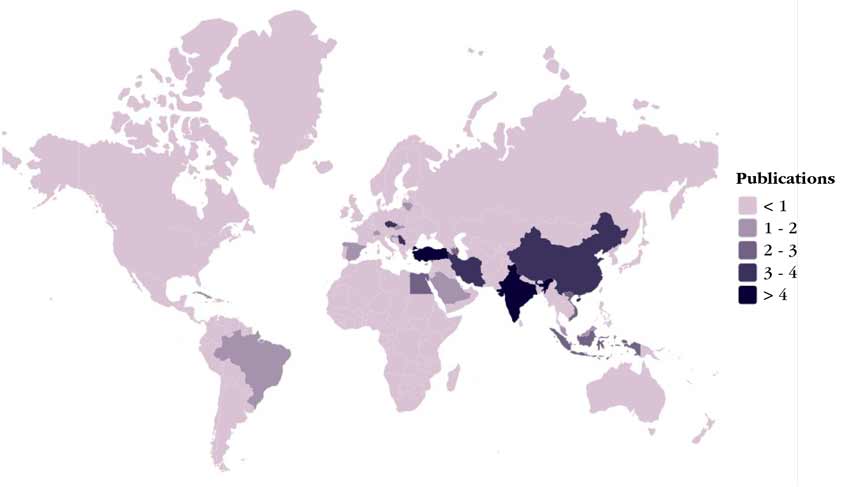
Figure 3 shows the countries of origin of the corresponding authors. The countries highlighted in purple represent authors from that location with related publications. The darker the shade of purple, the higher the number of related publications in that country. Most authors are from Turkey with ten publications, representing 19.61% of the total. India has five publications representing 11.75%. The countries with four to three publications include Iran, Taiwan, China, the Czech Republic, and Serbia. Two publications were identified for each of the following countries: Azerbaijan, Egypt, Indonesia, and Vietnam. The remaining works are written by individuals from Brazil, Croatia, Cuba, Cyprus, Lithuania, Malaysia, Saudi Arabia, Slovakia, Spain, and Switzerland, with each country contributing one publication. Asian countries provide a significant contribution, accounting for 68.63% of the publications related to the topic, with Turkey and India standing out. On the other hand, European countries contribute less, representing 23.53% of the total, with the Czech Republic and Serbia at the forefront.
Figure 3. Scientific publications by country
Font: Own elaboration.
According to quality standards, Table 4 and 5 show the 17 most cited publications without self-citations in the Scopus and WoS databases, respectively. In addition to these parameters, Table 4 includes the Field-Weighted Citation Impact (FWCI) from Scopus, according to Elsevier (n.d.), assesses the citation performance of a document relative to similar documents within its field. This metric considers factors such as publication year, document type, and associated disciplines. In Table 5, has been added the Category Normalized Citation Impact (CNCI), which is equivalent to the FWCI in WoS. CNCI measures the impact of a document by comparing its actual citation count to the expected citation rate for documents of a similar type, publication year, and subject area (Clarivate-Incites, n.d.). A value above 1.00 in both FWCI and CNCI indicates a higher citation frequency than would be expected in comparison to the average for similar publications in the same field.
Table 4. Citation counts per publication and the FWCI in Scopus.
Publication |
Citations |
Self-citations |
Citations without self-citations |
FWCI |
115 |
0 |
115 |
9.25 |
|
138 |
31 |
107 |
11.09 |
|
93 |
4 |
89 |
4.16 |
|
80 |
7 |
73 |
4.35 |
|
84 |
25 |
59 |
4.0 |
|
63 |
6 |
57 |
3.28 |
|
47 |
0 |
47 |
5.17 |
|
44 |
0 |
44 |
5.06 |
|
40 |
7 |
33 |
3.20 |
|
30 |
5 |
25 |
4.41 |
|
24 |
0 |
24 |
0.32 |
|
24 |
3 |
21 |
0.89 |
|
21 |
0 |
21 |
1.27 |
|
23 |
5 |
18 |
1.32 |
|
17 |
0 |
17 |
1.16 |
|
18 |
2 |
16 |
0.51 |
|
15 |
0 |
15 |
3.50 |
Font: Own elaboration.
In Scopus, the highest cited articles, cited more than a hundred times, include Abdel-Basset et al. (2020), which proposes a hybrid method using Analytic Network Process (ANP) and TOPSIS based on neutrosophic bipolar numbers to address the Chief Executive Officer (CEO) in a private energy company in Egypt. In second place, Nabeeh et al. (2019) also uses the traditional TOPSIS method but integrate it with neutrosophic Analytic Hierarchy Process (AHP) to select a managerial position in a public organization in Egypt. Both case studies are conducted in Egypt and use similar techniques to address a manager selection process. These similarities are attributed to the participation of the same authors in both articles. In contrast, Nabeeh et al. (2019) have a lower number of citations than Abdel-Basset et al. (2020), but a greater impact than the global average in terms of document type, year of publication and field. They remain in the top two positions in Table 4, with values that are significantly above the average, 11.09 and 9.25, respectively. With regard to Yalçin & Pehlivan (2019), it should be noted that although it does not occupy a position at the forefront in terms of number of citations, ranking at number eight, it has a greater impact than Sang et al. (2015) despite having a lower number of citations. This is indicated by its FWCI of 5.17, positioning it at the third highest impact level.
According to the citations in WoS, the highest cited publications with more than eighty citations are Nabeeh et al. (2019) in the first place, which is the second most cited paper in Scopus, and Karabasevic et al. (2018). In this study, they propose the Stepwise Weight Assessment Ratio Analysis (SWARA) to determine the weights of the criteria and the Evaluation based on Distance from Average Solution (EDAS) to rank and select the candidates in an it company for a non-managerial position in Serbia. It is noteworthy that the most cited article is not the one with the highest impact. Nabeeh et al. (2019) rank fourth in terms of citation impact, while Ulutaş et al. (2020) hold the top position with a CNCI of 7.09, despite being ranked tenth for the number of citations. Similarly, although Dockalíková & Kashi (2013b) is the least cited article in Table 5, it ranks according to citation impact with a value of 5.57.
Table 5. Citation counts per publication and CNCI in WoS
Publication |
Citations |
Self-citations |
Citations without self-citations |
CNCI |
88 |
0 |
88 |
5.51 |
|
81 |
0 |
81 |
6.27 |
|
79 |
0 |
79 |
2.58 |
|
67 |
0 |
67 |
3.56 |
|
54 |
0 |
54 |
2.47 |
|
39 |
0 |
39 |
2.97 |
|
39 |
0 |
39 |
1.98 |
|
38 |
0 |
38 |
2.27 |
|
25 |
0 |
25 |
1.79 |
|
24 |
0 |
24 |
7.09 |
|
20 |
0 |
20 |
0.81 |
|
17 |
0 |
17 |
1.06 |
|
17 |
0 |
17 |
0.9 |
|
17 |
0 |
17 |
1.23 |
|
12 |
0 |
12 |
0.99 |
|
11 |
0 |
11 |
0.55 |
|
7 |
0 |
7 |
5.57 |
Font: Own elaboration.
In conclusion, considering both databases, the three highest cited publications correspond to the following papers: Abdel-Basset et al. (2020), Nabeeh et al. (2019), and Karabasevic et al. (2018). Two of these studies analyses the selection process for a managerial position, which addresses the first research secondary question of this systematic review. Based on the citation impact as determined by the FWCI, over 80% of the 17 most cited publications in this systematic review exceed the value of 1, indicating that they are above the expected global average. Regarding the CNCI, 76% are higher than the average. Combining the most cited publications from the two databases results in Table 6, which lists the eighteen top publications and their respective countries of origin. It is noteworthy that Turskis et al. (2017) are found exclusively in Scopus, while Dockalíková and Kashi (2013b) is only indexed in WoS.
Table 6. The most cited publications in both Scopus and WoS, along with the countries of the corresponding authors
Publication |
Country |
Egypt |
|
Egypt |
|
China |
|
Iran |
|
Serbia |
|
Turkey |
|
Turkey |
|
India |
|
Serbia |
|
Serbia |
|
Iran |
|
Turkey |
|
Turkey |
|
Lithuania |
|
Iran |
|
Taiwan |
|
Turkey |
|
Czech Republic |
Font: Own elaboration.
Figure 3 shows that Turkey stands out as the country that has published the most studies on the topic. Table 7 also highlights that half of its publications are among the most cited, representing 27.78% of the highest cited publications. In contrast, India, the second country with the most contributions according to Figure 3, has only one study on the list of the most cited studies. Iran and Serbia each account for 16.67% of the most cited scientific works. In the case of Iran, three out of the four papers published are listed in Table 6. As regard Serbia, 100% of its contributions are among the most cited. Egypt is in a similar situation. Both contributions are listed in Table 6 and, as mentioned above, are among the three most cited studies.
Table 7. Number of publications from Table 6 grouped by country and the percentage representation of the total
Country |
Number of publications included in Table 6 |
Percentage |
Turkey |
5 |
27.78 |
Iran |
3 |
16.67 |
Serbia |
3 |
16.67 |
Egypt |
2 |
11.11 |
China |
1 |
5.56 |
Czech Republic |
1 |
5.56 |
India |
1 |
5.56 |
Lithuania |
1 |
5.56 |
Taiwan |
1 |
5.56 |
Font: Own elaboration.
Results Addressing the Research Questions
Table 8 summarizes the results collected in selected publications to address the formulated research questions. Regarding organizational type, twenty-nine studies (56.86%) focused on private organizations, a significant difference from the public sector where only twelve publications (23.53%) were identified. This emphasizes the importance of PS in private companies.
In terms of sectors, the education sector is represented by nine studies (17.65%). However, most of these publications refer to the public or unspecified type of organization. Secondly, Information Technology (IT) is the next most important sector with eight publications (15.69%), six of which focus on private organizations. This trend can be attributed to the high demand for it profiles and their shortage on the job market. Thirdly, the textile and the energy sector each have five studies (9.80%). Regarding the Textile sector, four out of the five publications refer to companies based in Turkey. This may be due to the importance of textile and apparel production, as their imports from this country.
The first secondary research question examines how multi-criteria methods help the decision-making in personnel selection, particularly for managerial positions. Among the studies reviewed, twenty-two publications (43.14%) focus on managerial roles, with Project Manager being the most analysed job position in the selection processes, representing 18.18% of the total managerial vacancies. Technical positions make up 22.73% of the managerial roles studied, such as Software Programmers or Systems Engineers. For non-managerial positions, twenty-five studies have been found. Of these, eight analyse academic staff positions at different levels of education, such as Teachers in a school or dual-qualification system, Professors and Lecturers at the University, corresponding to 36% of these no-managerial vacancies. The second most analysed job position is it role such as Business Intelligence Experts or Software Developers, with five publications, accounting for 20% of the no-manager positions. This highlights the importance of academic staff and it personnel for the organizations. Each study identifies different criteria or competencies to assess individual candidates for a particular vacancy. It was observed that only 27.45% of the publications explain the meaning of each criterion or competency. They provide the name of the criteria and some of them are of a rather qualitative nature, making it difficult to know exactly which aspects they intend to evaluate.
The second secondary research question investigates which multi-criteria methods involve candidate ranking to identify the best fit for a position. In forty-two studies (82.35%), in addition to ranking applicants, some case studies require the use of a combination of MCMD methods or techniques. For example, one method is used to assign weights to the criteria, while another is employed to rank the alternatives (candidates). Despite the variety of methods for ranking candidates to identify the ideal person, TOPSIS is the most used, as it calculates the distance between each candidate and the ideal profile, and appears in twenty-four publications (47.06%). Meanwhile, AHP is present in about 40% of the publications, mainly for assigning weights to the criteria and obtaining the candidate ranking. This suggests that both methods are highly valuable for addressing personnel selection problems.
Table 8. Findings of the review addressing the research questions in selected publications in alphabetical order
Publication |
Job position |
Organization or company |
Sector |
Type |
Managerial |
Criteria or |
Type of multi-criteria method and techniques combinations |
Chief executive officer |
Elsewedy electric group |
Energy |
Private |
Yes |
No |
Neutrosophic ANP / Neutrosophic TOPSIS |
|
Project manager |
Mapna company |
Energy |
Private |
Yes |
No |
Linguistic extension of fuzzy integral method |
|
Logistics specialist |
XYZ Logistics |
Logistics |
Private |
No |
Yes |
Intuitionistic fuzzy TOPSIS |
|
Project manager |
Mapna company |
Energy |
Private |
Yes |
Yes |
PROMETHEE |
|
IT Middle level manager |
it Greek Firm |
Information Technology (it) |
Private |
Yes |
No |
FUZZY TOPSIS |
|
Saudi ministry of foreign affairs |
Saudi Arabia Government |
Public |
Public |
Yes |
No |
AHP |
|
Assistant professor |
Indian University |
Education |
Unspecified |
No |
No |
FUZZY TOPSIS |
|
it Junior developer |
Spin-off it company at Sakarya University |
Information Technology (IT) |
Public |
No |
No |
FUZZY AHP |
|
Marketing manager |
Enterprise |
Unspecified |
Private |
Yes |
No |
TOPSIS / PROMETHEE / L- TOPSIS / L-PROMETHEE |
|
it Project manager |
Energy company |
Energy |
Private |
Yes |
No |
G-AHP |
|
Public relations |
Travel agency |
Tourism |
Private |
No |
Yes |
FUZZY Delphi Method / ANP /TOPSIS |
|
Person buttonhole machine: electronic and touch panel |
Textile factory |
Textile |
Privat |
No |
Yes |
WS / AHP / TOPSIS / PROMETHEE |
|
Middle manager operations |
International shipping company |
Logistics |
Private |
Yes |
Yes |
FUZZY MCDM |
|
Specialist in quality management |
Unspecified |
Unspecified |
Unspecified |
No |
Yes |
AHP /WSA |
|
Specialist in quality management |
Unspecified |
Unspecified |
Unspecified |
No |
Yes |
AHP / TOPSIS / VIKOR |
|
Academic staffs |
Academy of finance (Faculty) |
Education |
Public |
No |
No |
TOPSIS / INS |
|
Different positions: Transportation, Sales, Customer care, Operations, Warehouse |
Supply chain firm |
Logistics |
Private |
Yes |
No |
AHP-LP /TOPSIS-LP |
|
Assembly line worker |
Textile factory |
Textile |
Private |
No |
No |
TOPSIS / IT2TrF |
|
Software programmer |
Company of information technologies for defense |
Information Technology IT) |
Public |
Yes |
No |
TOPSIS absolute |
|
Dual-qualification nursing teacher |
University |
Education |
Unspecified |
No |
No |
AHP |
|
it Business intelligence expert |
it company |
Information Technology it) |
Private |
No |
Yes |
SWARA / ARAS-G |
|
Deputy manager |
Logistics company |
Logistics |
Private |
Yes |
No |
TOPSIS / fuzzy numbers |
|
Industrial engineer |
Pipe manufacturing plant |
Manufacturing |
Private |
No |
No |
FUZZY ELECTRE |
|
HR manager |
Industrial enterprise |
Industry |
Private |
Yes |
Yes |
AHP |
|
Sales manager |
Furniture manufacturing and selling |
Manufacturing |
Private |
Yes |
No |
SWARA / ARAS |
|
it business system support experts |
it company |
Information Technology it) |
Private |
No |
No |
SWARA / EDAS |
|
Software programmer |
Software company |
Information Technology it) |
Private |
No |
No |
VIKOR/IVFS/IFS |
|
Fashion designer |
Spazio apparel company |
Textile |
Private |
Yes |
No |
AHP / GRA / Intuitive fuzzy logic |
|
IT Different positions: Project manager, Team lead, Software engineer, Test engineer |
Software company |
Information Technology it) |
Private |
Yes |
No |
AHP-LP |
|
Senior administrative managers |
Chinese state-owned enterprise |
Unspecified |
Public |
Yes |
Yes |
LGWM / IFNS |
|
Project manager |
Large company |
Unspecified |
Private |
Yes |
No |
TODIM-FSE / Behavioural TOPSIS |
|
Unspecified position |
Unspecified |
Unspecified |
Unspecified |
Unspecified |
Yes |
Grey-based MCDM |
|
Unspecified position |
State oil company of the Azerbaijan republic |
Energy |
Public |
Unspecified |
No |
Multi-objective optimization based on TOPSIS |
|
Expert of humanitarian and social projects |
Non-governmental organisation (NGO) |
Humanitarian |
Non-profit |
No |
No |
FUZZY AHP / ANP / TOPSIS |
|
Customer service manager |
Smart village Cairo Egypt |
Public |
Public |
Yes |
No |
Neutrosophic AHP / TOPSIS |
|
Professor |
University |
Education |
Unspecified |
No |
No |
AHP/TOPSIS/GRA |
|
Marketing position |
Textile factory |
Textile |
Private |
Unspecified |
No |
AHP / DP stochastic |
|
Professor of Informatics |
Neapolis University Pafos |
Education |
Private |
No |
No |
FUZZY AHP / Fuzzy Delphi Method |
|
Unspecified position |
Indonesian Hospitals |
Healthcare |
Public |
Unspecified |
No |
TOPSIS |
|
Assistant Professor in Informatics and Organization |
Higher education institutions in the Republic of Croatia |
Education |
Private / Public |
No |
Yes |
AHP |
|
Chief financial officers |
Unspecified |
Unspecified |
Unspecified |
Yes |
Yes |
Aggregate acceptability index (AAI) |
|
it personnel |
Dairy company |
Food |
Private |
No |
No |
FUZZY AHP / FUZZY TOPSIS |
|
it System analyst engineer |
Software company |
Information Technology (IT) |
Private |
Yes |
No |
Fuzzy TOPSIS / km algorithm |
|
Senel et al. (2018) |
Unspecified position |
Unspecified |
Automotive |
Public |
No |
No |
TOPSIS / ELECTRE |
Lecturer in natural resources and environment |
Hanoi University of Natural Resources and Environment |
Education |
Public |
No |
No |
fuzzy MCDM |
|
Director for Estates and Economy Office |
State Public Organization |
Public |
Public |
Yes |
No |
AHP / Delphi / ARAS-F / EDAS-F |
|
Production manager |
Textile factory |
Textile |
Private |
Yes |
No |
PIPRECIA-G /OCRA-G |
|
Internal auditor |
Multinational company |
Unspecified |
Private |
No |
Yes |
AHP / FCE / WMCGP |
|
Six blue-collar personnel |
Manufacturing firm |
Manufacturing |
Private |
No |
No |
FUZZY CODAS / fuzzy envelopes HFLTSs based on CLEs |
|
Teacher |
Lower secondary education stage |
Education |
Public |
No |
No |
FUZZY TOPSIS |
|
Teacher |
AIMishbah Foundation School |
Education |
Unspecified |
No |
No |
TOPSIS / SAW |
Font: Own elaboration.
Discussion
In response to the first research question, drawing on the results of the review summarized in Table 8, the findings demonstrate the significance of PS in private organizations, 56.86% of the studies are concentrated on this type, among which 72.73% of the publications have been conducted on the selection of managerial roles, emphasizing the importance of investing in the selection of a leader. Since it is a strategic decision-making process that will affect the performance of the organization in terms of customer satisfaction, quality, innovation, profitability, and competitiveness, as indicate by Dwivedi et al. (2020), who propose a model for selecting a team of managers to launch a new business line in a supply chain company. Within the managerial position, the Project Manager role is the most analysed position, accounting for 18.18%. This is because project management competencies are crucial to ensure the growth and sustainability of an organization. Therefore, selecting candidates for this position is a challenge. In addition, project management involves a high level of risk due to the nature of projects. Lima and Gomes (2022) propose a behavioural TOPSIS that enables the categorization of the candidates' risk profiles for decision-makers, assessing whether they tend to accept risks or show risk aversion.
In terms of sectors, the it industry is the most predominant in managerial vacancies and ranks second for non-managerial positions, indicating a high demand for qualified personnel with managerial skills in it companies. The Education sector stands out in non-managerial vacancies in comparison with the it sector. Among the studies focusing on the selection of academic staff, approximately 80% relate to Higher Education, such as universities or faculties. Redep et al. (2015) emphasize the challenge of evaluating candidates for academic positions in Higher Education due to the intense competition for qualified teaching staff with doctoral degrees and the limited number of available positions. The large pool of candidates, who meet the minimum legal requirements, increases the complexity of the selection process. Consequently, this study proposes a model that incorporates additional criteria and sub-criteria and weights them using the AHP. This method involves a pairwise comparison of criteria to determine their relative importance. Based on the relevance of these criteria, assessments can be conducted, and this approach enhances decision-makers' efficiency by facilitating a faster, more objective, and transparent selection of the best candidate for a faculty position. Other authors, such as Paraskevas et al. (2022) and Nallakaruppan and Kumaran (2018), have utilized AHP in combination with different variants to address faculty member selection in Higher Education. Despite the significance of these roles in Higher Education, the analysis of the publications does not identify any vacancies related to managerial skills. Consequently, this could be identified as a gap in the literature.
On the other hand, as indicated in Table 8, most publications selected for this systematic review (72.55%) lack an exhaustive description of each criterion or competency. Such information is essential for decision-makers to assess candidates, as well as the competency level that each candidate must attain for the specific job position. Wang et al. (2022) propose the establishment of a competency library aligned with departmental goals. This library provides a brief definition of the main criteria and sub-criteria. Afterward, qualitative levels are described, allowing the interviewer to assign a generic level to each candidate for each competency: no expertise, emerging, developing, intermediate, advanced, very advanced, or expert. However, these studies do not include a rating scale for each competency, such as a scale from 1 to 5 which defines the meanings for each level. Regarding the test conducted to assess the competencies of each candidate, the publications do not demonstrate how the interview is structured to evaluate the competencies of each candidate. However, Wang et al. (2022) briefly explain the selection process without going into detail about the interview or examination they present to them. In conclusion, the absence of the rating scale, which includes the meaning of each level for each competency and the method of assessment, represents two additional gaps in the literature reviewed.
The competencies or criteria associated with positions are often derived from the literature, as seen in the study by Heidary Dahooie et al. (2018). Therefore, it is understood that prior analysis and design of the position (job description) have not been conducted or shown in the publication specifically in each organization. This means there is a lack of the analysis of functions, tasks, responsibilities, and competencies needed to meet the requirements, leading to the adoption of generic competencies. On the other hand, Altuntas and Yildirim (2022) conducted a study on the competencies required in job postings for the vacancy to be filled but they do not develop or provide the job description. Turskis et al. (2017), Paraskevas et al. (2022), and Chang (2015), use the Delphi method with experts to establish the criteria for evaluating candidates for a specific position, but they do not provide details on the procedure followed, corresponding this another gap in the reviewed publications.
Addressing the second research question, various MCDM methods are used for ranking candidates to identify the most suitable individual and to calculate each candidate's distance from the ideal profile. TOPSIS method and its variants, based on the premise that the optimal candidate, has the highest similarity to the positive ideal alternative and the lowest similarity to the negative ideal alternative is present in almost half of the publications (47.06%). Table 9 shows some variants of the TOPSIS method found in the analysed publications and their contributions. Most variations of TOPSIS are used to model uncertainty and data imprecision, including evaluations from decision-makers in PS (Ramdania et al., 2020; Şenel et al., 2018). Typically, the TOPSIS method is combined with another technique prior to candidate ranking to assign importance to criteria (Dockalíková & Kashi, 2013a; Mediouni & Cheikhrouhou, 2019). For example, Samanlioglu et al. (2018) and Özdemir (2013) suggest using the AHP for the selecting it personnel and in the textile sector, respectively. Similarly, Chang (2015) suggests the employment of the ANP to derive the weights of the criteria and consider the interdependencies among them in the selection of managerial positions. Table 10 shows the additional relevant methods used to rank candidates and identify the optimal fit for the position, some of which compare each candidate with an ideal profile. Finally, there are other candidate sorting methods applied to PS that are not as relevant in this study because they only appear in one publication, and they are also combined with AHP, such as the Weighted Sum Approach (WSA) (Dockalíková & Kashi, 2013a) or Grey Relational Analysis (GRA), which calculates the distance between the candidate and the ideal profile (Kucuk & Atilgan, 2019). Methods that also involve the ranking of candidates, but whose authors combine them with other methods different from AHP, are combinative Distance-based Assesment (CODAS) (Yalçin & Pehlivan, 2019) and viseKriterijumska Optimizacija I Kompromisno Resenje (vikor) (Krishankumar et al., 2020). The latter also measures the candidate's distance from the ideal profile for a given vacancy and organization, specifically in the it sector.
Table 9. TOPSIS variations in selected publications from the review
TOPSISvariants |
What does it contribute in relation to TOPSIS? |
Neutrosophic TOPSIS |
The use of the neutrosophic set aim to improve the accuracy of the evaluation process for decision-makers. According to Abdel-Basset et al. (2020), the neutrosophic approach facilitates the characterization of uncertainty across multiple factors and simplifies the complex judgment phase. This could enable leaders or managers to deal with uncertain information and address the selection of managerial positions in private and public organizations, as suggests Nabeeh et al. (2019). |
Fuzzy TOPSIS |
To deal with the uncertainty and ambiguity inherent in the decision-makers judgements, fuzzy TOPSIS uses fuzzy sets to express the decision-makers information and preferences. First, the distance to the fuzzy positive ideal solution, the distance to the fuzzy negative ideal solution, and the closeness coefficients (CC) are calculated. Then fuzzy TOPSIS determines the ranking of the candidates based on the CC. The difference is that TOPSIS works with real and deterministic values, while fuzzy TOPSIS considers the uncertainty and imprecision of the data to calculate the distances to the ideal solution. Several selected publications of this review use this variant of TOPSIS or with fuzzy numbers (Efe & Kurt, 2018), in particular some authors such as Baharin et al. (2021), Jabbarova and Jabbarova (2023), and Sang et al. (2015) apply these methods to address managerial position selection processes. On the other hand, this variant also applies to the education sector, where selecting high-quality teachers is of considerable importance, as it is related to the success of students both in university (Behera & Sarkar, 2013; Dung et al., 2018) and secondary school (Zaganjori et al., 2020). |
Behavioral TOPSIS |
In the case of Project Manager vacancies, the risk profile of the candidates has been the subject of evaluation. In TOPSIS, the candidate ranking is determined based on the results of the decision-makers candidate evaluations and the subsequent calculation of the CC proximity index. Behavioural TOPSIS, in addition to calculating the ranking, incorporates the loos aversion rate A into the value function Vof each alternative (candidate). This results in different A values and thus different rankings for the three risk perspectives V aggressive, V neutral and V conservative (Lima & Gomes, 2022). |
Multi-objective optimization based on TOPSIS |
This method is a modification that concerns only certain aspects of the HR management task. To include additional elements in TOPSIS, consider the following: decision-makers group, hierarchical structuring of criteria, assigning significance weights to criteria, and the experience of experts involved in assessing candidates. Mammadova and Jabrayilova (2018) suggest the consideration of scientific expertise in the algorithmic factors related to the evaluating alternatives. TOPSIS based multi-objective optimization improves decision-making accuracy by prioritising based on proximity to the ideal solution, thus ensuring objectivity and transparency of managerial decisions. |
TOPSIS-LP |
Dwivedi et al. (2020) propose TOPSIS with Linear Programming (LP) to improve the assessment of the decision-makers by considering the restrictions imposed by the business, such as salary, maximum annual budget per employee, and limitations on the number of positions for each vacancy. The use of LP makes it possible to optimise both the cost and efficiency of the selection process, identifying the key positions to fill to build an efficient team at minimum cost. |
Font: Own elaboration.
Table 10. MCDM methods that involve candidate ranking in selected publications from the review
MCDM methods that involve candidate ranking or comparing each alternative with an ideal solution |
What does it contribute? |
AHP |
Some authors use AHP as an evaluation system model without using a ranking method to select the best candidate (Bahurmoz et al., 2015; Bilgehan Erdem, 2016; Lele, 2015). Chen et al. (2015) establish an assessment model for recruiting dual-qualified nursing teachers. The model uses AHP p to provide a quantitative analysis approach, determining the weight of criteria such as biographical analysis, theoretical knowledge examination, clinical nursing skills assessment, and interview and lecture evaluations. After the evaluation by experts, a table is generated with the scores assigned to each candidate for each analysed criteria, obtaining an average of each expert's opinion for all criteria. These scores are determined based on the previously assigned weights, and the result is obtained for each candidate. This method could be useful for the selection of the dual-qualification nursing teacher. Selecting this profile can be challenging because qualified candidates may not be readily available. However, it is a crucial role in the nursing profession as it bridges the gap between theory and practice in these studies (Chen et al., 2015). |
ARAS |
The role of Director for Estates and Economy Office, as presented in the real case study by Turskis et al. (2017), is a challenging managerial position due the multidisciplinary nature, making it particularly difficult to assess the criteria. The authors describe the competencies and scales used to determine the criteria values. Criteria are ranked by experts from most to least important, and each expert constructed a pairwise comparison matrix. Subsequently, the criteria weights are then calculated based on the opinions of all experts. The Additive Ratio Assessment (ARAS) is then used to address the problem. ARAS is a method that compares pairs of alternatives and assigns preference values to each pair, rather than comparing each alternative with an ideal solution and anti-ideal solution as TOPSIS does. After constructing the normalized-weighted decision-making matrix, it is obtained the candidate ranking by calculating the weighted sum of preference values for each alternative. This determines the best performance assessment and solves the PS problem. This method can be applied to select other managerial positions, such as a sales director at a manufacturing company (Karabasevic et al., 2016), or to address other types of vacancies in the it sector, as demonstrate by Heidary Dahooie et al. (2018). |
EDAS |
The EDAS method calculates the distance between each alternative and the average solution, evaluates their relative performance and provides a ranking of alternatives based on their relative distance to the average solution. Turskis et al. (2017) use this method in the same case study, resulting in identical candidate rankings, demonstrating its effectiveness in addressing complex PS problems. Similarly, Karabasevic et al. (2018) propose a model based on EDAS to assist decision-makers in identifying the most suitable candidates effortlessly. The model is flexible and can incorporate additional criteria or sub-critera to align with specific objectives in the it business. |
PROMETHEE |
The Preference Ranking Organization Method for Enrichment Evaluations (PROMETHEE) method relies on pairwise comparisons of decision points based on evaluation factors. Importance weights reflect the relationship level between evaluation factors, and each evaluation factor also considers its internal relationship. Danişan et al. (2022) apply this method in a PS at a high-quality textile factory, where the position plays a crucial role in the functioning of the sewing line. The weights for the selection criteria were calculated using AHP and then utilized in the PROMETHEE method to rank the five candidates. The results were compared with TOPSIS, and the same raking was obtained. PROMETHEE is a valuable instrument for ensuring effective PS in all sectors and fields. It has been noted by authors such as Chen and Hung (2020) and Anisseh et al. (2016) use it in their case studies to select a marketing manager and a project manager respectively, in different sectors. |
Font: Own elaboration.
Conclusions and Future Research Agenda
PS becomes a challenge in a company or organization, decision-makers make decisions based on qualitative methods such as interviews or group activities. These methods could use ambiguous expressions and imprecise terms throughout the process, leading to uncertain judgments and reducing the effectiveness of investments in human capital (Abdel-Basset et al., 2020). In terms of the impact, the metrics used in the databases demonstrate that including quantitative measures, such as multi-criteria methods applied to the PS, improves the decision-making process. This is evidenced by the high impact of the publications selected in this SLR, with over 80% of the most cited works exceeding the established average.
The SLR presented in this paper addresses two research questions, one based on selecting managerial positions and the other based on MCMD methods applied to selection processes, both widely discussed in Section 3.3 and leading us to identify gaps for researchers and practitioners in candidates' selection. This paper builds upon the existing review by Ruvalcaba Coyaso and Vermonden (2015) on a related topic in several ways. First, it adapts the PRISMA procedure to the context of this investigation. Second, our review establishes inclusion and exclusion criteria that align with the research questions and develops a specific systematic review protocol for selecting publications. This process improves the information provided in the previously published reviews on the topic, while also enhancing the rigor and reliability of our review. It avoids subjective decisions and reduces duplicated work.
Following a comprehensive examination of the 51 selected publications and the subsequent analysis, this systematic review addresses two research questions. Regarding the first research question, the findings emphasize the significance of ps within private sector entities, with more than half of the publications focusing on this area. Specifically, over 70% of these studies concentrate on managerial positions. This fact highlights the importance of investing in the selection process of these vacancies, as it is regarded as a strategic decision-making process. It can be concluded that the application of MCMD methods in PS problem enables the handling of both quantitative and qualitative judgments, transforming linguistic values into quantitative data to reduce subjectivity, and identifying the optimal candidate for the vacancy, particularly relevant to managerial positions. Addressing the second research question, among the MCMD methods used for candidate ranking to determine the ideal fit for the position, TOPIS and its variations are one of the most utilized in PS, as they determine the distance of each candidate from the ideal profile for a given job position. In contrast, AHP is the second most applied method for ranking candidates. It is worth noting that in almost all the publications reviewed in this systematic review, multiple MCMD methods are often combined to solve the PS problems.
Regarding the founded gaps, it can be observed that the reviewed publications do not address the selection of leadership roles, such as deans, associate deans, program directors, department chairs or faculty responsible for national and international accreditation among others in Higher Education. In addition, a later study by Izar Landeta et al. (2023) apply five MCMD, including TOPSIS, to address a case of faculty selection, though not for managerial positions. This is even though managerial positions are significant within this context. Therefore, we recommend as further research agenda to investigate the criteria and processes employed in selecting academic leadership positions, to identify the competencies and soft skills that should be considered in the candidates for such roles. While some competencies may be common with those of professors, others will be specific to the managerial role. This information would be highly valuable to Chief Human Resources
Officers (chro) in educational institutions, who must integrate these managerial competencies into their institution's information systems. A further gap related to the selection process is the absence of a comprehensive methodology for analysing and designing specific job vacancies. To address this gap, further research is recommended to demonstrate the entire process of analysing responsibilities and tasks, indicating the competencies or criteria to design a specific job description. It is also necessary to specify the required level for each criterion applicable to each position. We suggest that the CHRO may implement MCMD methods to analyse, design, and select job positions. This fact leads to facilitate the description of more accurate job positions, thereby enabling to attract suitable candidates and implement a more rigorous and objective selection process.
This review identifies two gaps in the literature related to competencies. The first is the lack of a rating scale that includes comprehensive descriptions of each level for each competency in most publications selected for this SLR. The researchers may study new models that incorporate a rating scale when integrating mcmd methods into selection processes. As future agenda for CHRO or selection professionals will be the creation of a comprehensive and detailed dictionary of competencies aligned with the organization, outlining both general and specific competencies or criteria for each position, including a detailed definition of each competency, as indicated by Wang et al. (2022). Additionally, we recommend establishing scales (e.g. from 1 to 5) for each competency and defining the meaning of each scale. This framework would facilitate a more comprehensive understanding of the assessment criteria for each vacancy. The second gap is the lack of clarity regarding the candidate assessment methodology. The reviewed studies do not explicitly demonstrate structure of the interviews, or the techniques employed to analyse the competencies of each candidate. It is therefore recommended as further research agenda to include details of the evaluation techniques in their investigations, as it is essential for personnel selection professionals to have a guide for designing assessment tests or the structure of the interview based on criteria or competencies.
Table 11 provides a summary of the gaps identified in this SLR, specifying whether they are related to researchers or practitioners, whether they pertain to the methodology, and outlining the proposed future agenda for researchers and practitioners.
Table 11. gaps and future agenda for researchers and practitioners
GAP |
Related to researchers |
Related to practitioners |
Related to methodology |
Future agenda for researchers |
Future agenda for practitioners |
Lack of selection of managerial roles in Higher Education when integrating MCMD methods. |
✓ |
✓ |
✓ |
To investigate the criteria and processes employed in selecting academic leadership positions. To identify the competencies and soft skills to managerial role in Higher Education. |
To integrate the competencies and soft skills required for managerial roles into the information systems of institutions. |
Absence of a methodology for job vacancy analysis and design specifically when integrating MCMD methods. |
✓ |
✓ |
✓ |
To model and monitor the process for analysing and designing job positions by identifying competencies and required level including MCMD methods. |
To implement MCMD methods to analyse, design and select job positions. To integrate competency-based job positions into the recruitment and selection process. |
Lack of a rating scale that defines each level for each competency when integrating MCMD methods. |
✓ |
✓ |
✓ |
To propose how to incorporate a rating scale when integrating MCMD methods into selection process. |
To determine the general and specific competencies or criteria aligned with the organization. To define each competency elaborating a detailed dictionary of competencies. To establish scales for each competency and define the meaning of each scale level. |
Insufficient clarity regarding the candidate assessment when integrating MCMD methods. |
✓ |
✓ |
✓ |
To describe how to incorporate evaluation techniques into the models. |
To design assessment test and structure of the interview base on criteria or competencies. |
Font: Own elaboration.
Contribution Roles (CRediT taxonomy)
Ana López-González: conceptualization; methodology; formal analysis; visualization; data curation; writing-original draft; writing-review/editing; investigation.
Eugenia Babiloni: conceptualization; methodology; formal analysis; writing-review/ editing; supervision.
Lourdes Canós-Darós: conceptualization; methodology; formal analysis; writing-review/ editing; supervision.
All authors read and approved the final manuscript.
Conflict of interest: The authors declare that they have no conflict of interest.
References
Abdel-Basset, M., Gamal, A., Son, L. H., & Smarandache, F. (2020). A bipolar neutrosophic multi criteria decision making framework for professional selection. Applied Sciences, 10(4), 1202. https://doi.org/10.3390/app10041202
Afshari, A. R., Yusuff, R. M., & Derayatifar, A. R. (2013). Linguistic extension of fuzzy integral for group personnel selection problem. Arabian Journal for Science and Engineering, 38, 2901-2910. https://doi.org/10.1007/s13369-012-0491-z
Afshari, A. R., Yusuff, R. M., Hong, T. S., & Ismail, Y. B. (2011). A review of the applications of multi criteria decision making for personnel selection problem. African Journal of Business Management, 5, 28.
Ahmed, R., Philbin, S. P., & Cheema, F.-A. (2020). Systematic literature review of project manager's leadership competencies. Engineering, Construction and Architectural Management, 28(1), 1-30. https://doi.org/10.1108/ecAM-05-2019-0276
Altuntas, G., & Yildirim, B. F. (2022). Logistics specialist selection with intuitionistic fuzzy TOPSIS method. International Journal of Logistics Systems and Management, 42(1), 1-34. https://doi.org/10.1504/IJLsM.2022.123513
Alvarez, S. M., & Maheut, J. (2022). Protocol: Sy stematic literature review of the application of the multicriteria decision analysis methodology in the evaluation of urban freight logistics initiatives. Working Papers on Operations Management, 13(2), 86-107. https://doi.org/10.4995/wpom.16780
Anisseh, M., Shahraki, M. R., & Hooshyar, S. (2016). Promethee use in personnel selection. Proceedings of the international conference on icr management for global competitiveness and economic growth in emerging economies, 127-138.
Baharin, N. H., Rashidi, N. F., & Mahad, N. F. (2021). Manager selection using Fuzzy TOPSIS method. Journal of Physics: Conference Series, 1988(1), 012057. https://doi.org/10.1088/1742-6596/1988/1/012057
Bahurmoz, A. M., Mukhtar, S. M., & Al-Sharqi, L. M. (2015). AHP as an effective consensus-based selection tool: A case of personnel selection for the Ministry of Foreign Affairs in Saudi Arabia. Journalfor Global Business Advancement, 8(2), 138-156. https://doi.org/10.1504/ jgba.2015.069527
Behera, D. K., & Sarkar, A. (2013). A TOPSIS-based multi-criteria approach to faculty recruitment: A case study. Applied Mechanics and Materials, 415, 741-744. https://doi.org/10.4028/www.scientific.net/AMM.415.741
Bilgehan Erdem, M. (2016). A fuzzy analytical hierarchy process application in personnel selection in it companies: A case study in a spin-off company. Acta Physica Polonica A, 130(1), 331-334. https://doi.org/10.12693/AphysPolA.130.331
Çelikbilek, Y. (2018). A grey analytic hierarchy process approach to project manager selection. Journal of Organizational Change Management, 31(3), 749-765. https://doi.org/10.1108/jocm-04-2017-0102
Chang, K.-L. (2015). The use of a hybrid MCDM model for public relations personnel selection. Informatica, 26(3), 389-406. https://doi.org/10.15388/Informatica.2015.54
Chen, C.-T., & Hung, W.-Z. (2020). A two-phase model for personnel selection based on multitype fuzzy information. Mathematics, 8(10), 1703. https://doi.org/10.3390/math8101703
Chen, H., Li, X., Zhu, J., & Li, L. (2015). Recruitment and selection of dual-qualification nursing teachers: A fuzzy analytic hierarchy process approach. Proceedings of the 2015 International Conference on Industrial Technology and Management Science, 906-909. https://doi.org/10.2991/itms-15.2015.217
Clarivate-Incites. (n.d.). Normalized indicators. InCites Indicators Handbook. https://incites.help.clarivate.com/Content/Indicators-Handbook/ih-normalized-indicators.htm?High-light=Category%20Normalized%20Citation%20Impact%20
Danişan, T., Özcan, E., & Eren, T. (2022). Personnel selection with multi-criteria decision making methods in the ready-to-wear sector. Tehnicki vjesnik, 29(4), 1339-1347. https://doi.org/10.17559/Tv-20210816220137
Ding, J.-F., Kuo, J.-F., & Tai, W.-H. (2019). A fuzzy evaluation model of choosing a middle manager for an international shipping service provider. Brodogradnja: Teorija i praksa brodogradnje ipomorske tehnike, 70(1), 93-107. https://doi.org/10.21278/brod70107
Dockalíková, I., & Kashi, K. (2013a). Employeesvrecruitment: Selecting the best candidates by the utilization of AHP and WSA method. The 7th International Days of Statistics and Economics, 347-356.
Dockalíková, I., & Kashi, K. (2013b). Selection of employees: Multiple attribute decision making methods in personnel management. European Conference on Management, Leadership and Governance, 367-375.
Dung, V., Thuy, L. T., Mai, P. Q., Van Dan, N., & Lan, N. T. M. (2018). TOPSIS approach using interval neutrosophic sets for personnel selection. Asian Journal of Scientific Research, 11(3), 434-440. https://doi.org/10.3923/ajsr.2018.434.440
Dwivedi, P., Chaturvedi, V., & Vashist, J. K. (2020). Efficient team formation from pool of talent: Comparing AHP-LP and TOPSIS -LP approach. Journal of Enterprise Information Management, 33(5), 1293-1318. https://doi.org/10.1108/jeiM-09-2019-0283
Efe, B., & Kurt, M. (2018). A systematic approach for an application of personnel selection in assembly line balancing problem. International Transactions in Operational Research, 25(3), 1001-1025. https://doi.org/10.1111/itor.12439
Elsevier. (n.d.). SCIVAL Metric: Field-Weighted Citation Impact (FWCI)— SCIVAL Support Center. https://service.elsevier.com/app/answers/detail/a_id/28192/supporthub/scival/p/10961/
Espinosa Robert, A. del C., Fernández-Pérez, Y., & Zulueta-Veliz, Y. (2022). A TOPSIS-based method for personnel selection in software projects. In Artificial Intelligence in Project Management and Making Decisions (pp. 245-257). Springer.
Evertz, L., & Süß, S. (2017). The importance of individual differences for applicant attraction: A literature review and avenues for future research. Management Review Quarterly, 67(3), 141-174. https://doi.org/10.1007/s11301-017-0126-2
García-Peñalvo, F. J. (2022). Developing robust state-of-the-art reports: Systematic Literature Reviews. Education in the Knowledge Society (EKS), 23. https://doi.org/10.14201/eks.28600
Hadadian, Z., Saedi, M., & Arabkorlu, Z. (2020). Selecting an Effective Leader: A Competency-Based Grey Relational Analysis Model. En M. H. Bilgin, H. Danis, E. Demir, & A. F. Aysan (Eds.), Proceedings of the 23rd Eurasia Business and Economics Society Conference (pp. 77-89). Springer International Publishing. https://doi.org/10.1007/978-3-030-40160-3_5
Heidary Dahooie, J., Beheshti Jazan Abadi, E., Vanaki, A. S., & Firoozfar, H. R. (2018). Competency-based it personnel selection using a hybrid SWARA and ARAS-G methodology. Human Factors and Ergonomics in Manufacturing & Service Industries, 28(1), 5-16. https://doi.org/10.1002/hfm.20713
Izar Landeta, J. M., Nájera Saldaña, J. A., & Zarate Camacho, L. A. (2023). Estudio comparativo de la aplicación de 5 métodos multicriterio de decisión al caso de selección de personal docente. Ingeniare. Revista chilena de ingeniería, 31(23), 1-15. http://dx.doi.org/10.4067/s0718-33052023000100223
Jabbarova, A. I., & Jabbarova, K. I. (2023). Solving employee selection problem under fuzzy-valued information. En R. A. Aliev, J. Kacprzyk, W. Pedrycz, Mo. Jamshidi, M. B. Babanli, & F. Sadikoglu (Eds.), 15th International Conference on Applications of Fuzzy Systems, Soft Computing and Artificial Intelligence Tools - ICAFS-2022 (pp. 620-625). Springer Nature Switzerland. https://doi.org/10.1007/978-3-031-25252-5_81
Jasemi, M., & Ahmadi, E. (2017). A new fuzzy ELECTRE based multiple criteria method for personnel selection. Scientia Iranica, 25(2), 943-953. https://doi.org/10.24200/sci.2017.4435
Jurík, L., & Sakál, P. (2014). Competencies of managers, as part of the intellectual capital in industrial enterprises. Ecic2014-Proceedings of the 6th European Conference on Intellectual Capital, 368-376.
Karabasevic, D., Zavadskas, E. K., Stanujkic, D., Popovic, G., & Brzakovic, M. (2018). An approach to personnel selection in the IT industry based on the EDAS method. Transformations in Business & Economics, 17(2), 54-65.
Karabasevic, D., Zavadskas, E. K., Turskis, Z., & Stanujkic, D. (2016). The framework for the selection of personnel based on the swara and aras methods under uncertainties. Informatica, 27(1), 49-65. https://doi.org/10.15388/Informatica.2016.76
Krishankumar, R., Premaladha, J., Ravichandran, K. S., Sekar, K. R., Manikandan, R., & Gao, X. Z. (2020). A novel extension to VIKOR method under intuitionistic fuzzy context for solving personnel selection problem. Soft Computing, 24, 1063-1081. https://doi.org/10.3233/jifs-171567
Kucuk, P. O., & Atilgan, T. (2019). Fashion designer selection with the method of GRA-based intuitionistic fuzzy multi-criteria decision making. Industria Textile, 70(5), 457-462. https://doi.org/10.35530/iT.070.05.1421
Lele, A. (2015). Formation of an efficient team by improvising employee selection process using AHP-LP for a software company in India. Management and Labour Studies, 40(1-2), 22-33. https://doi.org/10.1177/0258042X15601531
Li, J., He, R., & Wang, T. (2022). A data-driven decision-making framework for personnel selection based on LGWM and IFNS. Applied Soft Computing, 126, 109227. https://doi.org/10.1016/j.asoc.2022.109227
Lima, Y., & Gomes, L. (2022). A new hybrid method for selecting the best project manager: TODIM-FSE and behavioral TOPSIS. Journal of Project Management, 7(1), 13-22. https://doi.org/10.5267/j.jpm.2021.8.001
Mallick, M. A., & Mukhopadhyay, S. (2023). Boomerang recruitment: An intelligent model for rehiring using a grey-based multicriteria decision-making methodology. Journal of Global Operations and Strategic Sourcing, 17(3): 574-595 https://doi.org/10.1108/JGOSS-08-2022-0093
Mammadova, M. H., & Jabrayilova, Z. G. (2018). Decision-making support in human resource management based on multi-objective optimization. Twms journal of pure and applied mathematics, 9(1), 52-72.
Marin-Garcia, J. A., Bayarri, L. R., & Huerta, L. A. (2015). Protocol: Comparing advantages and disadvantages of rating scales, behavior observation scales and paired comparison scales for behavior assessment of competencies in workers. A systematic literature review. Working Papers on Operations Management, 6(2), 49-63. http://dx.doi.org/10.4995/wpom.v6i2.4032
Martinez-Tomas, J., & Marin-Garcia, J. A. (2019). Protocol: What does the wage structure depend on? Evidence from the INE salary national survey (pilot study with 2006 data). WPOM-Working Papers on Operations Management, 10(1), 70-103.
Mediouni, A., & Cheikhrouhou, N. (2019). Expert selection for humanitarian projects development: A group decision making approach with incomplete information Relations. IFAC-PapersOnLine, 52(13), 1943-1948. https://doi.org/10.1016/j.ifacol.2019.11.48
Moher, D., Liberati, A., Tetzlaff, J., & Altman, D. G. (2010). Preferred reporting items for systematic reviews and meta-analyses: The PRISMA statement. International Journal of Surgery, 8(5), 336-341. https://doi.org/10.1016/j.ijsu.2010.02.007
Nabeeh, N. A., Smarandache, F., Abdel-Basset, M., El-Ghareeb, H. A., & Aboelfetouh, A. (2019). An integrated neutrosophic-topsis approach and its application to personnel selection: A new trend in brain processing and analysis. IEEE Access, 7, 29734-29744. https://doi.org/10.1109/ACCESS.2019.2899841
Nallakaruppan, M. K., & Kumaran, U. S. (2018). Quick fix for obstacles emerging in management recruitment measure using IOT-based candidate selection. Service Oriented Computing and Applications, 12(3), 275-284. https://doi.org/10.1007/s11761-018-0236-2
Nardes, L., Gallon, S., Taufer, E., & Bitencourt, B. M. (2021). The implementation of a human resources management model based on the competency-based management in a private higher education institution. Revista Gestao Organizacional, 14(2), 69-94. https://doi.org/10.22277/rgo.v14i2.5644
Özdemir, A. (2013). A two-phase multi criteria dynamic programing approach for personnel selection process. Problems and Perspectives in Management, 11(2), 98-108.
Page, M. J., McKenzie, J. E., Bossuyt, P. M., Boutron, I., Hoffmann, T. C., Mulrow, C. D., Shamseer, L., Tetzlaff, J. M., Akl, E. A., Brennan, S. E., Chou, R., Glanville, J., Grimshaw, J. M., Hróbjartsson, A., Lalu, M. M., Li, T., Loder, E. W., Mayo-Wilson, E., McDonald, S., ... Moher, D. (2021). The PRISMA 2020 statement: An updated guideline for reporting systematic reviews. BMJ, 372(71). https://doi.org/10.1136/bmj.n71
Paraskevas, A., Zagoris, K., & Chatzichristofis, S. (2022). An intelligent decision support model for staff selection based on the application of the Fuzzy Delphi Method and the Fuzzy Analytical Hierarchical Process. 13th International Conference on Information, Intelligence, Systems & Applications IISA 2022, 1-9. https://doi.org/10.1109/iisA56318.2022.9904358
Qamar, F., Afshan, G., & Rana, S. A. (2023). Sustainable HRM and well-being: Systematic review and future research agenda. Management Review Quarterly, 1-51. https://doi.org/10.1007/s11301-023-00360-6
Rahimi, S. A., Archambault, P. M., Ravitsky, V., Lemoine, M.-E., Langlois, S., Forest, J.-C., Giguère, A., Rousseau, F., Dolan, J. G., & Légaré, F. (2019). An analytical mobile app for shared decision making about prenatal screening: Protocol for a mixed methods study. JMIR Research Protocols, 8(10), e13321. https://doi.org/10.2196/13321
Ramdania, D. R., Manaf, K., Junaedi, F. R., Fathonih, A., & Hadiana, A. (2020). TOPSIS Method on selection of new employees' acceptance. 6th International Conference on Wireless and Telematics, 1-4.
Redep, N. B., Calopa, M. K., & Bockaj, J. (2015). Decision making on human resource capacity in the higher education institutions. ICERI 2015 Proceedings, 2514-2524.
Romero, M., Romero, L., Cuadrado, M. L., & Corcuera, M. I. D. (2015). Optimum acceptability of recruitment systems: A new multi-criteria approach on human resources. International Journal of Business Innovation and Research, 9(6), 682-697. https://doi.org/10.1504/IJBIR.2015.072490
Ruvalcaba Coyaso, F. J., & Vermonden, A. (2015). Lógica difusa para la toma de decisiones y la selección de personal. Revista Universidad y Empresa, 17(29), Article 29. https://doi.org/10.12804/rev.univ.empresa.29.2015.10
Samanlioglu, F., Taskaya, Y. E., Gulen, U. C., & Cokcan, O. (2018). A fuzzy AHp-Topsis-based group decision-making approach to it personnel selection. International Journal of Fuzzy Systems, 20, 1576-1591.
Sánchez-Meca, J. (2010). Cómo realizar una revisión sistemática y un meta-análisis. Aula abierta, 38(2), 53-64.
Sang, X., Liu, X., & Qin, J. (2015). An analytical solution to fuzzy TOPSIS and its application in personnel selection for knowledge-intensive enterprise. Applied Soft Computing, 30, 190-204. https://doi.org/10.1016/j.asoc.2015.01.002
Şenel, B., Ş enel, M., & Aydemir, G. (2018). Use and comparison of Topsis and Electre methods in personnel selection. ITM Web of Conferences, 22, 01021. https://doi.org/10.1051/itmconf/20182201021
Shamseer, L., Moher, D., Clarke, M., Ghersi, D., Liberati, A., Petticrew, M., Shekelle, P., & Stewart, L. A. (2015). Preferred reporting items for systematic review and meta-analysis protocols (PRISMA-P) 2015: Elaboration and explanation. BMJ, 349, g7647. https://doi.org/10.1136/bmj.g7647
Shaygan, S. Y. Y., Cagla Ozen, Fazli Yildirim, Tugrul Daim, Amir. (2022). Proposing an application model for personnel recruitment by using a multi-criteria decision-making (MCDM) approach: A case of blue-collar cashier personnel recruitment. In The Routledge Companion to Technology Management (pp. 433-449). Routledge.
Tuana, N. A. (2018). Developing a generalized fuzzy multi-criteria decision making for personnel selection. Fuzzy economic review, 23(2). https://doi.org/10.25102/fer.2018.02.02
Turskis, Z., Kersulienè, V., & Vinogradova-Zinkevic, I. (2017). A new fuzzy hybrid multi-criteria decision-making approach to solve personnel assessment problems. Case study: Director selection for estates and economy office. Economic Computation & Economic Cybernetics Studies & Research, 51 (3).
Ulutaş, A., Popovic, G., Stanujkic, D., Karabasevic, D., Zavadskas, E. K., & Turskis, Z. (2020). A new hybrid MCDM model for personnel selection based on a novel grey PIPRECIA and grey ocra methods. Mathematics, 8(10), 1698. https://doi.org/10.3390/math8101698
Wang, X., Ferreira, F. A., Tao, M., & Chang, C.-T. (2022). A hybrid AHP-FCE-WMCGP approach for internal auditor selection: A generic framework. International Journal of Fuzzy Systems, 24(5), 2229-2249. https://doi.org/10.1007/s40815-022-01266-3
Wingate, T. G., Rasheed, S., Risavy, S. D., & Robie, C. (2024). How does bias enter the employment interview? Identifying the riskiest applicant characteristics, interviewer characteristics, and sources of potentially biasing information. International Journal of Selection and Assessment, n/a(n/a). https://doi.org/10.1111/ijsa.12467
Yalçin, N., & Pehlivan, N. Y. (2019). Application of the fuzzy codas method based on fuzzy envelopes for hesitant fuzzy linguistic term sets: A case study on a personnel selection problem. Symmetry, 11(4), 493. https://doi.org/10.3390/sym11040493
Zaganjori, O., Krepl, V., & Maitah, M. (2020). Teaching staff recruitment in pre-university education: Case of Albania. Proceedings 17th international conference efficiency and responsibility in education, 324-331.
Zulfikar, W. B., Wahana, A., Maylawati, D. S., Taufik, I., & Hodijah, H. S. (2018). An approach for teacher recruitment system using simple additive weighting and TOPSIS. IOP Conference Series: Materials Science and Engineering, 434(1), 012059. https://doi.org/10.1088/1757-899X/434/1/012059