Different studies suggest that to achieve greater competitiveness, improve product quality, reduce costs, and achieve greater customer satisfaction, organizations must encourage the adoption of new technologies (Rambe & Khaola, 2021; Wei et al., 2022). To do this, they can acquire or develop new technologies, or implement changes to existing ones (Bolatan et al., 2022). Additionally, the ability to innovate has a positive impact on a company's performance, as it enables them to achieve sustainable performance and a competitive advantage in the market (Jalil et al., 2021).
Although the adoption of new technologies is crucial to drive economic growth for businesses, government policies and regulations can limit their implementation (Hooks et al., 2022). Therefore, to achieve greater economic growth through innovation, countries must commit to globalization to drive technological development and implementation, as well as knowledge transfer (Skare & Riberio Soriano, 2021). For this, the government, industrial community, and productive community must collaborate in developing programs that promote industry-focused education to drive innovation and technological development (Karuppiah et al., 2022).
Currently, Cloud Computing, Big Data, and Blockchain are tools that offer potential possibilities for technological management in organizations (Morawiec & Sottysik-Piorunkiewicz, 2022). As an example, implementing Blockchain technology can greatly enhance several operations within organizations, including the prevention of counterfeit products and supply chain fraud, cost reduction, and efficiency improvement (Han & Rani, 2022). Additionally, this technology's influence extends to various aspects such as business, ethics, corporate governance, and sustainability due to its ability to establish a decentralized, transparent, and traceable system (Ronaghi & Mosakhani, 2022). However, the adoption of Blockchain can present challenges that can complicate its implementation, so organizations must establish an appropriate framework for it, according to the characteristics of the business (Taherdoost, 2022).
Despite the relevance of technological adoption in the business sector, there has not been an article to date that presents an analysis of the origin, evolution, and research trends in this field. However, some works that approach the topic have been identified.
For example, a review was conducted on the additive manufacturing technology adoption for supply chain resilience (Naghshineh & Carvalho, 2022). A systematic literature review on Blockchain Acceptance Models (Taherdoost, 2022). A survey of breakthroughs in blockchain technology (Sanka et al., 2021). A systematic review of drivers and barriers to the adoption of Industry 4.0 technology (Ghobakhloo et al., 2022). A meta-analysis of research on the adoption of sustainable technologies (Neves et al., 2022).
Facing the identified knowledge gap, this study aims to conduct a bibliometric analysis of global research on technological adoption in the business sector, through publications recorded in the Scopus and Web of Science (WOS) databases, published between 2000 and 2022. To achieve this, tools such as Bibliometrix, Gephi, and Tree of Science (TOS) were used. Thus, through a network analysis, the most relevant documents, authors, and countries on the subject were identified, and the most important documents were categorized using the metaphorical framework of the science tree. Finally, using clustering techniques, the main research approaches adopted globally on technological adoption in the business sector were established.
This document is divided into four sections. The first section presents the theoretical foundation, where the main elements and associated themes, as well as related concepts, are analyzed. The second section analyzes the methodology used to select and analyze articles related to the research objective. The third section presents scientific mapping and bibliometric analysis. Finally, the fourth section presents the results of the network analysis, a discussion of the findings, and describes the conclusions and suggestions for future research.
To analyze and understand technological adoption in companies, it is essential to reflect on fundamental concepts and review the literary contributions of different authors and their research. One of the reference works in this field is Rogers et al. (2010), who established that innovation is constantly occurring in organizations and follows a sequence of five stages divided into two moments: Initiation (1. Agenda Setting, 2. Matching) and Implementation (3. Redefining / Restructuring, 4. Clarifying, and 5. Routinizing). However, they warn that one of the main limitations in these processes is the establishment of overly high goals, as this can lead to neglecting important stages in the innovation process and failing in the implementation objective.
To understand the current situation regarding technological adoption in companies, it is necessary to evaluate the development of innovation since the 1960s. During this decade, Rothwell (1992) exposes that the evolution of technology was sequential, as explained by the "technology-push" and "need-pull" theories. Likewise, this author indicates that in the early 1970s, a shift towards a more interactive coupling model occurred, which was dominant until the early 1980s. During this latter period, emphasis was placed on integrating the Research and Development (R&D) interface, suggesting that it should directly involve public policy. This is necessary because financial constraints limit the use of creative inputs and innovation in organizations (Aghion & Tirole, 1994). Furthermore, it is essential to strengthen R&D policies and practices to maintain progress and competitiveness in any business sector (Cresswell & Sheikh, 2013).
Innovation must be analyzed from various perspectives, considering that depending on the type of innovation, unique and sophisticated development strategies may be required that involve greater risk. However, moderately innovative products do not have as much success as highly innovative products (García & Calantone, 2002). Therefore, it cannot be ignored that the development of innovation and the adoption of new technologies are complex processes that involve inherent risks and are subject to social development and contextual limitations. That is, achieving people's understanding, adoption, and learning of technology is a critical factor (Straub, 2009). All of this requires an open stance from all involved in these processes, as their role can generate different contributions from multiple perspectives. For example, workers, from their perspective, have information that managers do not have, which allows them to interpret situations differently (Rogers et al., 2010).
From the above, it is essential to understand organizations as stable systems of individuals who collaborate to achieve common goals (Rogers et al., 2010). Consequently, innovation processes must identify the factors that motivate people to get involved and persuade others to follow a different course of action, as well as understand particular behaviors in specific contexts (Ajzen, 1991). Therefore, it is necessary to refer to the theory of planned behavior, as the implementation and use of technology are based on individual acceptance, motivation, and behavior (Venkatesh et al., 2003). It is important to note that perceived usefulness is a key determinant for people to adopt different technological tools and, essentially, these tools cannot help organizations if they are not used (Davis et al., 1989).
Hence, technological adoption in organizations should not only focus on the implementation process but also on how people understand, accept, and learn about the technology. This is why adoption models often focus on specific characteristics of the context, the individual, and the innovation to predict its future use (Straub, 2009). It is essential to expand knowledge about the adoption of innovation practices in organizations to improve and leverage their potential (Cresswell & Sheikh, 2013). In this sense, individuals must understand that companies can benefit from incorporating technology into their processes, but at the same time, they themselves can also benefit (Zhang & Dhaliwal, 2009).
However, the challenge for organizations is not limited to individual acceptance of technological adoption but is also affected by financial constraints that limit the use of creative and innovative inputs (Aghion & Tirole, 1994). Furthermore, there exists a structural problem in the global economy, evidenced by marked inequalities in certain regions, as Freeman (1987) recognized when he indicated that "Third World" countries have faced difficulties in adopting and developing new technological tools, despite the potential advantages they could provide in terms of competitiveness. Nevertheless, addressing this problem would require a radical modification of trade, industrial, and governmental policies (Asheim & Gertler, 2006), something that has not been achieved to date.
This paper was developed based on the concept of science mapping, through which sci-entometric tools and bibliometric tracking are used to visualize the intellectual structure, patterns, and trends of a knowledge area (Chen, 2017; Leydesdorff, 1987; Noyons et al., 1999). Different methods, frequently employed for this type of analysis, are used for this purpose, as suggested by Zupic & Cater (2015): author co-citations analysis (Chen, 1999; White & McCain, 1998), document co-citation analysis (Small, 1973), co-word analysis (Callon et al., 1983). Likewise, techniques for network visualization (Herman et al., 2000), relevant indicators and metrics, including citation counts (Garfield, 1955) and the h-index (Hirsch, 2005), are employed.
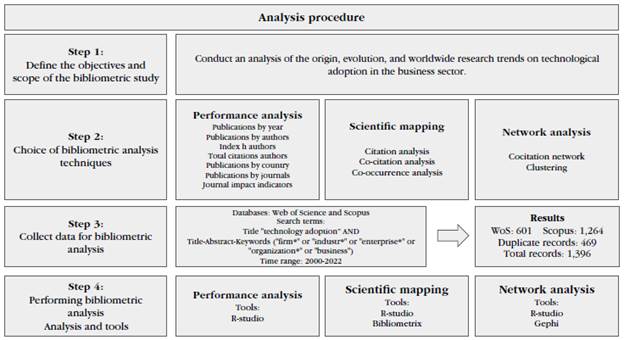
To conduct the scientific mapping of research on technological adoption in the business sector, a search was done on Web of Science (WoS) and Scopus, which are considered the main databases worldwide (Bar-Ilan, 2008; Martín-Martín et al., 2018; Mongeon & Paul-Hus, 2016; Pranckuté, 2021). Comprehensive analysis through both tools allows for a broader overview of knowledge in a specific research area (Echchakoui, 2020; Zhu & Liu, 2020). In the search process, the following terms were used as references: "technology adoption" AND "firm*" or "industr*" or "enterprise*" or "organization*" or "business", considering publications registered between 2000 and 2022. This search generated 1264 records in Scopus and 601 in WoS (consultation date 01/15/2023), which were compared to establish duplicate data (469 records) and thus purify the data source, which in this case was consolidated into 1396 records.
The tools Bibliometrix (Aria & Cuccurullo, 2017) and Gephi (Mathieu et al., 2009) were used for data analysis and visualization. Bibliometrix version 3.1 was employed, which is a free open-access tool with functionalities that allow bibliometric studies, including author co-citation analysis, collaboration network analysis, document co-citation and co-word analysis, as well as facilitating work with different databases (Aria et al., 2020). This tool has been used in various studies (Dervis., 2020; di Vaio et al., 2021; Duque & Oliva, 2022; Homolak et al., 2020; Queiroz et al., 2020), generating reliability in its results. Subsequently, the documents were classified using the metaphorical Tree of Science (TOS) scheme through the ToS tool (Robledo et al., 2022; Valencia-Hernandez et al., 2020; Zuluaga et al., 2022). The scheme has three categories: Seminal documents representing the roots, structural documents representing the trunk, and clusters (current perspectives) representing the branches (Figure 5), allowing for visualization of this field's theoretical evolution.
As for the Gephi software, version 0.9.4 was used, which is a tool for network analysis that allows for a detailed visualization of how the different components of the co-citation network are interconnected, it also allows for the identification of indicators for each element in the network. This application has been used in accordance with previous studies (Donato, 2017; Donthu et al., 2020; Ferguson, 2012; Hurtado & Ortiz, 2022; Jacomy et al., 2014; Meier, 2020; Pineda Guerrero et al., 2021).
The network obtained from the documents found in the databases was divided into clusters, using the clustering algorithm proposed by Blondel et al. (2008), which allows documents to be classified into groups through co-citation analysis, thus establishing the main research fronts in this area (Chen, 2017). Subsequently, impact and relationship metrics such as Indegree (Wallis, 2007), Betweenness Centrality (Freeman, 1977), and PageRank (Page et al., 1999), were calculated for each document. The PageRank identifies the most representative and highest quality documents in each group, considering the citations received from other highly cited documents (Ding et al., 2009; Yan et al., 2010). Finally, using text mining programmed in R with the WordCloud package (Ohri, 2012), the titles and keywords of each work that integrates each cluster were taken to generate the word clouds that facilitate the identification of the topics they contain.
Based on the above, it is important to indicate that the methodological procedure used in this research is based on the structure suggested by Donthu et al. (2021), whose implementation is developed in four (4) stages, which are described in Figure 1. It has also been used in previous studies (Barrera et al., 2022; Castellanos et al., 2022; Duque et al., 2020, 2021; Hoyos et al., 2023; Loaiza et al., 2022; Restrepo et al., 2023; Robledo et al., 2023).
The results presented in Figure 2 show the trend in publications since 2000, segmented by database and calculated as a total after merging the records from the Scopus and WOS databases, considering the removal of duplicates. The trend reflects a steady increase in publications on innovation and technological adoption over the past two decades. This is evidenced by the average number of publications between 2000 and 2023, which has even reached up to 220 publications per year. The acceleration in the trend occurred after 2016, with an average of 111 publications between that year and 2022. Furthermore, approximately one in every two papers was published between 2018 and 2022. These results reflect the relevance of the topic and its current importance, indicating that the scientific and academic community is interested in expanding research in this important area.
Figure 3 graphically displays the journals with the highest number of publications in the field of innovation and technological adoption in organizations. This exercise provides a contrast between the Scopus and WOS databases, as their impact indicators are not homologous. Therefore, it is pertinent to present the individual impact indicators for each journal to provide a more comprehensive and complete view of their impact. The impact indicators of the journals are associated with the JIF (Journal Impact Factor) based on the data indexed in Web of Science Core Collection, the SJR (SCImago Journal Rank) calculated through the information reflected in the Scopus database, as well as the quartile in which they are classified in each database.
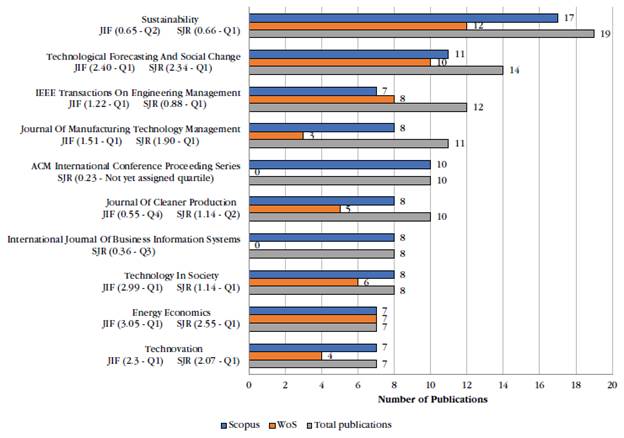
Based on the exercise previously described, it can be determined that the journal with the highest number of publications in the field is the North American journal Sustainability, with a total of 19 records. It is also classified in quartile 1 of both JIF and SJR indices, making it a highly impactful editorial. It is followed by Technological Forecasting and Social Change (a specialized journal in environment and technological factors) with 14 publications. In addition to these two journals, the other eight on the list are renowned journals, as 9 of them are classified in quartile 1 of the SCImago Journal Rank, making them reference journals in global research on innovation and technological adoption.
Table 1 shows the countries with the highest contribution to the field of innovation and technological adoption. Researchers from the United States contribute 393 publications, representing approximately 35.63 % of the global production in the field, followed by China with 132 publications, representing 11.97 %. These two nations are the main powers in the field, and when relating the top 10 most relevant journals in the field (Figure 3) with the country, it is established that 4 are from the United States and 6 from China. This list reveals that contributions to global research on innovation and technological adoption mainly come from these countries. Additionally, other nations such as the United Kingdom, India, Australia, Malaysia, Canada, Indonesia, Italy, and Taiwan contribute to a lesser extent but significantly on a global level.
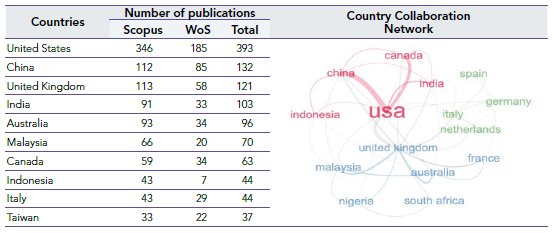
Based on the country collaboration network tool, it can be explained why researchers from the United States and China are the most prolific in terms of scientific production on innovation and technological adoption. This is because the support and collaboration between them are the strongest, with 4 out of every 10 articles published on the topic being authored by researchers from these regions. However, researchers from the United States have the highest number of co-authors from other countries, meaning they have a wider research network, which boosts their production.
Table 2 shows the most prolific authors in the field of innovation and technological adoption, relating their h-index and citations in Scopus and WOS. The author with the highest number of publications in the area is Albert P.C. Chan (The Hong Kong Polytechnic University), who has published a total of 6 articles in these databases, with an h-index of 70 in Scopus. Regarding the author with the highest impact indicators within this list, we find Viswanath Venkatesh from The University of Minnesota, who has an h-index of 65 and a total of 51871 citations in WOS, while in Scopus an h-index of 70 and 69947 citations; only in Scopus, his 5 registered articles report 959 citations, which means an average of more than 191 per article. It is worth noting that 13 out of the 20 authors in this list are affiliated with institutions in the United States, which is consistent with the previous findings.
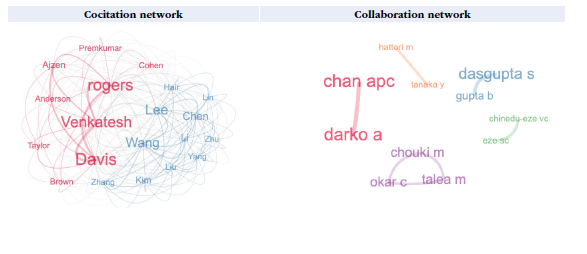
Figure 4 presents the co-citation and collaboration networks of authors. The first one expresses an author's influence within a scientific community through the impact of their research and the degree of referencing it receives. For this case, the five authors with the highest influence and considered seminal authors in innovation and technological adoption are Viswanath Venkatesh (University of Minnesota), Fred D. Davis (Texas Tech University), Everett M. Rogers (Ohio State University), Joseph Wang (University of California), and David Pope Anderson (University of California). The second network associates groups of researchers who have the highest number of publications as co-authors, and it is closely related to Table 2. For example, the group composed of Albert P.C. Chan and Darko A (the authors in positions 1 and 9 in the list of the highest number of publications on the topic) is the most important, as these researchers are co-authors of three articles (registered in the databases), while Chouki M and Okar C have two publications (the authors in positions 1 and 2 in the list of the highest number of publications on the topic). This demonstrates, as in the case of Chan, that collaborative work generates greater productivity.
The co-citation network is generated from records obtained in WoS and Scopus, and for its visualization, the metaphor of the tree of science is employed (Figure 5), where documents are classified into three categories that allow describing the origin, evolution, and trends of research in this area. At the root, seminal, classic, or also known as hegemonic documents are classified, which present the theoretical foundations of the topic. In the trunk, documents known as structural are associated, which connect the classics with the most recent ones, but especially, which begin to define trends in the topic. The classic and structural documents were used to build the theoretical approach of this article. Finally, in the branches, the four main identified clusters are located.
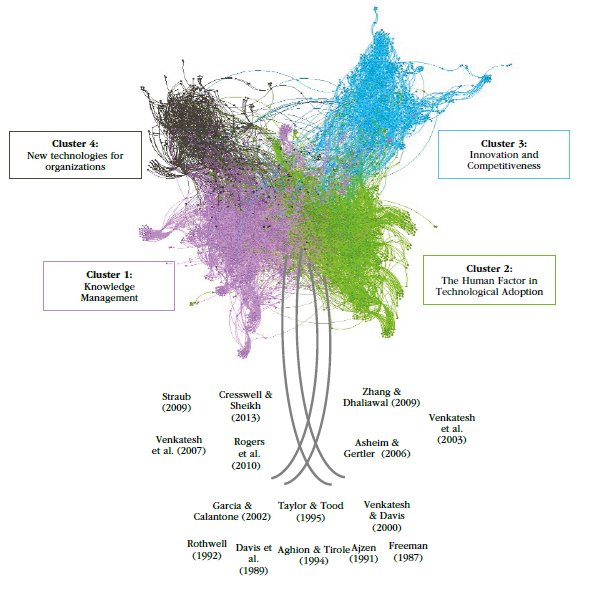
The following is an analysis of the documents representing the branches, where the most recent research lines are identified, determining the emerging sub-areas from the literature.
One of the main research lines in technological adoption in the business sector is Knowledge Management, conceived as the generator of competitive advantages for organizations. Technological adoption brings multiple challenges for organizations, and it is considered that to promote innovation, it should not only focus on R&D but also complementary assets such as the underlying infrastructure (Teece, 1986). In other words, innovation should not be limited to the technological core, but an organizational integration should be proposed that focuses on different internal and external components (Ettlie & Reza, 1992). Therefore, to face the challenges that organizations are exposed to, it is essential to have human capital, an essential factor for individual, business, and socioeconomic growth, as well as for the adoption and adaptation of new technologies (Blundell et al., 1999).
Thus, it is recommended to strengthen the theoretical approaches that allow for the analysis of Knowledge Management in organizations, based on their capacity for resources and human capital with the required skills for this purpose. As a result, organizations can effectively manage knowledge by identifying, capturing, storing, mapping, disseminating, creating, and utilizing it to obtain the most advantageous benefits (Egbu et al., 2005).
However, organizations must strengthen their human capacities to face each challenge in terms of technological adoption, since failing to do so may cause even a leading company to lose not only technological leadership but also market leadership (Alderighi & Feder, 2021). Consequently, it is suggested that organizations carry out education campaigns to increase awareness of the benefits of technology adoption (Andaregie & Astatkie, 2022), since the adoption of technology and human capital are crucial determinants for organizational growth (Skare & Blazevic Buric, 2021).
In line with this, innovation, and particularly new technology, should be associated with the practices of organizations that stimulate employee participation, autonomy, and learning practices. Innovation can be understood as a phenomenon interrelated between working conditions and organizational practices (Mofakhami, 2022). This is considering the human capacity to obtain extraordinary results derived from a specific need, which has generated early adoption of technology and industrialization (Mokyr et al., 2022).
However, to effectively achieve knowledge management within organizations, it is essential to have committed administrators, as training requires specialists with skills that most companies lack, which can be costly (Canhoto & Clear, 2020), However, when directors can identify the potential to add value through new knowledge for the company, it favors decision-making concerning cost-benefit (Merendino et al., 2018).
In the process of technological adoption in organizations, it is essential to analyze the essential factors to achieve objectives and maximize results. In this analysis, it is possible to identify that one of the fundamental factors is the human being as the central axis in all aspects related to its development, adoption, and use.
Initially, it is pertinent to indicate that technology has gradually become a critical source of sustainable competitive advantages in organizations (Kim et al., 2008), and maintaining a competitive advantage in the current market is important for both companies and society (Jensen & Scheraga, 1998). It is worth noting that the advantage is characterized by the magnitude of the impact on the consumer (Mattila, 1999), that is, the results can be evidenced through acceptance and use, starting from its ease of use and utility for users (Morosan & Jeong, 2008).
Consequently, the human-organization-technology synergy should be considered as a general concept that allows to explain the heterogeneity of the incorporation of technology in organizational management (Xu & Lu, 2022), the customer-employee dyad interaction is a vital component in establishing a prosperous relationship based on the interactions that occur within it (Mattila, 1999). Therefore, the human being is not only conceived as an essential factor within the organization but is also relevant as an external factor, since consumer acceptance is the key to technology adoption (Liu et al., 2020).
Based on the previously mentioned, it is necessary to emphasize that the adoption of IT could lead companies to develop a competitive advantage, generating loyalty, brand awareness, brand knowledge, and perceived value in the consumer (Varelas et al., 2021), as long as the basic concept is considered that perceived usefulness is a determining factor for technology usability (Bianchi et al., 2022), meaning that the adoption of new IT must be appealing to the end user, their motivation, and the benefits it generates for them (Jajic et al., 2022).
Finally, organizations must strive to develop new IT, based on the knowledge of the effect it will generate on end users or customers (Licup & Materum, 2021), but for this objective to be successful, conviction and knowledge on the part of employees are necessary to link the synergy between these essential elements.
Currently, organizations face a globalized market and direct competition between companies worldwide. Additionally, they face increasing needs for operational renewal, especially regarding the adoption of innovative technologies that aim to meet the needs of customers, companies, employees, and users in general.
The above discussion shows that there is a wide range of variables that can influence the likelihood of an actor adopting an innovation (Wejnert, 2002), which contributes to the renewal of the company through its dynamic and reciprocal relationship with the competencies of the companies (Danneels, 2002), generating an integration between innovations, administrative, technological and product ideas, enhancing productive capacity (Abrahamson & Rosenkopf, 1997).
Hence, the integration of innovation and the implementation of new information technology are correlated with substantial advancements in the efficiency of operations in intricate industrial settings, as well as with a significant rise in the development of novel products, process enhancement, and exploration of avenues for growth (Xue et al., 2012). This means that products from high-tech industries generally have a strong influence on the abilities of managers to initiate and expand new businesses (Oakey & Cooper, 1991).
Consistent with the aforementioned description, it is presumed that the encouragement of any novel technology, which involves substantial research and development inputs and innovation, is a critical element for maintaining industrial growth in the twenty-first century (Oakey & Cooper, 1991), even facilitating the integration of companies into global value chains and placing them in a higher quality business environment (Vu et al., 2021), therefore, it is evident that companies could respond to market challenges by using new technologies and being more innovative (Nugroho et al., 2022).
It is noteworthy that the implementation of information technologies and the ability to innovate significantly affect organizational performance. However, this impact must be amplified and reinforced by skilled human resources through knowledge management and training programs (Sam' et al., 2022), since success in technology adoption and innovation often requires cooperation between individual actors and organizations. (Bentivoglio et al., 2021).
To conclude, it can be deduced that the adoption of novel technologies can facilitate both organizational efficiency and effectiveness, representing a crucial source of sustained competitive advantage for companies in the long run (Neumeyer et al., 2021). Therefore, entrepreneurs must take advantage of knowledge and technological developments to achieve results that add value to the organization (Ganotakis et al., 2021).
New technologies aim to respond to the solution of the problems and needs organizations are exposed to, generating alternatives that allow them to be more competitive, enhancing their operation, generating new products, attracting new customers, and venturing into new markets.
To illustrate the above, the use of intelligent applications proposed by different technologies such as blockchain and the cloud has strengthened data security processes, access policies, and support data privacy for organizations (Taherizadeh et al., 2018). Furthermore, other studies suggest that blockchain is a highly disruptive technology that could have the ability to reconfigure all aspects of society and its operations (Swan, 2015), which has increased its acceptance and use in large-scale business environments (Woodside et al., 2017).
Likewise, new technologies provide tools to protect organizations from attacks that compromise their security, information, and processes, such as cyber-attacks, which can be controlled with blockchain technology or cloud-based information (Kshetri, 2017). Therefore, it can be affirmed that blockchain technology and cloud-based information are emerging and potentially revolutionary technologies for the processes associated with businesses (Saberi et al., 2019).
Blockchain technology initially sought to solve problems in the financial sector, but thanks to its functionality and security, it has become a very attractive tool for solving problems in the non-financial industries (Crosby et al., 2016). The use of technology is associated with acceptance and its benefits, which in essence are the solutions for the challenges organizations face and its effective contribution to social inclusion in developing countries (Pilkington, 2016).
Nevertheless, the intention to adopt blockchain technology must be accompanied by the issues related to the development of technical capabilities for deployment (Kamble et al., 2019). In other words, to effectively leverage technological adoption and maximize the benefits that come with it, it is necessary to provide training, knowledge management, and technology skill development (Andaregie & Astatkie, 2022).
The bibliometric analysis performed on technological adoption in the business sector reveals fundamental trends and patterns essential for understanding the evolution and impact of this area. By identifying the four main clusters (Knowledge Management, The Human Factor in Technological Adoption, Innovation and Competitiveness, and New Technologies for Organizations), this analysis provides a multidimensional and enriching perspective on the topic.
In the Knowledge Management cluster, the importance of considering knowledge as a strategic resource is highlighted. This approach shows that efficient knowledge management is key to the successful integration of new technologies, which can lead to innovations and strengthen market competitiveness. This understanding directly connects with the Innovation and Competitiveness cluster, which links technological adoption with a company's ability to innovate and remain competitive in a globalized market. The effective integration of new technologies is crucial for improving processes, products, and services, highlighting the interdependence between technological innovation and business success.
In parallel, the Human Factor in Technological Adoption cluster emphasizes that technological success depends on the tools and the acceptance, motivation, and behavior of the individuals involved. This finding highlights the need for people-centered approaches to technology implementation, addressing resistance to change and promoting training and skill development. This human aspect is a cross-cutting element that influences all areas of the technological adoption process.
Finally, the New Technologies for Organizations cluster examines how emerging technologies, from artificial intelligence to blockchain-based solutions, are redefining the business environment. These technologies present unprecedented opportunities to transform organizations, improve security and trust, and contribute to sustainability. This focus on new technologies intertwines with the other clusters, demonstrating how technological innovation is a key driver for knowledge, competitiveness, and human adaptation in the business world.
Together, these clusters offer a comprehensive understanding of the multiple factors interacting with technological adoption in the business sector, highlighting both the challenges and opportunities in this dynamic and constantly evolving field. Moreover, the analysis of these clusters has practical implications. They provide businesses and policymakers with a framework for understanding and addressing the challenges of technological adoption. These findings emphasize the need to implement a holistic approach that focuses not only on technology but also on human and organizational aspects to ensure successful implementation.
This article analyzes the origin, evolution, and research trends on technological adoption globally in the business sector. Bibliometric tools and techniques were used, considering the main databases (WOS and Scopus). Additionally, a scientific mapping was done to identify the most important documents, authors, journals, and countries in the field. Furthermore, the main research fronts in this field were established.
This research has certain limitations. Despite using Scopus and WOS databases as the main sources, which are recognized worldwide, publications that may be relevant in the field but are published in journals that are not indexed in these catalogs were not included in the mapping. In addition, specific bibliometric techniques and the natural bias of researchers can generate limitations in the interpretation of data. Therefore, it is recommended that future research validate the findings presented in this article. The following research, presented in Table 3, agenda arises because of the analysis of the clusters.
| Cluster | Topic | Reference |
|---|---|---|
| Knowledge Management | Establishing the effect of the technological adoption impact on human capital in different contexts and cultures. | (Skare & Blazevic Buric, 2021) |
| Analyzing the relationship between the growth of new technology and the corporate governance processes of organizations. | (Merendino et al., 2018) | |
| The Human Factor in Technological Adoption | Evaluating how the combination of different technologies could generate significant social and climate benefits, such as the combination of Blockchain and Big Data use. | (Liu et al., 2020) (Ezzaouia & Bulchand-Gidumal, 2022) |
| Innovation and Competitiveness | Analyzing how innovation and the transfer of technology affect productivity and competitiveness. | (Rambe & Khaola, 2021) |
| Analyzing the impact of cooperation and the quality of R&D activities of SMES in different contexts. | (Lewandowska, 2021) | |
| New technologies for organizations | Deepening the research on technologies that support security aspects of sensitive data, evaluating the sensitivity to information loss or hacking. | (Taherizadeh et al., 2018) |
| Since blockchain adoption is in its early stages, research should be conducted on blockchain and its evolution of implementation in the supply chain. | (Saberi et al., 2019) |
The scientific community's interest in this field is increasing, as indicated by bibliometric analysis. The journal Sustainability leads in the number of publications, but it is not specialized in technology and innovation topics. On the other hand, Technological Forecasting and Social Change is the second journal with the most publications and it focuses on these topics. As for countries, the United States leads global research because influential authors such as Viswanath Venkatesh, Everett M. Rogers, and Fred D. Davis are associated with universities in this country.
The review of the documents shows that organizations are constantly exposed to multiple challenges to achieve greater competitiveness, improve their products' quality, reduce costs, and generate customer satisfaction. An essential factor in addressing these challenges is innovation and technological adoption, as it enables them to strengthen their operations, maximize profitability, and generate positive impacts on society in terms of environmental sustainability. Furthermore, the literature agrees that human beings are central to all aspects related to the development, adoption, and use of technology. Therefore, the implementation and use of technology are based on individual and collective acceptance, motivation, and behavior.
Knowledge management is perceived as the generator of competitive advantages for organizations, in which human capital is the differentiating factor. Thus, organizations must promote investment in R&D to strengthen this competitive advantage. Additionally, it is essential to consider that new technologies bring significant benefits to organizations in terms of productivity, security, and trust. However, these benefits transcend organizations, as they also generate positive impacts related to social, environmental, and climate factors. Therefore, organizations must effectively leverage technological developments to maximize these benefits, starting with training, knowledge management, and the development of technological skills.
Finally, it is pertinent to indicate that there is a direct relationship between investment in R&D and countries' productivity and competitiveness. Therefore, national governments must modify their trade, industrial, and governmental policies to favor investment in R&D in organizations. This is based on the fact that the adoption of new technologies contributes to organizational effectiveness and is a key source of long-term competitive advantage for companies.
Abrahamson, E., & Rosenkopf, L. (1997). Social network effects on the extent of innovation diffusion: A computer simulation. Organization Science, 8(3), 289-309. https://doi.org/10.1287/orsc.8.3.289
E. Abrahamson L Rosenkopf 1997Social network effects on the extent of innovation diffusion: A computer simulationOrganization Science83289309https://doi.org/10.1287/orsc.8.3.289
Aghion, P., & Tirole, J. (1994). The management of innovation. The Quarterly Journal of Economics, 109(4), 1185-1209. https://doi.org/10.2307/2118360
P. Aghion J Tirole 1994The management of innovationThe Quarterly Journal of Economics109411851209https://doi.org/10.2307/2118360
Ajzen, I. (1991). The theory of planned behavior. Organizational Behavior and Human Decision Processes, 50(2), 179-211. https://doi.org/10.1016/0749-5978(91)90020-T
I Ajzen 1991The theory of planned behaviorOrganizational Behavior and Human Decision Processes502179211https://doi.org/10.1016/0749-5978(91)90020-T
Alderighi, M., & Feder, C. (2021). Snobby markets and technology adoption. Economics of Innovation and New Technology, 30(6), 603-620. https://doi.org/10.1080/10438599.2020.1741945
M. Alderighi C Feder 2021Snobby markets and technology adoptionEconomics of Innovation and New Technology306603620https://doi.org/10.1080/10438599.2020.1741945
Andaregie, A., & Astatkie, T. (2022). Determinants of technology adoption by micro and small enterprises (MSES) in Awi zone, Northwest Ethiopia. African Journal of Science, Technology, Innovation and Development, 14(4), 997-1006. https://doi.org/10.1080/20421338.2021.1923385
A. Andaregie T Astatkie 2022Determinants of technology adoption by micro and small enterprises (MSES) in Awi zone, Northwest EthiopiaAfrican Journal of Science, Technology, Innovation and Development1449971006https://doi.org/10.1080/20421338.2021.1923385
Aria, M., & Cuccurullo, C. (2017). bibliometrix: An R-tool for comprehensive science mapping analysis. Journal of Informetrics, 11(4), 959-975. https://doi.org/10.1016/j.joi.2017.08.007
M. Aria C Cuccurullo 2017bibliometrix: An R-tool for comprehensive science mapping analysisJournal of Informetrics114959975https://doi.org/10.1016/j.joi.2017.08.007
Aria, M., Misuraca, M., & Spano, M. (2020). Mapping the evolution of social research and data science on 30 years of social indicators research. Social Indicators Research, 149(3), 803831. https://doi.org/10.1007/s11205-020-02281-3
M. Aria M. Misuraca M Spano 2020Mapping the evolution of social research and data science on 30 years of social indicators researchSocial Indicators Research1493803831803831https://doi.org/10.1007/s11205-020-02281-3
Asheim, B. T., & Gertler, M. S. (2006). The geography of innovation: Regional innovation systems. In J. Fagerberg, & D. C. Mowery (Eds.), The Oxford handbook of innovation (pp. 291-317). Oxford University Press. https://doi.org/10.1093/oxfordhb/9780199286805.003.0011
B. T. Asheim M. S Gertler 2006The geography of innovation: Regional innovation systems J Fagerberg D. C. Mowery The Oxford handbook of innovation291317Oxford University Presshttps://doi.org/10.1093/oxfordhb/9780199286805.003.0011
Bar-Ilan, J. (2008). Which h-index? - A comparison of WoS, Scopus and Google Scholar. Scientometrics, 74(2), 257-271. https://doi.org/10.1007/s11192-008-0216-y
J Bar-Ilan 2008Which h-index? - A comparison of WoS, Scopus and Google ScholarScientometrics742257271https://doi.org/10.1007/s11192-008-0216-y
Barrera, A., Duque, J., & Jaime, A. V. (2022). Actor engagement: origin, evolution and trends. Journal of Business & Industrial Marketing, 38(7), 1479-1497. https://doi.org/10.1108/JBIM-11-2021-0512
A. Barrera J. Duque A. V Jaime 2022Actor engagement: origin, evolution and trendsJournal of Business & Industrial Marketing38714791497https://doi.org/10.1108/JBIM-11-2021-0512
Bastian, M., Heymann, S., & Jacomy, M. (2009). Gephi: An open source software for exploring and manipulating networks. Proceedings of the International AAAI Conference on Weblogs and Social Media, 3(1), 361-362. https://doi.org/10.1609/icwsm.v3i1.13937
M. Bastian S. Heymann M Jacomy 2009Gephi: An open source software for exploring and manipulating networksProceedings of the International AAAI Conference on Weblogs and Social Media31361362https://doi.org/10.1609/icwsm.v3i1.13937
Bentivoglio, D., Bucci, G., Belletti, M., & Finco, A. (2021). A theoretical framework on network's dynamics for precision agriculture technologies adoption. Revista de Economia e Sociologia Rural, 60(4). https://doi.org/10.1590/1806-9479.2021.245721
D. Bentivoglio G. Bucci M. Belletti A Finco 2021A theoretical framework on network's dynamics for precision agriculture technologies adoptionRevista de Economia e Sociologia Rural604https://doi.org/10.1590/1806-9479.2021.245721
Bianchi, C., Tuzovic, S., & Kuppelwieser, V. G. (2022). Investigating the drivers of wearable technology adoption for healthcare in South America. Information Technology & People, 36(2), 916-939. https://doi.org/10.1108/ITP-01-2021-0049
C. Bianchi S. Tuzovic V. G Kuppelwieser 2022Investigating the drivers of wearable technology adoption for healthcare in South AmericaInformation Technology & People362916939https://doi.org/10.1108/ITP-01-2021-0049
Blondel, V. D., Guillaume, J.-L., Lambiotte, R., & Lefebvre, E. (2008). Fast unfolding of communities in large networks. Journal of Statistical Mechanics: Theory and Experiment (10), P10008. https://doi.org/10.1088/1742-5468/2008/10/p10008
V. D. Blondel J.-L. Guillaume R. Lambiotte E Lefebvre 2008Fast unfolding of communities in large networksJournal of Statistical Mechanics: Theory and Experiment10P10008P10008https://doi.org/10.1088/1742-5468/2008/10/p10008
Blundell, R., Dearden, L., Meghir, C., & Sianesi, B. (1999). Human capital investment: The returns from education and training to the individual, the firm and the economy. Fiscal Studies, 20(1), 1-23. https://doi.org/10.1111/j.1475-5890.1999.tb00001.x
R. Blundell L. Dearden C. Meghir B Sianesi 1999Human capital investment: The returns from education and training to the individual, the firm and the economyFiscal Studies201123https://doi.org/10.1111/j.1475-5890.1999.tb00001.x
Bolatan, G. I. S., Giadedi, A., & Daim, T. U. (2022). Exploring acquiring technologies: Adoption, adaptation, and knowledge management. IEEE Transactions on Engineering Management, 71, 1-9. https://doi.org/10.1109/TEM.2022.3168901
G. I. S. Bolatan A. Giadedi T. U Daim 2022Exploring acquiring technologies: Adoption, adaptation, and knowledge managementIEEE Transactions on Engineering Management7119https://doi.org/10.1109/TEM.2022.3168901
Callon, M., Courtial, J.-P., Turner, W. A., & Bauin, S. (1983). From translations to problematic networks: An introduction to co-word analysis. Social Sciences Information. Information Sur Les Sciences Sociales, 22(2), 191-235. https://doi.org/10.1177/053901883022002003
M. Callon J.-P. Courtial W. A. Turner S Bauin 1983From translations to problematic networks: An introduction to co-word analysisSocial Sciences Information. Information Sur Les Sciences Sociales222191235https://doi.org/10.1177/053901883022002003
Canhoto, A. I., & Clear, F. (2020). Artificial intelligence and machine learning as business tools: A framework for diagnosing value destruction potential. Business Horizons, 63(2), 183-193. https://doi.org/10.1016/j.bushor.2019.11.003
A. I. Canhoto F Clear 2020Artificial intelligence and machine learning as business tools: A framework for diagnosing value destruction potentialBusiness Horizons632183193https://doi.org/10.1016/j.bushor.2019.11.003
Castellanos, J. D. G., Hurtado, P. L. D., Barahona, L., & Peña, E. (2022). Marco de referencia y tendencias de investigación de economía colaborativa. Revista En-contexto, 10(16), 267-292. https://doi.org/10.53995/23463279.1159
J. D. G. Castellanos P. L. D. Hurtado L. Barahona E Peña 2022Marco de referencia y tendencias de investigación de economía colaborativaRevista En-contexto1016267292https://doi.org/10.53995/23463279.1159
Chen, C. (1999). Visualising semantic spaces and author co-citation networks in digital libraries. Information Processing & Management, 35(3), 401-420. https://doi.org/10.1016/S0306-4573(98)00068-5
C Chen 1999Visualising semantic spaces and author co-citation networks in digital librariesInformation Processing & Management353401420https://doi.org/10.1016/S0306-4573(98)00068-5
Chen, C. (2017). Science mapping: A systematic review of the literature. Journal of Data and Information Science. https://par.nsf.gov/servlets/purl/10063059
C Chen 2017Science mapping: A systematic review of the literatureJournal of Data and Information Sciencehttps://par.nsf.gov/servlets/purl/10063059
Cresswell, K., & Sheikh, A. (2013). Organizational issues in the implementation and adoption of health information technology innovations: An interpretative review. International Journal of Medical Informatics, 82(5), e73-e86. https://doi.org/10.1016/j.ijmedinf.2012.10.007
K. Cresswell A Sheikh 2013Organizational issues in the implementation and adoption of health information technology innovations: An interpretative reviewInternational Journal of Medical Informatics825e73e86https://doi.org/10.1016/j.ijmedinf.2012.10.007
Crosby, M., Pattanayak, P., & Verma, S. (2016). Blockchain technology: Beyond bitcoin. Applied, (2), 6-19. https://j2-capital.com/wp-content/uploads/2017/11/AIR-2016-Blockchain.pdf
M. Crosby P. Pattanayak S Verma 2016Blockchain technology: Beyond bitcoinApplied2619https://j2-capital.com/wp-content/uploads/2017/11/AIR-2016-Blockchain.pdf
Danneels, E. (2002). The dynamics of product innovation and firm competences. Strategic Management Journal, 23(12), 1095-1121. https://doi.org/10.1002/smj.275
E Danneels 2002The dynamics of product innovation and firm competencesStrategic Management Journal231210951121https://doi.org/10.1002/smj.275
Davis, F. D., Bagozzi, R. P., & Warshaw, P. R. (1989). User acceptance of computer technology: A comparison of two theoretical models. Management Science, 35(8), 982-1003. https://doi.org/10.1287/mnsc.35.8.982
F. D. Davis R. P. Bagozzi P. R Warshaw 1989User acceptance of computer technology: A comparison of two theoretical modelsManagement Science3589821003https://doi.org/10.1287/mnsc.35.8.982
Dervis., H. (2020). Bibliometric analysis using Bibliometrix an R Package. Journal of Scientometric Research, 8(3), 156-160. https://doi.org/10.5530/jscires.8.3.32
H Dervis. 2020Bibliometric analysis using Bibliometrix an R PackageJournal of Scientometric Research83156160https://doi.org/10.5530/jscires.8.3.32
Ding, Y., Yan, E., Frazho, A., & Caverlee, J. (2009). PageRank for ranking authors in co-citation networks. Journal of the American Society for Information Science and Technology, 60(11), 2229-2243. https://doi.org/10.1002/asi.21171
Y. Ding E. Yan A. Frazho J. Caverlee 2009PageRank for ranking authors in co-citation networksJournal of the American Society for Information Science and Technology601122292243https://doi.org/10.1002/asi.21171
Di Vaio, A., Palladino, R., Pezzi, A., & Kalisz, D. E. (2021). The role of digital innovation in knowledge management systems: A systematic literature review. Journal of Business Research, 123, 220-231. https://doi.org/10.1016/j.jbusres.2020.09.042
A. Di Vaio R. Palladino A. Pezzi D. E Kalisz 2021The role of digital innovation in knowledge management systems: A systematic literature reviewJournal of Business Research123220231https://doi.org/10.1016/j.jbusres.2020.09.042
Donato, V. (2017). Towards design process validation integrating graph theory into BIM. Architectural Engineering and Design Management, 13(1), 22-38. https://doi.org/10.1080/17452007.2016.1208602
V Donato 2017Towards design process validation integrating graph theory into BIMArchitectural Engineering and Design Management1312238https://doi.org/10.1080/17452007.2016.1208602
Donthu, N., Kumar, S., Mukherjee, D., Pandey, N., & Lim, W. M. (2021). How to conduct a bibliometric analysis: An overview and guidelines. Journal of Business Research, 133, 285-296. https://doi.org/10.1016/j.jbusres.2021.04.070
N. Donthu S. Kumar D. Mukherjee N. Pandey W. M Lim 2021How to conduct a bibliometric analysis: An overview and guidelinesJournal of Business Research133285296https://doi.org/10.1016/j.jbusres.2021.04.070
Donthu, N., Kumar, S., & Pattnaik, D. (2020). Forty-five years of Journal of Business Research: A bibliometric analysis. Journal of Business Research, 109, 1-14. https://doi.org/10.1016/J.jbusres.2019.10.039
N. Donthu S. Kumar D Pattnaik 2020Forty-five years of Journal of Business Research: A bibliometric analysisJournal of Business Research109114https://doi.org/10.1016/J.jbusres.2019.10.039
Duque, P., Meza, O. E., Giraldo, D., & Barreto, K. (2021). Economía social y economía solidaria: un análisis bibliométrico y revisión de literatura. REYESCO. Revista de Estudios Cooperativos, 138, e75566. https://doi.org/10.5209/reve.75566
P. Duque O. E. Meza D. Giraldo K Barreto 2021Economía social y economía solidaria: un análisis bibliométrico y revisión de literaturaREYESCO. Revista de Estudios Cooperativos138e75566https://doi.org/10.5209/reve.75566
Duque, P., & Oliva, E. J. D. (2022). Tendencias emergentes en la literatura sobre el compromiso del cliente: un análisis bibliométrico. Estudios Gerenciales, 38(162), 120-132. https://doi.org/10.18046/j.estger.2022.162.4528
P. Duque E. J. D Oliva 2022Tendencias emergentes en la literatura sobre el compromiso del cliente: un análisis bibliométricoEstudios Gerenciales38162120132https://doi.org/10.18046/j.estger.2022.162.4528
Duque, P., Samboni, V., Castro, M., Montoya, L. A., & Montoya, I. A. (2020). Neuromarketing: Its current status and research perspectives. Estudios Gerenciales, 36(157), 525-539. https://doi.org/10.18046/j.estger.2020.157.3890
P. Duque V. Samboni M. Castro L. A. Montoya I. A Montoya 2020Neuromarketing: Its current status and research perspectivesEstudios Gerenciales36157525539https://doi.org/10.18046/j.estger.2020.157.3890
Echchakoui, S. (2020). Why and how to merge Scopus and Web of Science during bibliome-tric analysis: the case of sales force literature from 1912 to 2019. Journal of Marketing Analytics, 8(3), 165-184. https://doi.org/10.1057/s41270-020-00081-9
S. Echchakoui 2020Why and how to merge Scopus and Web of Science during bibliome-tric analysis: the case of sales force literature from 1912 to 2019.Journal of Marketing Analytics83165184https://doi.org/10.1057/s41270-020-00081-9
Egbu, C. O., Hari, S., & Renukappa, S. H. (2005). Knowledge management for sustainable competitiveness in small and medium surveying practices. Structural Survey, 23(1), 7-21. https://doi.org/10.1108/02630800510586871
C. O. Egbu S. Hari S. H Renukappa 2005Knowledge management for sustainable competitiveness in small and medium surveying practicesStructural Survey231721https://doi.org/10.1108/02630800510586871
Ettlie, J. E., & Reza, E. M. (1992). Organizational integration and process innovation. Academy of Management Journal, 35(4), 795-827. https://www.jstor.org/stable/256316
J. E. Ettlie E. M Reza 1992Organizational integration and process innovationAcademy of Management Journal354795827https://www.jstor.org/stable/256316
Ezzaouia, I., & Bulchand-Gidumal, J. (2022). The impact of information technology adoption on hotel performance: Evidence from a developing country. Journal of Quality Assurance in Hospitality & Tourism, 24(5), 1-23. https://doi.org/10.1080/1528008X.2022.2077886
I. Ezzaouia J Bulchand-Gidumal 2022The impact of information technology adoption on hotel performance: Evidence from a developing countryJournal of Quality Assurance in Hospitality & Tourism245123https://doi.org/10.1080/1528008X.2022.2077886
Ferguson, R. (2012). Learning analytics: Drivers, developments and challenges. International Journal of Technology Enhanced Learning, 4(5-6), 304. https://doi.org/10.1504/IJTEL.2012.051816
R Ferguson 2012Learning analytics: Drivers, developments and challengesInternational Journal of Technology Enhanced Learning45-6304304https://doi.org/10.1504/IJTEL.2012.051816
Freeman, C. (1987). Technical innovation, diffusion, and long cycles of economic development. In T. Vasco (Ed.), The Long-Wave Debate (pp. 295-309). Springer Berlin Heidelberg. https://doi.org/10.1007/978-3-662-10351-7_21
C Freeman 1987Technical innovation, diffusion, and long cycles of economic development T Vasco The Long-Wave Debate295309Springer Berlin Heidelberghttps://doi.org/10.1007/978-3-662-10351-7_21
Freeman, L. C. (1977). A set of measures of centrality based on betweenness. Sociometry, 40(1), 35-41. https://doi.org/10.2307/3033543
L. C Freeman 1977A set of measures of centrality based on betweennessSociometry4013541https://doi.org/10.2307/3033543
Ganotakis, P., D'Angelo, A., & Konara, P. (2021). From latent to emergent entrepreneurship: The role of human capital in entrepreneurial founding teams and the effect of external knowledge spillovers for technology adoption. Technological Forecasting and Social Change, 170, 120912. https://doi.org/10.1016/j.techfore.2021.120912
P. Ganotakis A. D'Angelo P Konara 2021From latent to emergent entrepreneurship: The role of human capital in entrepreneurial founding teams and the effect of external knowledge spillovers for technology adoptionTechnological Forecasting and Social Change170120912120912https://doi.org/10.1016/j.techfore.2021.120912
García, R., & Calantone, R. (2002). A critical look at technological innovation typology and innovativeness terminology: A literature review. The Journal of Product Innovation Management, 19(2), 110-132. https://doi.org/10.1111/1540-5885.1920110
R. García R Calantone 2002A critical look at technological innovation typology and innovativeness terminology: A literature reviewThe Journal of Product Innovation Management192110132https://doi.org/10.1111/1540-5885.1920110
Garfield, E. (1955). Citation indexes for science: A new dimension in documentation through association of ideas. Science, 122(3159), 108-111. https://doi.org/10.1126/scien-ce.122.3159.108
E Garfield 1955Citation indexes for science: A new dimension in documentation through association of ideasScience1223159108111https://doi.org/10.1126/scien-ce.122.3159.108
Ghobakhloo, M., Iranmanesh, M., Vilkas, M., Grybauskas, A., & Amran, A. (2022). Drivers and barriers of Industry 4.0 technology adoption among manufacturing SMEs: a systematic review and transformation roadmap. International Journal of Manufacturing Technology and Management, 33(6), 1029-1058. https://doi.org/10.1108/JMTM-12-2021-0505
M. Ghobakhloo M. Iranmanesh M. Vilkas A. Grybauskas A. Amran 2022Drivers and barriers of Industry 4.0 technology adoption among manufacturing SMEs: a systematic review and transformation roadmapInternational Journal of Manufacturing Technology and Management33610291058https://doi.org/10.1108/JMTM-12-2021-0505
Han, X., & Rani, P. (2022). Evaluate the barriers of blockchain technology adoption in sustainable supply chain management in the manufacturing sector using a novel Pythagorean ffuzzy-cRmc-CoCoSo approach. Operations Management Research, 15, 725-742. https://doi.org/10.1007/s12063-021-00245-5
X. Han P Rani 2022Evaluate the barriers of blockchain technology adoption in sustainable supply chain management in the manufacturing sector using a novel Pythagorean ffuzzy-cRmc-CoCoSo approachOperations Management Research15725742https://doi.org/10.1007/s12063-021-00245-5
Herman, I., Melancon, G., & Marshall, M. S. (2000). Graph visualization and navigation in information visualization: A survey. IEEE Transactions on Visualization and Computer Graphics, 6(1), 24-43. https://doi.org/10.1109/2945.841119
I. Herman G. Melancon M. S Marshall 2000Graph visualization and navigation in information visualization: A surveyIEEE Transactions on Visualization and Computer Graphics612443https://doi.org/10.1109/2945.841119
Hirsch, J. E. (2005). An index to quantify an individual's scientific research output. Proceedings of the National Academy of Sciences of the United States of America, 102(46), 16569-16572. https://doi.org/10.1073/pnas.0507655102
J. E Hirsch 2005An index to quantify an individual's scientific research outputProceedings of the National Academy of Sciences of the United States of America102461656916572https://doi.org/10.1073/pnas.0507655102
Homolak, J., Kodvanj, I., & Virag, D. (2020). Preliminary analysis of covro-19 academic information patterns: a call for open science in the times of closed borders. Scientometrics , 124(3), 2687-2701. https://doi.org/10.1007/s11192-020-03587-2
J. Homolak I. Kodvanj D Virag 2020Preliminary analysis of covro-19 academic information patterns: a call for open science in the times of closed bordersScientometrics124326872701https://doi.org/10.1007/s11192-020-03587-2
Hooks, D., Davis, Z., Agrawal, V., & Li, Z. (2022). Exploring factors influencing technology adoption rate at the macro level: A predictive model. Technology in Society, 68, 101826. https://doi.org/10.1016/j.techsoc.2021.101826
D. Hooks Z. Davis V. Agrawal Z Li 2022Exploring factors influencing technology adoption rate at the macro level: A predictive modelTechnology in Society68101826101826https://doi.org/10.1016/j.techsoc.2021.101826
Hoyos, O., Castro Duque, M., León, N. T., Salazar, D. T., Montoya-Restrepo, L. A., Montoya-Restrepo, I. A., & Duque, P. (2023). Gobierno corporativo y desarrollo sostenible: un análisis bibliométrico. Revista CEA, 9(19), e2190. https://doi.org/10.22430/24223182.2190
O. Hoyos M. Castro Duque N. T. León D. T. Salazar L. A. Montoya-Restrepo I. A. Montoya-Restrepo P Duque 2023Gobierno corporativo y desarrollo sostenible: un análisis bibliométricoRevista CEA919e2190https://doi.org/10.22430/24223182.2190
Hurtado, P. D., & Ortiz, D. O. (2022). Perspectivas y tendencias de investigación en emprendimiento social. Desarrollo Gerencial, 14(1), 1-26. https://doi.org/10.17081/dege.14.1.5082
P. D. Hurtado D. O Ortiz 2022Perspectivas y tendencias de investigación en emprendimiento socialDesarrollo Gerencial141126https://doi.org/10.17081/dege.14.1.5082
Jacomy, M., Venturini, T., Heymann, S., & Bastian, M. (2014). ForceAtlas2, a continuous graph layout algorithm for handy network visualization designed for the Gephi software. PloS One, 9(6), e98679. https://doi.org/10.1371/journal.pone.0098679
M. Jacomy T. Venturini S. Heymann M Bastian 2014ForceAtlas2, a continuous graph layout algorithm for handy network visualization designed for the Gephi softwarePloS One96e98679https://doi.org/10.1371/journal.pone.0098679
JajiC, I., SpremiC, M., & Miloloza, I. (2022). Behavioural intention determinants of augmented reality technology adoption in supermarkets/hypermarkets. International Journal of E-Services and Mobile Applications (IJESMA), 14(1), 1-22. https://doi.org/10.4018/IJESMA.289632
I. JajiC M. SpremiC I Miloloza 2022Behavioural intention determinants of augmented reality technology adoption in supermarkets/hypermarketsInternational Journal of E-Services and Mobile Applications (IJESMA)141122https://doi.org/10.4018/IJESMA.289632
Jalil, M. F., Ali, A., & Kamarulzaman, R. (2021). Does innovation capability improve SME performance in Malaysia? The mediating effect of technology adoption. The International Journal of Entrepreneurship and Innovation, 23(4), 253-267. https://doi.org/10.1177/14657503211048967
M. F. Jalil A. Ali R Kamarulzaman 2021Does innovation capability improve SME performance in Malaysia? The mediating effect of technology adoptionThe International Journal of Entrepreneurship and Innovation234253267https://doi.org/10.1177/14657503211048967
Jensen, O. W., & Scheraga, C. A. (1998). Transferring technology: Costs and benefits. Technology in Society, 20(1), 99-112. https://doi.org/10.1016/S0160-791X(97)00031-6
O. W. Jensen C. A Scheraga 1998Transferring technology: Costs and benefitsTechnology in Society20199112https://doi.org/10.1016/S0160-791X(97)00031-6
Kamble, S., Gunasekaran, A., & Arha, H. (2019). Understanding the blockchain technology adoption in supply chains-Indian context. International Journal of Production Research, 57(7), 2009-2033. https://doi.org/10.1080/00207543.2018.1518610
S. Kamble A. Gunasekaran H Arha 2019Understanding the blockchain technology adoption in supply chains-Indian contextInternational Journal of Production Research57720092033https://doi.org/10.1080/00207543.2018.1518610
Karuppiah, K., Sankaranarayanan, B., D'Adamo, I., & Mithun, A. S. (2022). Evaluation of key factors for industry 4.0 technologies adoption in small and medium enterprises (SMES): an emerging economy context. Journal of Asia Business Studies, 17(2), 347-370. https://doi.org/10.1108/JABS-05-2021-0202
K. Karuppiah B. Sankaranarayanan I. D'Adamo A. S Mithun 2022Evaluation of key factors for industry 4.0 technologies adoption in small and medium enterprises (SMES): an emerging economy contextJournal of Asia Business Studies172347370https://doi.org/10.1108/JABS-05-2021-0202
Kim, T. G., Lee, J. H., & Law, R. (2008). An empirical examination of the acceptance behaviour of hotel front office systems: An extended technology acceptance model. Tourism Management, 29(3), 500-513. https://doi.org/10.1016/j.tourman.2007.05.016
T. G. Kim J. H. Lee R Law 2008An empirical examination of the acceptance behaviour of hotel front office systems: An extended technology acceptance modelTourism Management293500513https://doi.org/10.1016/j.tourman.2007.05.016
Kshetri, N. (2017). Can blockchain strengthen the Internet of things? IT Professional, 19(4), 68-72. https://doi.org/10.1109/MITP.2017.3051335
N Kshetri 2017Can blockchain strengthen the Internet of things?IT Professional1946872https://doi.org/10.1109/MITP.2017.3051335
Lewandowska, A. (2021). Interactions between investments in innovation and SME competitiveness in the peripheral regions. Journal of Intercultural Studies , 14(1), 285-307. https://doi.org/10.14254/2071-8330.2021/14-1/20
A Lewandowska 2021Interactions between investments in innovation and SME competitiveness in the peripheral regionsJournal of Intercultural Studies141285307https://doi.org/10.14254/2071-8330.2021/14-1/20
Leydesdorff, L. (1987). Various methods for the mapping of science. Scientometrics , 11 (5), 295-324. https://doi.org/10.1007/BF02279351
L Leydesdorff 1987Various methods for the mapping of scienceScientometrics115295324https://doi.org/10.1007/BF02279351
Licup, R. J. M., & Materum, L. (2021). A framework understanding organizational culture and sustainability towards technology adoption with the aid of management information systems in the telecommunications sector. Journal of Engineering Science and Technology Special Issue on ACSAT, (5), 41-56. http://jestec.taylors.edu.my/Special%20Issue%20I%20 ACSAT%202021/ACSAT%2021_1_4.pdf
R. J. M. Licup L Materum 2021A framework understanding organizational culture and sustainability towards technology adoption with the aid of management information systems in the telecommunications sectorJournal of Engineering Science and Technology Special Issue on ACSAT54156http://jestec.taylors.edu.my/Special%20Issue%20I%20 ACSAT%202021/ACSAT%2021_1_4.pdf
Liu, C., Rouse, W. B., & Belanger, D. (2020). Understanding risks and opportunities of autonomous vehicle technology adoption through systems dynamic scenario modeling-The American insurance industry. IEEE Systems Journal, 14(1), 1365-1374. https://doi.org/10.1109/JSYST.2019.2913647
C. Liu W. B. Rouse D Belanger 2020Understanding risks and opportunities of autonomous vehicle technology adoption through systems dynamic scenario modeling-The American insurance industryIEEE Systems Journal14113651374https://doi.org/10.1109/JSYST.2019.2913647
Loaiza, Y., Olga, P. M., & Duque, P. (2022). ¿Qué novedades hay en la investigación sobre metacognición? Respuestas de acuerdo con la literatura actual. Educación y Educadores, 25(3), e2535. https://doi.org/10.5294/edu.2022.25.3.5
Y. Loaiza P. M. Olga P Duque 2022¿Qué novedades hay en la investigación sobre metacognición? Respuestas de acuerdo con la literatura actualEducación y Educadores253e2535https://doi.org/10.5294/edu.2022.25.3.5
Martín-Martín, A., Orduna-Malea, E., Thelwall, M., & Delgado López-Cózar, E. (2018). Google Scholar, Web of Science, and Scopus: A systematic comparison of citations in 252 subject categories. Journal of Informetrics, 12(4), 1160-1177. https://doi.org/10.1016/j.joi.2018.09.002
A. Martín-Martín E. Orduna-Malea M. Thelwall E Delgado López-Cózar 2018Google Scholar, Web of Science, and Scopus: A systematic comparison of citations in 252 subject categoriesJournal of Informetrics12411601177https://doi.org/10.1016/j.joi.2018.09.002
Mattila, A. S. (1999). The role of culture and purchase motivation in service encounter evaluations. Journal of Professional Services Marketing, 13(4/5), 376-389. https://doi.org/10.1108/08876049910282655
A. S Mattila 1999The role of culture and purchase motivation in service encounter evaluationsJournal of Professional Services Marketing134/5376389https://doi.org/10.1108/08876049910282655
Meier, F. (2020). Social network analysis as a tool for data analysis and visualization in information behaviour and interactive information retrieval research. Proceedings of the 2020 Conference on Human Information Interaction and Retrieval, 10, 477-480. https://doi.org/10.1145/3343413.3378018
F Meier 2020Social network analysis as a tool for data analysis and visualization in information behaviour and interactive information retrieval researchProceedings of the 2020 Conference on Human Information Interaction and Retrieval10477480https://doi.org/10.1145/3343413.3378018
Merendino, A., Dibb, S., Meadows, M., Quinn, L., Wilson, D., Simkin, L., & Canhoto, A. (2018). Big data, big decisions: The impact of big data on board level decision-making. Journal of Business Research, 93, 67-78. https://doi.org/10.1016/j.jbusres.2018.08.029
A. Merendino S. Dibb M. Meadows L. Quinn D. Wilson L. Simkin A Canhoto 2018Big data, big decisions: The impact of big data on board level decision-makingJournal of Business Research936778https://doi.org/10.1016/j.jbusres.2018.08.029
Mofakhami, M. (2022). Is innovation good for European workers? Beyond the employment destruction/creation effects, technology adoption affects the working conditions of European workers. Journal of the Knowledge Economy, 13(3), 2386-2430. https://doi.org/10.1007/s13132-021-00819-5
M Mofakhami 2022Is innovation good for European workers? Beyond the employment destruction/creation effects, technology adoption affects the working conditions of European workersJournal of the Knowledge Economy13323862430https://doi.org/10.1007/s13132-021-00819-5
Mokyr, J., Sarid, A., & van der Beek, K. (2022). The wheels of change: Technology adoption, millwrights and the persistence in Britain'S industrialisation. The Economic Journal, 132(645), 1894-1926. https://doi.org/10.1093/ej/ueab102
J. Mokyr A. Sarid K van der Beek 2022The wheels of change: Technology adoption, millwrights and the persistence in Britain'S industrialisationThe Economic Journal13264518941926https://doi.org/10.1093/ej/ueab102
Mongeon, P., & Paul-Hus, A. (2016). The journal coverage of Web of Science and Scopus: a comparative analysis. Scientometrics , 106(1), 213-228. https://doi.org/10.1007/s11192-015-1765-5
P. Mongeon A Paul-Hus 2016The journal coverage of Web of Science and Scopus: a comparative analysisScientometrics1061213228https://doi.org/10.1007/s11192-015-1765-5
Morawiec, P., & Sottysik-Piorunkiewicz, A. (2022). Cloud computing, big data, and blockchain technology adoption in ERP implementation methodology. Sustainability: Science Practice and Policy, 14(7), 3714. https://doi.org/10.3390/su14073714
P. Morawiec A Sottysik-Piorunkiewicz 2022Cloud computing, big data, and blockchain technology adoption in ERP implementation methodologySustainability: Science Practice and Policy14737143714https://doi.org/10.3390/su14073714
Morosan, C., & Jeong, M. (2008). Users' perceptions of two types of hotel reservation web sites. International Journal of Hospitality Management, 27(2), 284-292. https://doi.org/10.1016/j.ijhm.2007.07.023
C. Morosan M Jeong 2008Users' perceptions of two types of hotel reservation web sitesInternational Journal of Hospitality Management272284292https://doi.org/10.1016/j.ijhm.2007.07.023
Naghshineh, B., & Carvalho, H. (2022). The implications of additive manufacturing technology adoption for supply chain resilience: A systematic search and review. International Journal of Production Economics, 247, 108387. https://doi.org/10.1016/j.ijpe.2021.108387
B. Naghshineh H Carvalho 2022The implications of additive manufacturing technology adoption for supply chain resilience: A systematic search and reviewInternational Journal of Production Economics247108387108387https://doi.org/10.1016/j.ijpe.2021.108387
Neumeyer, X., Santos, S. C., & Morris, M. H. (2021). Overcoming barriers to technology adoption when fostering entrepreneurship among the poor: The role of technology and digital literacy. IEEE Transactions on Engineering Management, 68(6), 1605-1618. https://doi.org/10.1109/TEM.2020.2989740
X. Neumeyer S. C. Santos M. H Morris 2021Overcoming barriers to technology adoption when fostering entrepreneurship among the poor: The role of technology and digital literacyIEEE Transactions on Engineering Management68616051618https://doi.org/10.1109/TEM.2020.2989740
Neves, C., Oliveira, T., & Santini, F. (2022). Sustainable technologies adoption research: A weight and meta-analysis. Renewable and Sustainable Energy Reviews, 165, 112627. https://doi.org/10.1016/j.rser.2022.112627
C. Neves T. Oliveira F Santini 2022Sustainable technologies adoption research: A weight and meta-analysisRenewable and Sustainable Energy Reviews165112627112627https://doi.org/10.1016/j.rser.2022.112627
Noyons, E. C. M., Moed, H. F., & Van Raan, A. F. J. (1999). Integrating research performance analysis and science mapping. Scientometrics , 46(3), 591-604. https://doi.org/10.1007/BF02459614
E. C. M. Noyons H. F. Moed A. F. J Van Raan 1999Integrating research performance analysis and science mappingScientometrics463591604https://doi.org/10.1007/BF02459614
Nugroho, A., Prijadi, R., & Dyah, K. R. (2022). Strategic orientations and firm performance: the role of information technology adoption capability. Journal of Strategy and Management, 15(4), 691-717. https://doi.org/10.1108/JSMA-06-2021-0133
A. Nugroho R. Prijadi K. R Dyah 2022Strategic orientations and firm performance: the role of information technology adoption capabilityJournal of Strategy and Management154691717https://doi.org/10.1108/JSMA-06-2021-0133
Oakey, R. P., & Cooper, S. Y. (1991). The relationship between product technology and innovation performance in high technology small firms. Technovation, 11(2), 79-92. https://doi.org/10.1016/0166-4972(91)90039-7
R. P. Oakey S. Y Cooper 1991The relationship between product technology and innovation performance in high technology small firmsTechnovation1127992https://doi.org/10.1016/0166-4972(91)90039-7
Page, L., Brin, S., Motwani, R., & Winograd, T. (1999). The PageRank Citation Ranking: Bringing Order to the Web. http://ilpubs.stanford.edu:8090/422/
L. Page S. Brin R. Motwani T Winograd 1999The PageRank Citation Ranking: Bringing Order to the Webhttp://ilpubs.stanford.edu:8090/422/
Pilkington, M. (2016). Blockchain technology: Principles and applications. In F. X. Olleros & M. Zhegu (Eds.), Research Handbook on Digital Transformations (pp. 225-253). Edward Elgar Publishing. https://doi.org/10.4337/9781784717766.00019
M Pilkington 2016Blockchain technology: Principles and applications F. X. Olleros M Zhegu Research Handbook on Digital Transformations225253Edward Elgar Publishinghttps://doi.org/10.4337/9781784717766.00019
Pineda Guerrero, M. S., Agudelo Aguirre, A. A., Rojas Medina, R. A., & Duque Hurtado, P. L. (2021). Valor en riesgo y simulación: una revisión sistemática. Económicas CUD, 43(1), 5782. https://doi.org/10.17981/econcuc.43.1.2022.econ.3
M. S. Pineda Guerrero A. A. Agudelo Aguirre R. A. Rojas Medina P. L Duque Hurtado 2021Valor en riesgo y simulación: una revisión sistemáticaEconómicas CUD43157825782https://doi.org/10.17981/econcuc.43.1.2022.econ.3
Pranckutè, R. (2021). Web of Science (WoS) and Scopus: The titans of bibliographic information in today's academic world. Publications, 9(1), 12. https://doi.org/10.3390/publications9010012
R Pranckutè 2021Web of Science (WoS) and Scopus: The titans of bibliographic information in today's academic worldPublications911212https://doi.org/10.3390/publications9010012
Queiroz, M. M., Ivanov, D., Dolgui, A., & Fosso Wamba, S. (2020). Impacts of epidemic outbreaks on supply chains: Mapping a research agenda amid the covro-19 pandemic through a structured literature review. Annals of Operations Research, 319, 1159-1196. https://doi.org/10.1007/s10479-020-03685-7
M. M. Queiroz D. Ivanov A. Dolgui S. Fosso Wamba 2020Impacts of epidemic outbreaks on supply chains: Mapping a research agenda amid the covro-19 pandemic through a structured literature reviewAnnals of Operations Research31911591196https://doi.org/10.1007/s10479-020-03685-7
Rambe, P., & Khaola, P. (2021). The impact of innovation on agribusiness competitiveness: the mediating role of technology transfer and productivity. European Journal of Innovation Management, 25(3), 741-773. https://doi.org/10.1108/EJIM-05-2020-0180
P. Rambe P. Khaola 2021The impact of innovation on agribusiness competitiveness: the mediating role of technology transfer and productivityEuropean Journal of Innovation Management253741773https://doi.org/10.1108/EJIM-05-2020-0180
Restrepo, C. A. D., Patiño, M., Duque, P., Cervantes, L. S. C., & Rivera, A. F. (2023). Financial performance in small and medium-sized enterprises (SMES): A bibliometric analysis of scientific production. Apuntes del Cenes, 42(75), 45-80. https://doi.org/10.19053/01203053.v42.n75.2023.14714
C. A. D. Restrepo M. Patiño P. Duque L. S. C. Cervantes A. F Rivera 2023Financial performance in small and medium-sized enterprises (SMES): A bibliometric analysis of scientific productionApuntes del Cenes42754580https://doi.org/10.19053/01203053.v42.n75.2023.14714
Robledo, S., Duque, P., & Aguirre, A. M. G. (2023). Word of mouth marketing: A scientome-tric analysis. Journal of Scientometric Research , 11(3), 436-446. https://doi.org/10.5530/ jscires.11.3.47
S. Robledo P. Duque A. M. G Aguirre 2023Word of mouth marketing: A scientome-tric analysisJournal of Scientometric Research113436446https://doi.org/10.5530/ jscires.11.3.47
Robledo, S., Zuluaga, M., Valencia-Hernandez, L.-A., Arbelaez-Echeverri, O. A.-E., Duque, P., & Alzate-Cardona, J.-D. (2022). Tree of Science with Scopus: A shiny application. Issues in Science and Technology Librarianship, (100). https://doi.org/10.29173/istl2698
S. Robledo M. Zuluaga L.-A. Valencia-Hernandez O. A.-E. Arbelaez-Echeverri P Duque J.-D Alzate-Cardona 2022Tree of Science with Scopus: A shiny applicationIssues in Science and Technology Librarianship100https://doi.org/10.29173/istl2698
Ronaghi, M. H., & Mosakhani, M. (2022). The effects of blockchain technology adoption on business ethics and social sustainability: Evidence from the Middle East. Environment, Development and Sustainability, 24(5), 6834-6859. https://doi.org/10.1007/s10668-021-01729-x
M. H. Ronaghi M Mosakhani 2022The effects of blockchain technology adoption on business ethics and social sustainability: Evidence from the Middle EastEnvironment, Development and Sustainability24568346859https://doi.org/10.1007/s10668-021-01729-x
Rothwell, R. (1992). Successful industrial innovation: Critical factors for the 1990s. R and D Management, 22(3), 221-240. https://doi.org/10.1111/j.1467-9310.1992.tb00812.x
R Rothwell 1992Successful industrial innovation: Critical factors for the 1990sR and D Management223221240https://doi.org/10.1111/j.1467-9310.1992.tb00812.x
Saberi, S., Kouhizadeh, M., & Sarkis, J. (2019). Blockchains and the supply chain: Findings from a broad study of practitioners. IEEE Engineering Management Review, 47(3), 95-103. https://doi.org/10.1109/EMR.2019.2928264
S. Saberi M. Kouhizadeh J Sarkis 2019Blockchains and the supply chain: Findings from a broad study of practitionersIEEE Engineering Management Review47395103https://doi.org/10.1109/EMR.2019.2928264
Sam', N. A., Raharja, un J., & Rivani, N. A. (2022). Effects of information and communication technology adoption and innovation capability on export performance: Study of Purwakarta ceramic industry in Indonesia. International Journal of Trade and Global Markets, 15(1), 104-113. https://doi.org/10.1504/ijtgm.2022.120876
N. A. Sam' un J. Raharja N. A Rivani 2022Effects of information and communication technology adoption and innovation capability on export performance: Study of Purwakarta ceramic industry in IndonesiaInternational Journal of Trade and Global Markets151104113https://doi.org/10.1504/ijtgm.2022.120876
Sanka, A. I., Irfan, M., Huang, I., & Cheung, R. C. C. (2021). A survey of breakthrough in bloc-kchain technology: Adoptions, applications, challenges and future research. Computer Communications, 169, 179-201. https://doi.org/10.1016/j.comcom.2020.12.028
A. I. Sanka M. Irfan I. Huang R. C. C Cheung 2021A survey of breakthrough in bloc-kchain technology: Adoptions, applications, challenges and future researchComputer Communications169179201https://doi.org/10.1016/j.comcom.2020.12.028
Skare, M., & Blazevic Buric, S. (2021). Technology adoption and human capital: Exploring the gender and cross-country impact 1870-2010. Technology Analysis & Strategic Management, 34(10), 1-17. https://doi.org/10.1080/09537325.2021.1948988
M. Skare S Blazevic Buric 2021Technology adoption and human capital: Exploring the gender and cross-country impact 1870-2010Technology Analysis & Strategic Management3410117https://doi.org/10.1080/09537325.2021.1948988
Skare, M., & Riberio Soriano, D. (2021). How globalization is changing digital technology adoption: An international perspective. Journal of Innovation & Knowledge, 6(4), 222-233. https://doi.org/10.1016/j.jik.2021.04.001
M. Skare D Riberio Soriano 2021How globalization is changing digital technology adoption: An international perspectiveJournal of Innovation & Knowledge64222233https://doi.org/10.1016/j.jik.2021.04.001
Small, H. (1973). Co-citation in the scientific literature: A new measure of the relationship between two documents. Journal of the American Society for Information Science. American Society for Information Science, 24(4), 265-269. https://doi.org/10.1002/asi.4630240406
H Small 1973Co-citation in the scientific literature: A new measure of the relationship between two documentsJournal of the American Society for Information Science. American Society for Information Science244265269https://doi.org/10.1002/asi.4630240406
Straub, E. T. (2009). Understanding technology adoption: Theory and future directions for informal learning. Review of Educational Research, 79(2), 625-649. https://doi.org/10.3102/0034654308325896
E. T Straub 2009Understanding technology adoption: Theory and future directions for informal learningReview of Educational Research792625649https://doi.org/10.3102/0034654308325896
Taherdoost, H. (2022). A critical review of blockchain acceptance models-Blockchain technology adoption frameworks and applications. Computers, 11(2), 24. https://doi.org/10.3390/computers11020024
H Taherdoost 2022A critical review of blockchain acceptance models-Blockchain technology adoption frameworks and applicationsComputers1122424https://doi.org/10.3390/computers11020024
Taherizadeh, S., Stankovski, V., & Grobelnik, M. (2018). A capillary computing architecture for dynamic internet of things: Orchestration of microservices from edge devices to fog and cloud providers. Sensors, 18(9), 2938. https://doi.org/10.3390/s18092938
S. Taherizadeh V. Stankovski M. Grobelnik 2018A capillary computing architecture for dynamic internet of things: Orchestration of microservices from edge devices to fog and cloud providersSensors18929382938https://doi.org/10.3390/s18092938
Taylor, S., & Todd, P. A. (1995). Understanding information technology usage: A test of competing models. Information Systems Research, 6(2), 144-176. https://doi.org/10.1287/isre.6.2.144
S. Taylor P. A Todd 1995Understanding information technology usage: A test of competing modelsInformation Systems Research62144176https://doi.org/10.1287/isre.6.2.144
Teece, D. J. (1986). Profiting from technological innovation: Implications for integration, collaboration, licensing and public policy. Research Policy, 15(6), 285-305. https://doi.org/10.1016/0048-7333(86)90027-2
D. J Teece 1986Profiting from technological innovation: Implications for integration, collaboration, licensing and public policyResearch Policy156285305https://doi.org/10.1016/0048-7333(86)90027-2
Valencia-Hernandez, D. S., Robledo, S., Pinilla, R., Duque-Méndez, N. D., & Olivar-Tost, G. (2020). SAP algorithm for citation analysis: An improvement to tree of science. Ingeniería e Investigación, 40(1), 45-49. https://doi.org/10.15446/ing.investig.v40n1.77718
D. S. Valencia-Hernandez S. Robledo R. Pinilla N. D. Duque-Méndez G Olivar-Tost 2020SAP algorithm for citation analysis: An improvement to tree of scienceIngeniería e Investigación4014549https://doi.org/10.15446/ing.investig.v40n1.77718
Varelas, S., Karvela, P., & Georgopoulos, N. (2021). The impact of information technology and sustainable strategies in hotel branding, evidence from the Greek environment. Sustainability: Science Practice and Policy, 13(15), 8543. https://doi.org/10.3390/su13158543
S. Varelas P. Karvela N Georgopoulos 2021The impact of information technology and sustainable strategies in hotel branding, evidence from the Greek environmentSustainability: Science Practice and Policy131585438543https://doi.org/10.3390/su13158543
Venkatesh, V., Morris, M. G., Davis, G. B., & Davis, F. D. (2003). User acceptance of information technology: Toward a unified view. The Mississippi Quarterly, 27(3), 425-478. https://doi.org/10.2307/30036540
V. Venkatesh M. G. Morris G. B. Davis F. D Davis 2003User acceptance of information technology: Toward a unified viewThe Mississippi Quarterly273425478https://doi.org/10.2307/30036540
Vu, N. H., Bui, T. A., Hoang, T. B., & Pham, H. M. (2021). Information technology adoption and integration into global value chains: Evidence from small- and medium-sized enterprises in Vietnam. Journal of International Development, 34(2), 259-286. https://doi.org/10.1002/jid.3591
N. H. Vu T. A. Bui T. B. Hoang H. M Pham 2021Information technology adoption and integration into global value chains: Evidence from small- and medium-sized enterprises in VietnamJournal of International Development342259286https://doi.org/10.1002/jid.3591
Wallis, W. D. (2007). A beginner's guide to graph theory. Birkhäuser Boston, MA. https://doi.org/10.1007/978-0-8176-4580-9
W. D Wallis 2007A beginner's guide to graph theoryBirkhäuser BostonMAhttps://doi.org/10.1007/978-0-8176-4580-9
Wei, Y., Zhu, R., & Tan, L. (2022). Emission trading scheme, technological innovation, and competitiveness: Evidence from China's thermal power enterprises. Journal of Environmental Management, 320, 115874. https://doi.org/10.1016/j.jenvman.2022.115874
Y. Wei R. Zhu L Tan 2022Emission trading scheme, technological innovation, and competitiveness: Evidence from China's thermal power enterprisesJournal of Environmental Management,320115874115874https://doi.org/10.1016/j.jenvman.2022.115874
Wejnert, B. (2002). Integrating models of diffusion of innovations: A conceptual framework. Annual Review of Sociology, 28(1), 297-326. https://doi.org/10.1146/annurev.soc.28.110601.141051
B Wejnert 2002Integrating models of diffusion of innovations: A conceptual frameworkAnnual Review of Sociology281297326https://doi.org/10.1146/annurev.soc.28.110601.141051
White, H. D., & McCain, K. W. (1998). Visualizing a discipline: An author co-citation analysis of information science, 1972-1995. Journal of the American Society for Information Science, 49(4), 327-355. https://doi.org/10.1002/(SICI)1097-4571(19980401)49:4<327::AID-ASI4>3.0.CO;2-4
H. D. White K. W McCain 1998Visualizing a discipline: An author co-citation analysis of information science, 1972-1995Journal of the American Society for Information Science494327355https://doi.org/10.1002/(SICI)1097-4571(19980401)49:4<327::AID-ASI4>3.0.CO;2-4
Woodside, J. M., Augustine, F. K. Jr. & Giberson, W. (2017). Blockchain technology adoption status and strategies. Journal of International Technology and Information Management, 26(2), 65-93. https://scholarworks.lib.csusb.edu/jitim/vol26/iss2/4/
J. M. Woodside F. K. Jr. Augustine W Giberson 2017Blockchain technology adoption status and strategiesJournal of International Technology and Information Management2626593https://scholarworks.lib.csusb.edu/jitim/vol26/iss2/4/
Xue, L., Ray, G., & Sambamurthy, V. (2012). Efficiency or innovation: How do industry environments moderate the effects of firms' IT asset portfolios? The Mississippi Quarterly, 36(2), 509-528. https://doi.org/10.2307/41703465
L. Xue G. Ray V Sambamurthy 2012Efficiency or innovation: How do industry environments moderate the effects of firms' IT asset portfolios?The Mississippi Quarterly362509528https://doi.org/10.2307/41703465
Xu, J., & Lu, W. (2022). Developing a human-organization-technology fit model for information technology adoption in organizations. Technology in Society, 70, 102010. https://doi.org/10.1016/j.techsoc.2022.102010
J. Xu W Lu 2022Developing a human-organization-technology fit model for information technology adoption in organizationsTechnology in Society70102010102010https://doi.org/10.1016/j.techsoc.2022.102010
Yan, E., Ding, Y., & Sugimoto, C. R. (2010). P-Rank: An indicator measuring prestige in heterogeneous scholarly networks. Journal of the American Society for Information Science and Technology , 62(3), 467-477 https://doi.org/10.1002/asi.21461
E. Yan Y. Ding C. R Sugimoto 2010P-Rank: An indicator measuring prestige in heterogeneous scholarly networksJournal of the American Society for Information Science and Technology623467477https://doi.org/10.1002/asi.21461
Zhang, C., & Dhaliwal, J. (2009). An investigation of resource-based and institutional theoretic factors in technology adoption for operations and supply chain management. International Journal of Production Economics, 120(1), 252-269. https://doi.org/10.1016/j.ijpe.2008.07.023
C. Zhang J Dhaliwal 2009An investigation of resource-based and institutional theoretic factors in technology adoption for operations and supply chain managementInternational Journal of Production Economics1201252269https://doi.org/10.1016/j.ijpe.2008.07.023
Zhu, J., & Liu, W. (2020). A tale of two databases: The use of Web of Science and Scopus in academic papers. Scientometrics , 123(1), 321-335. https://doi.org/10.1007/s11192-020-03387-8
J. Zhu W Liu 2020A tale of two databases: The use of Web of Science and Scopus in academic papersScientometrics1231321335https://doi.org/10.1007/s11192-020-03387-8
Zuluaga, M., Robledo, S., Arbelaez-Echeverri, O., Osorio-Zuluaga, G. A., & Duque-Méndez, N. (2022). Tree of science - ToS: A web-based tool for scientific literature recommendation. search less, research more! Issues in Science and Technology Librarianship, 100. https://doi.org/10.29173/istl2696
M. Zuluaga S. Robledo O. Arbelaez-Echeverri G. A Osorio-Zuluaga N Duque-Méndez 2022Tree of science - ToS: A web-based tool for scientific literature recommendation. search less, research more!Issues in Science and Technology Librarianship100https://doi.org/10.29173/istl2696
Zupic, I., & Cater, T. (2015). Bibliometric methods in management and organization. Organizational Research Methods, 18(3), 429-472. https://doi.org/10.1177/1094428114562629
I. Zupic T Cater 2015Bibliometric methods in management and organizationOrganizational Research Methods183429472https://doi.org/10.1177/1094428114562629
[2] Duque, P., & Díaz, S. (2024). Technological Adoption in the Business Sector: Origin, Evolution, and Research Trends. Universidad & Empresa, 26(46), 1-35. https://doi.org/10.12804/revistas.urosario.edu.co/empresa/a.13129