10.12804/revistas.urosario.edu.co/economia/a.15850
Articulos
Priya Das 1
Ankur Sarkar 2
Subir Kumar Sen3
1 Tripura University (India).
 priya568das@gmail.com
 0000-0002-7632-6467
2 Tripura University (India).
ankursarkar77@gmail.com
0009-0004-7367-6631
3 Tripura University (India).
subirkumarsen@gmail.com
0000-0001-9535-1687
Received: September 25, 2025
Accepted: June 6, 2026
Para citar este artículo: Das, P., Sarkar, A., & Kumar Sen, S. (2025). Application of MCDM Techniques in Bank Performance Evaluation: A Systematic Review of Literature. Revista de Economía del Rosario, 28(2), 1-33. https://doi.org/10.12804/revistas.urosario.edu.co/economia/a.15850
Abstract
This study systematically reviews the application of Multi-Criteria Decision-Making (MCDM) techniques in bank performance evaluation using the PRISMA framework and an evidence gap mapping approach. After screening 1,546 articles from SCOPUS, Web of Science, and Google Scholar, 68 relevant papers were identified. The findings reveal that most studies employ a combination of MCDM techniques, with AHP and TOPSIS emerging as the most frequently used methods. The review further indicates a predominance of framework-independent criteria selection and financial performance indicators, while structured multidimensional frameworks such as CAMEL/CAMELS and the Balanced Scorecard (BSC) receive comparatively limited attention. In addition, the literature is geographically concentrated in a few countries, particularly Turkey. The study identifies opportunities for future research in framework-based evaluation, the integration of non-financial and ESG indicators, robustness analysis of MCDM rankings, and broader geographical applications.
Keywords: Banks; Performance Evaluation; MCDM; CAMELS; BSC.
JEL Classification: C02, C40, C44, D81, G21, L25
Resumen
Este estudio revisa sistemáticamente la aplicación de técnicas de toma de decisiones multicriterio (MCDM, por sus siglas en inglés) en la evaluación del desempeño bancario, utilizando el marco prisma y un enfoque de mapeo de brechas de evidencia. Tras examinar 1546 artículos de SCOPUS, Web of Science y Google Scholar, se identificaron 68 trabajos relevantes. Los hallazgos revelan que la mayoría de los estudios emplean una combinación de técnicas MCDM, destacando AHP y TOPSIS como los métodos más utilizados. La revisión indica, además, un predominio de la selección de criterios independientes de marcos específicos y de indicadores de desempeño financiero, mientras que los marcos multidimensionales estructurados —como CAMEL/CAMELS y el Cuadro de Mando Integral (BSC)— reciben una atención comparativamente limitada. Asimismo, la literatura se concentra geográficamente en unos pocos países, particularmente en Turquía. El estudio identifica oportunidades para futuras investigaciones en áreas como la evaluación basada en marcos, la integración de indicadores no financieros y ESG, el análisis de robustez de las clasificaciones MCDM y la aplicación en un ámbito geográfico más amplio.
Palabras clave: Bancos; Evaluación del desempeño; MCDM; camels; BSC.
Clasificación JEL: C02, C40, C44, D81, G21, L25
Resumo
Este estudo revisa sistematicamente a aplicação de técnicas de Tomada de Decisão Multicritério (MCDM) na avaliação de desempenho bancário, utilizando a metodologia PRISMA e uma abordagem de mapeamento de lacunas de evidências. Após a triagem de 1546 artigos das bases SCOPUS, Web of Science e Google Scholar, foram identificados 68 trabalhos relevantes. Os resultados revelam que a maioria dos estudos emprega uma combinação de técnicas MCDM, sendo o AHP e o TOPSIS os métodos mais utilizados. A revisão indica ainda uma predominância na seleção de critérios independentes de estruturas predefinidas e no uso de indicadores de desempenho financeiro, enquanto estruturas multidimensionais estruturadas, como CAMEL/CAMELS e o Balanced Scorecard (BSC), recebem atenção comparativamente limitada. Além disso, a literatura concentra-se geograficamente em poucos países, particularmente na Turquia. O estudo identifica oportunidades para pesquisas futuras em avaliação baseada em estruturas predefinidas, integração de indicadores não financeiros e de ESG, análise de robustez de classificações mcdm e aplicações geográficas mais amplas.
Palavras-chave: Bancos; Avaliação de Desempenho; mcdm; camels; bsc.
Classificação JEL: C02, C40, C44, D81, G21, L25
Introduction
Bank performance refers to how effectively a bank utilizes its resources to achieve its objectives, reflecting its financial stability and long-term sustainability. Performance evaluation is crucial, as the failure of banks can destabilize economies, leading to reduced output, unemployment, and financial market instability (Baydas & Elma, 2021; Grossman, 1993). For policymakers, investors, regulators, and customers, assessing bank performance provides essential insights for stability and profitability, while minimizing risky operations.
In today's competitive and uncertain environment, decisions based solely on intuition are insufficient; instead, banks require advanced analytical frameworks (Özari & Can, 2023). A variety of tools have been developed, ranging from ratio analysis, camels rating, Delphi, regression, BSC, and DEA to sophisticated decision-making frameworks (Abdel-Basset et al., 2021). Among these, Multi-Criteria Decision-Making (MCDM) methods have gained prominence for simultaneously addressing multiple, often conflicting, performance indicators (Laha & Biswas, 2019; Çakali, 2022; Ic et al., 2022). MCDM, referred to as Multi-Criteria Decision Analysis (MCDA), is a well-established branch of Operations Research that supports decision-making in scenarios involving multiple and often conflicting criteria. MCDM approaches allow decision-makers to evaluate alternatives in a systematic manner by combining several quantitative and qualitative indicators into a coherent analytical framework. Numerous techniques, such as AHP, TOPSIS, VIKOR, ELECTRE, PROMETHEE, and their fuzzy extensions, have been developed and used over time in several sectors, including manufacturing, healthcare, energy, sustainability, and finance. These techniques have drawn significant attention to the banking sector as they offer a structured approach to evaluate multiple factors of the banking environment simultaneously.
In banking, MCDM techniques offer a holistic and systematic evaluation of diverse parameters such as financial soundness, efficiency, risk, customer satisfaction, and strategy alignment, facilitating consensus-based and data-driven judgments (Marjanovic & Popovic, 2020; Ozcalici & Bumin, 2020). By enabling banks to optimize resource allocation and strengthen sustainability, MCDM improves the robustness of financial analysis and supports long-term stability (Laha & Biswas, 2019). Banks must use this comprehensive approach to make informed decisions, optimize resource allocation, and improve overall performance in a competitive environment.
While MCDM methods have been widely applied in diverse fields such as healthcare, supplier selection, manufacturing, energy, and sustainability (Chai et al., 2013; Mardani et al., 2016; Chowdhury & Paul, 2020; Lak et al., 2020; Chakraborty et al., 2023), a consolidated review of their application in bank performance evaluation remains absent. To address this gap, the present study systematically reviews MCDM approaches in banking, identifies key findings and limitations, and suggests future research directions. By reviewing various MCDM methods utilized in bank performance evaluation, the study sheds light on the fundamental components and principles underlying these techniques. By delving into various MCDM techniques applied in bank performance evaluation, this review highlights how MCDM techniques capture the multifaceted dimensions of bank performance through diverse evaluation approaches.
The primary objective of this review is to critically examine the application of MCDM methods in evaluating bank performance. Specifically, it analyses the techniques employed, highlights key findings and limitations, and suggests future research directions. To achieve this, the study adopts a structured methodology to identify, select, and analyse relevant literature from reputable databases. An evidence gap map was used to capture current research trends and identify potential gaps (Robinson et al., 2011). In addition, the PRISMA 2020 framework (Page et al., 2021) guided the systematic selection and review of studies, ensuring transparency and rigor throughout the process.
The study is organized into five sections. Section 1 presents the introduction, significance, and primary objective of the research. Section 2 offers a comprehensive literature review, covering prior studies on banking performance, applications of MCDM methods, and the different frameworks and criteria adopted in earlier works. Section 3 details the tools, techniques, and methodological approach employed. Section 4 discusses the results and key findings, while Section 5 concludes with policy implications, recommendations, and directions for future research.
Literature Review
While conducting the study, different research questions arose. What are the different MCDM tools used in the literature of bank performance evaluation? Do researchers use any structured framework for criteria selection? What are the major criteria used in bank performance evaluation using MCDM approaches? What weighting and outranking methods have been employed in bank performance evaluation using MCDM? Do different MCDM approaches produce consistent outcomes in the studies? What gaps remain in the existing literature? An extensive survey of relevant literature was conducted to answer the above questions. The available literature has been subdivided into the following parts: Need for Conducting Performance Evaluation of Banks, mcdm Techniques in Bank Performance Evaluation, and Performance Evaluation Framework (i.e., the framework for criteria selection).
The Importance of Bank Performance Evaluation
Banks are the backbone of financial systems, facilitating savings mobilization, capital allocation, innovation, and economic growth (Sama et al., 2022; Guru & Mahalik, 2021). Distress in this sector adversely impacts output, employment, and stability (Çakali, 2022). Even minor bank failures can contract GDP (Grossman, 1993), while systemic shocks can paralyze entire economies. Hence, policymakers continuously monitor banking reforms and credit conditions, addressing the macroeconomic effects of banking distress, which is critical for developing effective policies to ensure financial stability and economic growth (Gilbert & Wheelock, 2007). The assessment of bank performance is fundamental for determining operational efficiency, overall financial health, and value creation for shareholders (Ünvan, 2020). Lin and Chang (2019) argued that performance evaluation would help compare a specific bank to the bank(s) that represent "best practices" in the sector. To contribute to the general economic prosperity of the country, banks must be able to operate effectively. As a result, it is necessary to review how the performance levels of financial institutions might be measured (Stankeviciené & Mencaité, 2012). Banks must maintain their composure in intense competition to survive in the long run. Banks must be monitored continuously to maintain stability and sustainability in a competitive environment (Amile et al., 2013).
Identifying problem areas within the organization and offering solutions to these issues has increased the need for bank performance evaluation (Amile et al., 2013; Seçme et al., 2009; Saini & Khanduja, 2019). Moreover, investors can make better investment decisions and learn more about banks by evaluating banks' performance (Seçme et al., 2009; Stankeviciené & Mencaité, 2012). Bank performance evaluation is essential for sector positioning since it compares banks to each other and to their benchmarks to discover who is leading and who is lagging (Guru & Mahalik, 2019). Banks must review their financial performance to improve service quality and competitiveness in a highly dynamic and competitive environment (Ic et al., 2021; Özari & Can, 2023).
Review of MCDM Methods Applied in Bank Performance Evaluation
Bank performance evaluation has widely employed AHP and TOPSIS, both in their classical and fuzzy forms, demonstrating their effectiveness in integrating qualitative and quantitative factors (Akkoç & Vatnsver, 2013; Amile et al., 2013; Keshavarz et al., 2014; Seçme et al., 2009; Stankeviciené & Mencaite, 2012; Saini & Khanduja, 2019; Reig-Mullor et al., 2020; Kumar & Sharma, 2023). To enhance robustness, later studies compared or combined multiple MCDM methods. For example, SAW, VIKOR, and TOPSIS were tested under fuzzy environments (Wu et al., 2009), while others integrated AHP, TOPSIS, VIKOR, and ELECTRE within frameworks such as BSC and CAMELS (Shaverdi et al., 2011; Hasan et al., 2016; Beheshtinia & Omidi, 2017). These comparisons often revealed method-specific variations, though many yielded consistent rankings (Stanujkic et al., 2013; Ginevicius & Podviezko, 2013; Shen & Tzeng, 2015; Chaudhuri & Ghosh, 2015).
Hybrid approaches further enriched the analysis. Studies combined FAHP, TOPSIS, ANN, DEA, DEMATEL, entropy, and clustering to capture multidimensional aspects of banking performance across different countries (Canakcioglu, 2019; Sedaghat, 2013; Wanke et al., 2016; Dinçer et al., 2019; Lin & Chang, 2019; Laha & Biswas, 2019; Marjanovic & Popovic, 2020; Ozcalici & Bumin, 2020). Research on Indian banks often applied VIKOR, TOPSIS, CRITIC, and GRA, consistently highlighting the strong performance of HDFC and Bandhan Bank (Chaudhuri & Ghosh, 2015; Guru & Mahalik, 2019; Gupta et al., 2021, 2021b; Sama et al., 2022; Kumar & Sharma, 2024). During the covid-19 period, newer models such as SWARA, MARCOS, DNMA, AND LMAW were applied, showing resilience and adaptability of MCDM in crisis contexts (Yazdi et al., 2022; Unlu et al., 2022; Demir, 2022). Recent works also explored entropy-based EDAS, fuzzy-COPRAS, OCRA, IV-TOPSIS, and K-means clustering, further confirming the versatility of MCDM tools in capturing the complexity of bank performance (Özari & Can, 2023; Sarigül et al., 2023; Ic et al., 2022).
Overall, the literature demonstrates that while different MCDM techniques may yield varying outcomes depending on criteria and weighting schemes, they consistently provide systematic, transparent, and comparative assessments of bank performance across diverse contexts (Bozdogan et al., 2021; Chitnis & Vaidya, 2018; Gavurova et al., 2017). This richness underscores MCDM'S strength as a powerful toolkit for evaluating and benchmarking banks globally.
Performance Evaluation Framework
Performance evaluation frameworks guide researchers in selecting appropriate financial and non-financial criteria for measuring bank performance. These criteria ratios, indicators, or matrices form the backbone of MCDM techniques, ensuring that evaluations capture diverse aspects of a bank's operations (Akkoç & Vatansever, 2013). Since a bank may perform well on one indicator but poorly on another, the choice of criteria is critical for accuracy and risk minimization (Seçme et al., 2009; Ünvan, 2020). To avoid bias and align with strategic objectives, criteria selection must follow a structured and systematic framework. Two dominant frameworks have emerged in the literature. The CAMEL/CAMELS framework emphasizes financial ratios such as capital adequacy, asset quality, earnings, liquidity, and sensitivity to risk, making it a popular tool for bank performance evaluation (GÖkalp, 2015; Stankeviciené & Mencaite, 2012; Reig-Mullor et al., 2020; Wanke et al., 2022). On the other hand, the Balanced Scorecard (BSC) framework extends beyond financial metrics, incorporating non-financial dimensions such as customer satisfaction, internal processes, and innovation (Akbarei et al., 2020; Beheshtinia & Omidi, 2017; Shaverdi et al., 2011; Ünlü et al., 2022; Wu et al., 2009; Yazdi et al., 2020).
However, many studies do not explicitly adopt a specific framework, instead they select criteria directly for their models (Seçme et al., 2009; Amile et al., 2013; Sedaghat, 2013; Saini & Khanduja, 2019; Mandic et al., 2014; Jaksic et al., 2016; Chitnis & Vaidya, 2018; Guru & Mahalik, 2021; Abdel-Basset et al., 2021; Puri & Verma, 2020; Sama et al., 2022; Gupta et al., 2021; Kumar & Sharma, 2024). Overall, the literature highlights that the framework choice of CAMELS, BSC, or ad-hoc criteria selection fundamentally shapes the robustness and comparability of bank performance assessments.
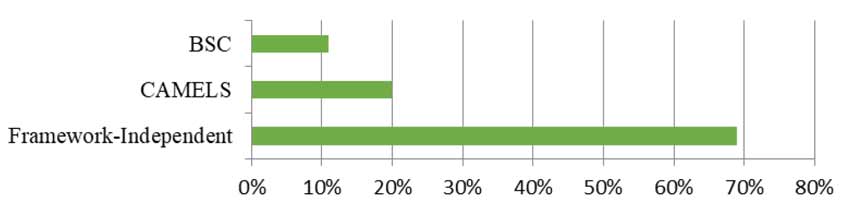
Although criteria selection is a significant task in MCDM, Figure 1 depicts that most studies did not follow any specific framework, i.e., framework-independent for selecting performance criteria. Some studies have highlighted the importance of non-financial indicators in bank performance evaluation along with financial ones (Seçme et al., 2009; Beheshtinia & Omidi, 2017; Yazdi et al., 2020; Akbarei et al., 2020; Ünlü et al., 2022). However, camels exclusively deals with the financial aspects of banks. On the other hand, the BSC framework also includes non-financial measures for institutional evaluation. However, there are limited studies that incorporated the BSC components in bank performance evaluation, as shown in Figure 1.
Figure 1. Percentage of studies that used frameworks for criteria selection
Source: Prepared by the Authors according to the Evidence Gap Map.
Financial Criteria
In MCDM, changes in criteria weights significantly affect rankings (Ozcalici & Bumin, 2020). According to Seçme et al. (2009), the criteria used in the MCDM model to evaluate bank performance can be classified into two main groups: financial and non-financial indicators (criteria).
Financial indicators remain the backbone of bank performance evaluation. Studies have widely relied on profitability, solvency, liquidity, and management efficiency ratios derived from banks' annual reports (Amile et al., 2013). ROA and ROE are among the most frequently applied criteria (Gilbert & Wheelock, 2007), though recent research stresses multidimensional approaches over single-ratio measures (Derbali, 2021; Jaouad & Lahsen, 2018). The camels framework has emerged as the most robust structure, offering comprehensive assessment across capital adequacy, asset quality, management efficiency, earnings quality, liquidity, and sensitivity to market risk (Roman & Sargu, 2013; Ginevicius & Podviezko, 2013; Reig-Mullor et al., 2020; Bozdogan et al., 2021). It not only enables early risk detection but also provides an objective basis for decision-making (Roman & Sargu, 2013). Since criteria weights strongly influence rankings in MCDM models (Ozcalici & Bumin, 2020), structured use of CAMELS has become a preferred pathway for integrating financial ratios into bank performance analysis. Table 1 outlines the studies incorporating financial ratios without any structured framework and studies using ratios under the CAMEL/CAMELS framework.
Non-Financial Criteria
Financial indicators are essential and widely used to assess the performance of banks (Table 1). Although financial criteria dominate, scholars increasingly emphasize non-financial indicators for a holistic evaluation (Seçme et al., 2009; Amile et al., 2013). Service quality and customer satisfaction are vital complements to financial soundness (Seçme et al., 2009). Rebai et al. (2012) extended the scope by integrating multi-stakeholder dimensions, including regulators, shareholders, customers, employees, managers, and civil society, through a multi-attribute utility framework.
The Balanced Scorecard (BSC) has also become an influential tool, translating strategic goals into measurable indicators across financial, customer, internal process, and learning-growth perspectives (Beheshtinia & Omidi, 2017; Ünlü et al., 2022). Combining MCDM with BSC offers banks a structured way to balance profitability with customer needs, sustainability, and regulatory pressures (Keshavarz et al., 2014; Akbarei et al., 2020; Yazdi et al., 2020). This evolution highlights a clear shift from purely ratio-based evaluations toward hybrid frameworks that capture both quantitative and qualitative dimensions of bank performance. Studies that have utilized non-financial parameters in banks' overall performance analysis using MCDM are outlined in Table 1.
Research Methodology
The present study undertakes a systematic review of literature on the application of Multi-Criteria Decision-Making (MCDM) techniques in bank performance evaluation within the banking sector. The primary objectives are to identify the various MCDM tools employed in measuring bank performance, to examine the analytical frameworks adopted in existing studies, and to highlight potential research gaps along with avenues for future investigation. The review process draws on reputable academic databases including Scopus, Web of Science, and Google Scholar, using targeted search strings comprising keywords such as "Bank Performance," "Performance Evaluation," "Decision Analysis," " MCDM," "MADM," "AHP," "ANP," "TOPSIS," "CRITIC," "VIKOR," "ELECTRE," "DEMATEL," "MOORA", "COPRAS," "PROMETHEE,", "SAW." Strict exclusion criteria are applied, omitting non-English articles, studies on non-banking institutions, works employing non-MCDM techniques, research with incomplete data or methodology, and non-journal publications such as conference proceedings and edited volumes. The PRISMA 2020 flow diagram illustrates the structured article selection, and the network construction shows relevant keyword co-occurrence connections. Furthermore, an evidence gap map approach is utilized to determine future research directions. The synthesis of this process results in a comprehensive summary of findings, accompanied by a delineation of the future scope of research in the domain.
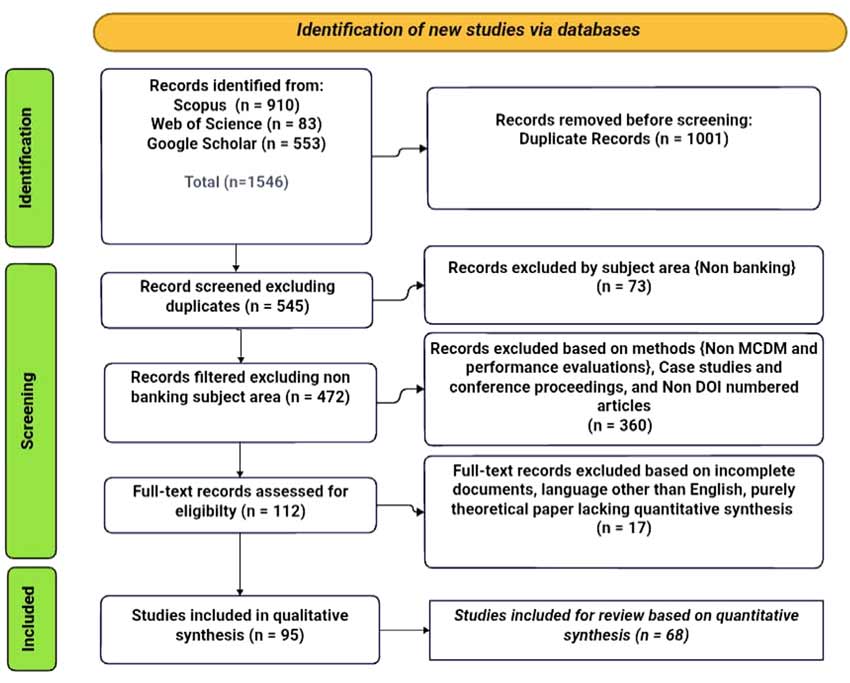
A systematic approach under the PRISMA 2020 (Page et al., 2021) framework was applied to select relevant literature to conduct the literature survey, presented in Figure 2.
Figure 2. Application of the PRISMA 2020 Flow Diagram for Scientific Literature Review
Source: Prepared by the Authors according to the PRISMA framework, 2020.
A systematic search was conducted across various renowned academic databases, including Scopus, Web of Science, and Google Scholar. The search terms (Keywords) used were chosen to encompass the relevant concepts of bank performance evaluation, MCDM methods, and decision science. A keyword-based search used the BOOLEAN operators and, OR, etc. The search strings included combinations of keywords such as "Multiple Criteria Decision Making," "MCDM," "bank performance evaluation," "financial institutions," "decision science," "banking sector," "AHP," "ANP," "SAW," "CRITIC," "TOPSIS," "VIKOR," "PROMETHEE," "ELECTRE," "COPRAS," and related terms. The studies collected were primarily conducted during the period from 2002 to 2024.
In the identification stage, 910 papers from Scopus, 83 papers from the Web of Science, and 553 research papers from Google Scholar were identified. In the screening stage, only 545 papers were retained after removing 1001 duplicate articles. Furthermore, from the remaining 73 research papers, non-banking records were excluded. Then, 360 non-methodical, case studies, conference papers, and non-Doi numbered articles were excluded. Out of which 112 full-text records were found eligible, and these were filtered to exclude incomplete papers and papers in languages other than English. In the last stage, a keywords-based search was further conducted, and a total of 68 papers, of which 28 were from the Scopus database, only five from the Web of Science database, and the remaining from Google Scholar, were retained as shown in Figure 2.
The process of selecting these 68 papers is presented above. Different inclusion and exclusion criteria were considered for the screening. Inclusion criteria include papers on bank performance evaluation, papers using MCDM techniques, articles published in authorized journals, and full-text articles. Exclusion criteria include papers written in a language other than English, papers on the performance evaluation of non-banking institutions, conference proceedings, and book chapters. Based on these 68 papers, index keywords were extracted.
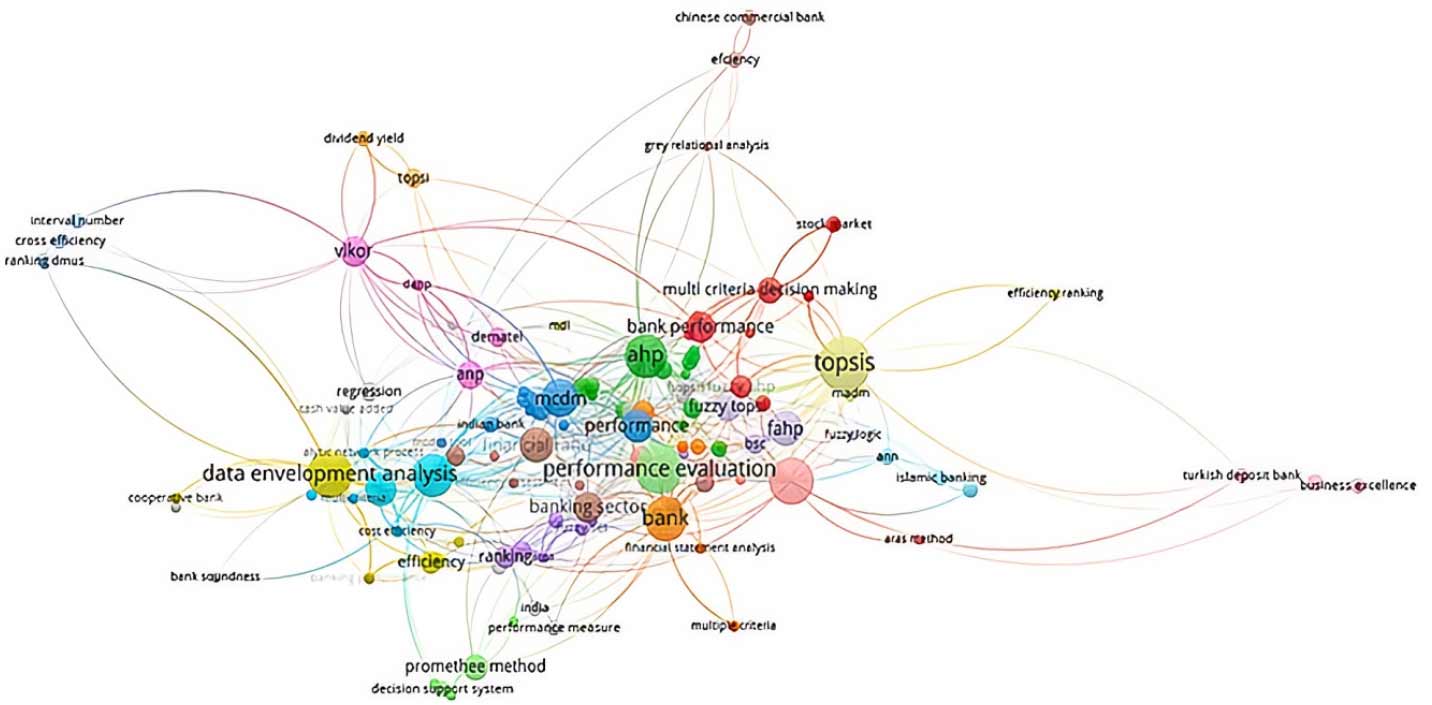
Based on these preliminary findings, the study has attempted to identify the co-occurrence network of index keywords (Radhakrishnan et al., 2017) to proceed further. The central theme of the study is clearly reflected in the co-occurrence network in Figure 3 and supports the broad objectives of the research. The presence of keywords such as "Performance Evaluation," "Efficiency," "Banking Sector," and "Bank Performance" at the center of the co-occurrence network, together with the keyword "Multi-Criteria Decision-Making" at its periphery, supports the title of this study.
Figure 3. Overlay Visualization of Co-occurrence Network of Keywords Used
Source: Prepared by the authors according to the data retrieved via VOSviewer software.
Discussion
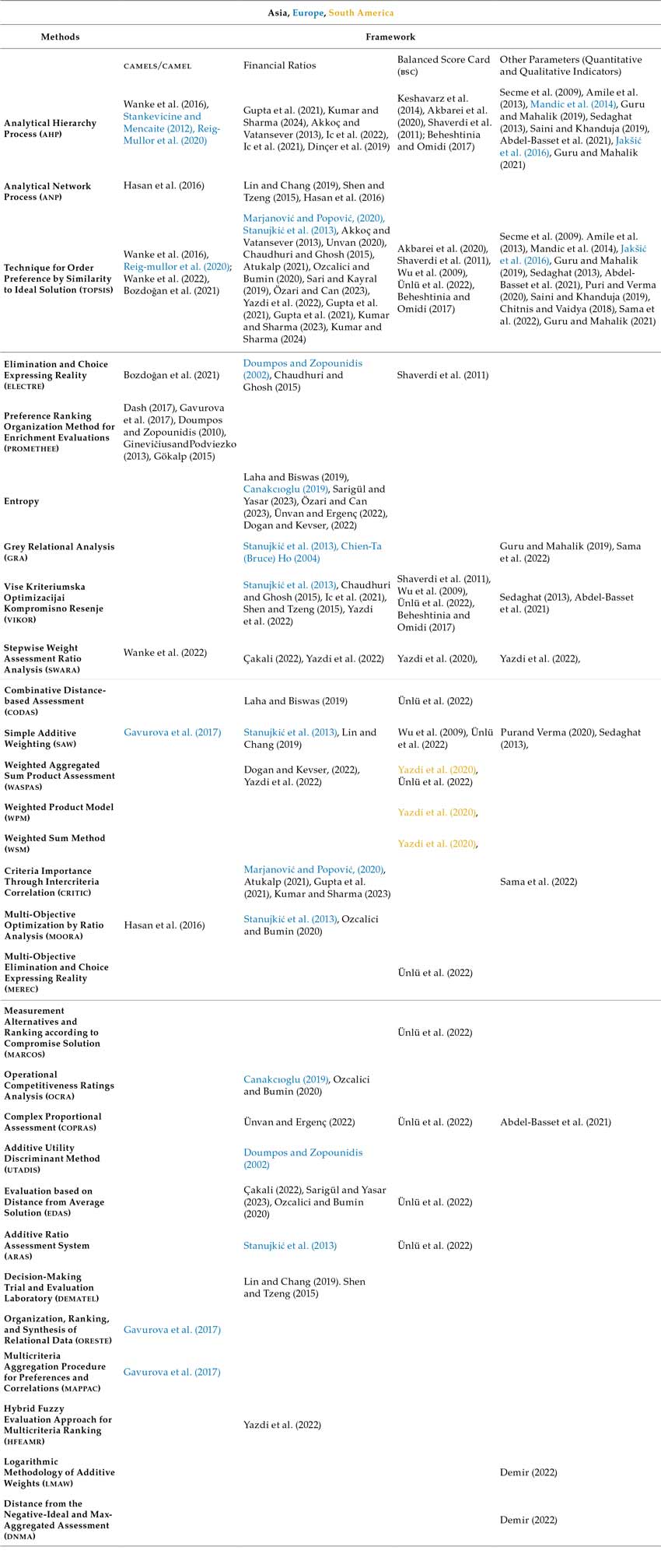
Based on the literature survey and index keywords analysis, the evidence gap map of the selected literature is prepared in Table 1 to identify the gap in the existing literature of the proposed study.
The blank cells in Table 1 indicate areas that have received comparatively limited attention with regards to frameworks and selected criteria (variables), MCDM methods, and where the study was conducted. The studies conducted in Asia are highlighted in black, the studies conducted in Europe are highlighted in blue, and the studies in South America are highlighted in yellow. Notably, minimal or no related work has been conducted in regions such as Africa, North America, and Australia. Around 30 MCDM methods have been used in the literature. Limited studies in Europe and South America used integrated MCDM techniques within the CAMEL/CAMELS and BSC frameworks. The studies in the third and fifth columns have used multiple financial and non-financial indices without following a proper framework for selecting variables (Figure 1).
Table 1. Summary of the Evidence Gap Map Approach for the Literature Survey
Source: Authors’ Compilation.
Furthermore, there is a need to integrate different significant MCDM approaches and their incorporation within the CAMELS and BSC multidimensional frameworks. It is further observed that most studies have used at least two MCDM techniques. Although a wide range of MCDM techniques has been applied, the literature is still concentrated around a small set of established approaches, particularly AHP and TOPSIS. Table 1 shows that most studies using MCDM methods in bank performance were conducted in Turkey, which falls under Euro-Asia, and in Iran, in Asia. However, further research is needed in other regions to expand the application of these methods.
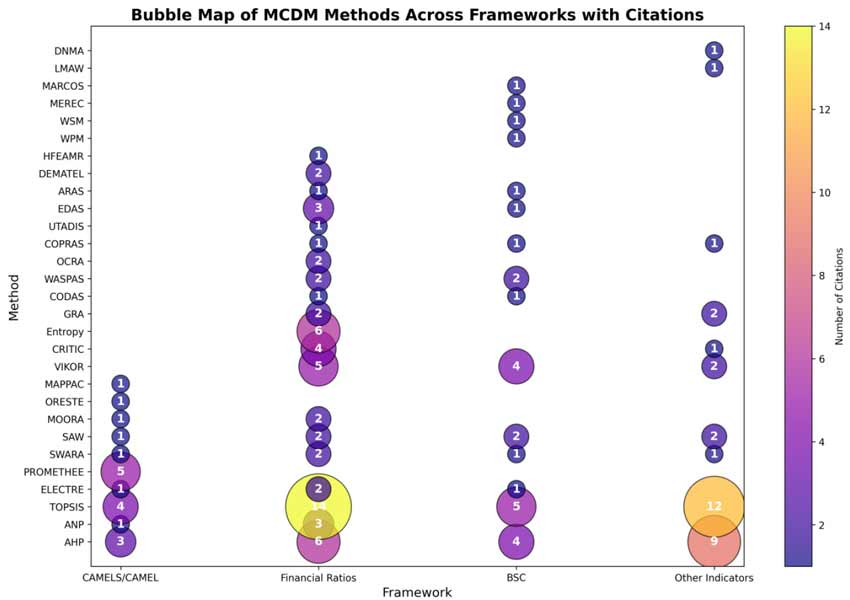
A single study can constitute multiple methods at a single time. From Figure 4, the Financial Ratios framework is the most widely used, with many methods cited multiple times, comparable to CAMELS/CAMEL, BSC, and other indicators. Where TOPSIS (14), Entropy (6), VIKOR (5), AHP (6), and critic (4) are highly applied under financial ratios. Other quantitative and qualitative indicators also show significant attention, especially with AHP (9) and ANP (12) citations. Under camels/camel, fewer methods are used, with mostly small bubbles, but PROMETHEE (5) and TOPSIS (4) stand out amongst all other techniques. The BSC framework has fewer studies overall, but TOPSIS (5), AHP (4), and VIKOR (4) stand out. Some less common MCDM methods such as DNMA, LMAW, MARCOS, WSM, WPM, and MEREC appear only occasionally in the reviewed literature, demonstrating minor presence of studies in bank performance evaluation, appearing only once in specific frameworks. These MCDM methods were used more than 140 times across different frameworks and are highlighted using a plasma color gradient ranging from blue, indicating a lower number of citations, to yellow, representing a higher number of citations.
Figure 4. Bubble Map of MCDM Techniques across Frameworks
Source: Prepared by the authors according to the present literature using Python programming.
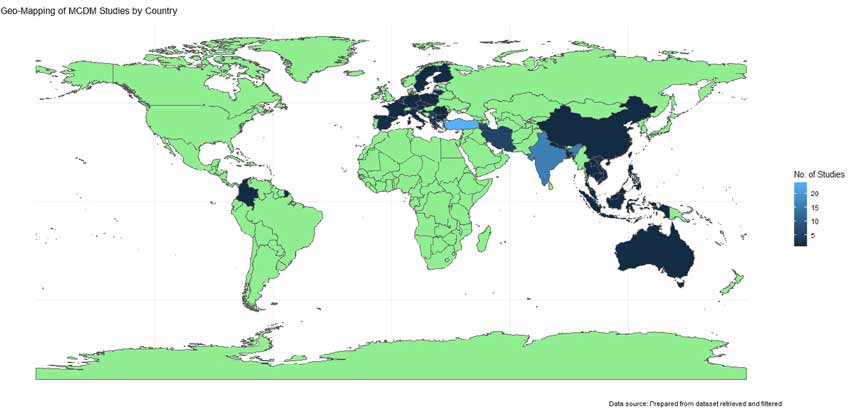
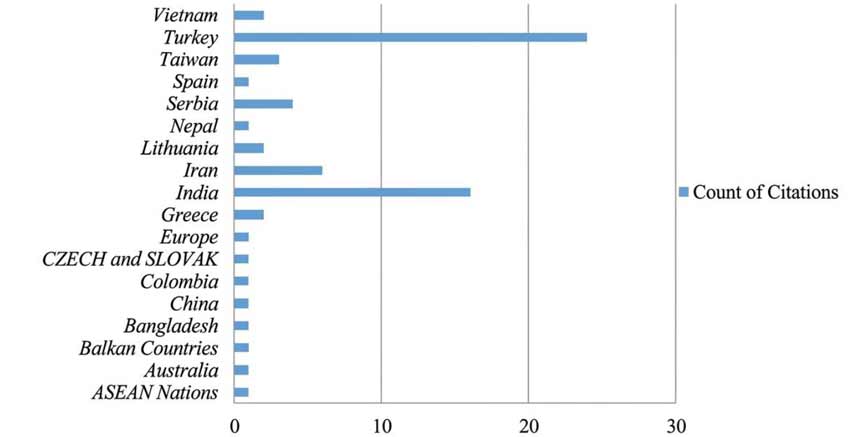
A visual representation of the statistics is provided in Figures 5 and 6. Out of the 68 records included, the map and graph above represent 18 specific countries and regions. The ASEAN banks consist of Vietnam, Thailand, Indonesia, Philippines, Malaysia, Singapore, Myanmar, Cambodia, Laos, Brunei, Balkan Countries consists of Serbia, Croatia, Bosnia and Herzegovina, Montenegro, Albania, Bulgaria, North Macedonia, Greece, Romania; Europe consists of nations such as Germany, France, Italy, Spain, Poland, Netherlands, Belgium, Austria, Sweden, Finland, and CZECH and SLOVAK represent Czechia and Slovakia respectively. However, the three regions show several noteworthy global trends. More than 50 % is made up of Asian countries. Among them, Turkey—a transcontinental country with the majority of its territory in Asia—leads with 24 scientific articles, accounting for approximately 35 % of all studies identified using the selected keywords. This is somewhat surprising given the size of these countries' populations and the speed of MCDM adaptation in banking world in recent years. In terms of banking performance evaluation using MCDM, relatively few studies were identified in China despite the size and significance of its banking sector, suggesting opportunities for future empirical investigation. India follows Turkey with 16 studies, representing about 23 %> of the reviewed literature on bank performance evaluation using MCDM, techniques.
Figure 5. Geo-Mapping of MCDM, Studies by Country
Source: Prepared by the authors according to the present literature using R programming.
Figure 6. Bar Graph of Citation Count by Country
Source: Prepared by the authors according to the present literature using an Excel Spreadsheet.
No studies from North American or African countries were identified in the reviewed sample. This geographical concentration suggests opportunities for future research in underrepresented regions, bearing in mind that the advanced MCDM, techniques of the North American and African banks can boost increased attention to the regulation of the rapid development of the banking industry. Iran and Serbia took the higher positions among the remaining countries, which is also unexpected, considering that they are not the tycoons of MCDM, techniques and bank performance evaluations. The inclusion of several other countries is somewhat surprising, given the geopolitical unrest they have experienced, which can influence various aspects of national development and institutional activity. From a global perspective, 46 of the 195 countries recognized by the un have produced at least one article on the application of MCDM, methods to bank performance evaluation since 2004. This represents for 23.6 % of all countries worldwide.
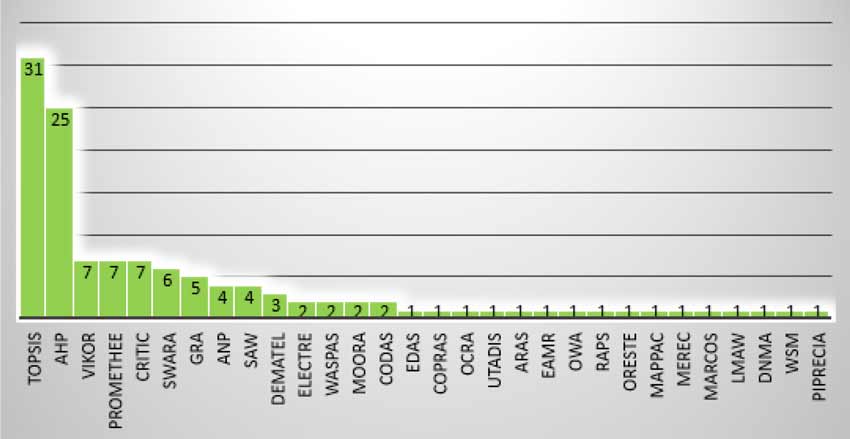
The extensive review shows that the studies used various MCDM, techniques to assess bank performance. As shown in Figure 7, most of the studies have utilized the TOPSIS and AHP techniques for analyzing bank performance. On the other hand, techniques such as the EDAS, COPRAS, OCRA, ARAS, EAMR, ORESTE, MAPPAC, MEREC, MARCOS, LMAW, DNMA, and vice versa appear less frequently in the literature reviewed. However, studies have mentioned that each technique has certain characteristics in managing specific parts of decision-making and performance evaluation. Consequently, studies have integrated various MCDM, techniques to maximize the positive attributes of each approach and offer an improved assessment. For instance, combining outranking techniques such as TOPSIS with subjective weighting techniques such as AHP and ANP is common in the studies.
Figure 7. Bar Chart of MCDM, Techniques Used in the Literature Review
Source: Prepared by the authors according to the literature using Excel Spreadsheet.
Together, the methodologies combine to give a hybrid modeling solution that links quantitative balance sheets to banker insights and allows cross validation to offset methodological weaknesses when studying multifaceted financial institutions. The relative importance of criteria is often determined using subjective (AHP, Fuzzy AHP) and objective (CRITIC, Entropy) weighting approaches. Studies that employed objective techniques typically highlighted criteria with low correlation and substantial variability. Some recent studies have highlighted the importance of objective-based weighting criteria over subjective weighting methods (e.g., AHP, ANP) where weights are assigned based on decision-maker choice and judgment, which ultimately may incur biases in decision-making (Kumar & Sharma, 2024; Sarigül & Yasar, 2023; Ünvan & Egence, 2022; Gupta et al., 2021; Atukalp, 2021; Sama et al., 2022; Marjanović & Popović, 2020; Canakcioglu, 2019).
Numerous studies identified the best-performing banks and suggested that other banks could improve their performance by using these significant players as benchmarks (Guru & Mahalik, 2021; Sama et al., 2020; Puri & Verma, 2020). For instance, HDFC Bank in India and specific banks in Turkey and the ASEAN region are frequently recognized in the literature for their outstanding performance. The optimal asset/liability management technique for lowering the cost and reducing credit risks is to apply these top asset/liability management benchmark institutions to empirically construct benchmark. Researchers often use sensitivity analysis (Demir, 2022; Gupta et al., 2021; Jaksic et al., 2016) to assess the consistency of results across several approaches, emphasizing the robustness of rankings using MCDM tools. The robustness of this validation process means that the ultimate ranking will remain the same even in periods of macroeconomic instability, market changes, or a marginal increase/decrease in financial weightings.
Performance evaluations frequently provide insights unique to the regional or industry environment. For instance, the regulatory frameworks and local economic conditions impact the performance trends of banks in Turkey, India, and the asean region. Studies comparing the performance of various kinds of banks (e.g., private vs. public, commercial vs. Islamic) revealed varied characteristics contributing to success in these segments. Some studies have consistently shown that the COVID-19 epidemic significantly impacted bank performance (Yazdi et al., 2022; Unlu et al., 2022; Demir, 2022), with notable shifts in stability and efficiency throughout this time. External factors, including market conditions, economic crises, and regulatory changes, significantly influenced bank financial performance. Researchers emphasized how crucial it is to use a variety of performance metrics to capture the intricate nature of bank performance accurately. This covers operational metrics, qualitative aspects, and financial ratios. A more comprehensive understanding of performance can be obtained using qualitative evaluations (such as customer satisfaction) with quantitative financial ratios. Studies have mentioned contradicting outcomes while using different MCDM approaches simultaneously in bank performance measurement.
For instance, Jaksic et al. (2016) found a change in the ranks of banks due to changes in separation measures. Stanujkic et al. (2013) obtained different results on the same data using different normalization procedures within the same method. On the other hand, Shaverdi et al. (2011) found the same ranking results using VIKOR and TOPSIS due to their methodological similarities. Surprisingly, the result of ELECTRE was also similar to VIKOR and TOPSIS, although the method differs from the other two. However, most of the studies found differences in ranking results while using different outranking methods (Dinçer et al., 2019; Beheshtinia & Omidi, 2017; Gavurova et al., 2017; Ginevicius & Podviezko, 2013). In traditional MCDM, the optimal choice was based on human judgment and preferences.
Decision-making was more accessible when the criteria were consistent, and objectives were well-defined. As decision-making becomes more complex and involves multiple contradicting criteria, decision-makers must exert greater cognitive effort to maintain consistency in their opinion. The evolution of MCDM techniques has been characterized by a gradual progression through different stages, each marked by innovations and improvements in methodology. Researchers have continuously refined MCDM approaches to address the complexities of decision-making processes involving multiple criteria and conflicting objectives.
The synthesis of the literature reviewed reveals several important opportunities for future research in bank performance evaluation using MCDM techniques. First, a considerable proportion of studies employ framework-independent criteria selection, while limited attention has been given to structured multidimensional frameworks such as camels/camel and the BSC. Second, existing studies predominantly rely on financial indicators, whereas non-financial dimensions, including customer satisfaction, innovation, digitalization, governance, and sustainability, remain underrepresented. Third, although numerous MCDM techniques have been applied, relatively few studies have examined the robustness and consistency of rankings generated by alternative weighting and outranking methods. Finally, the literature reviewed is geographically concentrated in a limited number of countries, particularly Turkey, India, and Iran. Further studies conducted in underrepresented regions, including Africa, North America, and Oceania, may enhance the generalizability of existing findings. In addition, incorporating uncertainty-aware approaches and ESG-oriented performance indicators represents a promising avenue for future research.
Conclusions
The significance of using advanced analytical tools in the analysis of banking performance in this competitive business environment cannot be overstated. Without adopting such advanced analytical tools, the advancement of technology, digitalization, and globalization of financial services, innovations, and diversification of banking products have made it difficult for banks to survive. Changes in economic policies lead to continuous mergers and acquisitions of banks, and sometimes the liquidation of a bank. Witnessing these, researchers and policymakers are moving towards the non-parametric evaluation techniques (i.e., MCDM) from the essential parametric statistical tools in the performance evaluation of banks to ensure an accurate and robust analysis. These will ultimately help different stakeholders, as well as the government itself, in making valuable judgments. Many studies on bank performance evaluation have been undertaken worldwide using different parametric and non-parametric tools.
This study reviewed journal articles published on the performance evaluation of commercial banks using MCDM techniques. The selection of relevant literature involved a thorough analysis considering some inclusion and exclusion criteria. The study included only full-text articles published in English. The review did not include any conference papers, editorials, book chapters, notes, or other materials not published as journal articles. It synthesized the review into four sections: the MCDM tools used, the study context, the framework for criteria selection, and the place or region of the study conducted. The study identified 68 research papers after thoroughly analysing and screening 1546 articles from Scopus, Web of Science, and Google Scholar databases using the PRISMA framework. The extensive literature survey discovered that most studies on bank performance evaluation using MCDM methods have been conducted in Turkey, in the Euro-Asia zone.
Most studies have used at least two MCDM techniques and highlighted the importance of applying an integrated MCDM model combining different weighting and outranking MCDM techniques to obtain robust results. AHP and TOPSIS are the most frequently used MCDM techniques in this domain, serving primarily as weighting and ranking methods, respectively. Furthermore, the evidence gap map shows there have been limited studies on bank performance evaluation under the multidimensional frameworks, e.g., camel/camels and BSC, using the MCDM techniques. The review also highlights the predominance of financial indicators and the need for broader integration of non-financial and sustainability-related dimensions in future evaluations.
Limitations
Although the research is based on a thorough analysis of papers on the performance evaluation of commercial banks using MCDM techniques, the study has some limitations. Studies focusing on bank branch performance, as well as the performance evaluation of development banks, cooperative banks, regional rural banks (RRBS), small finance banks, and payment banks using MCDM techniques, were excluded from the review. There were studies involving fuzzy logic and fuzzy numbers, along with the application of MCDM techniques. However, reviewing the application of these fuzzy set concepts in the articles separately is out of the scope of our study. Different MCDM techniques used by the researchers in bank performance evaluation and studies may vary in methodology, data sources, and performance indicators. Synthesizing these diverse studies into a coherent review was challenging. Some studies may have methodological limitations, such as small sample size, limited data, or inadequate validation of the models. These limitations may affect the validity and generalization of the findings.
Future Research Directions
Future research could focus on assessing the concordance of bank rankings generated by hybrid MCDM frameworks. Future studies could analyze the influence of different weighting and normalization methods within CAMELS/ CAMEL and BSC frameworks. Future research could effectively investigate integrated ranking approaches and incorporate fuzzy sets into decision-making under uncertainty. Additionally, including non-financial performance indicators and ESG-oriented indices alongside financial parameters in performance evaluation models can greatly enhance evaluation and provide a true overview of the banking environment. Furthermore, future research could be expanded beyond commercial banks to include RRBs, cooperative banks, and development banks. These directions may contribute to more robust and comprehensive MCDM applications in the banking sector.
Policy Implications
Regulators and policymakers can use the most renowned MCDM tools to develop more comprehensive evaluation frameworks beyond financial ratios, including qualitative factors such as risk management, corporate governance, and customer satisfaction. Central banks and financial authorities can adopt MCDM models to improve early warning systems for financial instability by integrating multiple performance indicators. The findings suggest that holistic performance assessment through MCDM can help identify inefficiencies in banks. This can guide policymakers in designing incentives or penalties for banks based on well-rounded performance metrics rather than just profitability. Policymakers can promote uniform assessment standards for banking institutions by implementing MCDM techniques, ensuring a transparent and impartial evaluation of banks. Regulatory agencies can require banks to report performance based on a multi-criteria framework, enhancing stakeholder confidence and reducing information asymmetry. MCDM techniques allow for a more nuanced analysis of credit, operational, and market risks. Central banks can integrate these models to improve stress-testing procedures and strengthen financial stability regulations. Policies can be designed to encourage banks to adopt risk-sensitive performance assessment methods that proactively identify vulnerabilities. Furthermore, MCDM methods can incorporate ESG factors into performance evaluation. This can guide policymakers in promoting sustainable banking policies.
References
Abdel-Basset, M., Mohamed, R., Elhoseny, M., Abouhawash, M., Nam, Y., & AbdelAziz, N. M. (2021). Efficient MCDM model for evaluating the performance of commercial banks: A case study. Computers, Materials and Continua, 67(3), 2729-2746. https://doi.org/10.32604/cmc.2021.015316
Akbarei, N., Monfard, M. V., & Sarfi, E. (2020). The performance evaluation of banks using balanced scorecards, fuzzy AHP, and fuzzy TOPSIS techniques, as well as offering solutions to performance improvement of banks. International Journal of Business Information Systems, 35(2), 204-224. https://doi.org/10.1504/IJBIS.2020.110169
Akkoç, S., & Vatansever, K. (2013). Fuzzy performance evaluation with AHP and Topsis methods: evidence from Turkish banking sector after the global financial crisis. Eurasian Journal of Business and Economics, 6(11), 53-74.
Amile, M., Sedaghat, M., & Poorhossein, M. (2013). Performance Evaluation of Banks using Fuzzy AHP and TOPSIS. Case study: State-owned Banks, Partially Private and Private Banks in Iran. Caspian Journal of Applied Sciences Research, 2(3).
Atukalp, M. E. (2021). Determining the relationship between stock return and financial performance: An analysis on Turkish deposit banks. Journal of Applied Statistics, 45(13-15), 2643-2657. https://doi.org/10.1080/02664763.2020.1849056
Baydas, M., & Elma, O. E. (2021). An objective criteria proposal for comparing MCDM and weighting methods in financial performance measurement: An application in Borsa Istanbul. Decision Making: Applications in Management and Engineering, 4(2), 257-279. https://doi.org/10.31181/dmame210402257b
Beheshtinia, M. A., & Omidi, S. (2017). A hybrid MCDM approach for performance evaluation in the banking industry. Kybernetes, 46(8), 1386-1407. https://doi.org/10.1108/K-03-2017-0105
Bozdogan, T., Odabas, A., & Shegiwal, A. H. (2021). Analysis of financial performance of foreign banks with branches in Turkey by TOPSIS and ELECTRE methods. Alanya Akademik Baki§, 5(2), 1049-1067. https://doi.org/10.29023/alanyaakademik.871031
Çakali, K. R. (2022). Performance evaluation of deposit banks with financial ratios: Use objective and subjective criteria weighting methods (Combined entropy-SWARA based EDAS method). Alanya Akademik Baki§, 6(2), 2351-2377. https://doi.org/10.29023/alanyaakademik.1056754
Canakcioglu, M. (2019). Evaluation of the banking performance of the Balkan countries with an integrated MCDM approach consists of Entropy and ocra techniques. Economy & Business Journal, 13(1), 341-366.
Chai, J., Liu, J. N., & Ngai, E. W. (2013). Application of decision-making techniques in supplier selection: A systematic literature review. Expert systems with applications, 40(10), 3872-3885. https://doi.org/10.1016/j.eswa.2012.12.040
Chakraborty, S., Raut, R. D., Rofin, T. M., & Chakraborty, S. (2023). A comprehensive and systematic review of multicriteria decision-making methods and applications in healthcare. Healthcare Analytics, 4, 100232. https://doi.org/10.1016/j.health.2023.100232
Chaudhuri, T., & Ghosh, I. (2015). Application of multicriteria decision-making models in regulatory evaluation of commercial banks in India and their consistency with public perception [Working paper]. SSRN. https://doi.org/10.2139/ssrn.2546647
Chitnis, A., & Vaidya, O. S. (2018). Efficiency ranking method using SFA and TOPSIS (ERM-ST): The case of Indian banks. Benchmarking: An International Journal, 25(2), 471-488. https://doi.org/10.1108/BIJ-08-2016-0126
Chowdhury, P., & Paul, S. K. (2020). Applications of MCDM methods in research on corporate sustainability: A systematic literature review. Management of Environmental Quality: An International Journal, 31(2), 385-405. https://doi.org/10.1108/MEQ-12-2019-0284
Dash, M. (2017). A model for bank performance measurement integrating multivariate factor structure with multicriteria PROMETHEE methodology. Asian Journal of Finance & Accounting, 9(1), 310-332. https://doi.org/10.5296/ajfa.v9i1.11073
Demir, G. (2022). Analysis of the financial performance of the deposit banking sector in the coviD-19 period with LMAW-DNMA methods. International Journal of Insurance and Finance, 2(2), 17-36. https://doi.org/10.52898/ijif.2022.7
Derbali, A. (2021). Determinants of the performance of Moroccan banks. Journal of Business and Socio-economic Development, 1(1), 102-117. https://doi.org/10.1108/JBSED-01-2021-0003
Dinçer, H., Hacioglu, U., Tatoglu, E., & Delen, D. (2019). Developing a hybrid analytics approach to measure the efficiency of deposit banks. Journal of Business Research, 104, 131-145. https://doi.org/10.1016/j.jbusres.2019.06.035
Dogan, M., & Kevser, M. (2022). Comparing the Financial Performance of Islamic Banks in 10 Countries: New Evidence Using Entropy and WASPAS Methods. Economics, 9(2), 197-210. https://doi.org/10.18488/29.v9i2.3110
Doumpos, M., & Zopounidis, C. (2002). Multicriteria classification methods in financial and banking decisions. International Transactions in Operational Research, 9(5), 567-581. https://doi.org/10.1111/1475-3995.00374
Doumpos, M., & Zopounidis, C. (2010). A multicriteria decision support system for bank rating. Decision Support Systems, 50(1), 55-63. https://doi.org/10.1016/j.dss.2010.07.002
Gavurova, B., Belas, J., Kocisova, K., & Kliestik, T. (2017). Comparison of selected methods for performance evaluation of Czech and Slovak commercial banks. Journal of Business Economics and Management, 18(5), 852-876. https://doi.org/10.3846/16111699.2017.1371637
Gilbert, R. A., & Wheelock, D. C. (2007). Measuring commercial bank profitability: Proceed with caution (Networks Financial Institute Working Paper No. 2007-WP-22) [Working paper]. Networks Financial Institute. http://doi.org/10.2139/ssrn.1060341
Ginevicius, R., & Podviezko, A. (2013). The evaluation of financial stability and soundness of Lithuanian banks. Economic Research-Ekonomskaistrazivanja, 26(2), 191-208. https://doi.org/10.1080/1331677X.2013.11517616
Gökalp, F. (2015). Comparing the financial performance of banks in Turkey by using the Promethee method. Ege Stratejik Ara§tirmalar Dergisi, 6(1), 63-82. https://doi.org/10.18354/esam.90895
Grossman, R. S. (1993). The macroeconomic consequences of bank failures under the national banking system. Explorations in Economic History,30(3), 294-320. https://doi.org/10.1006/exeh.1993.1012
Gupta, S., Mathew, M., Gupta, S., & Dawar, V. (2021). Benchmarking the private sector banks in India using the MCDM approach. Journal of Public Affairs, 21(2), e2409. https://doi.org/10.1002/pa.2409
Gupta, S., Mathew, M., Syal, G., & Jain, J. (2021). A hybrid MCDM approach for evaluating the financial performance of public sector banks in India. International Journal of Business Excellence, 24(4), 481-501. https://doi.org/10.1504/IJBEX.2021.117648
Guru, S., & Mahalik, D. K. (2019). A comparative study on performance measurement of Indian public sector banks using AHP-TOPSIS and AHP-grey relational analysis. Opsearch, 56(4), 1213-1239. https://doi.org/10.1007/s12597-019-00411-1
Guru, S., & Mahalik, D. K. (2021). Ranking the performance of Indian public sector banks using analytic hierarchy process and technique for order preference by similarity to an ideal solution. International Journal of Process Management and Benchmarking, 11(1), 28-43. https://doi.org/10.1504/IJPMB.2021.112246
Hasan, D., Ümit, H., & Serhat, Y. (2016). Performance assessment of deposit banks with camels analysis using fuzzy ANP-Moora approaches and an application on the Turkish banking sector. Asian Journal of Research in Business Economics and Management, 6(2), 32-56. https://doi.org/10.5958/2249-7307.2016.00009.8
Ho, C. T. (2004). Performance evaluation of Australia's central banks. Asian Review of Accounting, 12(1), 19-33. https://doi.org/10.1108/eb060771
Ic, Y. T., Celik, B., Kavak, S., & Baki, B. (2021). Development of a multicriteria decision-making model for comparing the performance of Turkish commercial banks. Journal of Advances in Management Research, 18(2), 250-272. https://doi.org/10.1108/JAMR-05-2020-0083
Ic, Y. T., Yurdakul, M., & Pehlivan, E. (2022). Developing a hybrid financial performance measurement model for Turkish commercial banks using ahp and doe methods. Soft Computing, 26, 2959-2979. https://doi.org/10.1007/s00500-021-06589-1
Jaksic, M., Moljevic, S., Aleksic, A., Misita, M., Arsovski, S., Tadic, D., & Mimovic, P. (2016). Fuzzy approach in ranking of banks according to financial performances. Mathematical Problems in Engineering, 2016, Article 6169586. https://doi.org/10.1155/2016/6169586
Jaouad, E., & Lahsen, O. (2018). Factors affecting bank performance: empirical evidence from Morocco. European Scientific Journal, 14(34), 255-267. https://doi.org/10.19044/esj.2018.v14n34p255
Keshavarz, E., Ftahikenari, M., Rohani, A., & Bagheri, S. M. (2014). Performance evaluation of banks using a balanced scorecard. International Journal of Business Excellence, 7(3), 371-393. https://doi.org/10.1504/IJBEX.2014.060781
Kumar, P., & Sharma, D. (2023). Benchmarking the financial performance of Indian commercial banks by a hybrid MCDM approach. International Journal of Process Management and Benchmarking, 15(3), 285-309. https://doi.org/10.1504/IJPMB.2023.134147
Kumar, P., & Sharma, D. (2024). Prioritizing the financial performance of Indian private sector banks by a hybrid MCDM approach. International Journal of Process Management and Benchmarking, 16(4), 490-511. https://doi.org/10.1504/IJPMB.2024.137145
Laha, S., & Biswas, S. (2019). Hybrid unsupervised learning and multicriteria decision-making approach for performance evaluation of Indian banks. Accounting, 5(4), 169-184. https://doi.org/10.5267/j.ac.2018.11.001
Lak Kamari, M., Isvand, H., & Alhuyi Nazari, M. (2020). Applications of multicriteria decision-making (MCDM) methods in renewable energy development: A review. Renewable Energy Research and Applications, 1(1), 47-54. https://doi.org/10.22044/rera.2020.8541.1006
Lin, A. J., & Chang, H. Y. (2019). Business sustainability performance evaluation for Taiwanese banks—A hybrid multiple-criteria decision making approach. Sustainability, 11(8), 2236. https://doi.org/10.3390/su11082236
Mandic, K., Delibasic, B., Knezevic, S., & Benkovic, S. (2014). Analysis of the financial parameters of Serbian banks through applying the fuzzy ahp and topsis methods. Economic Modeling, 43, 30-37. https://doi.org/10.1016/j.econmod.2014.07.036
Mardani, A., Zavadskas, E. K., Khalifah, Z., Jusoh, A., & Nor, K. M. (2016). Multiple criteria decision-making techniques in transportation systems: A systematic review of the state of the art literature. Transport, 31(3), 359-385. https://doi.org/10.3846/16484142.2015.1121517
Marjanovic, I., & Popovic, Z. (2020). MCDM approach for assessment of financial performance of Serbian banks. In Business Performance and Financial Institutions in Europe: Business Models and Value Creation Across European Industries (pp. 71-90). Springer. https://doi.org/10.1007/978-3-030-57517-5_5
Özari, Ç., & Can, E. N. (2023). Financial Performance Evaluating and Ranking Approach for Banks in Bist Sustainability Index Using Topsis and K-Means Clustering Method. Academic Journal of Interdisciplinary Studies, 12(1), 34-50. https://doi.org/10.36941/ajis-2023-0004
Ozcalici, M., & Bumin, M. (2020). An integrated multicriteria decision-making model with self-organizing maps is used to assess the performance of publicly traded banks in Borsa Istanbul. Applied Soft Computing, 90, Article 106166. https://doi.org/10.1016/j.asoc.2020.106166
Page, M. J., McKenzie, J. E., Bossuyt, P. M., Boutron, I., Hoffmann, T. C., Mulrow, C. D., Shamseer, L., Tetzlaff, J. M., Akl, E. A., Brennan, S. E., Chou, R., Glanville, J., Grimshaw, J. M., Hróbjartsson, A., Lalu, M. M., Li, T., Loder, E. W., Mayo-Wilson, E., McDonald, S., & Moher, D. (2021). The PRISMA 2020 statement: An updated guideline for reporting systematic reviews. BMJ, 372, n71. https://doi.org/10.1136/bmj.n71
Puri, J., & Verma, M. (2020). Integrated data envelopment analysis and multicriteria decision-making ranking approach based on peer-evaluations and subjective preferences: A case study in the banking sector. Data Technologies and Applications, 54(4), 551-582. https://doi.org/10.1108/DTA-01-2020-0003
Radhakrishnan, S., Erbis, S., Isaacs, J. A., & Kamarthi, S. (2017). Novel keyword co-occurrence network-based methods to foster systematic reviews of scientific literature. PloS One, 12(3), e0172778. https://doi.org/10.1371/journal.pone.0172778
Rebai, S., Azaiez, M. N., & Saidane, D. (2012). Sustainable performance evaluation of banks using a multi-attribute utility model: An application to French banks. Procedia Economics and Finance, 2, 363-372. https://doi.org/10.1016/S2212-5671(12)00098-6
Reig-Mullor, J., Brotons-Martinez, J. M., & Sansalvador-Selles, M. E. (2020). A novel approach to improve the bank ranking process: an empirical study in Spain. Journal of Intelligent & Fuzzy Systems, 38(5), 5323-5331. https://doi.org/10.3233/JIFS-179626
Robinson, K. A., Saldanha, I. J., & Mckoy, N. A. (2011). Development of a framework to identify research gaps from systematic reviews. Journal of Clinical Epidemiology, 64(12), 1325-1330. https://doi.org/10.1016/j.jclinepi.2011.06.009
Roman, A., & §argu, A. C. (2013). Analyzing the financial soundness of the commercial banks in Romania: an approach based on the camel's framework. Procedia Economics and Finance, 6, 703-712. https://doi.org/10.1016/S2212-5671(13)00192-5
Saini, N., & Khanduja, D. (2019). Financial performance evaluation using made approaches in Indian banks. In S. S. Das, G. N. Tiwari, K. M. Pandey, & A. K. Roy (Eds.), Advances in interdisciplinary engineering: Select proceedings of flame 2018 (pp. 439-449). Springer. https://doi.org/10.1007/978-981-13-6577-5_42
Sama, H. R., Kosuri, S. V. K., & Kalvakolanu, S. (2022). Evaluating and ranking the Indian private sector banks—A multicriteria decision-making approach. Journal of Public Affairs, 22(2), e2419. https://doi.org/10.1002/pa.2419
Sari, T., & Kayral, 1. E. (2019). Applying a two-stage TOPSIS approach and stepwise regression in evaluating bank performance: evidence from Turkish banks. Banks and Bank Systems, 14(4), 114. https://doi.org/10.21511/bbs.14(4).2019.11
Sarigül, S. S., Pinar, A. V. C. I., & Yaçar, E. (2023). Evaluation of the Financial Performance of Deposit Banks Operating in Turkey by Entropy-supported EDAS Method. JOEEP: Journal of Emerging Economies and Policy, 8(1), 239-255.
Seçme, N. Y., Bayrakdaroglu, A., & Kahraman, C. (2009). Fuzzy performance evaluation in the Turkish banking sector using analytic hierarchy process and TOPSIS. Expert Systems with Applications, 36(9), 11699-11709. https://doi.org/10.1016/j.eswa.2009.03.013
Sedaghat, M. (2013). A productivity improvement evaluation model by integrating AHP, TOPSIS, and VIKOR methods under a fuzzy environment (case study: State-owned, partially private, and private banks in Iran). Economic Computation and Economic Cybernetics Studies and Research, 47(1), 235-258.
Shaverdi, M., Akbari, M., & Tafti, S. F. (2011). Combining fuzzy MCDM with BSC approach in performance evaluation of Iranian private banking sector. Advances in Fuzzy Systems, 2011, 1-12. https://doi.org/10.1155/2011/148712
Shen, K. Y., & Tzeng, G. H. (2015). A decision rule-based soft computing model for supporting financial performance improvement of the banking industry. Soft Computing, 19, 859-874. https://doi.org/10.1007/s00500-014-1413-7
Stankeviciené, J., & Mencaité, E. (2012). The evaluation of bank performance using a multicriteria decision-making model: a case study on Lithuanian commercial banks. Technological and Economic Development of Economy, 18(1), 189-205. https://doi.org/10.3846/20294913.2012.668373
Stanujkic, D., Dordevic, B., & Dordevic, M. (2013). Comparative analysis of some prominent MCDM methods: A case of ranking Serbian banks. Serbian Journal of Management, 8(2), 213-241. https://doi.org/10.5937/sjm8-3774
Ünlü, U., Yalçin, N., & Avçarligil, N. (2022). Analysis of efficiency and productivity of commercial banks in Turkey pre-and during coviD-19 with an integrated MCDM approach. Mathematics, 10(13), 2300. https://doi.org/10.3390/math10132300
Ünvan, Y. A. (2020). Financial performance analysis of banks with TOPSIS and fuzzy TOPSIS approaches. Gazi University Journal of Science, 33(4), 904-923. https://doi.org/10.35378/gujs.730294
Ünvan, Y. A., & Ergenç, C. (2022). Financial performance analysis with the fuzzy COPRAS and entropy-COPRAS approaches. Computational Economics, 59(4), 1577-1605. https://doi.org/10.1007/s10614-021-10143-4
Wanke, P., Kalam Azad, M. A., Barros, C. P., & Hadi-Vencheh, A. (2016). Predicting performance in ASEAN banks: an integrated fuzzy MCDM -neural network approach. Expert Systems, 33(3), 213-229. https://doi.org/10.1111/exsy.12144
Wanke, P., Azad, M. A. K., Yazdi, A. K., Birau, F. R., & Spulbar, C. M. (2022). Revisiting camels rating system and the performance of Asean banks: a comprehensive mcdm/z-numbers approach. IEEE Access, 10, 54098-54109. http://doi.org/10.1109/ACCESS.2022.3171339
Wu, H. Y., Tzeng, G. H., & Chen, Y. H. (2009). A fuzzy MCDM approach for evaluating banking performance based on Balanced Scorecard. Expert Systems with Applications, 36(6), 10135-10147. https://doi.org/10.1016/j.eswa.2009.01.005
Yazdi, A. K., Hanne, T., & Gómez, J. C. O. (2020). Evaluating the performance of Colombian banks by hybrid multicriteria decision-making methods. Journal of Business Economics and Management, 21(6), 1707-1730. https://doi.org/10.3846/jbem.2020.11758
Yazdi, A. K., Spulbar, C., Hanne, T., & Birau, R. (2022). Ranking performance indicators related to banking by using hybrid multicriteria methods in an uncertain environment: A case study for Iran under coviD-19 conditions. Systems Science & Control Engineering, 10(1), 166-180. https://doi.org/10.1080/21642583.2022.2052996