10.12804/revistas.urosario.edu.co/disertaciones/a.15432
AVANCES (Tema Abierto)
Miguel Garcés-Prettel 1
Claudia Mellado 2
Alfonso Dager de los Ríos 3
Yessica Blanco-Torres 4
María Caballero Dávila 5
Leonardo Domínguez Márquez 6
1 Universidad Tecnológica de Bolívar (Colombia)
 mgarces@utb.edu.co
2 Pontificia Universidad Católica de Valparaíso (Chile)
 0000-0002-9281-1526
claudia.mellado@pucv.cl
3 Universidad Tecnológica de Bolívar (Colombia)
0009-0006-2665-0951
fonchodager_08@hotmail.com
4 Universidad Tecnológica de Bolívar (Colombia)
0000-0002-5082-2577
yblanto06@gmail.com
5 Universidad Tecnológica de Bolívar (Colombia)
0009-0000-3195-2520
mariadavilac13@gmail.com
6 Universidad Tecnológica de Bolívar (Colombia)
0000-0002-6212-9577
leo_dominguez8@hotmail.com
Recibido: 20 de abril de 2025
Aceptado: 1 de agosto de 2025
Fecha de prepublicación: 10 de octubre de 2025
Para citar este articulo: Garcés-Prettel, M., Mellado, C., Dager de los Ríos, A., Blanco-Torres, Y., Caballero Dávila, M., & Domínguez Márquez, L. (2026). Journalism in Crisis or in Times of Crisis? Rethinking News Coverage of COVID-19 in Colombia. Anuario Electrónico de Estudios en Comunicación Social "Disertaciones", 19(1). https://doi.org/10.12804/revistas.urosario.edu.co/disertaciones/a.15432
ABSTRACT
The COVID-19 pandemic put journalism to the test, reaffirming both its importance and its limitations in times of crisis. This study examines news coverage in Colombia during the first year of the health emergency. It analyzes the predominant news formats, thematic focus, source usage, and variations across media outlets, and tests two hypotheses related to these aspects. Based on more than 5,000 news stories, patterns were identified that reflect editorial dynamics in a context where access to verified information was essential. The findings reveal that television produced the largest volume of news, followed by radio, with a predominance of short reports and general articles. A comparative analysis showed consistent differences in source diversity and thematic emphasis across media types, confirming the hypotheses formulated. Coverage displayed a strong reliance on government sources and limited use of expert voices, reducing diversity and analytical depth. Rather than broadening public debate, the media reproduced institutional narratives, downplaying other dimensions of COVID-19's social and health impact. The evidence calls for rethinking of how the media should respond to future crises, through journalism that not only reports the facts but also analyzes them with the rigor demanded by society.
Keywords: Journalism; news; media; COVID-19; sources of information.
RESUMEN
La pandemia del Covid-19 puso a prueba al periodismo, reafirmando tanto su importancia como sus limitaciones en tiempos de crisis. Este estudio examina la cobertura informativa en Colombia durante el primer año de la emergencia sanitaria. Analiza los formatos informativos predominantes, el enfoque temático, el uso de las fuentes y las variaciones entre los medios de comunicación, y prueba dos hipótesis relacionadas con estos aspectos. A partir de más de 5 000 noticias, se identificaron patrones que reflejan dinámicas editoriales en un contexto donde el acceso a información verificada fue fundamental. Los hallazgos revelan que la televisión produjo el mayor volumen de noticias, seguida por la radio, con un predominio de reportes breves y artículos generales. Un análisis comparativo mostró diferencias consistentes en la diversidad de fuentes y el énfasis temático entre los distintos tipos de medios, confirmando las hipótesis planteadas. La cobertura mostró una fuerte dependencia de fuentes gubernamentales y un uso limitado de voces expertas, lo que redujo la diversidad y la profundidad analítica. En lugar de ampliar el debate público, los medios reprodujeron narrativas institucionales, minimizando otras dimensiones del impacto social y sanitario del Covid-19. La evidencia invita a repensar cómo deben los medios abordar futuras crisis con un periodismo que no solo registre los hechos, sino que los analice con el rigor que la sociedad exige.
Palabras clave: periodismo; noticias; medios; Covid-19; fuentes de información.
RESUMO
A pandemia da covid-19 colocou o jornalismo à prova, reafirmando tanto sua importância quanto suas limitações em tempos de crise. Nesse sentido, neste estudo, analisa-se a cobertura jornalística na Colômbia durante o primeiro ano da emergência sanitária. Analisam-se os formatos de notícia predominantes, o foco temático, o uso de fontes e as variações entre os meios de comunicação, além de testar duas hipóteses relacionadas a esses aspectos. Com base em mais de 5.000 reportagens, foram identificados padrões que refletem dinâmicas editoriais em um contexto no qual o acesso à informação verificada foi essencial. Os resultados revelam que a televisão produziu o maior volume de notícias, seguida pelo rádio, com predominância de reportagens curtas e artigos gerais. Uma análise comparativa mostrou diferenças consistentes na diversidade de fontes e na abordagem temática entre os diferentes tipos de mídia, confirmando ambas as hipóteses. A cobertura demonstrou forte dependência de fontes governamentais e uso limitado de vozes especializadas, reduzindo a diversidade e a profundidade analítica. Em vez de ampliar o debate público, os meios de comunicação reproduziram narrativas institucionais, minimizando outras dimensões do impacto social e sanitário da covid-19. As evidências convidam a repensar como a mídia deve enfrentar futuras crises com um jornalismo que não apenas registre os fatos, mas também os analise com o rigor que a sociedade exige.
Palavras-chave: jornalismo; notícias; mídia; covid-19; fontes de informação.
Journalism in Crisis or in Times of Crisis? Rethinking News Coverage of COVID-19 in Colombia
During the global health crisis triggered by the COVID-19 pandemic, journalists around the world faced the direct consequences of the disease as well as its socioeconomic and political impacts, which affected all spheres of life, including newsrooms (Garfin, Silver & Holman, 2020; Brennen, 2020). In this context, journalism served not only as a democratic pillar but also as a critical tool for coping with the crisis, as access to accurate and contextualized information became essential for mitigating risks and guiding public behavior.
This paper contributes to the field of public health by offering insight into the role of the news media in covering this global emergency. Specifically, it analyzes the prevailing trends in news coverage throughout the first year of the COVID-19 pandemic in Colombia. According to the World Health Organization (2021), approximately 15 million people died from COVID-19 between 2020 and 2021. In Colombia, the first official outbreak was recorded on March 6, 2020, prompting the government to impose a national lockdown from March 24 to September 1 of that year through Decree 457. Despite these efforts, Colombia registered 306,080 deaths in 2020, of which 17 % were linked to COVID-19. By 2021, this figure rose to 360,502, with 22 % attributed to the virus (Ministerio de Salud y Protección Social de Colombia, 2022).
The circulation of information played a decisive role in public health management, as it contributed to people's awareness and the adoption of preventive measures to reduce infections and fatalities. However, both journalism and society faced multiple challenges, including the spread of misinformation and the persistence of digital divides that limited access to reliable information (Pavlik, 2020). In response to this crisis, some scholars proposed a more constructive approach to journalism, one that not only informs but also soothes the psychological distress of audiences living in fear, uncertainty, and isolation (Van Antwerpen et al., 2022). Others advocated for comprehensive coverage that prioritizes the public interest and provides in-depth reporting on the pandemic's economic, social, and political effects, rather than focusing solely on infection and death rates (Garcés et al., 2021).
Given these concerns, this study aims to examine the news coverage of Colombian journalists during the first year of the pandemic, based on a representative sample of news items. The research seeks to answer the following questions: What were the most prominent news formats, topics, and types of sources used in Colombian media coverage during this period? Were there observable differences in coverage based on the type of media outlet? Finally, the study offers a set of recommendations to strengthen the quality of news coverage in future public health emergencies.
Theoretical Framework and State of the Question
The COVID-19 pandemic posed an enormous challenge to journalism worldwide. Media systems, already affected by structural tensions such as ownership concentration and shrinking revenue models, had to rapidly adapt to a context marked by fear, uncertainty, and the urgent need for reliable information. The role of the press became essential, both by keeping citizens informed about the progression of the virus and by fostering public debate on the social, political, and institutional responses to the crisis. As several authors have pointed out, the pandemic was not only a health emergency but also a stress test for democratic values and press freedom (Papadopoulou & Maniou, 2021).
In countries such as Spain and Italy, for instance, Tejedor et al. (2020) found that the political elite became the most visible group in the media, reinforcing a top-down model of communication during the first months of the pandemic. This pattern also emerged in Latin America. De Frutos (2022) described how Latin American media struggled with limited knowledge about the virus, fragmented political responses, and uneven institutional capacities. The lack of preparedness, coupled with the urgency of the situation, created a complex environment for journalism. Greene et al. (2022) emphasized that journalistic routines had to be reshaped: remote work, virtual interviews, and technology-mediated reporting became the norm. In countries like Colombia, these transformations occurred in a setting marked by political instability and persistent violence against the press.
Indeed, 2020 was one of the most challenging periods in Colombia's recent history, as COVID-19 exacerbated structural inequalities and prompted new demands for health and social protection. Health workers faced adverse working conditions, and many sectors of the population demanded urgent action from the government (Polanco et al., 2021; López et al., 2021). Simultaneously, social protests emerged across the country, calling for justice, security, and institutional accountability. These protests were often covered in ways that downplayed their underlying causes, focusing instead on public order and disruption, as noted by several civil society observers. Journalists were also targets of aggression during the protests, as documented by organizations such as FLIP (Barrera, 2021).
Given the convergence of health, political, and social crises, analyzing the journalistic coverage of that year is essential. An effective way to assess media performance is by analyzing the types of sources used and the themes prioritized by different outlets. These aspects are necessary to understand news coverage, as they offer insight into how the media manage uncertainty and political pressure, especially in democracies with fragile institutions. Analyzing sources helps identify levels of pluralism and editorial autonomy, while examining themes sheds light on the media's agenda-setting role. The combined study of these two elements provides a valuable empirical foundation to understand the role journalism played during the pandemic.
From a broader perspective, the Journalistic Role Performance (JRP) Project offers a comprehensive framework to examine how journalists enact their professional roles through news content. This approach was particularly valuable for studies like Hallin et al. (2023), which analyzed journalistic performance in 37 countries during the COVID-19 pandemic. Their findings revealed that, under these circumstances, news outlets moved away from their traditional watchdog and infotainment roles, adopting more service-oriented and civic functions instead. The study conducted across these 37 countries relied on standardized measurements of journalistic roles developed by Mellado (2015), who identified at least six dimensions of role performance: watchdog, interventionist, civic, service, loyal-facilitator, and disseminator.
Each of these dimensions reflect a distinct way in which journalism relates to power, audiences, and the public interest. Mellado and Van Dalen (2014) also emphasized the persistent gap between professional ideals and actual performance, a gap that becomes especially salient in settings shaped by structural constraints. In Colombia, this gap is particularly significant given the impact of media ownership concentration, precarious working conditions, and political violence. The national report of the JRP-Colombia project (Garcés-Prettel, 2024), which employed the same conceptual framework of journalistic roles and the same instrument, revealed a similar pattern, with a predominance of the dissemination function and a relatively limited presence of watchdog roles.
While journalistic roles are not the primary focus of this study, some findings from the Colombian JRP report offer a relevant backdrop for understanding coverage patterns during the pandemic. The predominance of the dissemination role in television, for example, is consistent with a reporting style centered on relaying official statements with minimal interpretation or critical sourcing. This editorial tendency may be linked to the limited presence of expert voices, which provides a conceptual basis for formulating a hypothesis focused on differences in source usage across media types. Likewise, the variation in thematic emphasis observed across platforms could reflect distinct editorial routines and audience expectations, pointing to the need for a second hypothesis centered on topic preferences by media format. In this sense, role performance serves as a useful reference to contextualize sourcing practices and thematic focus. Both aspects are essential to understanding news coverage, understood here as the process through which media outlets select, organize, and communicate socially relevant events and issues (Romero González, 2024).
Analyzing sources helps uncover the degree of pluralism and editorial independence within media systems, while examining thematic focus sheds light on how media contribute to agenda-setting. Previous studies have shown that the pandemic reinforced a hierarchy of voices in news coverage, with political and institutional sources gaining greater visibility over citizen or expert voices. For instance, Mellado et al. (2021) found that in Chile, political figures dominated COVID-19-related content across social media platforms, while citizen and scientific voices had significantly less representation. Similarly, Sanahuja and López (2022) noted that in Spain, fact-checking platforms relied heavily on institutional and scientific sources, highlighting the role of sourcing in maintaining credibility and ensuring verification. In Andalusia, San Miguel et al. (2022) reported that journalists adapted to new routines by using video calls to access sources, while also facing growing pressure to publish unverified content due to tight deadlines.
In addition to source analysis, the way media outlets select and structure the topics they cover is equally relevant to understanding how information shaped public perceptions during the pandemic. In health emergencies, the news agenda often narrows its focus to case numbers, official responses, and government announcements, while overlooking deeper structural concerns such as inequality, mental health, and the impact on everyday life in local communities. A content analysis of major digital newspapers in Argentina by Zunino and Arcangeletti Yacante (2022) showed that coverage during COVID-19 was dominated by political framing and evaluations of government policies, which reflects a highly selective approach to news reporting. In another study, Zunino (2022) examined the circulation of vaccine-related news on digital platforms and identified significant gaps between the content published by media outlets and the stories that garnered the most public engagement on Facebook. These findings contribute to a more robust foundation for analyzing how different types of media shape their thematic focus during times of crisis—not only in terms of what they highlight, but also in the kinds of issues they downplay or leave unaddressed.
Taken together, these state-of-the-art findings highlight the need to examine how sources were used during the pandemic—not merely as editorial choices, but as a lens through which to understand broader structural dynamics within the media ecosystem. This article contributes to this field of journalistic knowledge by examining news coverage in Colombia during the first year of the health emergency, based on two hypotheses. H1: There are statistically significant differences in the average number of sources used by media outlets depending on whether they are radio, print, television, or digital platforms. H2: There is a statistically significant relationship between the type of media and the predominant themes in COVID-19 coverage in Colombia. Exploring both thematic focus and sourcing during this critical period offers deeper insight into the degree of openness, the diversity of perspectives, and the editorial criteria that shape journalistic content.
Method
This quantitative study complements the findings of the second phase of the international Journalistic Role Performance (JRP) project in Colombia, which examined journalistic roles in 37 countries. However, this article does not address journalistic roles, since that topic was already covered in the JRP report by Garcés et al. (2024). Instead, it focuses on specific aspects of news coverage during the pandemic.
The study is also linked to the health communication project registered under code NV03PS2201 through the Ethics Committee of Universidad Tecnológica de Bolívar (Technological University of Bolivar or UTB, as per its Spanish acronym), tasked with national coordination of JRP. To address the research questions, we conducted a content analysis of 5,137 news items published during 2020 in newspapers, online media, radio, and television channels nationwide.
Each type of media accounted for approximately 25 % of the total number of cases, meaning that there is an even distribution, i.e., 1,284 in each of the different types of media. For the analysis, several news outlets were chosen, as follows: for printed press, El Espectador and QHubo; for digital media, Pulzo.com and Minuto30; for radio, W Radio and Blu Radio; and for television, Caracol TV and CM& Noticias.
These outlets were chosen because they ranked among the most popular and widely consumed news sources in Colombia during the data collection period. The choice was based on media rankings provided by Comscore and Centro Nacional de Consultoría (the National Consultancy Center). We used the week-based method built with a stratified-systematic sample of two weeks for all news media from January 2nd to December 31st, 2020.
One issue or program was selected for each day of the week. The sample unit included the most watched newscast on each selected TV channel, the most listened to news program on each selected radio channel, the full issue of selected newspapers, and the full web page of selected online news sites. The analysis unit was the news item.
A news item is defined as a set of adjoining elements that refer to the same event, topic or individual. The number of news items analyzed by each media in Colombia is detailed in Table 1. By the same token, the types of sources included were evaluated, which encompass politicians or parties, companies, security forces such as the police, legal and prosecution sources, military or defense personnel, health professionals, educational institutions, civil society, religion or churches, citizens, organizations, among others.
Each source was coded as being present or absent according to its occurrence in the news, pursuant to the parameters established in the codebook developed by JRP experts. To asses diversity of views, a coding scheme was used to determine whether a news item presented a range of perspectives on a specific issue. A 0 indicated the absence of source perspectives, 1 denoted one-sided coverage (featuring only one source's viewpoint or a consistent set of views), and 2 signified the inclusion of multiple sources and perspectives.
Regarding the use of expert sources, each news item was evaluated to determine whether it included sources identified as specialists in their field. A coding of 0 indicated the absence of expert sources, while 1 indicated their presence. Four last-semester students from the Social Communication program carried out the coding of the news items. To ensure accuracy, each news story was read and reviewed several times by the students, who received extensive training between 2019 and 2020. This training enabled them to properly understand and apply the code book.
Each item was encoded directly into an online platform designed for that particular purpose. The news sample to be analyzed was randomly distributed among the coders to reduce bias and prevent any single coder from analyzing the entire output of one media outlet. According to Krippendorff's alpha, the final overall reliability among coders was 0.82 in the Colombian case. The media outlets analyzed included a variety of formats and editorial approaches; therefore, not all of them featured editorials in the same way—or at all. This diversity allowed for a broad representation of theme-based priorities and informational approaches in terms of news coverage during the study period.
Results
Over the course of the first year of the COVID-19 pandemic in Colombia, articles were the predominant format, which accounted for 61 % of the total news coverage. Articles stand out due to their offer of detailed information, including sources and analysis on key aspects of events: Who, how, when and where they occurred.
Short news stories came in second place (32.5 %), providing basic information on contingent events. Although these news stories do not provide the same level of detail as full articles, they offer a quick and efficient way to keep audiences informed about the latest developments. On the other hand, and at a lower frequency, interviews and reports were produced, accounting for 3.1 % and 3.4 % respectively.
Next, the emerging information topics in the pandemic context were examined along with their differences regarding the type of preferred media outlet, which helps to understand the priorities and approaches in coverage during this specific period.
The data in Table 1 reflects the frequency of news topics during the first year of the pandemic, showing both the volume of news items produced and the leading media outlets for each category. The thematic classifications were based on the JRP code book that guided the analysis. As expected, COVID-19 emerged as the central topic, representing 32 % of the news production and receiving most of its coverage from television outlets. Health information in general, which accounted for 21.4 %, was also broadly addressed on television.
Secondly, politics (24.4 %) and the actions of government leadership and legislators (22.6 %) gained considerable visibility during the first year of the pandemic. Political content received broad coverage on the radio, while government stakeholders were more frequently featured on television. This pattern, consistent with previous findings, highlights sustained public interest in decision-making and crisis management during a period when political and health issues became closely interconnected.
Crime and police actions (16.8 %) also received notable attention, especially in the printed press, reflecting the interest in covering authorities' efforts to address internal security challenges amid the health crisis. By contrast, external homeland security attracted little media interest (3.5 %), with radio being the outlet that most often reported on it. This indicates that local and regional security concerns were prioritized over broader homeland security issues during the pandemic.
Throughout the first year of the pandemic, the economy (11.7 %) hogged media attention, especially on television. However, issues on human rights and related social matters received little coverage, only a modest 5.6 %, mainly on the radio. Similarly, employment coverage (2.3 %) was low and more prominently broadcast on television. While this reflects a greater degree of media focus on the economy from a structural standpoint, it came at the expense of addressing social impacts on citizens. The limited coverage of these issues contrasts with the severity of the pandemic's socioeconomic effects and may indicate an editorial focus more aligned with official economic narratives than with citizen-centered concerns.
Coverage on religious issues (0.8 %), lifestyles (3.1 %) and environmental sustainability (3.1 %) garnered a low frequency of media attention, the first two without any significant differences about the type of media. By the same token, education (2.1 %) and energy issues (0.9 %) were given scant coverage, with the radio being the prevailing outlet. It is worth noting that education-related issues were not predominant, despite the sector being one of the hardest hit by the social distancing measures implemented during that period.
On the other hand, regarding the characteristics of the sources used in news production, sources related to state policy were the most frequently cited (29.5 %) during the first year of the pandemic, followed by business-related sources (8.1 %). In contrast, sources on security and police (5.3 %), legal (5.5 %), military (1.5 %), religious (0.5 %), and educational issues (2.9 %) experienced a more limited presence. Citizen sources accounted for a considerable share (13.9 %). The high reliance on official voices, while understandable in a public health emergency, may have contributed to reinforcing a top-down flow of information, leaving little space for alternative or critical perspectives.
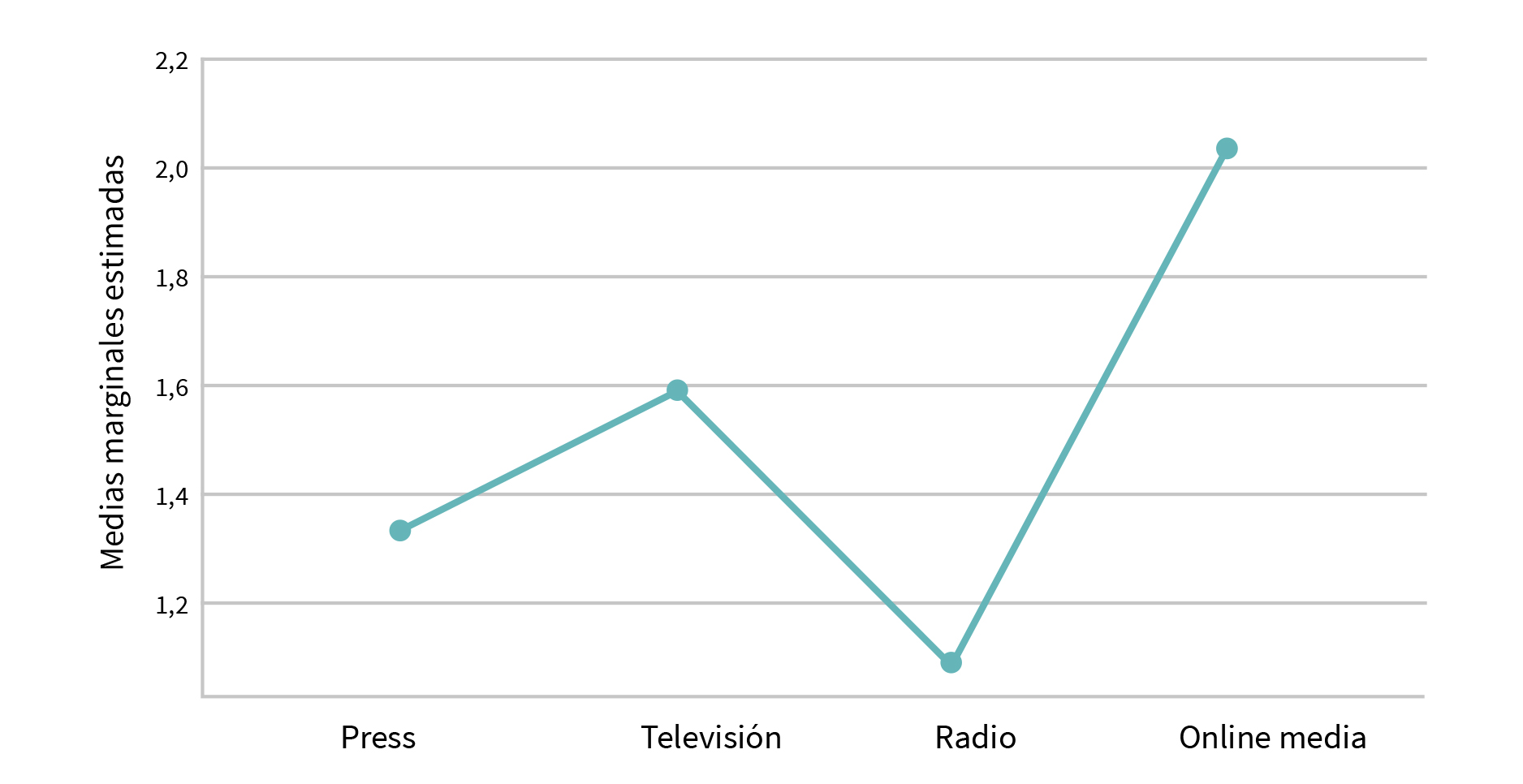
Regarding the number of sources, almost a quarter (24.8 %) of the news items produced by the media analyzed in Colombia lacked sources of information. A total of 38.2 % of the news stories relied on a single source, while 18.3 % included 2 sources. On the other hand, 14.2 % of the news reports used between 3 and 4 sources, and only 4.5 % was based on five or more sources. The following graph, obtained through a univariate analysis using Bonferroni's comparison method, shows the average number of sources used in the media.
Figure 1 shows that the highest average of sources used was found in online media, with an average of 2.03 sources per news item, followed by television with an average of 1.59 sources, printed press with 1.34 sources, and radio with 1.09 sources. These findings indicate that online media, on average, drew on a broader range of sources than their counterparts. One possible explanation for this greater plurality is the higher editorial flexibility of digital newsrooms. Without rigid production routines or legacy structures, these platforms may have had more room to incorporate a diversity of sources and voices, even under the constraints of the pandemic. Their workflows tend to be more adaptive, and their teams often operate with fewer layers of control, which can open space for different perspectives to emerge in coverage.
When considering the results of the Bonferroni's analysis (p = 0.00), which show significant differences in the number of sources used according to the type of media, it can be observed that both online and television media used considerably more sources than printed press and radio, with mean differences ranging from 0.25 to 0.94. To complement this finding, an analysis was made on the diversity of viewpoints in the sources utilized.
A closer look at the news content shows that 24.8 % lacked multiple perspectives in their sources. Another 58.8 % of the stories presented unilateral coverage, based on a single point of view. Only 16.4 % included a diversity of perspectives, showing limited representation of different opinions in media reporting. At a more specialized level, 96.7 % of the news items did not include expert sources. This limited range of sources and viewpoints may have undermined the quality of information provided during that time.
The data in Table 2 reveal noticeable differences among the various types of news media in terms of diversity of views and use of specialized sources. In television, 66 % of the stories relied on a single-source perspective, reflecting a tendency toward unilateral coverage. Radio and printed press followed with similar levels, at 52.6 % and 52.4 % respectively. In contrast, online media showed greater variety, with 27.8 % of its content incorporating multiple sources and viewpoints.
In the case of television, this reliance on single-source reporting may result from tight time constraints, high dependence on official briefings, and the format's preference for clear, authoritative messages. However, it also reflects limited room for contrast or deliberation, which reduces the depth of the coverage. When many stories echo a single voice, opportunities for scrutiny and democratic debate are significantly diminished. These practices, while shaped by the operational demands of TV journalism, have tended to favor official narratives over diverse interpretations of the crisis. This dynamic reinforces concerns about the vulnerability of traditional media to institutional dominance in times of emergency, narrowing public understanding and sidelining marginalized or dissenting voices.
As for the use of expert voices, the printed press recorded the highest percentage (4.2 %), with comparatively higher attention to specialized information. These contrasts point to the relevance of examining how each media type approached pandemic coverage, given its potential impact on how the public understood and processed the events.
These results empirically support the two hypotheses posed in this study. H1 is confirmed through the Bonferroni test (p < 0.05), which revealed significant differences in the average number of sources used across media types, being notably higher in online and television outlets. This pattern aligns with the structural flexibility of digital platforms and audiovisual formats, which tend to accommodate a broader range of perspectives.
Similarly, H2 is supported by the statistically significant association between media type and the topics prioritized in coverage (Cramer's V, p < 0.05). The thematic focus varied consistently across platforms, reflecting distinct editorial logic and audience dynamics. Altogether, these findings illustrate how the Colombian media system filtered the pandemic through differentiated sourcing practices and thematic emphases, depending on the platform.
Discussion
In this study, we aimed at researching the types of news, news topics, and predominant sources in news production during the first year of the COVID-19 pandemic in Colombia, as well as analyzing whether there are differences in this coverage according to the type of news media. The results discussed below provide an insight into the informative dynamics in this critical period.
In line with the literature reviewed, the findings reveal that during the pandemic period in Colombia, the media played a key role in reporting on the health crisis. The prevailing news formats, such as articles and short news stories, reflect the need to provide more detailed and up-to-date information to citizens, which according to Pavlik (2020) must fall in line with the social role of the media as providers of reliable information during public health emergencies.
COVID-19 occupied a central place in the Colombian news agenda, in line with previous studies that identified the virus and related diseases as key topics during pandemics (Tejedor et al., 2020). At the same time, the frequent appearance of topics such as politics, economics, and crime reflects the complexity of the situation and the need to address its multiple dimensions—an observation consistent with other pandemic contexts (Sweet et al., 2020).
The findings further highlight the predominance of state policy-related sources and the remarkable presence of citizen sources. This result aligns with prior research that emphasizes the importance of including a wide range of voices in pandemic coverage and avoiding the dominance of institutional actors (Garcés et al., 2021). Mellado et al. (2021) also found that this trend was present across different platforms and countries, pointing to a strong influence of the State in shaping pandemic-related news in Latin America. In their study of Chilean media on social networks, they showed that source diversity was shaped by the logic of each platform. Twitter, for example, tended to amplify a smaller range of voices and prioritized political sources over citizen ones. This reinforces the idea that platform dynamics shape whose voices are amplified or marginalized in crisis reporting.
Among the most revealing patterns, online media stood apart not only by volume but by the kind of journalism they practiced. They incorporated a broader range of sources and perspectives, even under the same constraints of remote work and institutional dominance. This may be due to the fact digital platforms—often more agile and less constrained by legacy routines—found greater room to operate in a context saturated with official narratives. This empirical trend reinforces H1, as the digital platforms showed statistically significant differences in the average number of sources used, compared to more traditional outlets. Their performance deserves closer attention, not as a replacement for traditional media, but as a counterweight capable of keeping plurality alive when consensus threatens to flatten the public conversation. This contrast highlights how editorial flexibility and production structure can either foster or inhibit pluralism, with direct consequences for the media's democratic function during public emergencies.
The lack of sources in a quarter of the news stories is worrisome, revealing the need to further guarantee the truthfulness and quality of the information brought forth. Beyond the absence of sources in nearly one out of every four news items, the data reveal a strikingly low engagement with expert voices. This underrepresentation of specialized knowledge during a public health emergency may have constrained the quality and depth of the coverage, limiting the media's ability to contextualize evolving scientific developments or address widespread misinformation. As Sanahuja and López-Rabadán (2022) found in the Spanish context, the use of expert and clearly identified sources was a central indicator of information quality in verification journalism, directly contributing to public trust and transparency.
The scarcity of expert voices and the limited plurality also reflect a broader editorial stance documented during the same period. According to Garcés-Prettel (2024), Colombian journalism in 2020 adopted a predominantly dissemination-oriented role, favoring neutral reporting over critical questioning. Within this framework, the press maintained a cautious stance, especially in a context shaped by health emergencies and social unrest. It avoided contentious topics and limited its engagement in more confrontational or investigative roles, as shown by the JRP report in Colombia, which found that fewer than three percent of news stories directly questioned political or economic actors.
Studies on news coverage during pandemics have reaffirmed these problems related to sources (López Veneroni, 2021). In this regard, Brennen et al. (2021) noted that, during this pandemic, information was often distorted or taken out of context, thus generating misinformation around COVID-19. Furthermore, the prevalence of one-sided coverage, coupled with a low percentage of diversity of views, reinforces the importance of ensuring a plurality of voices and stakeholders in the media. Van Antwerpen et al. (2022) also pointed to this in their analysis of information quality during health crises. Similar challenges were also documented on digital platforms, where the speed of publication and volume of information further complicated verification efforts.
This differentiated editorial behavior across platforms also reflects the uneven adoption of journalistic roles. For example, Garcés-Prettel (2024) documented a particularly limited civic role in Colombian journalism during the pandemic, with few stories that gave visibility to citizen voices or situated grassroots demands in context. This pattern is consistent with the low presence of social and human rights issues observed in this study.
In future research, it would be pertinent to explore the longitudinal evolution of media coverage during the COVID-19 pandemic in Colombia, comparing it with other international settings to better understand cultural and political influences. Another important step is to examine the impact of media coverage on public confidence and perceptions of risk. On the other hand, it has been suggested that an assessment be conducted on how the truthfulness and quality of information may have been compromised by the precariousness employment conditions faced by journalists—a phenomenon that was compounded in Latin America during the pandemic (De Frutos, 2022). These analyses could drill deeper into an understanding of the dynamics between media and pandemic management.
The findings offer several professional and ethical implications for journalism. The next section will outline final conclusions and recommendations seeking to promote reflection and improve the quality of information in future pandemics. As with any exploratory analysis, this study has limitations that must be acknowledged. The selection of eight mainstream media outlets, while representative of national news consumption, does not encompass regional or alternative media perspectives, which may have offered distinct narrative approaches. It is essential to take this into account in the new wave of measures that will be carried out for this study.
This broader context of editorial restraint had consequences beyond source selection and diversity. When journalism limits itself to echoing official bulletins, it narrows the space for democratic deliberation. At a moment that demanded scrutiny, empathy, and a plurality of perspectives, many newsrooms opted for safety over depth. This silence was not neutral; it shaped what could be questioned, what could be imagined, and ultimately, what the public understood about the crisis they were living through.
This discussion of sourcing and thematic patterns also resonates with the theoretical lens of journalistic role performance. While this study did not explicitly measure role enactment, the prevalence of official voices and the prioritization of certain topics over others are consistent with a dominant dissemination-oriented role, as described by Mellado (2014) and reaffirmed in the Colombian JRP report (Garcés-Prettel, 2024). This concept offers a useful lens to understanding how structural constraints may have shaped the selection of sources and thematic priorities and may have constrained the media's contribution to pluralism and public deliberation during the pandemic.
These editorial decisions also had a clear impact on how news topics were configured. As stated in H2, each media type showed distinct topic preferences during the pandemic, reflecting different editorial logics and constraints. Television focused on official narratives and health updates, radio leaned into political and legal matters, and the press emphasized crime and entertainment. This narrowing of topics reveals how structural limitations shaped the diversity of issues that made it into the news across different platforms.
A similar pattern was documented by Zunino and Arcangeletti Yacante (2022) in their analysis of digital newspapers in Argentina, where political framing and the evaluation of government actions led to a narrowly focused type of coverage. Their findings show that reporting tended to revolve around official narratives, often overlooking broader social impacts. In a related study, Zunino (2022) analyzed how vaccination news circulated on social media and found clear differences between the content prioritized by media outlets and the stories that generated the most engagement from users. These dynamics resemble the thematic trends identified in Colombian media and help frame the findings of this study within a broader Latin American context, where editorial choices and platform dynamics shaped what became visible and what was left out of public view. Taken together, these insights reinforce the second hypothesis: media type was associated not only with the volume of coverage, but also with the types of issues each platform prioritized.
This differentiated thematic focus confirms the presence of distinct editorial logics across platforms. Television prioritized government and health-related news, likely due to its broad audience reach and closer alignment with institutional sources. Radio leaned toward political and legal topics, reflecting its longstanding role as a space for civic dialogue and local debate. The press, on the other hand, focused on crime, sports and entertainment, which suggests a more commercial approach aimed at audience appeal. These editorial choices were not arbitrary. They responded to structural conditions such as ownership models, newsroom routines and the availability of resources. As noted by Hallin et al. (2023) and Mellado and Van Dalen (2014), these factors influence how journalism carries out its public service function. Recognizing how each media platform filters reality through specific thematic emphases helps to better understand the boundaries of pluralism and critical reflection in times of crisis.
Conclusion and Recommendations
The findings presented here offer not only a window into how news reporting unfolded in Colombia during the pandemic but also reveal key limitations in journalistic practice that deserve further reflection. Among these critical aspects are the prevalence of government sources, the absence of any sources in about a quarter of the news items analyzed, the predominantly unilateral coverage, and the limited range of sources and views in most of the news stories produced.
Instead of broadening the public debate on the pandemic, the news media reproduced institutional narratives, whilst downplaying other dimensions of the social and health impact of COVID. The differences in topic and source coverage across media types reveal a diversity of journalistic approaches to understanding and addressing the health crisis. These empirical insights pave the way for rethinking how news media can face future crises—through a type of journalism that not only records facts but also examines them with the rigor and perspective demanded by society.
In response to these findings, some recommendations are derived that may contribute to strengthening the quality of information in future pandemics, such as:
· Furtherance of the use of specialized sources: Journalists should be encouraged to seek information from experts in relevant fields to ensure more complete and accurate coverage before, during and after this type of health crisis. This aspect is a key factor, considering that the volume and type of information that was circulated around the COVID-19 virus generated harmful social responses and dispositions (López Veneroni, 2021).
· Diversification of the thematic coverage: It is important to expand coverage beyond the political and health aspects, addressing the social, economic, and environmental impacts of the pandemic more robustly in order to offer citizens a more comprehensive view of the situation.
· Encouragement of citizen participation: News media should actively engage citizens in generating informational content, promoting a greater diversity of perspectives and experiences.
· The need to promote the truthfulness and diversity of information: Media must ensure unbiased coverage that includes multiple sources and viewpoints, as well as rigorous verification of information to ward off misinformation. Garfin et al. (2020) recommend, as part of balanced coverage of pandemics, avoiding the use of sensationalism and disturbing images as methods of misinformation.
Insisting on diversity of sources is not merely a technical standard; it is a matter of public responsibility. Yet during the first year of the pandemic, the very structure of journalistic labor was under strain. Teleworking, closed institutions, and the absence of street reporting altered the rhythms of access. These conditions did not excuse the lack of voices, but they helped explain it. Future preparedness will depend not just on editorial will, but on structural readiness to uphold pluralism even when routines collapse.
Moreover, journalism schools and training programs should reflect on these findings to strengthen their curricular focus on crisis reporting. Equipping future journalists with the tools to navigate uncertainty, verify complex information, and seek out diverse and credible sources is essential for safeguarding the quality of public discourse in health emergencies. These recommendations, if considered, can help journalists and news media play a more effective role in disseminating reliable information and in building a more informed society that is better prepared to cope with public health challenges, such as the one we have experienced with the COVID-19 pandemic.
Ultimately, the COVID-19 pandemic calls attention to the urgent need for journalism that not only informs or disseminates, but also questions, contextualizes, and amplifies the voices of those most affected. In times of crisis, the role of the press cannot be limited to relying on official versions. It must act as a mediator for a comprehensive understanding of events, facilitate social dialogue, and serve as a guardian of pluralism and information accuracy. Recovering this civic role is not just an ethical imperative, but a democratic necessity. The lessons learned from this analysis should serve both as a diagnosis of past coverage and as a foundation for more responsive, inclusive, and accountable journalism in future emergencies.
Declarations: Conflict of Interest
The author declares no conflicts of interest related to financial, institutional, authorship, or sponsorship matters that may compromise the impartiality or integrity of this publication.
Data Integrity and Accuracy
The author guarantees the integrity of the data presented, the accuracy of the analysis conducted, and the reliability of all sources cited.
Ethical Considerations
This study did not involve human participants, minors, patients, or communities requiring informed consent or special publication authorizations. The research was based exclusively on public news content. Therefore, no ethical clearance involving human subjects was necessary beyond the institutional authorization previously granted for the project.
References
1. Barrera, A. D. (2021). Movilización social en pandemia: las protestas de septiembre del 2020 en Bogotá. Revista Ciudades, Estados y Política, 8(3), 79-93.
2. Brennen, J. S., Simon, F. M., Howard, P. N., & Nielsen, R. K. (2020). Types, sources, and claims of COVID-19 misinformation. RISJ Factsheets. Reuters Institute for the Study of Journalism. https://ora.ox.ac.uk/objects/uuid:178db677-fa8b-491d-beda-4bacdc9d7069
3. De Frutos, R., & Sanjurjo, S. (2022). Impacto del COVID-19 en el periodismo latinoamericano: entre la precariedad laboral y las secuelas psicológicas. Cuadernos.info, (51), 114-137. https://doi.org/10.7764/cdi.51.27329
4. Garcés-Prettel, M. (2024). Informe de los hallazgos de la segunda ola del JRP (Journalistic Role Performance Project. Universidad Tecnológica de Bolívar.
5. Garcés, M., Navarro-Díaz, L. R., Jaramillo-Echeverri, L. G., & Santoya-Montes, Y. (2021). Representaciones sociales de la recepción mediática durante la cuarentena por la COVID-19 en Colombia: entre mensajes y significados. Cadernos de Saúde Pública, 37(2). https://doi.org/10.1590/0102-311x00203520
6. Garfin, D. R., Silver, R. C., & Holman, E. A. (2020). The novel coronavirus (COVID-2019) outbreak: Amplification of public health consequences by media exposure. Health Psychology, 39(5), 355-357. https://doi.org/10.1037/hea0000875
7. Greene González, M. F., Cerda Diez, M. F., & Ortiz Leiva, G. (2022). Prácticas periodísticas en tiempos de pandemia de coronavirus. Un estudio comparado entre Chile y Colombia. Revista Comunicación, 21(1), 195-213. https://doi.org/10.26441/rc21.1-2022-a10
8. Hallin, D. C., Mellado, C., Cohen, A., Hubé, N., Nolan, D., Szabó, G., ... & Ybáñez, N. (2023). Journalistic role performance in times of COVID. Journalism Studies, 24(16), 1977-1998. https://doi.org/10.1080/1461 670X.2023.2274584
9. López Veneroni, F. (2021). De la pandemia a la infodemia. Revista Mexicana de Ciencias Políticas y Sociales, 66(242). https://doi.org/10.22201/fcpys.2448492xe.2021.242.79330
10. López, O., Rivera-Aguilera, G., González Benavente, R., Nova, C., García Villamil, B., & Forjan Espinoza, V. (2021). Narrativa épica, profesionales de la salud y pandemia: Análisis de medios en Chile y Colombia. Psicoperspectivas, 20(3), 18-29.
11. Mellado, C. (2015). Professional Roles in News Content: Six dimensions of journalistic role performance. Journalism Studies, 16(4), 596-614. https://doi.org/10.1080/1461670X.2014.922276
12. Mellado, C., Hallin, D., Cárcamo, L., Alfaro, R., Jackson, D., Humanes, M. L., et al. (2021). Sourcing pandemic news: A cross-national computational analysis of mainstream media coverage of COVID-19 on Facebook, Twitter, and Instagram. Digital Journalism, 9(9), 1261-1285. https://doi.org/10.1080/21670811.2021.1942114
13. Ministerio de Salud y Protección Social. (2022). Mortalidad en Colombia, periodo 2020-2021. MinSalud.
14. Mellado, C., & Van Dalen, A. (2014). Between rhetoric and practice: Explaining the gap between role conception and performance in journalism. Journalism Studies, 15(6), 859-878. http://dx.doi.org/10.1080/1461670X.2013.838046
15. Mellado, C., Cárcamo-Ulloa, L., Alfaro, A., Inai, D., & Isbej, J. (2021). Fuentes informativas en tiempos de Covid-19: Cómo los medios en Chile narraron la pandemia a través de sus redes sociales. Profesional de la Información, 30(4). https://doi.org/10.3145/epi.2021.jul.21
16. Papadopoulou, L., & Maniou, T. A. (2021). 'Lockdown' on digital journalism? Mapping threats to press freedom during the COVID-19 pandemic crisis. Digital Journalism, 9(9), 1344-1366. https://doi.org/10.1080/21670811.2021.1945472
17. Pavlik, J. V. (2020). Engaging journalism: News in the time of the COVID-19 pandemic. SEARCH: The Journal of Media and Communication Research, 13(1), 1-17. https://www.researchwithrutgers.com/en/publications/engaging-journalism-news-in-the-time-of-the-covid-19-pandemic
18. Polanco, N., Cediel, N., Benavides, E., & Villamil, L. C. (2021). Covid-19 como sindemia en la ruralidad colombiana: brechas y desigualdades. Equidad & Desarrollo, (37), 53-74.
19. Romero González, D. F. (2024). La autocensura periodística en el medio tradicional Radio Genial 106.9 FM: un análisis del impacto en la cobertura informativa (Bachelor's thesis, La Libertad, Universidad Estatal Península de Santa Elena, 2024).
20. San Miguel, A. R., Valenzuela, N. S. G., & Zambrano, R. E. (2022). Los profesionales de la información y las fake news durante la pandemia del covid-19. VivatAcademia, (155), 3.
21. Sanahuja Sanahuja, R., & López Rabadán, P. (2022). Source management as a quality criterion in verification journalism: Use and trends in COVID-19 coverage in Spain. Hipertext.net, 24, 9-22. https://doi.org/10.31009/hipertext.net.2022.i24.02
22. Sweet, M., Williams, M., Armstrong, R., Mohamed, J., Finlay, S. M., & Coopes, A. (2020). Converging crises: Public interest journalism, pandemics and public health. Public Health Research & Practice, 30(4). https://doi.org/10.17061/phrp3042029
23. Tejedor, S., Cervi, L., Tusa, F., Portales, M., & Zabotina, M. (2020). Information on the COVID-19 pandemic in daily newspapers' front pages: Case study of Spain and Italy. International Journal of Environmental Research and Public Health, 17(17), 6330. https://doi.org/10.3390/ijerph17176330
24. Van Antwerpen, N., Turnbull, D., & Searston, R. A. (2022). What's positive in a pandemic? Journalism professionals' perspectives on constructive approaches to COVID-19 news reporting. Journalism Studies, 23(4), 506-524. https://doi.org/10.1080/1461670x.2022.2032804
25. World Health Organization. (2022). Las muertes por COVID-19 sumarían 15 millones entre2020y2021. https://www.un.org/es/desa/las-muertes-por-covid-19-sumar%C3% ADan-15-millones-entre-2020-y-2021
26. Zunino, E. (2022). Brechas y concentración de la información: un estudio sobre agendas, encuadres y consumos de noticias sobre vacunas en el marco del Covid-19 en la Argentina. Revista de comunicación, 21(1),469-495. https://doi.org/10.26441/RC21.1-2022-A24
27. Zunino, E. A., & Yacante, C. A. (2020). La cobertura mediática de la COVID-19 en la Argentina: un estudio sobre el tratamiento informativo de la pandemia en los principales medios online del país. Prácticas de oficio. Investigación y reflexión en Ciencias Sociales, (25), 18-18. https://revistas.ungs.edu.ar/index.php/po/article/view/31
Annexes
Table 1. Information topics and predominant dissemination channels
Information |
News |
Percentage |
Media of |
Cramer's V |
COVID-19. |
1646 |
32 % |
Television |
0.00 |
Politics. |
1252 |
24.4 % |
Radio |
0.00 |
Government officials and legislators. |
1159 |
22.6 % |
Television |
0.00 |
Health Care in general. |
1101 |
21.4 % |
Television |
0.00 |
Crime and police actions. |
865 |
16.8 % |
Printed Press |
0.00 |
Sports. |
727 |
14.2 % |
Printed Press |
0.00 |
Economy. |
603 |
11.7 % |
Television |
0.00 |
Entertainment and celebrities. |
449 |
8.7 % |
Printed Press |
0.00 |
Courts and legal system. |
308 |
6 % |
Radio |
0.00 |
Human rights and other social issues. |
290 |
5.6 % |
Printed Press |
0.00 |
Accidents and natural disasters. |
283 |
5.5 % |
Radio |
0.00 |
Transportation. |
240 |
4.7 % |
Television |
0.01 |
Defense and homeland security. |
182 |
3.5 % |
Radio |
0.00 |
Campaigns and elections. |
169 |
3.3 % |
Radio |
0.00 |
Lifestyle. |
160 |
3.1 % |
Printed Press |
0.07 |
Environmental sustainability. |
158 |
3.1 % |
Printed Press |
0.00 |
Picket lines or protests. |
152 |
3 % |
Radio |
0.00 |
Culture in general. |
144 |
2.8 % |
Printed Press |
0.00 |
Employment and labor in general. |
119 |
2.3 % |
Television |
0.02 |
Science and Technology. |
119 |
2.3 % |
Online |
0.00 |
Education. |
110 |
2.1 % |
Radio |
0.00 |
Housing, infrastructure and public works. |
103 |
2 % |
Printed Press |
0.00 |
Renewable and non-renewable energy and resources. |
47 |
0.9 % |
Radio |
0.04 |
Religion. |
40 |
0.8 % |
Radio |
0.07 |
Source: Prepared by the authors.
Table 2. Differences between the diversity of viewpoints and the use of specialized sources according to the type of media
Source characteristics |
Printed |
Television |
Radio |
Online |
Absence of viewpoints. |
35.8 %* |
21.6 % |
33.9 % |
7.9. % |
Unilateral coverage with a single viewpoint, i.e., that of the source. |
52.4 % |
66 %* |
52.6 % |
64.3 % |
Multiple sources and viewpoints. |
11.8 % |
12.5 % |
13.5 % |
27.8 %* |
Use of specialized sources. |
4.2 %* |
3.7 % |
2.7 % |
2.7 % |
*Note: Asterisks mean that the difference is significant (Cramer V p-value < 0.05).
Source: Prepared by the authors.
Figure 1. Number of sources used according to media type
Source: Prepared by the authors.