
10.12804/revistas.urosario.edu.co/disertaciones/a.14990
ESTUDIOS
Eva Gómez Fernández 1
1 Universidad de Cantabria (España)
 evagomezfer22@gmail.com
Received: October 30,2024
Approved: April 27,2025
Prepublication date: June 17,2025
To cite this article: Gómez Fernández, E. (2025). "Bolshevists are on the rise!". Political cartoon and cinema as ideological means to spread the first red scare. Anuario Electrónico de Estudios en Comunicación Social "Disertaciones", 18(2). https://doi.org/10.12804/revistas.urosario.edu.co/disertaciones/a.14990
ABSTRACT
This study delves into American anti-communist propaganda of 1919, revealing how political cartoons and silent films were strategically crafted to shape public opinion amid widespread social and political turmoil. The content analysis leads to several results. Through powerful symbols like the red flag and bomb-shaped helmets, propaganda instilled an exaggerated fear of communism, casting progressive ideologies as chaotic, treacherous, and a direct threat to societal stability. These intense depictions of radicals, alongside calls for local militias over centralized police, signal a deep-seated resistance to social equality and a reinforcement of traditional, patriarchal values in American society. By drawing on Anglo-Israelism and weaving in racial and anti-Semitic prejudices, this propaganda tapped into latent xenophobia, further dividing the social landscape. The portrayal of women who rejected conventional roles underscored opposition to modernization and feminist movements, revealing anxieties about social change. This research provides a critical perspective on these tools of influence, illustrating how propaganda techniques from the past still resonate in shaping public perceptions of ideological threats, and offering insight into the lasting power of media to direct political and social narratives.
Keywords: First Red Scare; anticommunism; United States; political cartoons; cinema.
RESUMEN
Este estudio explora la propaganda anticomunista estadounidense de 1919, mostrando cómo las caricaturas políticas y el cine mudo funcionaron como herramientas para moldear y manipular la opinión pública en un período de intensa agitación social y política. El análisis de contenido lleva a varios resultados. A través del uso de símbolos como la bandera roja y el casco en forma de bomba, esta propaganda fomentó un temor exacerbado hacia el comunismo y vilipendió las ideologías progresistas, asociándolas deliberadamente con el caos, la traición y la amenaza a la estabilidad social. Las representaciones exageradamente negativas de los radicales, junto con la promoción de milicias locales sobre fuerzas de policía centralizadas, reflejan una resistencia a los ideales de igualdad social y la reafirmación de valores tradicionales y patriarcales en la cultura estadounidense. La influencia de ideologías como el angloisraelismo y los prejuicios raciales y antisemitas reforzaron una xenofobia latente que impregnaba esta propaganda, mientras que la demonización de las mujeres que desafiaban roles tradicionales manifestaba una oposición a la modernización y al avance del feminismo. Este estudio ofrece así una perspectiva crítica sobre los mecanismos de manipulación en el contexto actual, ilustrando cómo estos instrumentos de propaganda siguen influyendo en la percepción pública de amenazas ideológicas.
Palabras clave: Primer Susto Rojo; anticomunismo; Estados Unidos; caricaturas políticas; cine.
RESUMO
Este estudo explora a propaganda anticomunista americana de 1919, revelando como caricaturas políticas e filmes mudos foram cuidadosamente elaborados para moldar a opinião pública em um período de intensa agitação social e política. A análise de conteúdo chega a vários resultados. Por meio de símbolos poderosos, como a bandeira vermelha e capacetes em forma de bomba, essa propaganda fomentou um medo exagerado do comunismo, retratando ideologias progressistas como caóticas, traiçoeiras e inerentemente desestabilizadoras. As representações intensas de radicais, juntamente com apelos por milícias locais em detrimento de uma polícia centralizada, refletem uma forte resistência à igualdade social e um reforço de valores tradicionais e patriarcais na sociedade estadunidense. Ao incorporar elementos do anglo-israelismo e expressões de viés racial e antissemita, essa propaganda despertou uma xenofobia latente, aprofundando as divisões sociais. As representações de mulheres que desafiavam papéis tradicionais destacaram a resistência à modernização e ao avanço feminista, revelando ansiedades em torno das mudanças sociais. Ao oferecer uma análise crítica desses mecanismos, o estudo demonstra como técnicas de propaganda antigas continuam a moldar percepções públicas sobre ameaças ideológicas, trazendo à tona o poder duradouro da mídia de influenciar narrativas políticas e sociais.
Palavras-chave: Primeira Ameaça Vermelha; anticomunismo; Estados Unidos; caricaturas políticas; cinema.
Introduction
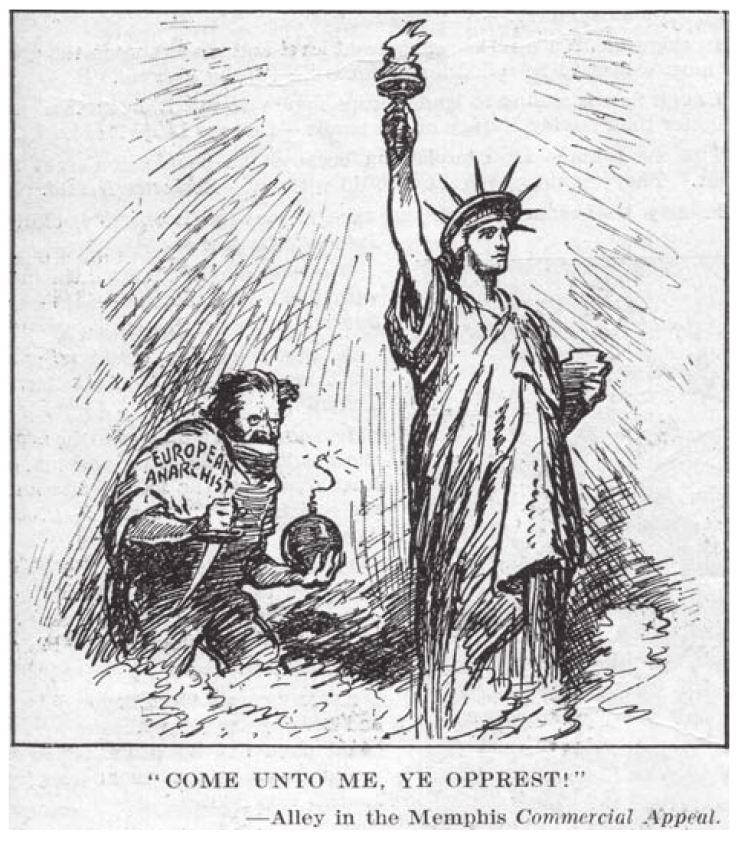
"Come Unto Me, Ye Opprest" (Figure 1) is a political cartoon created by James P. Alley, first published in the Memphis Commercial Appeal and later featured in diverse American newspapers. The cartoon's title mimics an Eastern European accent using an English linguistic variation. It depicts two main figures: a disheveled European man carrying a bomb, portrayed as an anarchist, and the Statue of Liberty. The man appears to threaten the Statue of Liberty, symbolizing the perceived danger that immigrants pose to the nation. Thus, the cartoon embodies anti-communist sentiments and a pronounced anti-immigration stance against Europeans.
Figure 1
Source: The Billy Ireland Cartoon Library & Museum.
This cartoon is a crucial example of how the press influenced American perceptions during the First Red Scare, which lasted from 1919 to 1920. This period was marked by intense fear of communism and anarchism, fueled by the aftermath of the Russian October Revolution of 1917. Similar movements in Italy, known as the Red Biennium or Biennio Rosso, involved anarchist and socialist uprisings in Northern Italy.
In the United States, anxiety over communism and anarchism was intensified by violent incidents such as the terrorist attacks orchestrated by followers of Luigi Galleani, as well as the activities of notable figures like Lithuanian anarchist Emma Goldman and Swedish unionist Joe Hill. Goldman was known for advocating sexual freedom and early ideas on birth control, while Hill, a member of the Industrial Workers of the World (IWW), used protest songs to promote communist and libertarian ideals (Foner, 1965). The events of 1919 provided a pretext for anti-immigrant, anti-communist, and anti-anarchist agendas (Bennett, 1995, pp. 183-198).
This atmosphere of fear and repression foreshadowed the later McCarthyism era, which began in the late 1940s and extended into the 1950s. Named after Senator Joseph Raymond McCarthy, this period involved a systematic campaign to identify, persecute, and ostracize suspected communists. McCarthyism particularly targeted artists and progressives in Hollywood. The film industry, with its strong nationalistic values, produced Christian fundamentalist propaganda, including works by Cecil B. DeMille such as Samson and Delilah (1949), The Ten Commandments (1956), and Ben-Hur (1959) (Mendes, 2015, pp. 250-254). McCarthyism gained prominence due to its context within the Cold War, a global struggle between the Eastern Bloc, led by the Soviet Union under Joseph Stalin, and the Western Bloc, represented by the United States under President Harry S. Truman.
On these pages, different political cartoons from the First Red Scare will be analyzed. Understanding these cartoons as carriers of a hegemonic narrative becomes more accessible through the study of this propagandist typology. Consequently, the following questions need to be addressed:
1. What visual elements in the political cartoons contribute to the anticommunist narrative?
2. Are there any recurring symbols or motifs in the cartoons and silent films that strengthen the hegemonic narrative against communism?
3. How did political cartoons and silent film serve as effective tools for shaping public opinion during First Red Scare?
As a result, it will be confirmed that the political cartoon worked as a propagandist tool to mold a biased public opinion that joined into the echo chamber. In other words, that phenomenon strengthens ideological polarization by rejecting the substance of another ideological sign. Thus, a visual message that people decoded was easily understood by those from even the most fragile social strata and those who were not highly literate.
Methodology
This research employs a mixed methodology that integrates cultural studies with political communication. Within the framework of cultural studies, it has been developed a specialized hermeneutical approach for analyzing political cartoons, which are central to this study. The analysis focuses on eight cartoons created by various illustrators between 1919 and 1920, all published in media outlets with a clear anti-communist bias. Hermeneutic analysis is indispensable in the study of political propaganda, as it enables a deep exploration of the symbolic and ideological layers within media texts. Beyond mere description, this approach interrogates how meaning is constructed and communicated, revealing the subtle mechanisms through which power, fear, and ideology are encoded in visual and narrative forms. Applied to the case of anti-communist propaganda during the First Red Scare, it allows for the interpretation of recurring visual motifs and narrative strategies, such as the portrayal of Bolsheviks as existential threats or the stigmatization of feminist figures, that served to legitimize repression and reinforce dominant social hierarchies. By situating these images within their broader historical and cultural frameworks, hermeneutic analysis reveals how propaganda mobilized collective anxieties to construct a polarized vision of society.
Furthermore, the integration of hermeneutics with political communication theory and cultural studies enriches the methodological foundation of the research. It facilitates a multi-layered reading of media texts, uncovering both their explicit content and the implicit values they convey. In doing so, this approach not only deepens our understanding of early 20th-century ideological narratives but also offers critical insights into the enduring mechanisms of propaganda in contemporary digital environments.
On the one hand, the eight cartoons are part of The Billy Ireland Cartoon Library & Museum collection at Ohio State University, accessed through The Opper Project —an educational initiative named after the American cartoonist Frederick Burr Opper. While The Opper Project provides explanatory lessons and exercises for high school students, the content of this article is specifically tailored for a university audience. The decision to analyze political cartoons from this collection reflects both a strategic methodological approach and a commitment to engaging with historically grounded, culturally significant visual media. As one of the most comprehensive repositories of American cartoon art, the library offers unparalleled access to materials from the early twentieth century —a period that directly coincides with the First Red Scare and the rise of ideological propaganda in visual form. From a methodological standpoint, the institutional curation and archival rigor of the collection ensure both the authenticity and contextual integrity of the selected materials. This allows for the construction of a representative and analytically robust corpus, guided by criteria such as symbolic recurrence, narrative structure, and ideological intensity.
Crucially, the visual texts housed in the collection offer extraordinary iconographic complexity. These cartoons function not merely as ephemeral illustrations but as culturally embedded artifacts that distill and dramatize the political discourses of their time. Their use of satire, exaggeration, allegory, and personification invites a hermeneutic analysis capable of uncovering latent meanings, ideological subtexts, and affective strategies. Framed within the interdisciplinary lens of political communication and cultural studies, these images become powerful entry points for examining how fear, nationalism, and moral panic were mobilized through visual rhetoric.
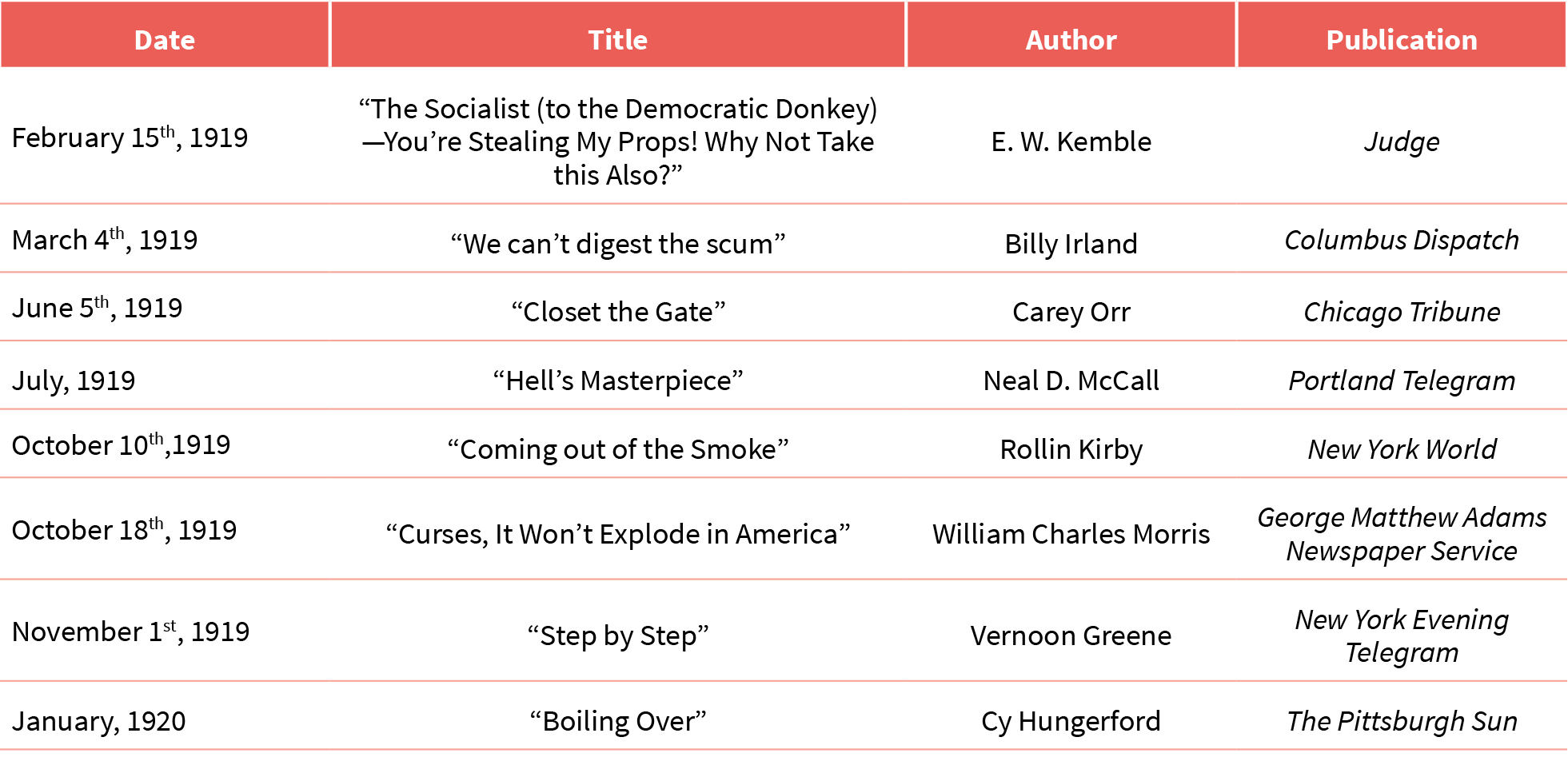
Additionally, this research includes a table featuring political cartoons from various newspaper archives. Note that two dates in the table are incomplete due to the unavailability of references (Table 1). These samples were selected because, in the author's view, they best illustrate the objectives of the paper.
Table 1
Source: Own elaboration.
This iconographic framework offers valuable insights into how hegemonic discourse was articulated and spread through the media of the time, including periodicals, newspapers, journals, and magazines. These media not only shaped public opinion but also actively created it, serving as tools for societal indoctrination. Despite some scholars' skepticism about the role of visual imagery in research, images —often considered historical artifacts— are crucial in constructing and conveying discourse through their iconographic content (Ferro, 1980, pp. 18-22).
Political cartoons, a distinct form of artistic expression, are particularly effective at redirecting ideological, social, and political critiques. They achieve this through satire or by employing a dichotomous Us versus Them framework. As ideological conduits, visual narratives play a pivotal role in political communication, often functioning as echo chambers (McDonnell & Werner, 2019). These echo chambers amplify specific discourses, particularly those aligned with far-right ideologies, through selective news reporting. By systematically excluding opposing viewpoints, they contribute to ideological polarization. This issue is increasingly relevant in today's digital era, where platforms like Telegram and WhatsApp often disseminate news that distorts reality or presents partial truths (Grómping, 2014, p. 42).
The crucial role of visual media in disseminating political messages cannot be overlooked. Cartoons, political caricatures, and memes are meticulously designed using specific semiotic codes, making their messages readily understandable to a broad audience. Visual communication as a tool to bridge literacy gaps is not a contemporary development. Ancient civilizations such as Egypt, Mesopotamia, and pre-Columbian societies employed visual strategies to address widespread illiteracy. Despite significant advancements in literacy during the early 20th century, the dominance of visual media over text has only intensified.
The image communicates a message in a country like the United States, where, even now, approximately 54 % of individuals aged 16 to 74 are classified as literate, yet many of them struggle with texts intended for eleven-year-olds (Schmidt, 2022). This phenomenon can be traced to enduring sociohistorical frameworks. As Isenberg (2017, p. 135) pointed out, British colonists in America perpetuated a hierarchical social structure akin to the British Crown's peripheral fringes, where social mobility was severely restricted and protections for the disadvantaged were minimal. While Black slaves and their descendants faced extreme social subjugation, impoverished whites, labeled as "Poor White Trash", also occupied a marginal societal position. However, they retained a paradoxical advantage over African Americans and Asian immigrants: the privilege of whiteness (Berlet & Lyons, 2016, pp. 20-40). Within this archaic notion of whiteness, far-right-affiliated political cartoons served as crucial vehicles for disseminating ideologies that highlighted perceived threats from the October 1917 Russian Revolution. This revolution, which led to the overthrow of the Romanov dynasty, sought to introduce values starkly contrasting with American imperialist principles. The U.S. administration viewed Lenin's vision of democracy as fundamentally incompatible with its own political and ideological framework. Ideologues employed conspiracy theories to indoctrinate a vulnerable public.
Regarding the cinema analysis, it has been chosen a silent film from 1919, Bolshevism on Trial. Bolshevism on Trial is based on Thomas Dixon Jr.'s novel Comrades: A Story of Social Adventure in California (Brundage, 2009, p. 29). The novel reflects four core aspects of American nationalism: Christianity, nativism, criticism of democracy, and a heteropatriarchal order. The fifth aspect, racial discrimination, is absent for two reasons: the 1915 film The Birth of a Nation faced backlash for its racist portrayal of the Ku Klux Klan, and President Wilson's praise of it was controversial. Additionally, Bolshevism on Trial focuses mainly on anti-communist sentiments in Europe and America, making racial discrimination a less central theme (Bennett, 1995, p. 184).
This period has been selected for analysis due to its frequent neglect in academic studies, which have largely concentrated on more prominent events like the Cold War and McCarthyism. This prevailing focus has overshadowed other significant facets of the era, leading to an incomplete and skewed understanding of historical developments. By turning our attention to this often-overlooked period, this paper aims to uncover and illuminate important topics and dynamics that have been unjustly marginalized in the dominant historical narrative
Analysis of the content
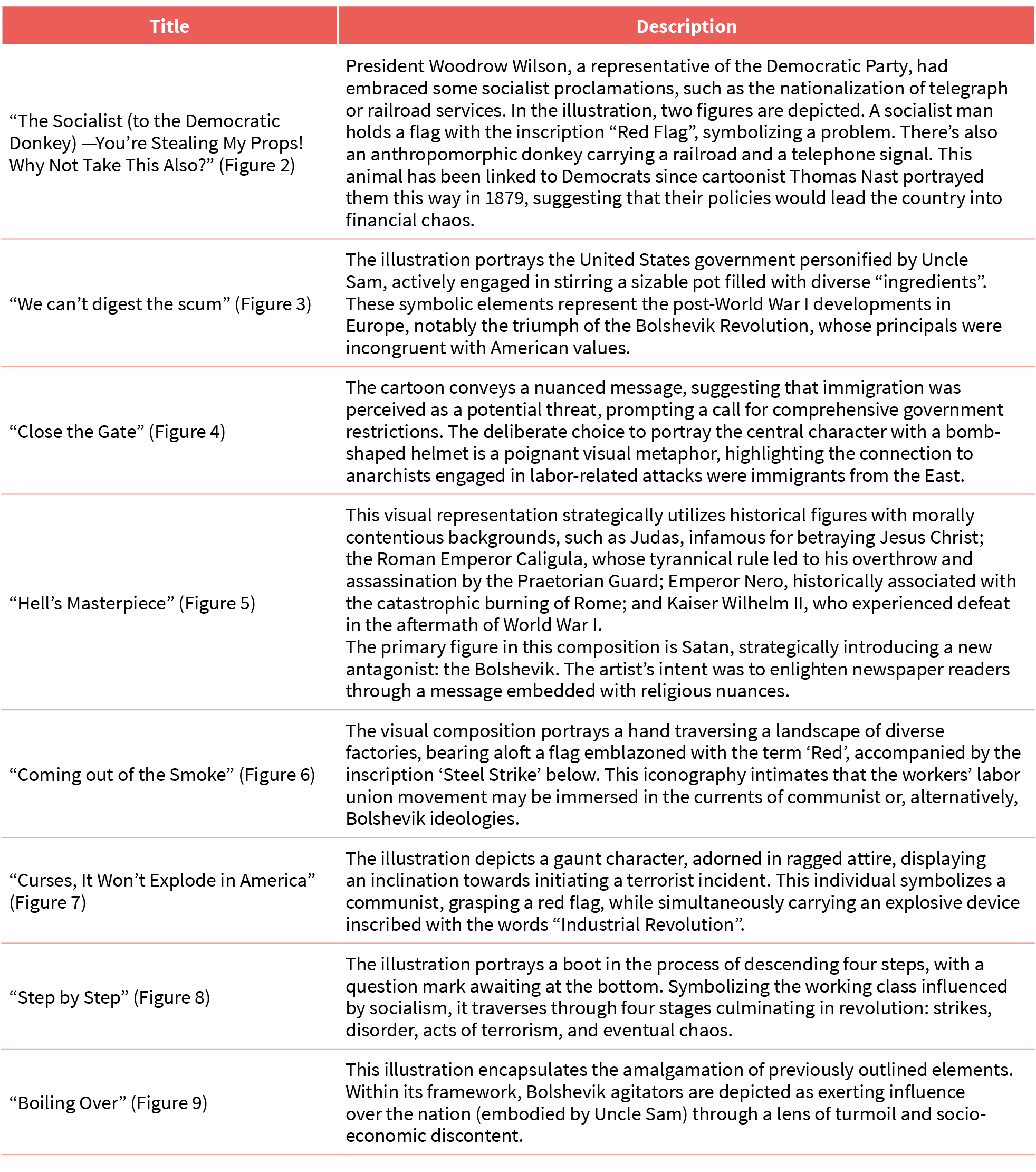
The following table (Table 2) presents a detailed examination of selected political paintings, organized into two columns. The first column lists the titles of the paintings, while the second provides comprehensive descriptions of their content. This systematic approach is crucial for identifying recurring themes and interpreting the ideological symbols used by the artists.
Table 2
Source: Own elaboration.
The primary function of these political cartoons was to instill a pervasive sense of fear within the public, a fear that was perpetuated through two interconnected mechanisms. The first is what can be characterized as "social fear", a construct designed to deliberately provoke widespread panic within the population. In this regard, the media —specifically, the political illustrations disseminated through newspapers— played a crucial role in simplifying and distorting complex realities to fashion the image of a specific and identifiable enemy. This process of enemy construction was often aligned with the broader goals of the governing apparatus, which utilized fear as a strategic tool to legitimize repressive or authoritarian measures (Chomsky & Herman, 1988).
These caricatures did not merely engage the rational faculties of the audience but sought to invoke an emotional response, amplifying sentiments of insecurity and alertness. The imagery employed was typically exaggerated and grotesque, serving to caricature the alien, whether a political, social, or foreign group, as a significant threat to the nation's well-being, as well as its foundational cultural and moral values. As Umberto Eco (2011) perceived, the creation of an enemy serves a symbolic function, whereby the definition of a collective Us is solidified through the construction of a threatening Them. This process often serves manipulative purposes, helping to consolidate internal cohesion by directing public hostility outward.
Furthermore, the propagation of fear through these visual narratives was not merely a matter of immediate political expediency but also aligned with broader economic imperatives. The media, as a commercial enterprise, benefits from the monetization of fear. Sensationalist headlines and provocative imagery capture the attention of the public, ensuring continuous consumption of information. This, in turn, reinforces the self-perpetuating cycle of social fear, which the media exploits to sustain its audience and enhance profitability (Hobsbawm, 1994).
Political Cartoons
Cartoonists employed a variety of graphic techniques, primarily centered on exaggerating the physical traits of the figures depicted. This technique, commonly used to distort and amplify certain characteristics, served to demonize or dehumanize antagonists, transforming them into a visually tangible threat (Northrop, 2011). By doing so, the public was encouraged to perceive these figures as enemies of social order, traditional values, or political stability, deliberately manipulating how conflicts were understood. In particular, the graphic portrayal of radical or disruptive figures —especially those associated with left-wing movements— aimed to instill distrust and rejection, steering the viewer toward a specific interpretation shaped by the sociopolitical context of that historical moment (Cohen, 2002).
The foundation of anti-communist graphic representation lies in the Industrial Revolution. This process radically transformed the economic and social structure of the time and was regarded by many as a disruptive force. Technological advancements and the mechanization of production led to a profound reorganization of labor relations, creating a new economic system: capitalism (Hobsbawm, 1999). However, this shift also gave rise to social tensions, reflected in the growing class struggle. The fear of progress, depicted in many cartoons, did not stem from technological change itself, but from its social and political consequences. The rise of the working class and the organization of labor sparked a series of strikes and protests that were interpreted as threats to the established order. The labor movement, heavily influenced by socialist and anarchist ideologies, gained strength, intensifying fears of a revolution that could destabilize the capitalist system in countries like the United States and Europe (Chilly & Wood, 2014).
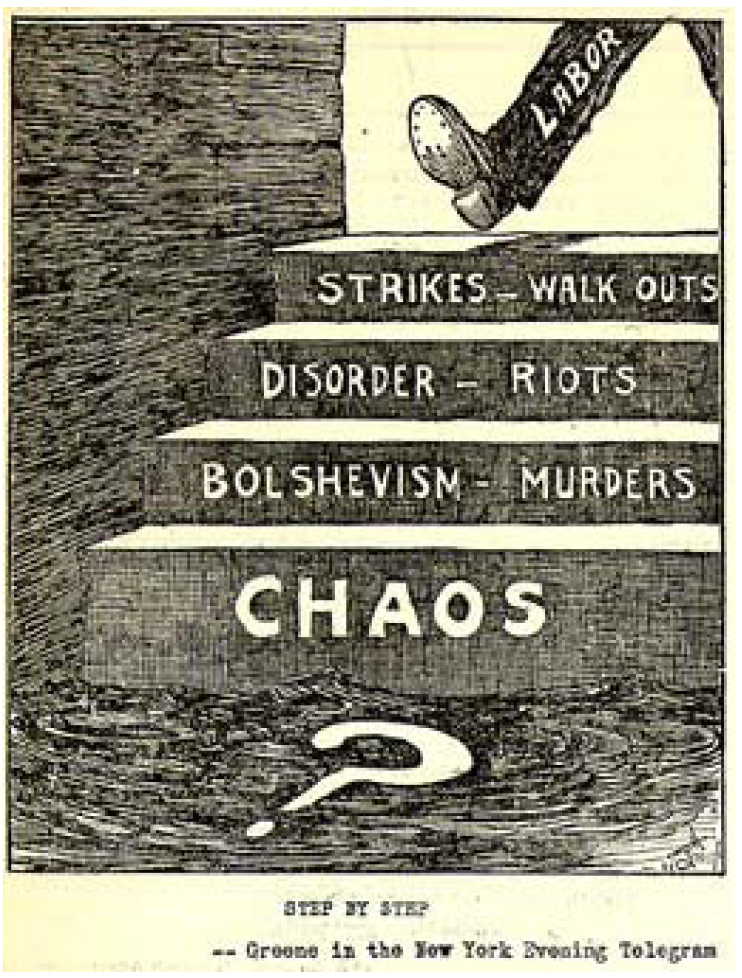
These fears were not unfounded, as revolutionary movements like the Bolshevik Revolution in Russia, which had a global impact, created panic among Western elites. The possibility that these radical ideas might spread to other countries, particularly the U.S., led to an atmosphere of paranoia and repression (Mudde, 2018, pp. 5-10). This anxiety was powerfully reflected in the visual propaganda of the era, as seen in Figure 8, where the revolutionary proletariat is depicted as a threat to the nation's social and economic fabric.
Figure 8
Source: The Billy Ireland Cartoon Library & Museum.
In response to this climate of fear and social unrest, governments enacted repressive measures. A notable example is the U.S. Sedition Act of 1918, which aimed to combat radical propaganda and curb the rise of movements perceived as domestic threats (Avrich, 1991). This law was part of a broader effort to contain the spread of socialist and anarchist ideas, which were seen as dangerous to the nation's stability. In cartoons like those depicted in Figures 3 and 9, Uncle Sam, symbolizing the American nation, is shown fighting to maintain control in the face of the growing threat of radicalism.
Figure 3
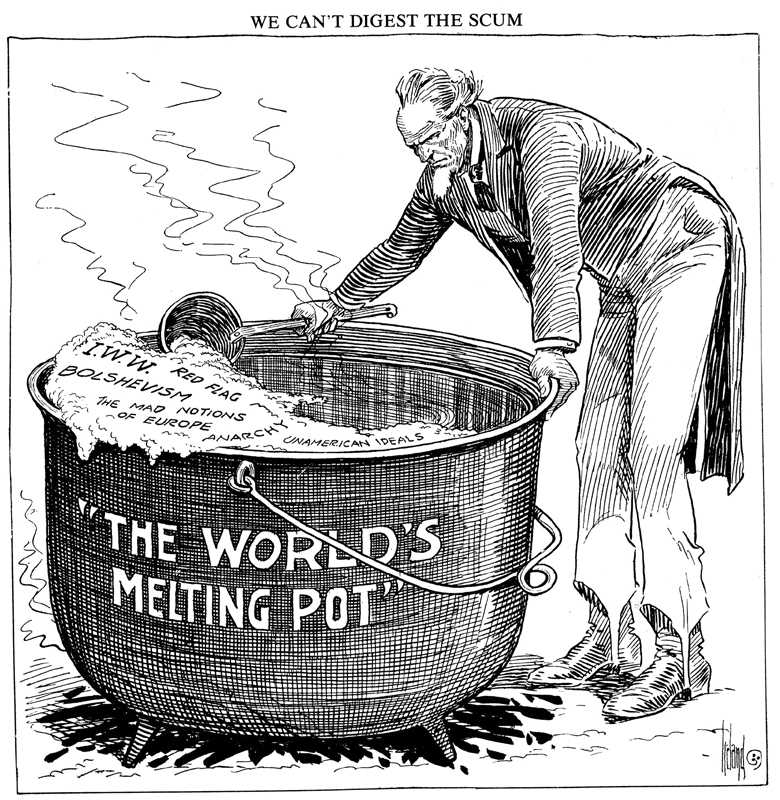
Source: The Billy Ireland Cartoon Library & Museum.
Figure 9
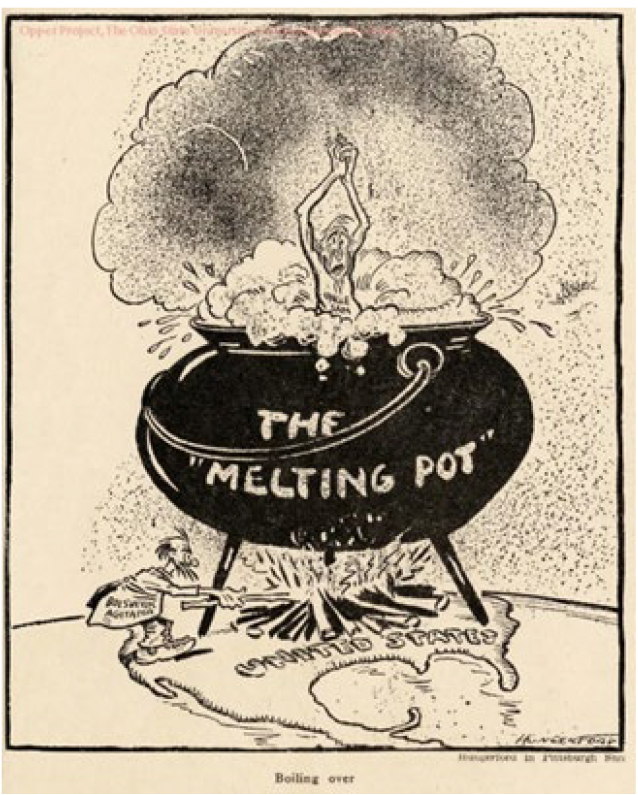
Source: The Billy Ireland Cartoon Library & Museum.
Another significant episode linked to this fear was the Palmer Raids, a series of U.S. government operations beginning in 1919 aimed at repressing radicals and left-wing activists. These raids, which fueled a wave of xenophobia and social polarization, sought to neutralize any perceived internal revolutionary threat. The image of the radical immigrant, seen as a carrier of dangerous ideas, became a frequent target in these cartoons, reinforcing the idea that foreigners posed a danger to national stability.
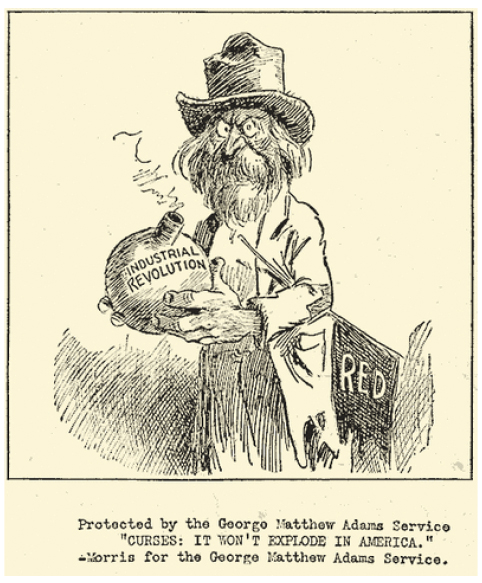
In this context, specific symbols associated with anti-communism and hostility toward immigration became crucial. One key example is the red flag, prominently featured in Figures 2, 6, and 7. This symbol, often accompanied by the word 'Red', was strongly linked to communism and revolution, immediately evoking a perceived threat to the prevailing social and economic order.
Figure 2
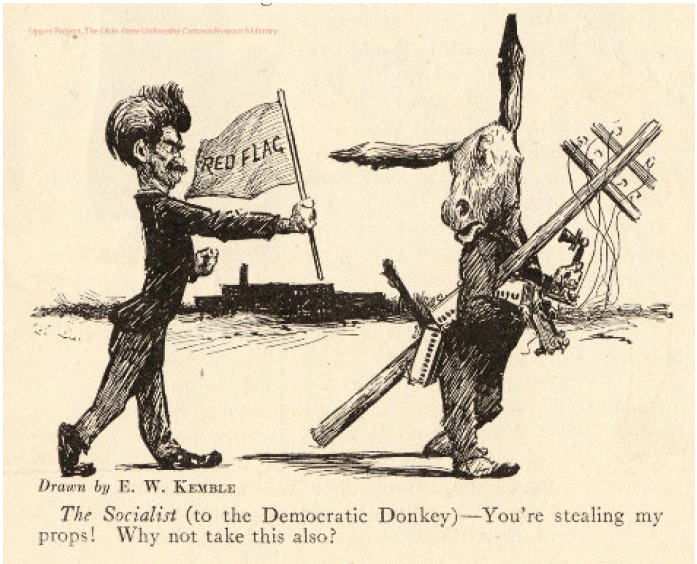
Source: The Billy Ireland Cartoon Library & Museum.
Figure 6
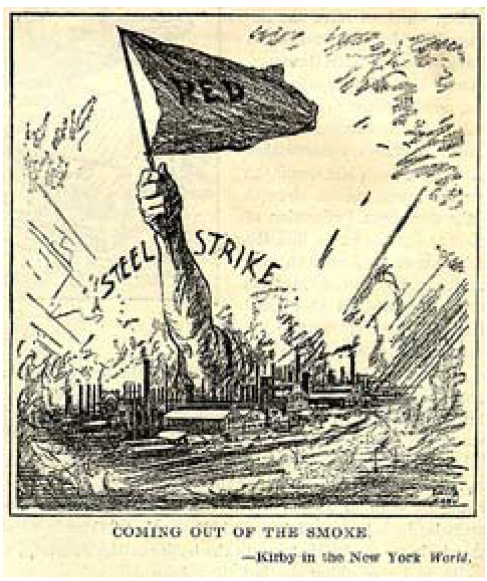
Source: The Billy Ireland Cartoon Library & Museum.
Figure 7
Source: The Billy Ireland Cartoon Library & Museum.
The red flag not only represented the labor struggle and the revolutionary ideas born out of the Bolshevik Revolution but also became an emblem of widespread fear regarding the rise of socialist and communist ideologies in the West. In these cartoons, its presence reinforced the perception that radical movements, often connected to immigration, could disrupt national stability. Red, traditionally associated with blood and violence, heightened the sense of impending danger, suggesting the possibility of a social uprising that could topple the established order, as depicted in Figure 9.
The use of this symbol in cartoons was deliberate and strategically positioned. Associating certain characters or groups with the red flag created a simplified but effective image of the enemy: communists, revolutionaries, and, in many cases, immigrants who were perceived as bearers of dangerous ideologies. The red flag, therefore, was not merely a visual element but a tool to stir latent fears in society, where the specter of communism intertwined with anti-immigrant sentiment, particularly against those from Eastern Europe, where socialist ideas were gaining ground.
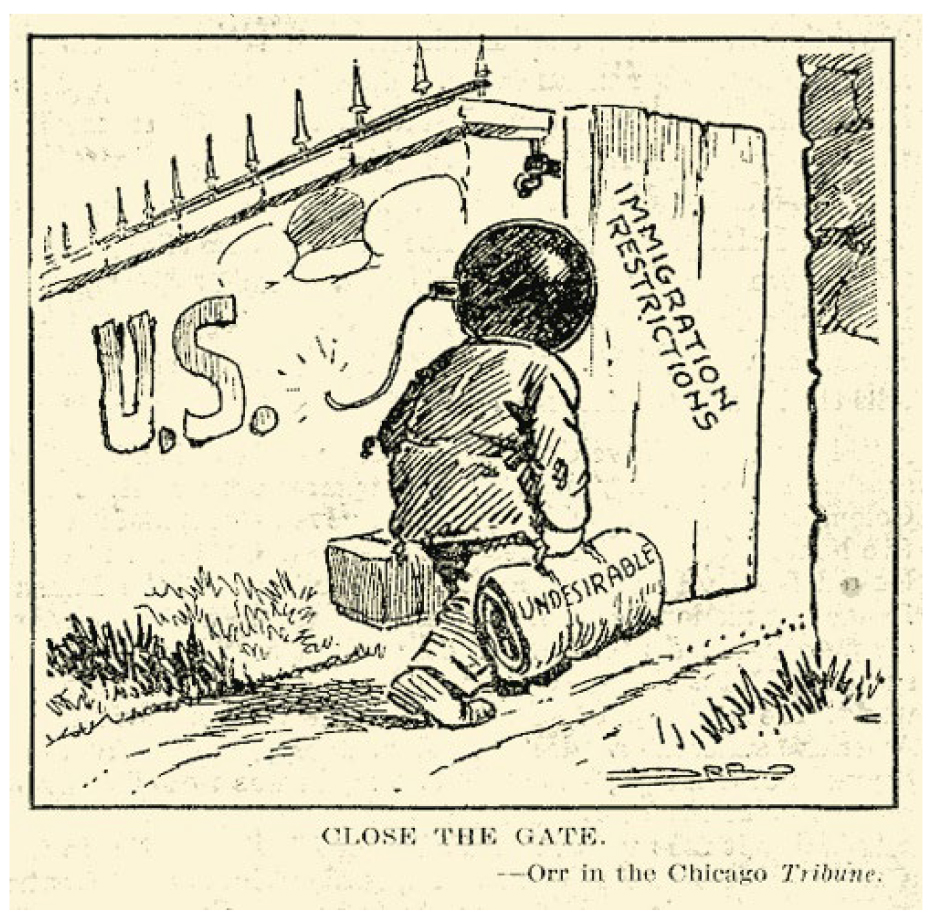
In this regard, the bomb-shaped helmet seen in Figure 4 is especially suggestive. This helmet, symbolizing the violence and chaos associated with these movements, is worn by a character portrayed as an immigrant from Eastern Europe. The choice of this graphic element was no accident: it emphasized the idea that immigrants brought radical and dangerous ideologies, such as anarchism and communism, and that their arrival in the United States posed a risk of attacks and unrest. This headgear reinforced American nativism —the rejection and hostility toward immigrants, particularly those from regions where these ideologies were on the rise, such as Russia or Eastern Europe (Mudde, 2018, pp. 20-29). In the first half of the 20th century, this nativism intensified, and the figure of the radical immigrant, supposedly arriving to destabilize the country, was used in numerous forms of visual propaganda to justify immigration restrictions and the repression of leftist movements.
Figure 4
Source: The Billy Ireland Cartoon Library & Museum.
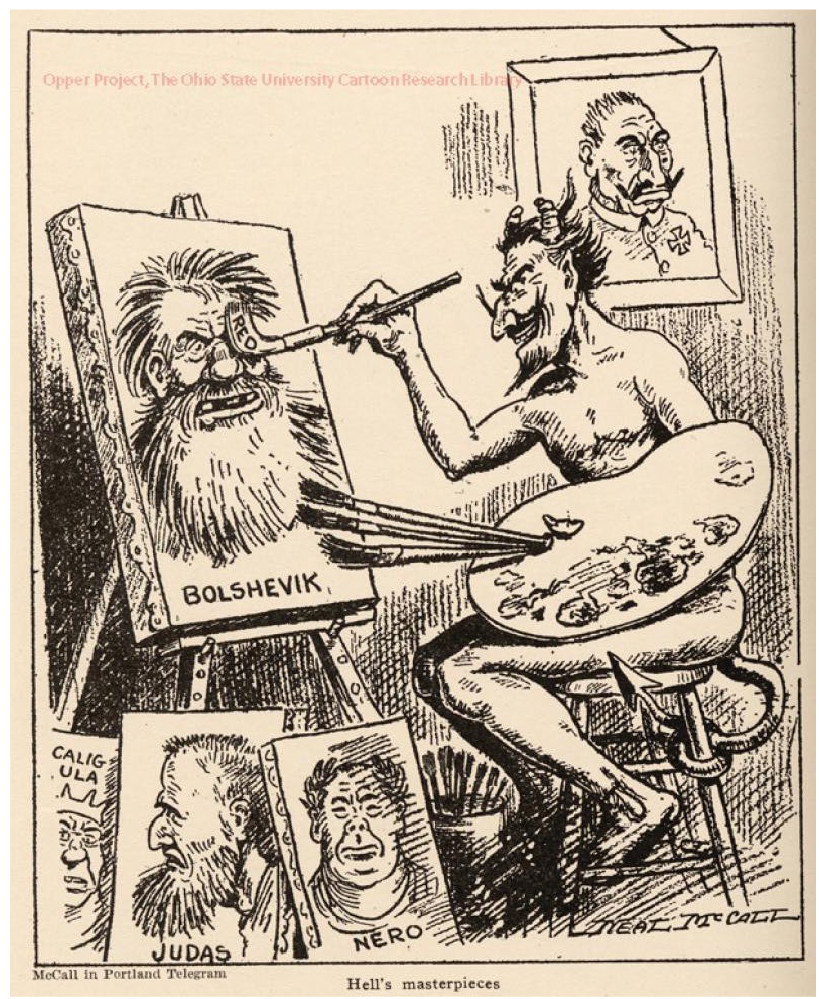
This worldview aimed to plant in the collective imagination the idea that communist, anarchist, and Bolshevik regimes would inevitably lead to chaos and ultimately result in tyranny. These ideologies were thus associated with tyrannical and destructive figures, often depicted negatively in the cartoons. An extreme example can be seen in Figure 5, where Bolshevism and communism are symbolically ruled by the devil. While the use of this biblical figure is not common in all illustrations, its appearance underscored the morally condemnatory view of these movements, reinforcing the notion that they were not only politically dangerous but also evil. In this context, the connection between American nativism and British Israelism cannot be overlooked —a belief that Americans were God's chosen people (Garnier, 1890). This ideology, deeply rooted in fundamentalist Christian circles, justified the demonization of those perceived as traitors to the nation and its core values. The inclusion of figures like Judas Iscariot in the cartoons is highly symbolic. Judas, known for betraying Christ, is here used as an emblem of disloyalty, representing communists, anarchists, and other radicals as traitors to the ideal of a divinely protected America.
Figure 5
Source: The Billy Ireland Cartoon Library & Museum.
In the referenced cartoon, Judas is accompanied by Roman emperors Caligula and Nero, as well as Kaiser Wilhelm II. The presence of the Kaiser is significant, as his defeat in World War I marked a turning point after which revolutionary movements like the Spartacist League emerged in Germany. This socialist-inspired group embodied the ruling class's fear that political instability could lead to a revolution, like what had occurred in Russia.
By including these figures, the cartoon does more than merely depict the external or internal enemies of the United States; it creates a narrative of moral and political collapse, linking the Kaiser's defeat and the rise of socialist movements with a broader threat that could extend globally.
Cinema: Bolshevism on Trial
The film, directed by Harley Knoles and guided by Baptist Thomas Dixon Jr., who infused it with his ideological views, serves as a propaganda tools that convey a patriotic and reactionary message, aligned with fundamentalist Christian values, while attacking communism, democracy, and feminism. It depicts Christianity, white supremacy, and patriarchy as core pillars of American society that must be defended against the perceived threats of communism and social reform. Furthermore, the work underscores the use of ideological and emotional manipulation to sway an audience that lacked the means to recognize the underlying propaganda.
The film begins with Colonel Worth, a World War I veteran, reading a newsreel during a break. He is shocked to learn that Barbara Bozenta, a wealthy young woman, is leading a political event promoting the benefits of communism. Worth's son, Norman, who has developed romantic feelings for Barbara and admires her concern for the underprivileged, tells his father that the initiative is commendable. In response, Colonel Worth, who has amassed a fortune, decides to purchase an island to conduct a small-scale experiment with a communist regime. He names it Paradise Island. Worth's goal is to show his son that communism leads only to misery, destruction, famine, and the rise of a corrupt political elite.
As predicted, the experiment fails because Barbara is manipulated by Herman Wolff, a scheming and undesirable figure who uses the political process to establish a dictatorial regime. Wolff creates a state police force called the Red Guard, legalizes divorce, and denies the existence of God. When Barbara discovers Wolff's deception, she feels betrayed. Attempting to escape, she is attacked by Wolff, who tries to rape her. Fortunately, Norman intervenes just in time to stop him. Upon learning of the situation, Colonel Worth sends troops to overthrow the oppressive regime in the name of God.
The film is heavily propagandistic and contains misogynistic elements. Barbara is depicted as a noble-hearted woman who, by deviating from traditional domestic roles, makes mistakes due to her perceived lack of reasoning and mental inferiority. Additionally, the film incorporates two anti-democratic themes that align with American patriotism. First, it criticizes the establishment of centralized police forces, suggesting that they are prone to tyranny and should be replaced by local militias. This reflects extreme right-wing opposition to state-controlled police and support for community-based militias (Chip & Lyons, 2000, pp. 26-32). Second, it portrays democracy as corrupt, favoring social inequality where racial and religious minorities are subservient to the dominant groups (Dixon, 2008, p. 113). The film also emphasizes Christian fundamentalism as a counter to feminism, atheism, and communism.
The film's core themes are deeply misogynistic. Barbara is portrayed as a virtuous woman with a noble heart, but her deviation from traditional domestic roles is depicted as leading to mistakes due to her perceived lack of reasoning and mental inferiority. Additionally, the film contains two anti-democratic features that align with American patriotism.
First, it criticizes centralized police forces, represented by Worth in the film, echoing Thomas Dixon Jr.'s disdain for Washington, D.C. The film suggests that such forces are prone to tyranny and advocates for local militias governed by community interests instead (Chip & Lyons, 2000, pp. 26-32).
Second, Dixon Jr. viewed democracy as corrupt because it perpetuated social inequalities, where racial minorities were subservient to whites, religious minorities to Christians, and women to men (Dixon, 2008, p. 116). Christian fundamentalism is portrayed as a resistance against feminism, atheism, and communism.
The film emphasizes the importance of God, reflecting Dixon's shift from a brief political career to becoming a Baptist pastor. Dixon championed a theocentric social system supporting hierarchical inequalities (Dixon, 2002, p. 44). Anglo-Israelism, a branch of Christian fundamentalism, claimed that Anglo-Saxons were God's chosen people (Chip & Lyons, 2000, p. 121). This movement, rooted in 18th-century British theories, distorted history and religion to promote its agenda.
According to this belief, the Israelites were divided into two groups: Jews, descendants of the Kingdom of Judah, and British Israelites, associated with the Tribe of Joseph (Hine, 1902, p. 15). Joseph's descendants, Ephraim and Manasseh, were believed to represent the British and North Americans, respectively (Allen, 2017, pp. 68-73). This ideology fostered a sense of racial and cultural superiority, reinforcing a xenophobic and racist undercurrent with anti-Semitic implications. Herman Wolff, the film's antagonist, is depicted with features reminiscent of anti-Semitic caricatures, and some film covers reflect similar themes, including one showing a communist strangling a laborer.
The film also portrays modernization as undermining traditional gender roles, where women were expected to be submissive and handle domestic duties. This ideal, known as "The Angel in the House", emerged in Victorian times. As communism, socialism, and anarchism gained prominence, women who supported these movements were demonized and labeled with terms like "asexual", "nymphomaniac", or "defective" to emphasize their supposed inferiority (Dixon, 2008, p. 32).
Final remarks
To conclude, the examination of American anti-communist propaganda from 1919, through political cartoons and silent film, reveals a carefully orchestrated campaign designed to shape and manipulate public opinion amid intense social and political unrest. The deployment of potent symbols, such as the red flag and the bomb-shaped helmet, was not merely a means of amplifying fear about revolutionary movements and immigrants but also a strategy to vilify progressive ideologies.
The era's cartoons and films employed deliberately exaggerated and negative portrayals of radicals and communists, associating them with treachery and chaos. This approach was instrumental in cementing the belief that these ideologies represented an immediate threat to societal stability. Furthermore, the critiques of democracy and the advocacy for local militias over centralized police forces reflected a broader resistance to ideals of social equality, while reaffirming traditional and patriarchal values.
The influence of Anglo-Israelism and the presence of racial and anti-Semitic prejudices in the propaganda highlight the pervasive racism and xenophobia of the time. The demonization of women who challenged traditional roles, alongside the resistance to modernization and feminism, underscored a broader anxiety about preserving a conservative social order against reformist forces.
This study illustrates how propaganda and cinema not only reflect but actively construct social and political realities. By employing emotionally charged imagery and ideological messages, these media played a crucial role in shaping public opinion in alignment with a conservative and anti-communist agenda. Understanding these strategies provides valuable insights into the manipulation of public perception and the societal response to ideological threats.
The analysis of these historical materials not only sheds light on the dynamics of the past but also offers important lessons on the enduring power of propaganda in shaping political and social narratives. As contemporary societies face similar challenges, recognizing these mechanisms of influence can enhance our critical understanding of current propaganda and its effects.
References
1. Allen, J. H. (2017). Judah's Sceptre and Joseph's Birthright. A. A. Beauchamp.
2. Avrich, P. (1991). Sacco and Vanzetti: the anarchist background. Princeton University Press.
3. Bennett, D. H. (1995). The party of fear: the American far-right from nativism to militia movement. Vintage Books.
4. Berlet, C., & Lyons, M. N. (2016). Right-wing populism in America: too close for comfort. The Guilford Press.
5. Brundage, W. F. (2009). Thomas Dixon: American Proteus. In M. K. Gillespie & R. L. Hall (Orgs.), Thomas Dixon Jr. and the birth of modern America (making the modern South) (pp. 23-45). Louisiana State University Press.
6. Chilly, C., & Wood, L. J. (2014). Los movimientos sociales, 1768-2008 desde sus orígenes a Facebook. Crítica.
7. Chomsky, N., & Herman, E. S. (1988). Manufacturing consent: the political economy of the mass media. Pantheon Books.
8. Cohen, S. (2002). Folk devils and moral panics: the creation of the mods and rockers. Routledge.
9. Dixon, T. (2002). The Leopard's spots: a romance of the white man's burden. The Project Gutenberg.
10. Dixon, T. (2008). The clansman: an historical romance of the Ku KluxKlan. The Project Gutenberg.
11. Eco, U. (2011). Construir al enemigo y otros escritos ocasionales. Lumen.
12. Ferro, M. (1980). Cine e historia. Gustavo Gili.
13. Foner, P. (1965). The case of Joe Hill. International Publishers Co.
14. Garnier, J. (1890). Israel in Britain: a brief statement of the evidences in proof of the Israelitish origin of the British race. Robert Bank & Son.
15. Grómping, M. (2014). 'Echo chambers' partisan Facebook groups during the 2014 Thai election. Asia Pacific Media Educator, 24(1), 39-59.
16. Hine, E. (1902). The British nation identified with lost Israel. Robert Bank & Sons.
17. Hobsbawm, E. (1994). The age of extremes: the short twentieth century, 1914-1991. Abacus.
18. Hobsbawm, E. (1999). Industry and empire: the birth of the Industrial Revolution. The New Press.
19. Isenberg, N. (2017). White trash: the 400-year untold history of class in America. Atlantic Book.
20. McDonnell, D., & Werner, A. (2019). International populism: the radical right in the European Parliament. Oxford University Press.
21. Mendes, E. M. (2015). A cruz, o gládio e a espada: representações da história no cinema de Cecil B. DeMille. Coimbra University Press.
22. Mudde, C. (2018). The far right in America. Routledge.
23. Northrop, S. (2011). American political cartoons: the evolution of a national identity, 1754-2010. Routledge.
24. Schmidt, E. (2022, March 16). Reading the numbers: 130 million American adults have low literacy skills, but funding differs drastically by state. apm Research Lab. https://www.apmresearchlab.org/10x-adult-literacy
