10.12804/revistas.urosario.edu.co/disertaciones/a.14790
ESTUDIOS
Dren Gërguri1
Jonila Godole2
Muhamet Jahiri3
1 University of Prishtina (Kosovo
 dren.gerguri@uni-pr.edu
2 University of Tirana (Albania)
jonila_godole@yahoo.de
3 University of Prishtina (Kosovo)
0000-0002-0082-7089
 muhamet.jahiri@uni-pr.edu (corresponding author)
Received: August 22,2024
Accepted: February 6,2025
Prepublication: April 9,2025
To cite this article: Gërguri, D., Godole, J., & Jahiri, M. (2025). From likes to votes: a cross-border analysis of Facebook campaigning in Albania and Kosovo's 2021 elections. Anuario Electrónico de Estudios en Comunicación Social "Disertaciones", 18(2). https://doi.org/10.12804/revistas.urosario.edu.co/disertaciones/a.14790
ABSTRACT
This study explores online political campaigning during the 2021 national elections in Albania and Kosovo, emphasizing the role of Facebook as a primary campaigning platform amidst the Covid-19 pandemic. Rooted in the concept of issue ownership within political communication in the Western Balkan context, the research explores the main themes and tactics political parties use to secure the electorate's votes. Employing DigiWorld's manual coding of 2,056 Facebook posts over four weeks, our findings highlight significant disparities in engagement levels on key issues like health and economy, underlining the nuanced interplay between digital issue ownership and voter engagement. The content analysis research uncovered a surprising pattern: government parties showed higher engagement levels in Covid-19-related discussions, contrary to our expectations. However, opposition parties led interactions on all topics. Notably, posts on the economy, rural issues, employment, and infrastructure elicited stronger public engagement, emphasizing their significance in the digital political landscape.
Keywords: Covid-19; elections; Facebook; issue ownership; online campaigning; voter's engagement.
RESUMEN
Este estudio explora las campañas políticas en línea durante las elecciones nacionales de 2021 en Albania y Kosovo, haciendo hincapié en el papel de Facebook como plataforma principal de campaña en medio de la pandemia de Covid-19. Basada en el concepto de propiedad de los temas dentro de la comunicación política en el contexto de los Balcanes Occidentales, la investigación explora los principales temas y tácticas utilizadas por los partidos políticos para asegurar los votos del electorado. Empleando la codificación manual de DigiWorld de 2056 publicaciones de Facebook durante cuatro semanas, nuestros hallazgos resaltan disparidades significativas en los niveles de participación en asuntos clave como la salud y la economía, subrayando la interacción matizada entre la propiedad de los temas digitales y la participación de los votantes. La investigación de análisis de contenido descubrió un patrón sorprendente: los partidos gubernamentales mostraron niveles más altos de participación en las discusiones relacionadas con Covid-19, contrariamente a nuestras expectativas. Sin embargo, los partidos de la oposición lideraron las interacciones para todos los temas. En particular, las publicaciones sobre la economía, los problemas rurales, el empleo y la infraestructura provocaron una mayor participación pública, lo que enfatiza su importancia en el panorama político digital.
Palabras clave: Covid-19; elecciones; Facebook; propiedad de los temas; campañas en línea; participación de los votantes.
RESUMO
Este estudo explora a campanha política online durante as eleições nacionais de 2021 na Albânia e Kosovo, enfatizando o papel do Facebook como uma plataforma de campanha primária em meio à pandemia da Covid-19. Enraizada no conceito de propriedade da questão dentro da comunicação política no contexto dos Balcãs Ocidentais, a pesquisa explora os principais temas e táticas usadas pelos partidos políticos para garantir os votos do eleitorado. Empregando a codificação manual do DigiWorld de 2056 postagens do Facebook ao longo de quatro semanas, nossas descobertas destacam disparidades significativas nos níveis de engajamento em questões-chave como saúde e economia, destacando a interação diferenciada entre a propriedade da questão digital e o engajamento do eleitor. A pesquisa de análise de conteúdo revelou um padrão surpreendente: os partidos do governo mostraram níveis mais altos de engajamento em discussões relacionadas à Covid-19, ao contrário de nossas expectativas. No entanto, os partidos da oposição lideraram as interações para todos os tópicos. Notavelmente, postagens sobre economia, questões rurais, emprego e infraestrutura provocaram um engajamento público mais forte, enfatizando sua importância no cenário político digital.
Palavras-chave: Covid-19; eleições; Facebook; propriedade da questão; campanha online; engajamento do eleitor.
Introduction
The rise of digital platforms and social media has fundamentally transformed political campaigns, offering new avenues for political actors to engage with voters. Online campaigning has become a prominent component of electoral processes, providing opportunities for candidates and parties to reach wider audiences, mobilize supporters, and influence public opinion. However, the impact of online campaigning on electoral outcomes, as well as its broader implications for democracy, remains complex and multifaceted.
Our study focuses on the political discourse in Kosovo and Albania, specifically examining the central themes that influenced campaigns during their recent parliamentary elections, which were conducted amid the Covid-19 pandemic. We employ a theory-driven approach to analyze how digital platforms, particularly Facebook, are used to assert issue ownership (Kamps, 2007) and frame political narratives. We combine quantitative and qualitative analysis to uncover prevalent themes, ranging from social and economic issues to matters of national importance. Moreover, this research goes beyond mere topic identification, exploring the dynamics and implications of these dominant themes in the context of digital political communication. We investigate how the different political parties in Albania and Kosovo engaged with these topics and analyze their strategies in framing the discourse.
The pandemic posed significant new challenges for election campaigns. These challenges included constraints on traditional, in-person campaigning due to social distancing measures and gathering restrictions. Additionally, there was a digital divide, with limited internet access in certain regions, making it challenging for political parties to effectively reach people nationwide. During this period, political parties were forced to adapt their campaign strategies, placing a heavy reliance on social media and online advertising. This complexity was particularly evident in transitional or hybrid regimes like Albania and Kosovo, non-Eu countries with still-evolving democratic institutions (Freedom House, 2023). From one perspective, Albania and Kosovo share several commonalities, including language, culture, historical backgrounds, democratization processes, and media systems (Gërguri & Zeneli, 2023; Godole, 2014, 2020).
Both Albania and Kosovo recently experienced significant shifts in their political arenas. In Kosovo, the political landscape experienced a seismic shift with the rise of the Self-determination Movement. After years of established political parties dominating the government, this movement achieved a historic victory in the 2021 elections, winning over 50 % of the vote, a majority not achieved by a political party in Kosovo. Albania, long marked by the predominance of two major parties, has also experienced a significant political transformation. In the recent election campaigns, the Socialist Party (PS) achieved a majority, enabling it to govern alone for a third consecutive term in 2021.
On the other hand, both countries exhibit differences: while elections in Kosovo are not contested by the opposition and are assessed by international reports as free, the situation in Albania is quite different, as we will further elaborate in this research. Therefore, we believe that these similarities and differences create a unique context for investigating political parties' use of social media, particularly Facebook, for their political objectives. We view this research as a significant contribution to the fusion of studies on this issue, especially in non-Eu countries with less consolidated liberal democracies. We aim to analyze the extent to which campaign communication strategies can become more uniform across different political systems in the context of Covid-19 restrictions.
There are very few analyses on the electoral campaigns of political parties in Albania and Kosovo (Kajsiu, 2010; Gërguri, 2019; Meka & Kalemaj, 2022; Fetoshi & Shahini-Hoxhaj, 2023) or in the Western Balkans (Kmezic & Bieber, 2017), and even fewer on specific topics like the concept of issue ownership.
1. Historical and Political Contextualization
Historical context is crucial when analyzing political dynamics, especially in understanding the unique backgrounds of political parties in each country. Albania's political landscape includes parties like PD, PS, and LSI, which comprise the Albanian sample included in our study. The Democratic Party (PD) of Albania, established on December 12, 1990, just before Albania's shift to political pluralism, initially advocated for a legal state, market economy, and human rights. Today, it is known for promoting economic liberalization and democratization. The Democratic Party is often characterized as having a broad, somewhat undefined ideology, uniting diverse groups under a common goal of supporting democracy (Biberaj, 1998, p. 66). The Socialist Party (PS), previously the Albanian Party of Labour (Communist Party), renamed itself during its 10th congress on June 10, 1991, and soon after, on July 3, adopted a new program. Aligning with European social democratic ideals, it supports privatization but advocates for maintaining agricultural cooperatives and some key industries under state control (Biberaj, 1998, p. 106). The LSI (Socialist Movement for Integration) split from the Socialist Party in 2004. Emphasizing its inclusivity through the term "movement", it implemented a one-member-one-vote system for leader elections. Since 2005 it has played the role of a "kingmaker" party, often holding a pivotal position in forming government coalitions with either the PS or pd. LSI identifies itself as a center-left, social-democratic party that is in favor of European integration.
In Kosovo the situation was distinct. The ideological orientation was not the primary motive that grouped people to create political parties before and after the war. During the 1990s, their program mainly focused on the liberation of Kosovo. After the war and during the period of Provisional Self-Government with the United Nations Interim Mission in Kosovo (UNMIK), where UNMIK enjoyed full powers (Baliqi, 2018; Beha & Hajrullahu, 2020), the focus on Kosovo's final status produced political parties without a clear ideological division (Berisha, 2020). Even after Kosovo gained independence, challenges in consolidating sovereignty and resolving the issue with Serbia left limited space for parties to define clear ideological paths. Today, parties present themselves with an ideological identity, often joined with pan-European parties. However, the lack of a clear ideological orientation is not always reflected in party members' beliefs and attitudes (D4D Institute, 2020).
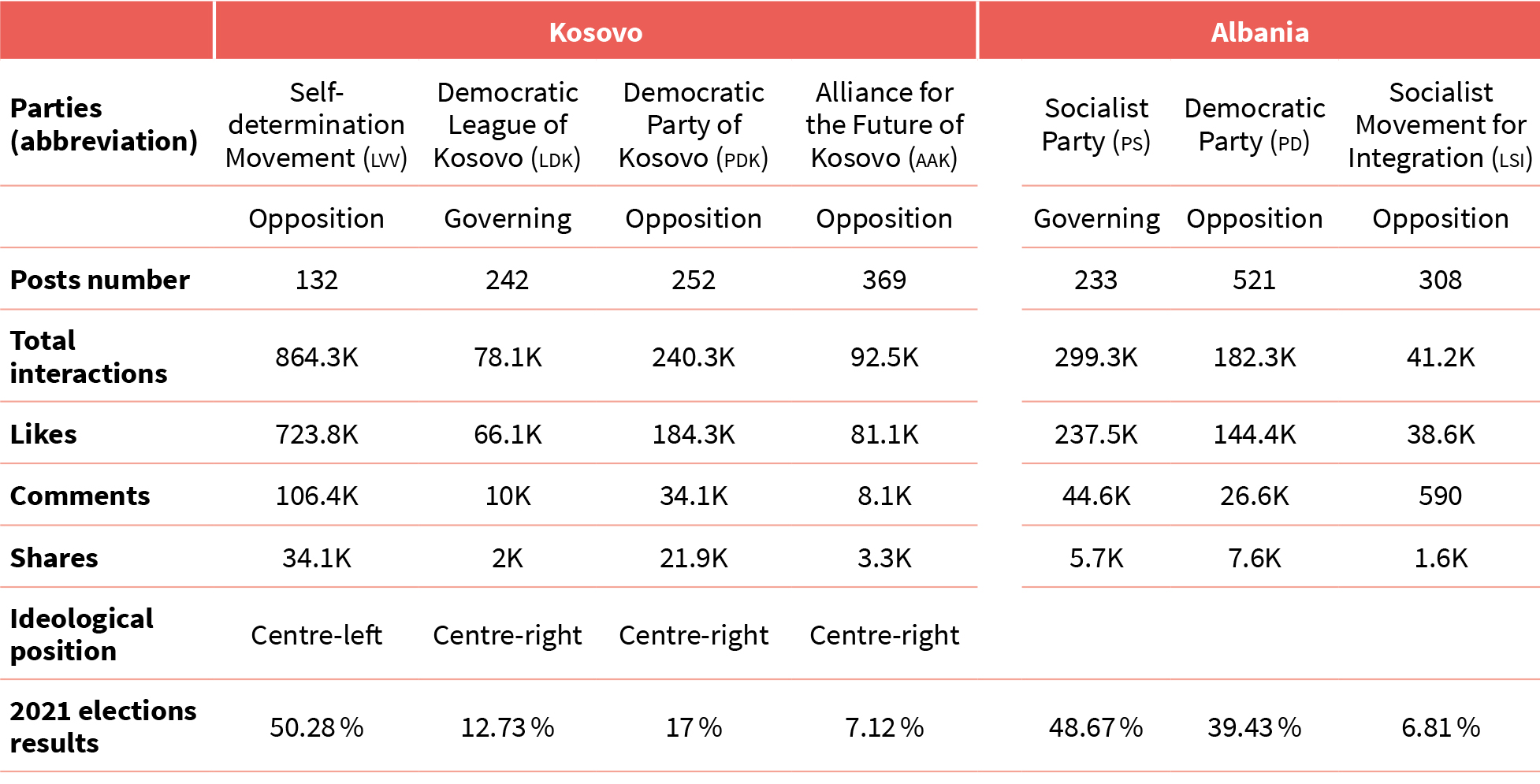
In the case of Kosovo, we included in our sample four parties, AAK, LDK, LVV, and PDK (see table 1). The oldest party in Kosovo is the Democratic League of Kosovo (LDK), which was founded in December 1989, as the main anti-socialist party. For almost two decades, the leader of LDK was former president Ibrahim Rugova, who was the leader of the party from the founding of the party until he died in January 2006. LDK is considered a political party that changed the country's political philosophy (Krasniqi, 2017). LDK is defined as a center-right ideology and advocates for economic liberalism and social conservatism (D4D Institute, 2014). The Democratic Party of Kosovo (PDK) emerged out of the political wing of the Kosovo Liberation Army (KLA) and was led by Hashim Thaçi from 1999 to 2016. Another party founded by former Kosovo Liberation Army (KLA) members was the Alliance for Future of Kosovo (AAK) in 2000 (ASHAK, 2018). PDK and AAK are also defined as centre-right with a combination of economically liberal but socially conservative policies (D4D Institute, 2014). The Self-Determination Movement (LVV) was a civil initiative in the beginning, entering to political spectrum in 2010. Albin Kurti has led LVV since it was founded in 2005. LVV belongs to the center-left ideology advocating for left policies, such as an economic system to create a social opportunity for citizens; it is strongly against privatization, and so on.
The 2021 elections in Albania and Kosovo were pandemic elections. This refers not only to the issues addressed by political parties but also to the methods and strategies that the political parties in both countries employed. In Albania, the pandemic arrived a few months after being hit hard by the 2019 earthquake, in which 51 people lost their lives, around 3000 were injured, and thousands of homes were destroyed (source). The pandemic brought significant challenges for the Albanian healthcare system, which in 2021 was ranked 74th out of 89 countries (Shehu, 2023, p. 5). Most countries facing elections during the pandemic period chose to postpone them, prioritizing not only public health and citizen safety but also adhering to the principles of the rule of law (Pyrzynska & Skoczylas, 2020, p. 237). The Albanian government decided to conduct general elections, bypassing several protective measures against gatherings of people. A digital divide further complicated the situation. Limited internet access in some areas made it difficult for political parties to reach people across the country. This was particularly evident in Albania, where only 77 % of families had internet access (AKEP, 2021). In contrast, Kosovo experienced a more advanced digital transformation, with 96.1 % of households having internet access (ASK, 2021). In Kosovo, the political crisis in 2020 after the outbreak of the pandemic aggravated the situation, complicating Kosovo's response to the health crisis (Gërguri, 2021), changing government at the peak of the Covid-19 and going to elections less than a year after the pandemic was spread in the country.
2. Theoretical framework
2.1. Understanding issue ownership in political communication
The concept of issue ownership in political communication is crucial for understanding how political parties strategically assert their stance in public debates, particularly through digital platforms like Facebook. Scholars have treated this concept as a strategic process to highlight and emphasize issues that align with a party's perceived strengths (Kamps, 2007). Central to this is John R. Petrocik's theory (1996) on issue ownership in political campaigns, which posits that candidates strategically employ issues to gain advantages. According to Petrocik, campaigns act as a form of marketing, intending to make their own issues the focal point of the election. He argues that voters are primarily pragmatic and instrumental, focusing more on problem-solving than policy specifics (Petrocik, 1996, p. 830), and their concerns vary with national conditions. Candidates' efforts influence them in priming and framing issues. In a contrasting perspective, Kevin Banda (2021) explores the immediate effects of issue ownership cues on voters' perceptions and evaluations of candidates. His work emphasizes the significance of these cues in shaping voter opinions in the short term. Interestingly, there appears to be a discrepancy between the issues emphasized by political parties and those capturing the public's attention. This discrepancy suggests that uncontrolled factors play a substantial role in user engagement and opinion-shaping (Banda, 2021; Hauler et al., 2020).
While these approaches to issue ownership are significant, they are primarily focused on the landscape of countries with prevailing liberal democracies, where political parties typically have a history established post-World War II. These parties often possess a strong political identity that translates into specific issues they represent for the electorate. Political parties in post-communist countries like Albania, or newly independent states like Kosovo, are relatively new and tend to shift from one issue to another. For pragmatic reasons, they often appear to claim ownership over a broad range of issues. Formally, the online party programs published in Albania are similar to those of their counterparts in Western Europe. The Socialists "own" issues related to progressive taxation and free healthcare, whereas the Democrats emphasize flat taxation and market liberalization. A commonality among all parties since the fall of the communist dictatorship is their reliance on external forces (such as the EU and nato) as allies in addressing internal challenges. To date, no party with a platform opposes Albania's integration into the EU or advocates for withdrawal from nato and other international organizations. Guided by this literature, we pose the following research questions:
RQ1: What were the prevailing topics of communication by political actors?
2.2. An issue-ownership dimension on Facebook
When voters leave the realm of traditional politics, they are more prone to act based on influences and short-term concerns. A gradually disorganized electorate gives social media more room to determine the agenda and necessitates a far more intensive campaigning effort from the parties. This suggests that social media has a greater influence on how the public views issue ownership (Stiegitz & Dang-Xuan, 2012). Political actors now use social media platforms as a major arena to take control of issues, sway public opinion, and refute their rivals' positions. Furthermore, political parties are paying more attention to examining the issues being discussed on social media. Stieglitz and Dang Xuan (2012) note that this may encourage politicians to participate more in these discussions.
Political parties often focus on specific issues, outlining their positions on the topics that are now consuming the political agenda. Prior studies have demonstrated the reciprocal effect of media, political, and public agendas (Gilardi et al., 2022; Vliegenthart & Walgrave, 2011) and these reciprocal effects are apparent on social media, where popular political issues are frequently correlated in the news, public opinion, and social media (Jungherr et al., 2015). Facebook provides a filtered view of political reality that is closely linked to traditional media (tv, Radio, or Newspaper) and public opinion around important topics. However, political parties using their pages to communicate directly with voters often try to impose issues or shift the focus of public opinion and traditional media. Since users discuss current political events on Facebook, issue ownership often reflects short-term shifts in issue salience in the public opinion or media (Kleinnijenhuis et al., 2019).
Since many of the topics discussed on Facebook sometimes come from the agenda of the traditional media or political parties using social media pages, certain issues will be emphasized even more on Facebook rather than presenting a different issue agenda. Some issues will be discussed more on Facebook when they appear prominently in the traditional media or in the social media pages of political parties. Therefore, social media platforms can play a significant role in shaping issue ownership and can quickly adapt to public and media agenda changes. This leads to the next research questions:
RQ2: How did different political parties engage with these topics, and how did their approaches differ between Albania and Kosovo?
2.3. Facebook as a site of engagement in "extraordinary circumstances"
With Facebook at the forefront, social media has become an integral part of political parties' communication strategies. The Covid-19 pandemic amplified its importance, as a primary venue for political discourse. Political communication researchers have studied the use of social media by political parties for election campaigns mostly as single-state case studies (Steppat & Castro, 2022) and most of the studies are from Western European countries as well as the United States (Hauler et al., 2020; Bene, 2021; Rossini et al., 2021; Nai et al., 2021; Gattermann & de Vreese, 2022; Magin, et al., 2017). The use of social media in election campaigns in Western Balkans has been studied in a small number of papers published in international journals thus far (Gërguri, 2019; Fetoshi & Shahini-Hoxhaj, 2023; Zguri, 2017; Kera & Hysa, 2020) and they did not have a country comparative approach, as they were focused on election campaign in a single state.
Studies on users' engagement with political parties' Facebook pages have received more attention in the past few years (Bene, 2021; Heiss et al., 2019; Keller & Kleinen-von Kónigslów, 2018; Xenos et al., 2017). However, fewer studies are focused on issues that trigger user engagement (Bene, 2021; Eberl et al., 2020). Political processes can be influenced by the media by emphasizing and concentrating on certain issues while neglecting others, explained by media theories such as agenda-setting (McCombs & Shaw, 1972), priming (Iyengar et al., 1982), and the punctuated equilibrium (Baumgartner & Jones, 1993).
In the social media age, where social media platforms are an important factor during election campaigns, the agenda online is often set by users' engagement, as algorithms will give more space and reach to those posts that have more engagement. Therefore, finding the issues that make people respond and engage is essential because, according to these theories, these issues will significantly impact how citizens behave politically and how politics are conducted.
Besides the issues that were part of the political discourse through different election campaigns, this time, the topic of Covid-19 was not limited to the campaign period. The pandemic has been one of the most important mobilizing issues for the government in Albania, contrary to Kosovo. During the campaign, the governing party in Kosovo was more focused on economy, an issue that they own as their leader and their prime minister candidate are both well-known economists, and for years, LDK always emphasize that the economy of Kosovo was better developed when they governed, and they had ministries related to economy. Therefore, we form the following hypothesis:
H1: Opposition parties in both countries engaged more on the topic of Covid-19 than governing parties.
H2: Posts related to economics or education show greater differences in engagement levels between Albania and Kosovo.
3. Method
3.1. Data collection, sample, and coding process
This study's empirical component is embedded within the larger Digital Election Campaigning Worldwide (DigiWorld) project, a comprehensive international research initiative. The DigiWorld project seeks to conduct a comparative analysis of election communication strategies across various countries. Our study contributes to this broader research endeavor, exploring specific aspects of election communication in Albania and Kosovo. Utilizing the DigiWorld coding scheme, we manually analyzed Facebook postings from four major political parties in Kosovo (n = 995) and three major political parties in Albania (n = 1,062). To select these parties, we considered two main factors: their presence in parliament and their history of participation in government. We defined 'major parties' as those that have consistently held a substantial number of parliamentary seats and have played a role in governing their countries. In Kosovo and Albania, we selected parties that have met these criteria since the 2010 and 2013 elections, respectively. Facebook was selected as it is the most popular social media platform in both countries (Datareportal, 2023), while the posts' engagements (reactions, comments, and shares) were collected using Crowdtangle in 2021 when the campaign happened in both countries. The full sample was coded by four coders, two coders per country, and they attended a training session about the coding scheme we used. The survey platform www.soscisurvey.de was utilized as a coding tool to streamline the coding process. We calculated Brennan and Prediger's kappa for our interrater reliability test, as per prior studies (Tonnesen et al., 2023), which is appropriate for sparse and robust binary categories (Quarfoot & Levine, 2016). The test revealed that the categories were generally understood and had satisfactory reliability (Brennan and Prediger's kappa = 0.86).
Table 1. Political Parties in the sample, their posts, and total interactions (likes, comments and shares) on Facebook for the 4 weeks
3.2. Measurement
A Facebook post is the unit of analysis for coding the content categories. The coding of photos and videos was limited even if the entire article is coded. For example, only the first image is coded in image galleries, while for videos, the first minute has been coded. The DigiWorld coding scheme consists of three different categories:
• Binary categories with 0 (not applicable) or 1 (applies) values. Typically, these categories are part of a larger category. This allows for the selection of multiple subcategories for the main category. For example, the main category "topics" contains the subcategories "polity", "politics", "taxes", etc., and each subcategory can have a 0 or 1 code applied to it, allowing for the coding of more than one subcategory.
• Categories with more than two values, where only one of them is applicable, and choosing one of them eliminates all the others. For example, in the category of "image", it is either a photograph, illustration, meme, cartoon, or selfie.
• Non-numeric categories in which the coder must copy and paste the links contained in the post.
The subjects discussed in the posts were assessed by categorizing whether specific policy matters were covered in the content. The second part of the codebook encompassed a variety of binary codes that captured issues. The focus on the topics varies from "polity," "politics", "economy and finance", "health", "education", "labor and social issues", and so on.
4. Findings
4.1. Macro-level: Country comparison
When observing the political parties' activities during the four-week period (see Figures 1 & 2), it is evident that, in the case of Albania, the main challenger (pd) put significantly more work into their Facebook campaign, creating a more significant number of posts than the incumbent party, ps. pd managed to gain around 10 % more compared to the 2017 elections. The situation in Kosovo was the pretty same: LVV, who won the 2019 elections, had the lowest Facebook activity in the 2021 election campaign, while one of the traditional parties, AAK, had the highest Face-book activity. However, predictably, there was no relationship between this activity and the election outcome. The results of the 2021 election gave a historic victory for LVV, having over 50 % of the votes, while AAK, despite high activity, achieved a lower result than in the 2019 elections.
Figure 1. Number of party posts (vertical axis) compared to election results (percentages in rectangle)
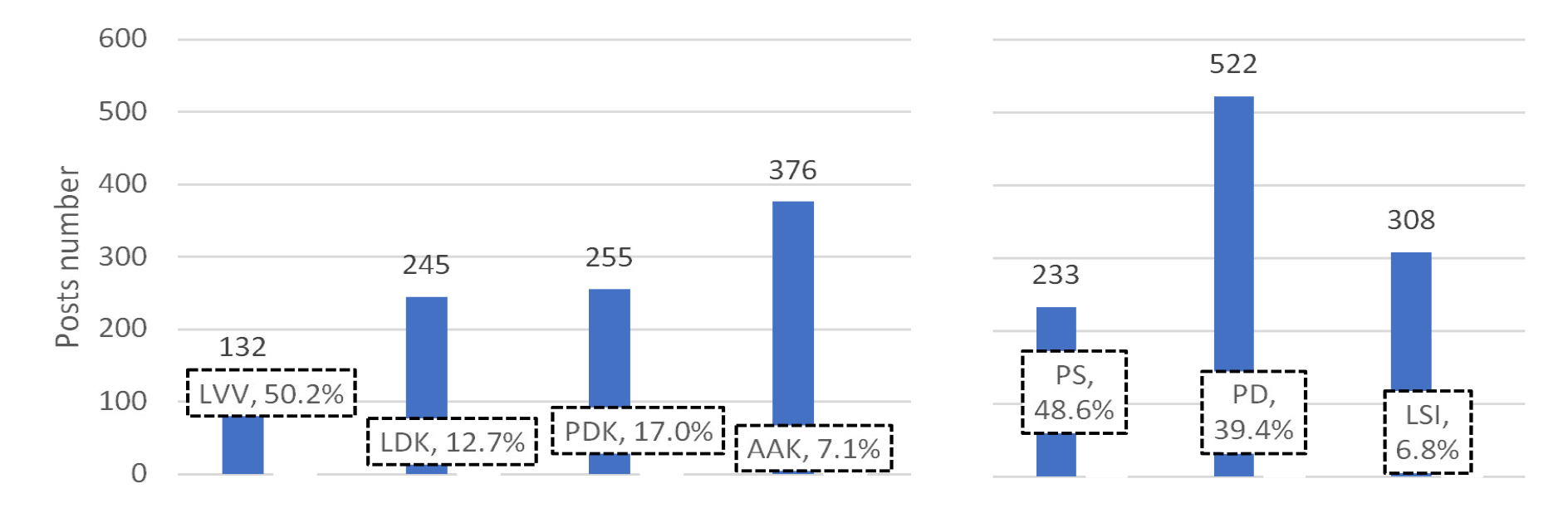
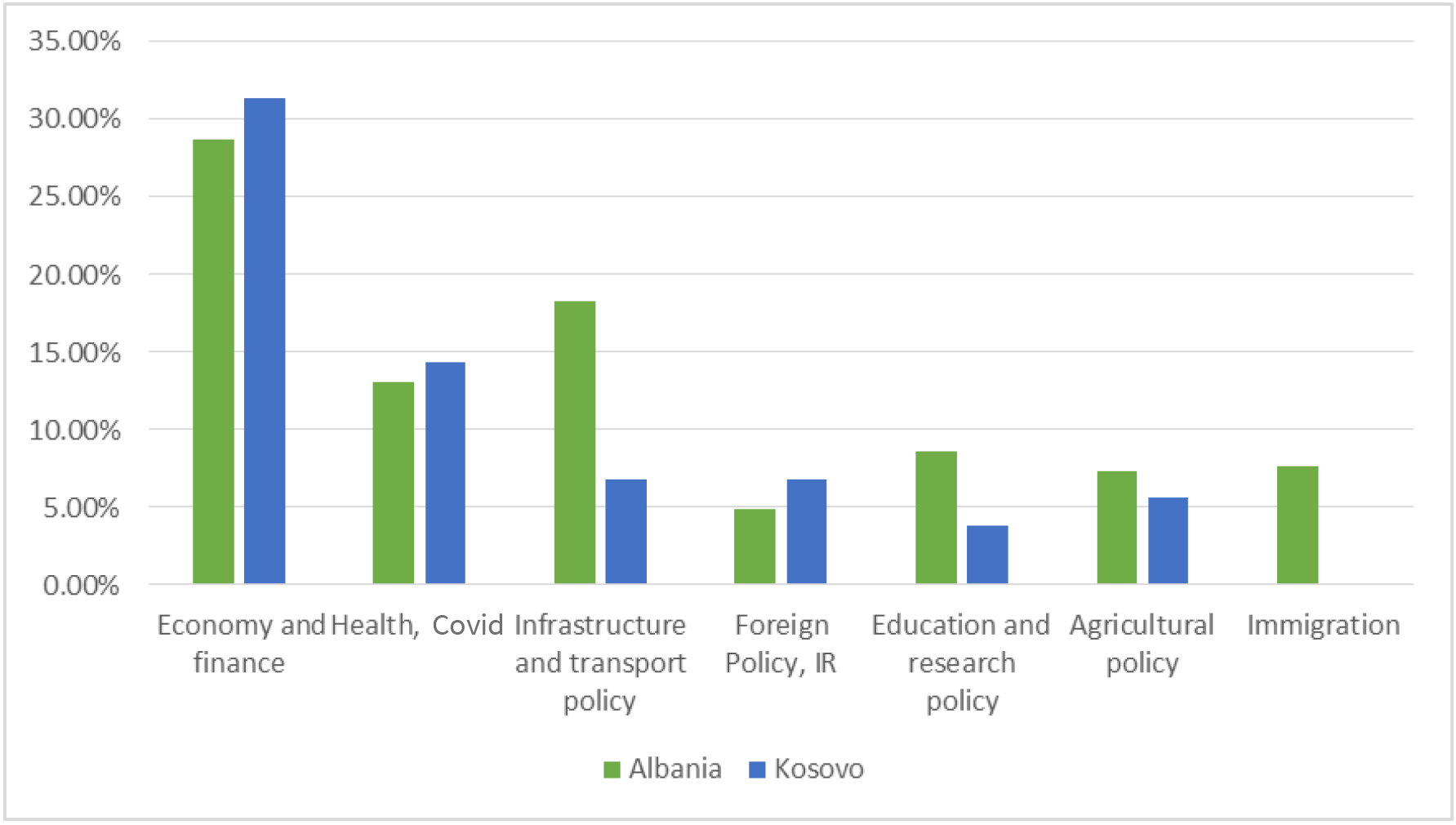
Figure 2. Topics (at least 5 % of total posts) during the analyzed period
Regarding the content of the party posts, there were many similarities between the two campaigns. All parties in both countries primarily used Facebook as an important channel for mobilization, calling for votes from their supporters (Albania = 73.1 % & Kosovo = 83.8 %). Facebook was used more often as an information channel by parties in Kosovo (14.5 %), compared to Albanian parties (6.8 %), posting news and information related to the campaign, including television appearances of party leaders or other actors on different tv channels. Even interaction was more often used by political parties in Kosovo, 8.1 %, while in Albania, it was only 1.1 %.
To address our initial research question (RQ1), which is focused on the macro level (represented by the countries in our sample), we have examined what the most prevailing topics of communication by political parties are. The results show that two dominant topics in both countries were related to economy and health. This is an expected outcome because, amid the challenges of the Covid-19 pandemic, health and the economy assumed dominant importance. The health crisis necessitated political parties to articulate their strategies for managing the pandemic, ensuring public health, and controlling the virus's spread. Voters were keenly interested in healthcare infrastructure, vaccination plans, and the overall pandemic response. Simultaneously, the economic impact of the pandemic, characterized by job losses and economic downturns, compelled political parties to address their plans for economic recovery. Voters sought assurances on economic stimulus, unemployment support, and measures to stabilize industries.
In Albania, infrastructure was also a frequent topic, which is directly related to the earthquake that happened less than two years before the national election. Voters would be particularly attentive to proposals demonstrating a commitment to rebuilding and safeguarding against future disasters, making infrastructure a pivotal issue in the electoral landscape.
Data on Table 2 presents the negative binominal regressions models and when examining the topics as predictors of post shares and comments, interesting similarities emerge. While economy-related posts were dominant in both countries when it comes to voters engagement in political parties' Facebook pages, posts in Kosovo were more likely to receive shares (IRR = 1.436; p <.01; CI = 1.171-1.761) and comments (IRR = 1.176; CI = 0.958-1.444). In Albania, such posts seemed to not matter for voters engagement, while they were more likely to decrease the number of shares by almost 20 % (IRR = 0.852; p <0.05; CI = 0.718-1.010) and number of comments by 50 % (IRR = 0.500; p <0.001; CI = 0.421-0.595).
Table 2. Topics post predictions of Facebook user engagement in Albania and Kosovo elections
Infrastructure was another important topic in Albania, and Facebook posts on political parties' pages about this issue were almost two times more likely to get comments (IRR = 1.771; CI = 1.473-2.129) and shares (IRR = 1.494; CI = 1.246-1.791). This was not the case in Kosovo as posts focused on infrastructure issues did not get voters' attention. Another important country's divergence emerges in the way Facebook users interacted with health-related posts. We noticed that posts focused on health and Covid-19 were more likely to be shared and received about 20 % more comments in Albania. In Kosovo, besides the economy, agriculture was another topic that attracted more voters' engagement. Voters were two times more likely to share (IRR = 2.380; CI = 1.614-3.510) and comment (IRR = 2.040; CI = 1.454-2.863) on posts about agriculture. Education was another topic that attracted more voters' engagement in Kosovo and had about 60 % more comments (IRR = 1.592; CI = 1.271-1.995) and about 50 % more shares (IRR = 1.457; CI = 1.107-1.917). However, in Albania, such posts on agriculture and education were more likely to decrease the number of shares by almost 30 %, while in comments, there is a better situation about posts on education, as they did not have negative effect on voters' engagement.
4.2. Meso-level: Party comparison
For the second research question (RQ2), the focus is on party comparisons regarding their engagement with dominant topics. Therefore, at the level of political parties, we wanted to compare governing parties with opposition parties on one of the prevailing topics, Covid-19. Generally, 15.5 % (n = 319) of the posts concerning the Covid-19 issue were published by political parties in both countries. LVV and LDK were two parties that had the primary responsibility for Covid-19 management in Kosovo as they governed in coalition for a period, and later, LDK governed alone. In their coalition, LVV led the Government and had the Ministry of Health until June 2020, when the government led by Kurti was overthrown by a no-confidence motion, and LDK created a new government, governing alone from June 2020 to the 2021 election. This created a situation when both parties could identify themselves with the issue of Covid-19. However, LDK was way more active than LVV posting more often about the health crisis, and by giving more attention to the issue, Covid-19 could be considered an associative issue ownership for LDK.
In Albania, the political situation is different because, unlike Kosovo, where there was a government coalition and the government changed during the crisis, in Albania, only one party led the country, PS, which was the party that posted more often for Covid-19. Leading alone because in Albania, there was no division of power in the field of health. PS had the topic of Covid as an associative ownership issue, and early studies (Tresch et al., 2013) show that parties find it more difficult to attack the ownership of other parties' associated issues. This may have prompted two opposition parties in Albania to focus on other topics.
An interesting result is the absence of corruption in the top topics of the campaign in Kosovo. In the election campaigns in Kosovo, corruption has always been one of the main topics. LVV is considered to have issue ownership because in every previous campaign it had attacked other parties for corruption. However, in the 2021 election campaign, corruption was not among the salient issues because all parties did not have strong attention to this topic. Previous research (Tresch et al., 2013) concludes that parties are unable to steal issues that voters associate with other parties, and this also applies to the Kosovo context because other parties were not focused on an issue that is owned by LVV.
We formulated hypothesis H1, suggesting that opposition parties would have greater engagement than governing parties in discussions related to Covid-19. To test our hypothesis, we calculated the mean number of total interactions (including reactions, shares, and comments) on posts related to the pandemic, categorized by party position, either in government or in opposition. Surprisingly, our findings contradict H1 as government parties (PS in Albania and LDK in Kosovo) had a higher average (1014.6 interactions) compared to opposition parties (996.2 interactions). However, when considering the meaning of total interactions across all topics, opposition parties outperformed government parties with an average of 885 interactions, while government parties averaged 811 interactions.
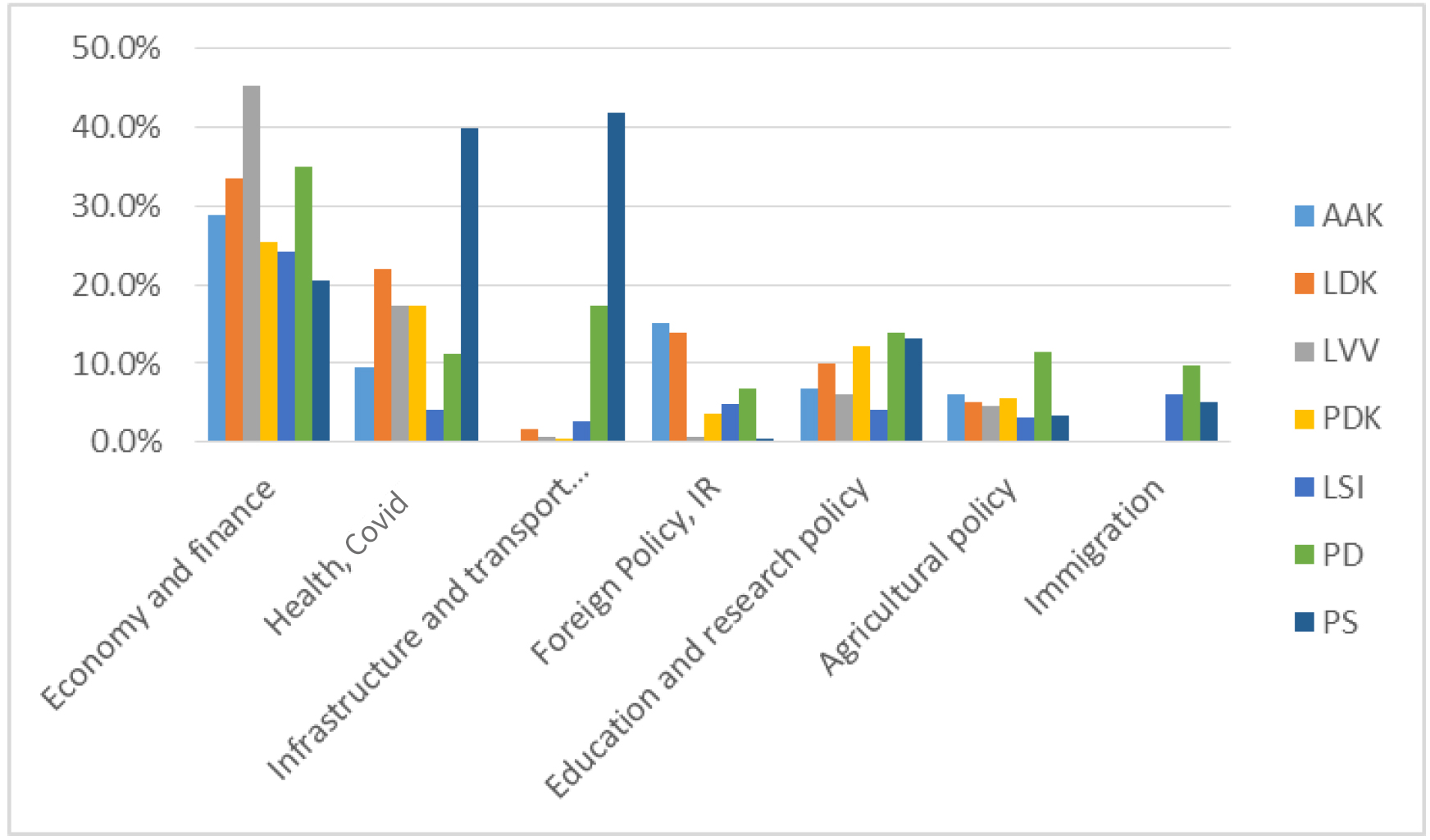
Figure 3. Prevailing topics by political parties
4.3. Micro-level: Topics comparison
For the second hypothesis, the focus is on topics. At the level of political parties, the most active party on the prevailing topic of Covid-19 was PS in Albania (93 posts) and LDK in Kosovo (53 posts each). Parties also posted more often about economic issues; this topic was the main one in the campaign of PD in Albania (182 posts) and AAK in Kosovo (107 posts). Infrastructure, particularly in the context of earthquake recovery, was a significant issue in Albania, with the ps and pd posting nearly 100 times about their solutions for affected people. In Kosovo, foreign policy, especially concerning the unresolved issue with Serbia, was a key campaign topic, with the AAK making 56 posts on this subject.
People are more likely to interact with postings that address topics that are meaningful to them (Eberl et al., 2020). We have examined whether there is a correlation between the topic of posts by the political parties and the standardized engagement metrics among Facebook users. The study shows that Facebook users are more engaged with posts focusing on the economy, rural issues, employment, and infrastructure. This is a crucial finding as it suggests that these topics resonated more with the electorate. For economic posts, the Socialist Movement for Integration (LSI) in Albania and ps showed significant engagement, while the PDK in Kosovo also had a positive correlation. In rural topics, the Vetèvendosje Movement (LVV) in Kosovo showed strong engagement, as did the LSI for reactions. LVV also saw significant engagement in agriculture and employment posts. ps's posts on infrastructure and LDK'S on foreign policy showed substantial engagement, though not significantly different in correlation coefficients.
Data in Table 3 presents the negative binominal regression models and when examining the topics as predictors of post shares and comments between four political parties in Kosovo. When looking into the results, interesting parallels cut across the parties on how their policy stances are used to drive engagement on social media. For instance, economic and education topics were more likely to be engaged across all parties. LVV is particularly exceptional in education (shares: IRR = 1.896, and comments: IRR = 2.149), which shows that their emphasis on education appealed to the voters and, therefore, received more engagement on social media. On the other hand, the topic of infrastructure is one in which LDK posts were more likely to receive comments (IRR = 1.844), and shares (IRR = 1.202), which may suggest that discussions about infrastructure might drive comments and shares within this party's base. Even though elections were held in the pandemic period, health-related posts did not attract voters' engagement in most of the parties.
Table 3. Topics post predictions of Facebook user engagement by four main political parties in Kosovo elections
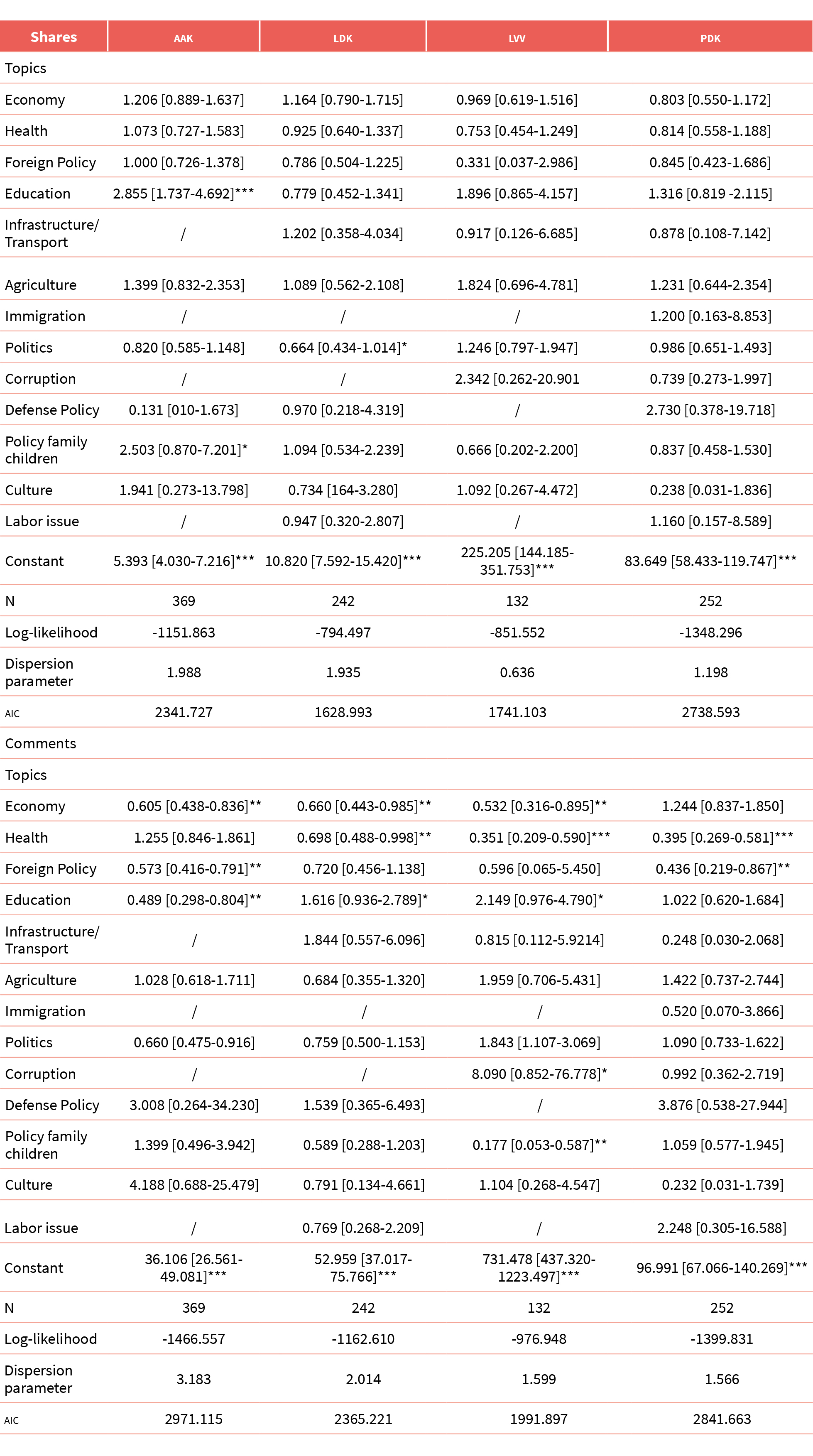
While for political parties in Kosovo, posting about the economy or education would get more engagement, in Albania, such posts on these topics were more likely to decrease the number of shares and comments by 10 % to 30 % (data on table 4). Therefore, H2 is supported because in Albania, posts about these topics did not resonate as strongly with the electorate as Kosovo, where these issues were highly attractive for voters.
Table 4. Topics post predictions of Facebook user engagement by three main political parties in Albania elections
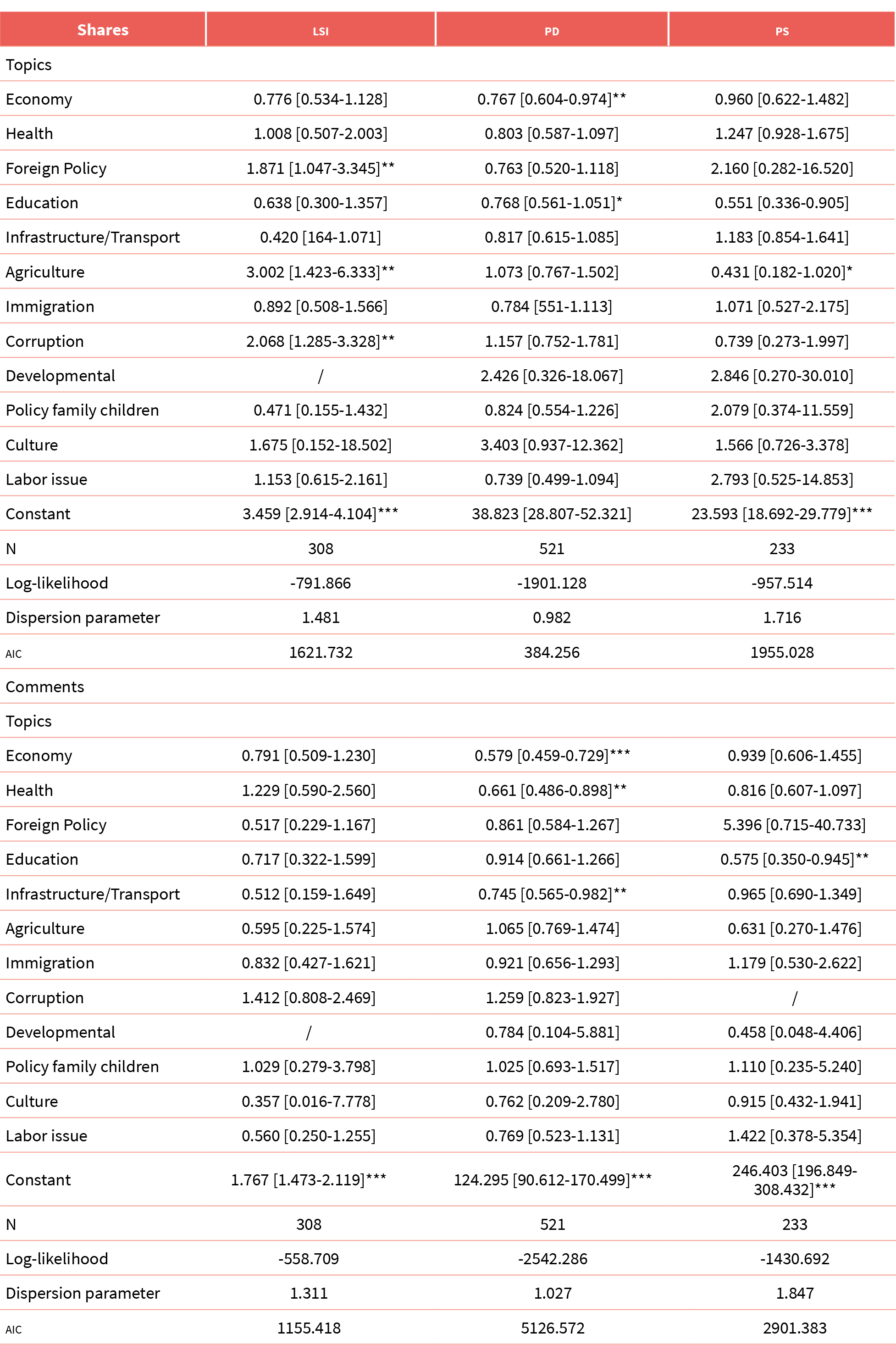
For Albania, the negative binomial regression models' data present similar trends of how different policy topics drive social media engagement. Agricultural posts proved significant for LSI, as followers of this party were three times more likely to share (IRR = 3.002) posts about this topic. Foreign policy was an engaging topic for PS, who were more likely to receive shares (IRR = 2.160) and comments (IRR = 5.396).
Health, despite the ongoing pandemic in 2021, did not generate the same level of engagement across the parties. Whereas the PS was more active in this topic, attracting more voters' engagement and having about 30 % more shares (IRR = 1.247; CI = 0.928-1.675), at the same time, they were more likely to decrease the number of comments by about 20 %(IRR = 0.816; ci = 0.607-1.097).
Conclusions
This comprehensive analysis of political parties' Facebook activities during the extraordinary circumstances of the 2021 pandemic elections in Albania and Kosovo has revealed several key findings, shedding light on the unique context of these two hybrid regime countries outside the European Union.
Primarily, it became evident that political parties in Albania and Kosovo, leveraged Facebook as a platform for mobilization and information dissemination. They effectively used it to connect with supporters, issue calls to vote, and provide campaign-related information during the challenging times brought about by the Covid-19 pandemic. One of the most noteworthy observations was the prevalence of specific topics in political discourse. Across parties in both countries, the dominant subjects of discussion revolved around the economy and health. Given the unprecedented nature of the pandemic, these topics naturally took center stage as parties outlined their strategies for managing the crisis, ensuring public health, and addressing economic challenges.
Our analysis also involved examining engagement levels among government and opposition parties, particularly regarding the Covid-19 topic. Contrary to our initial hypothesis (H1), government parties, specifically the Socialist Party (ps) in Albania and the Democratic League of Kosovo (ldk) in Kosovo, garnered a higher mean number of total interactions compared to opposition parties in this specific context. However, when considering interactions across all topics, opposition parties consistently outperformed government parties. Furthermore, our study explored the correlation between the topics of party posts and user engagement metrics. It revealed that users were more inclined to engage with posts related to specific issues, including the economy, rural matters, employment, and infrastructure. These topics resonated with the public and consistently generated higher levels of engagement, underscoring the importance of addressing these concerns in political discourse. The distinct political landscapes of Albania and Kosovo, characterized by factors such as the unique leadership style of figures like Edi Rama, non-ideological party dynamics, and other contextual specificities, add depth to our findings. These countries face distinctive political challenges, and our analysis underscores how social media, particularly Facebook, shapes political communication within these unique contexts.
Despite the valuable insights gained from our research, several limitations must be acknowledged. First, our analysis focused exclusively on Facebook, and other social media platforms were not considered. Future research should expand the scope to include a broader range of digital platforms (such as Instagram and TikTok) to provide a more comprehensive understanding of political communication. Second, the study's timeframe was limited to a specific four-week period during the election campaigns. A longitudinal analysis spanning a more extended period could capture evolving trends and dynamics in political communication. Third, an important limitation is that we focus on analyzing posts from political parties rather than individual leaders. Given the historical context in these countries, charismatic leaders often play a significant role in shaping political narratives. Future research should consider the inclusion of leaders' social media posts for a more holistic analysis.
References
1. Akademia e Shkencave dhe e Arteve e Kosovès (ASHAK). (2018). Fjalori Enciklopedik I Kosovës. ASHAK.
2. Baliqi, B. (2018). Promoting multi-ethnicity or maintaining a divided society: dilemmas of power-sharing in Kosovo. Journal on Ethnopolitics and Minority Issues in Europe, 17(1), 49-71.
3. Banda, K. K. (2021). Issue ownership cues and candidate support. Party Politics, 27(3), 552-564. https://doi.org/10.1177/1354068819869901
4. Beha, A., & Hajrullahu, A. (2020). Soft competitive authoritarianism and negative stability in Kosovo: statebuilding from UNMIK to EULEX and beyond. Southeast European and Black Sea Studies, 20(1), 103-122. https://doi.org/10.1080/14683857.2019.1709686
5. Bene, M. (2021). Topics to talk about: the effects of political topics and issue ownership on user engagement with politicians' Facebook posts during the 2018 Hungarian general election. Journal of Information Technology & Politics, 18(3), 338-354. https://doi.org/10.1080/19331681.2021.1881015
6. Berisha, B. (2020) Partitè politike nè Kosovè. In W. Hofmeister & K. Grabow, Partite politke: funksioni dhe organizimi nê shoqêritê demokratike (2nd ed.) (pp. 77-92). KAS & IPSP.
7. Biberaj, E. (1998). Albania in transition: the rocky road to democracy. Westview Press.
8. D4D Institute. (2014). Kosovo's political compass: mapping party ideology. D4D.
9. D4D Institute. (2020). Kosovo's political compass: evolution of party orientation 2014-2020. KAS & D4D.
10. Eberl, J.-M., Tolochko, P., Jost, P., Heidenreich, T., & Boomgaarden, H. G. (2020). What's in a post?: how sentiment and issue salience affect users' emotional reactions on Facebook. Journal of Information Technology & Politics, 17(1), 48-65. https://doi.org/10.1080/19331681.2019.1710318
11. Fetoshi, A., & Shahini-Hoxhaj, R. (2023). The impact of the media in election campaign during the Covid-19 pandemic: the case of Kosovo. Central European Journal of Communication, 16(1-33), 59-78. https://doi.org/10.51480/1899-5101.16.1(33).4
12. Freedom House. (2023). Nations in transit 2023. https://freedomhouse.org/sites/default/files/2023-05/NIT_2023_Digital.pdf
13. Gattermann, K., & De Vreese, C. H. (2022). Understanding leader evaluations in European Parliament elections. European Union Politics, 23(1), 141-160. https://doi.org/10.1177/14651165211046108
14. Gërguri, D. (2019). Campaigning on Facebook: posts and online social networking as campaign tools in the 2017 general elections in the Republic of Kosovo. Central European Journal of Communication, 12(1-22), 92-109. https://doi.org/10.19195/1899-5101.12.1(22).6
15. Gërguri, D. (2021). Kosovo: political crisis, one more challenge alongside Covid-19. In D. Lilleker, I. A. Coman, M. Gregor & E. Novelli, Governance and rhetoric in times of crisis (pp. 312-322). Routledge.
16. Gërguri, D., & Zeneli, A. (2023). Kosovo: political transition, digitalization and the media landscape. In B. Dobek-Ostrowska & J. Kleut (Eds.), Media systems in Balkan countries: context and dynamics of changes (pp. 211-228). Peter Lang Edition.
17. Gilardi, F., Gessler, T., Kubli, M., & Müller, S. (2022). Social media and political agenda setting. Political Communication, 39(1), 39-60. https://doi.org/10.1080/10584609.2021.1910390
18. Godole, J. (2014). Gazetariashqiptarenê tranzicion: aktorêt, strukturatdheinstitucionet. Papirus.
19. Godole, J. (2020). Albanian media in transformation: achievements and challenges. In N. Daskalova & H. Sittig (Eds.), Three decades later the media in South East Europe after 1989 (pp. 13-38). KAS.
20. Hauler, J., Magin, M., Russmann, U., Baranowski, P., Bene, M., Schlosser, K., Wurst, A.-K., Fenoll, V., Krus-chinski, S., & Maurer, P. (2020). Reaching out to the Europeans: political parties' Facebook strategies of issue ownership and the second-order character of European election campaigns. In C. Holtz-Bacha (Ed.), Europawahlkampf 2019: zur rolle der medien [European election campaigning 2019: on the role of the media] (pp. 87-113). Springer.
21. Heiss, R., Schmuck, D., & Matthes, J. (2019). What drives interaction in political actors' Facebook posts?: profile and content predictors of user engagement and political actors' reactions. Information, Communication & Society, 22(10), 1497-1513.
22. Jungherr, A., Schoen, H., & Jürgens, P. (2015). The mediation of politics through Twitter: an analysis of messages posted during the campaign for the German federal election 2013. Journal of Computer-Mediated Communication, 21(1), 50-68.
23. Kajsiu, B. (2010). Down with politics!: the crisis of representation in post-communist Albania. East European Politics and Societies, 24(2), 229-253. https://doi.org/10.1177/0888325409354354
24. Keller, T. R., & Kleinen-von Kónigslów, K. (2018). Pseudo-discursive, mobilizing, emotional, and entertaining: identifying four successful communication styles of political actors on social media during the 2015 Swiss national elections. Journal of Information Technology & Politics, 15(4), 358-377.
25. Kera, G., & Hysa, A. (2020). Influencing votes, winning elections: clientelist practices and private funding of electoral campaigns in Albania. Southeast European and Black Sea Studies, 20(1), 123-139. https://doi.org/10.1080/14683857.2019.1709698
26. Kleinnijenhuis, J., Van Hoof, A., & Van Atteveldt, W. (2019). The combined effects of mass media and social media on political perceptions and preferences. Journal of Communication, 69(6), 650-673.
27. Kmezic, M., & Bieber, F. (2017). The crisis of democracy in the Western Balkans: an anatomy of stabilitocracy and the limits of EU democracy promotion. Balkans in Europe Policy Advisory Group (BiEPAG).
28. Krasniqi, M. (2017). Sekretet qê nuki mori me vete Ibrahim Rugova. pen Qendra.
29. Magin, M., Podschuweit, N., Hauler, J., & Russmann, U. (2017). Campaigning in the fourth age of political communication: a multi-method study on the use of Facebook by German and Austrian parties in the 2013 national election campaigns. Information, Communication & Society, 20(11), 1698-1719.
30. Meka, E., & Kalemaj, I. (2022). Critics of democracy: the impact of communist legacy on support for democracy and voting behavior in Albania. Problems of Post-Communism, 69(6), 486-497. https://doi.org/10.1080/10758216.2020.1851607
31. Nai, A., Medeiros, M., Maier, M., & Maier, J., (2021). Euroscepticism and the use of negative, uncivil and emotional campaigns in the 2019 European Parliament election: a winning combination. European Union Politics, 23(1). https://doi.org/10.1177/14651165211035675
32. Quarfoot, D., & Levine, R. A. (2016). How robust are multirater interrater reliability indices tochanges in frequency distribution? The American Statistician, 70(4), 373-384.
33. Pyrzynska, A., & Skoczylas, D. (2020). Elections during Covid-19 pandemic in the light of democratic values and international standards of human rights protection. European Research Studies Journal, XXIII(2 Special), 226-246. https://doi.org/10.35808/ersj/1820
34. Rossini, P., Stromer-Galley, J., & Zhang, F. (2021). Exploring the relationship between campaign discourse on Facebook and the public's comments: a case study of incivility during the 2016 us presidential election. Political Studies, 69(1), 89-107. https://doi.org/10.1177/0032321719890818
35. Shehu, R. (2023). Pandemic management lessons learned for a more secure future. idm. https://idmalbania. org/study-report-pandemic-management-lessons-learned-for-a-more-secure-future/
36. Steppat, D., & Castro, L. (2022). Content analysis in the research field of election campaign communication. In F. Oehmer-Pedrazzi et al. (Eds.), Standardisierte Inhaltsanalyse in der Kommunikationswissenschaft: standardized content analysis in communication research (pp. 313-328). Springer.
37. Stieglitz, S., & Dang-Xuan, L. (2012). Social media and political communication: a social media analytics framework. Social Network Analysis and Mining, 3(4).
38. Tonnesen, H., Bene, M., Hauler, J., Larsson, A. O., Magin, M., Skogerbo, E., & Wurst, A.-K. (2023). Between anger and love: a multi-level study on the impact of policy issues on user reactions in national election campaigns on Facebook in Germany, Hungary, and Norway. NewMedia & Society.https://doi.org/10.1177/14614448231208122
39. Tresch, A., Lefevere, J., & Walgrave, S. (2013). "Steal me if you can!": the impact of campaign messages on associative issue ownership. Party Politics, 21(2).
40. Vliegenthart, R., & Walgrave, S. (2011). Content matters: the dynamics of parliamentary questioning in Belgium and Denmark. Comparative Political Studies, 44(8), 1031-1059.
41. Xenos, M. A., Macafee, T., & Pole, A. (2017). Understanding variations in user response to social media campaigns: a study of Facebook posts in the 2010 us elections. New Media & Society, 19(6), 826-842.
42. Zguri, R. (2017). Marrêdhêniet mes medias dhe politikês nê Shqipêri. FES.