
10.12804/revistas.urosario.edu.co/disertaciones/a.14752
AVANCES (TEMA ABIERTO)
Karla Palma1
Claudio Salinas2
1 Universidad de Chile
Research Center for Integrated Disaster Research Management (Cigiden)
 0000-0002-3191-4038
 karla.palma@uchile.cl
2 Universidad de Chile
0000-0001-8332-9431
claudiorsm@u.uchile.cl
Received: August 7,2024
Approved: January 16,2025
Prepublication: March 18,2025
To cite this article: Palma, K., & Salinas, C. (2025). Rethinking news coverage of disasters: from crisis to risk management in media routines. Anuario Electrónico de Estudios en Comunicación Social "Disertaciones", 18(2). https://doi.org/10.12804/revistas.urosario.edu.co/disertaciones/a.14752
ABSTRACT
This study examines the intersection of journalistic routines and disaster risk reduction, focusing on the complexities of socio-natural disasters. Using an interdisciplinary approach that combines journalism, communication, and disaster management studies, it investigates how journalistic practices adapt to address these challenges. A mixed-methods content analysis methodology was employed, analyzing 370 articles from Chilean national media outlets (la Cuarta, La Tercera, Las Últimas Noticias, and Emol) that covered the 2015 Atacama flood. Data were collected between March 26 and May 24, 2015, using a coding framework that categorized sources, framing techniques, and temporalities.
The results revealed that government authorities were the most frequently cited sources, followed by residents and private companies. A gender analysis indicated that male sources were cited more often than female sources. The news primarily emphasized the crisis phase of the disaster, with limited coverage of the complete disaster risk cycle. The findings suggest that Chilean news coverage reinforces governmental narratives, underrepresents local voices, and focuses on immediate crises, overlooking systemic causes and long-term recovery efforts. This study underscores the need for journalistic practices to better integrate the disaster risk cycle, aiming to enhance public understanding and resilience to future disasters.
Keywords: Journalistic routines; risk communication; disaster risk reduction; Chile; Atacama flood 2015.
RESUMEN
Este estudio explora la intersección entre las rutinas periodísticas y la reducción del riesgo de desastres, con un enfoque en las complejidades de los desastres socionaturales. La investigación utiliza un enfoque interdisciplinario que combina estudios de periodismo, comunicación y gestión de desastres para examinar cómo las rutinas periodísticas evolucionan para abordar estos desafíos. Se usó un enfoque de análisis de contenido de métodos mixtos, analizando 370 artículos de medios chilenos nacionales (La Cuarta, La Tercera, Las Últimas Noticias y Emol) que cubren el aluvión de Atacama de 2015. Los datos fueron recolectados desde el 26 de marzo hasta el 24 de mayo de 2015, empleando un marco de codificación que categorizó las fuentes, las técnicas de encuadre y las temporalidades. Los resultados revelaron que las autoridades gubernamentales fueron las fuentes más citadas, seguidas por residentes y empresas privadas. El análisis de género mostró que las fuentes masculinas fueron citadas más que las fuentes femeninas. La noticia se centró en la fase de crisis del desastre, prestando poca atención al ciclo completo del riesgo de desastre. Los hallazgos sugieren que la cobertura informativa chilena refuerza las narrativas gubernamentales, subrepresenta las voces locales y se enfoca principalmente en la crisis inmediata, descuidando las causas sistémicas y la recuperación a largo plazo. Este estudio destaca la necesidad de que las prácticas periodísticas integren mejor el ciclo de riesgo de desastre para mejorar la comprensión pública y la resiliencia frente a futuros desastres.
Palabras clave: rutinas periodísticas; comunicación del riesgo; reducción del riesgo de desastres; Chile; aluvión 2015.
RESUMO
Neste estudo, são exploradas a intersecção de rotinas jornalísticas e a redução de risco de desastres, com foco nas complexidades de desastres socionaturais. Na pesquisa, é usada abordagem interdisciplinar que combina jornalismo, comunicação e estudos de gestão de desastres para examinar como as rotinas jornalísticas evoluem para enfrentar esses desafios. Uma abordagem análise de contenido de métodos mistos foi usada, em que foram analisados 370 artigos de veículos de comunicação nacionais chilenos (La Cuarta, La Tercera, Las Últimas Noticias e Emol), os quais cobriram a enchente de 2015 no Atacama. Os dados foram coletados de 26 de março a 24 de maio de 2015, a partir de uma estrutura de codificação que categorizou fontes, técnicas de enquadramento e temporalidades. Os resultados revelaram que autoridades governamentais foram as fontes mais citadas, seguidas por moradores e empresas privadas. A análise de gênero mostrou que fontes masculinas foram citadas mais do que fontes femininas. As notícias se concentraram principalmente na fase de crise do desastre, com atenção limitada ao ciclo completo de risco de desastre. As descobertas sugerem que a cobertura jornalística chilena reforça narrativas governamentais, sub-representa vozes locais e foca principalmente na crise imediata, negligenciando causas sistêmicas e recuperação de longo prazo. Neste estudo, é destacada a necessidade de práticas jornalísticas para melhor integrar o ciclo de risco de desastres a fim de atingir a compreensão pública e a resiliência a desastres futuros.
Palavras-chave: rotinas jornalísticas; comunicação de risco; redução de risco de desastres; Chile; inundação do Atacama 2015.
Introduction
Creating news involves more than merely reporting facts; journalists must exercise due diligence in source selection and information verification before publication. These actions, known in media literature as news routines, form part of a broader process in which journalists transform raw information into news (Salinas & Stange, 2009). This process is not purely technical; it reflects cultural norms and guidelines that shape journalistic practices. As such, news routines represent an interpretation of reality, influencing the news story itself.
Traditionally, journalism studies have contrasted the practical, "real" practices of journalists with the ideal ethical and normative frameworks governing their profession. Tuchman (1983) argues that these frameworks are integral to professional routines. Striking a balance between practical and ideal practices is essential to adapting news routines to reflect reality. This adaptability ensures that news routines remain dynamic and responsive to social processes, such as disaster coverage, rather than becoming stagnant.
Typically, journalistic routines are described from the perspective of what journalists do —or should do— to construct the news (Salinas & Stange, 2009; Retegui et al., 2019). This is because journalistic practices leave concrete traces in the final product, namely, the news. For instance, when asked, "what do journalists do?" common answers include: "They write articles, investigate 'facts', gather information and sources, make phone calls, browse the internet, and attend conferences" (Salinas & Stange, 2009, p. 12). Press routines, therefore, consist of a series of operations that collectively define how certain facts, events, or processes are covered.
While press routines encompass numerous operations —from determining newsworthiness criteria to crafting headlines— one of the central dimensions for evaluating the quality and plurality of news lies in the use of sources. Tuchman (1983) emphasizes the importance of sourcing in news construction, noting that it significantly impacts pluralism and representation in media narratives. In Chile, studies on press pluralism often analyze the diversity of voices or sources used in news production. Diversity in source usage —both in total and by section— based on source type and recurrence, is considered an attribute of pluralism (Stange et al., 2018, p. 1831).
Tuchman (1983) describes news as the routinization of the unexpected, a concept echoed by Wilkins (2016), who examined journalists' work during hazard and disaster coverage. Wilkins highlights how journalistic routines transform the unpredictable into the predictable. For instance, disaster news narratives often follow foreseeable patterns: coverage in the initial hours tends to focus on immediate events and short-term impacts, with little attention paid to systemic issues or long-term recovery efforts.
Moreover, news reporting frequently involves repeating established practices and routines. Saldaña (2022) observed this phenomenon in Chile during the 2014 earthquake, where journalists relied on the same coverage models and practices they had used during the 2010 earthquake. This suggests that journalistic routines, particularly in disaster coverage, are cyclical and perpetuate established patterns.
A decade ago, Wilkins (2016) stressed the need for guidelines to help journalists cover disasters from a systemic perspective. Drawing from disaster studies literature, Wilkins' suggestion can be interpreted as a call to integrate the disaster risk cycle into journalistic practices. This systemic approach emphasizes understanding the elements that constitute disaster risk and includes a "mitigation watchdog" perspective, which promotes disaster threat mitigation as an ethical responsibility of journalism. Wilkins' approach suggests embedding journalistic practices in the disaster risk construction phase, extending their role beyond mere crisis coverage.
The importance of journalistic approaches to disaster coverage goes beyond fleeting trends. Public understanding of disasters is heavily influenced by journalistic work (Lester & Hutchins, 2012; Knowles & Loeb, 2021; Palma & Salinas, 2024). News routines play a vital role in shaping societal perceptions of risk. An accurate understanding of hazards is critical for informed decision-making in the face of potential risks. Therefore, journalistic practices should address the systemic nature of disasters rather than oversimplify them.
Given this context, our study aims to explore how journalistic routines develop in the context of socio-natural disasters. Specifically, we focus on source analysis and its intersection with disaster temporality as defined by the risk cycle. This approach seeks to investigate how news routines can evolve to capture the complexity of disasters, moving beyond traditional, reductive news construction practices.
Professional routines
News reporting typically adheres to structured routines that rely heavily on editorial decisions to define the newsworthiness of events. These routines involve repetitive processes for gathering information, rooted in pre-established procedures implemented prior to actual news coverage. As Salinas and Stange (2015) describe, news production draws upon these procedures, which become tools and rationalities shaping journalistic practice. Both journalists and editors internalize these methods, creating an organized and standardized system for news creation.
Tuchman (1983) emphasizes that these recurring procedures often prioritize certain qualifications when writing the news, particularly through the selection of sources. The interaction between the media and sources is identified as the "key moment in the production and acquisition of information by journalists" (Salinas & Stange, 2009; Retegui et al., 2019).
Sources are pivotal in providing relevant and credible information; as Díaz and Mellado (2017) note, they form a cornerstone of journalistic practice. Berkowitz (2010) highlights that the inclusion of specific sources significantly influences the framing of news content, shaping public perception of the events reported.
In turn, "establishing the types of sources included in press coverage helps shape the overall framing of the news" (Retegui et al., 2019). The choice of sources that support the information effectively grants a certain visibility and legitimacy to specific actors operating in the public sphere. Retegui et al. (2019) states: "In general, it is assumed that the frames promoted by official sources will have guaranteed access to journalists and, ultimately, to the content they present in the media" (p. 241).
Furthermore, using certain sources and the generation of frames is based on a notion of newsworthiness, which involves considering what is and is not news. Within this delimitation of routine, news will preferably come from institutional and governmental sources (Bretones, 2020).
In the study of disasters, it was found that the most frequently used sources for writing the news are government authorities, experts who, although they do not live in the affected places, are assumed to be knowledgeable figures based on their professional knowledge, or sources that represent institutions that act as mediators of disastrous events, such as the judicial power. In addition, elite sources represent economic interests that take precedence over discussing the systemic causes that generate disasters (Palma & Lieberherr, 2022; Palma & Salinas, 2024). If we consider that disasters are the outcome of unmanaged risks that can result from economic development models focused solely on maximizing profits and externalizing the negative impacts of production on communities and the environment (Lavell, 2003), the impact of source representation matters even more when disaster risk reduction is at stake.
In the event of disasters, it is commonly believed that they are solely of natural origin. However, the components of disaster risk can arise from various sources (such as anthropogenic, natural, or a combination of both), and the occurrence of disasters is determined by the exposure to these risks and the vulnerability of social groups. Moreover, Knowles (2014) argues that this naturalization of risk is not random but serves the purpose of diluting responsibilities for the occurrence of disasters. Therefore, while it is believed that disasters are natural and inevitable, it is crucial to recognize that this view may not accurately reflect the true causes of disasters.
The short news cycle, as opposed to a systemic view of disaster
Traditionally, in journalism, timing refers to the brief duration of events and their immediate impact, which disrupts daily life. News routines operating within this temporality intensify during the occurrence of the event, capturing it as a fixed moment. Rodrigo Alsina (1989) observes that news construction involves transforming information into worlds: "'The Theory of Possible Worlds', described by Umberto Eco (1981, p. 157 ff.), refers to the states of affairs the reader envisages. However, I take the concept of the possible world to explain the production process of informative journalistic discourse. In a way, the journalist can be compared to a privileged reader of events, from which he builds worlds that he then communicates to the audience" (p. 149).
Thus, if news coverage tends to focus on short but intense events, the systemic extension of a disaster may not receive adequate attention. This limited focus can hinder effective disaster management, as the media often emphasizes the emergency rather than mitigation strategies, as suggested by Wilkins (2016), or the underlying threats that constitute risk. Furthermore, as noted by Saldaña (2022), disaster coverage frequently becomes repetitive. Recognizing that news coverage may enclose the disaster in short timeframes is essential; it involves what could be referred to as accumulated short periods of the disaster.
Drawing from disaster studies literature, disasters are understood as part of the risk cycle, where risk is a constant presence. The goal is to reduce risk and strengthen community resilience (Keck & Sakdapolrak, 2013) to improve responses to disastrous events.
The United Nations Office for Disaster Risk Reduction defines disaster risk as: "The potential loss of life, injury, or destroyed or damaged assets which could occur to a system, society, or a community in a specific period, determined probabilistically as a function of hazard, exposure, vulnerability, and capacity" (UNISDR, 2009, p. 30). Similarly, a disaster is the realization of various risk conditions, where the press acts as one of the contributing factors (Palma & Salinas, 2024).
Risk is characterized by its systemic nature, complexity, and nonlinearity. This means an event could trigger consequences far greater than the initial occurrence (Lavell, 2003; Riorda et al., 2022). Understanding risk requires recognizing it as a cycle encompassing several phases, which authors may group or categorize differently. In simplified terms, the cycle can be divided into three main stages. First is the mitigation and preparedness stage, where efforts are made to minimize risks, avoid new hazards, and build response capabilities. Secondly, there is the emergency and response phase. Finally, there is the recovery stage, which involves the rehabilitation and reconstruction of the affected area, which ties back to the cycle's start, emphasizing risk reduction to prevent future disasters.
Comparing news routines during disasters with the disaster risk cycle reveals significant differences. The latter involves institutionalized practices grounded in rationality, reflected in the material operations journalists rely on for their coverage. The clearest representation of institutionalized news production is the concept of bureaucracy, as explained by Salinas and Stange (2009): "[...] its production responds to institutional requirements and habits, to widely shared and accepted professional social and cultural norms. Therefore, the routine bears the mark of the institution in its production process. It is a product of journalistic bureaucracy" (p. 36).
Following this perspective, the daily work of journalists would be mechanical, adopting productive forms that pre-exist individual professional activity. These pre-existing forms are characterized by short, accumulated periods that do not align with the disaster risk cycle, which centres on the emergency stage.
In the context of a disaster, news routines, as products of bureaucratic production, are challenged by the disaster scenario. These challenges encompass various issues, including information scarcity, a lack of sources, the working conditions for journalists covering disasters, and the prevalence of emotional and sensational stories (Puente et al., 2013); CNTV, 2014, 2015; Palma & Salinas, 2024). This contrast highlights the tension between standardized, bureaucratic routines and an entropic scenario. However, the latter requires effective communication with the population. To achieve this, news routines must be adjusted to focus on the processes leading up to the disaster rather than solely on the emergency itself. Such a shift demands a different rationality, one capable of creating a new "possible world" concerning disaster risk.
In the following section, using the case of the 2015 flood in the Atacama region in northern Chile, we will analyze news routines in the context of disasters. The analysis will emphasize source selection and the temporal framing used to address the disaster in the examined news stories.
A Brief Description of the Flood of 2015
The Atacama Flood was a disaster that affected several townships in the region, causing extensive damage to the population. More than 30 people lost their lives, dozens went missing, and hundreds were impacted. The floods carried toxic residues from ravines and urban areas toward the sea, where they had been accumulating for decades. The most affected towns were Tierra Amarilla, Copiapó, Diego de Almagro, and Chañaral. Chañaral, in particular, suffered the greatest impact due to the flooding of the Salado River, which could not handle the high water volumes. This resulted in effects similar to those of a tsunami in the affected areas (Wilcox et al., 2016). The magnitude of the disaster led to significant changes in the urban development plan for the city of Copiapó. The Ministry of Housing and Urbanism issued resolutions 205 and 715, which reorganized urban planning by incorporating the risk zones through which the floodwaters passed.
Once conditions improved following the flood, a team of geologists from the University of Atacama investigated the geological record. Their findings revealed that floods in the area occur approximately every 30 to 35 years, underscoring that the city of Copiapó is built on a flood deposit. This indicates that the geological threat is ongoing (Romero Sánchez, 2016).
The periodicity of these events emphasizes the importance of studying the routines observed in response to the flood. Such analysis can provide a valuable reference for addressing similar phenomena in the region and for comparable disasters that are becoming increasingly frequent across the country.
Methodology
In this paper, we have conducted descriptive and comprehensive research using a mixed approach. Our primary focus is on the press coverage and news routines of the Chilean press with national scope. We analyzed three dimensions of these routines: the sources used in constructing news related to disasters, the framing techniques employed to shape the disaster's meaning, and the temporalities in which the disaster is situated. Temporalities refer to whether the catastrophe is framed within the present crisis or placed in the context of a larger cycle. Our methodology is based on the works of Palma et al. (2022), Salinas and Stange (2015), and Palma and Sánchez (2021).
To examine news reporting practices, we developed a grid to record the coverage of the March 2015 flood in the Atacama region. This event was selected due to its significant impact on both urban and rural communities and the extensive media coverage it received. Additionally, it sparked the development of a new discourse to explain the disaster's magnitude, origins, and aftermath. This case is particularly noteworthy because it involved critical decisions regarding the inclusion of information, consultation of sources, structuring of specific sections, and presentation of details that influenced the coverage.
This study employed a rigorous methodology in which a group of coders worked alongside the researchers to evaluate and discuss the results of the coding process. They carefully examined an initial data sample and collaborated to address any discrepancies or challenges encountered during coding. Through this qualitative approach, the team developed a clear and consistent understanding of the categories they were coding from the news, resulting in higher-quality analysis (O'Connor & Joffe, 2020). The process was conducted in two stages, culminating in interpretative convergence, and all coding was performed manually. The coding instrument utilized can be seen in table 1.
Table 1. The coding instrument utilized
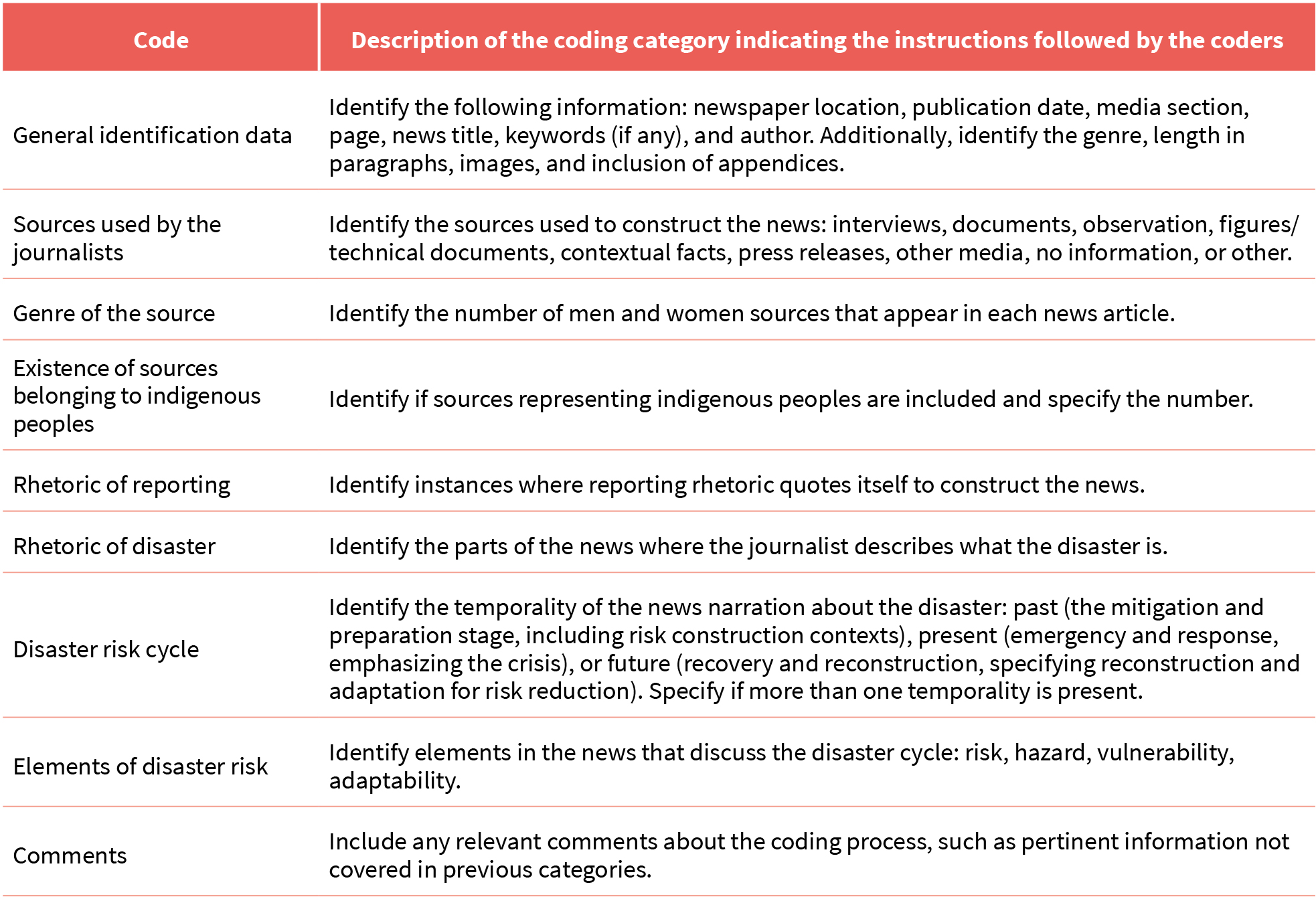
The initial sample consisted of 433 news items. Opinion articles and advertorials were excluded, and only news analysis pieces constructed by daily news routines were considered. Thus, we analyzed 370 news items from the national media La Cuarta, La Tercera, Las Últimas Noticias (LUN), and Emol (electronic version of the print media El Mercurio).
The news coverage of the flood disaster began on March 26, 2015, with an article published in La Tercera and ended on May 24, 2015, with a publication in La Cuarta. The sample includes all the news articles published in the media studied during this period. Therefore, we analyzed the complete news cycle of this disaster.
It is important to note that the media system in Chile, particularly in the written press, is highly concentrated in what is referred to as the duopoly of two business groups: El Mercurio sap and La Tercera. These two media conglomerates own all the national media that were analyzed (Monckeberg, 2011). The article we present here provides a national media perspective on the disaster being studied.
The categories of collected data were then grouped into three sections to analyze the sources and voices used in constructing news related to disasters, the framing techniques used to shape the perception of the disaster, and the temporalities in which the disaster is situated. This translates into three sections that structure the results: Who speaks to the media during a disaster, The meaning of speech and the rhetoric used to construct press information, and The temporality based on the notions of the risk cycle. This approach was taken to develop an analysis that integrates an interdisciplinary conversation among communication, journalism, and disaster studies literature, considering a systemic view of the elements and stages that constitute disaster risk. Furthermore, the data is accompanied by excerpts from sample examples that better illustrate the characteristics identified in the results of the journalistic routines.
Results
Who speaks to the media during a disaster?
Out of the 370 pieces analyzed, the average number of times men are consulted as news sources is 1.85 mentions per piece, with a standard deviation of 1.85. In comparison, women are mentioned an average of 0.61 times, with a standard deviation of 1.03. This means that, on average, a male source may be considered up to three times for every single mention of a female source, as shown in Figure 1.
Figure 1. Average Mentions per News Article and Standard Deviation by Sex

Source Gender
The standard deviation for male mentions reflects a wide variation, with values both above and below the mean (1.85). This indicates that some news stories feature significantly higher numbers of male mentions, while others include very few. Conversely, the standard deviation for women (1.03) is lower, indicating less pronounced variability in their representation. Women consistently appear less often and are rarely considered as authoritative voices in news pieces.
When analyzing individual media outlets, the trends remain consistent. In La Tercera, La Cuarta, and Emol, women account for approximately one-third of the total sources used (33.5 %, 30.49 %, and 32.74 %, respectively), while men represent about two-thirds. However, in Las Últimas Noticias, the disparity is even greater, with men making up 73.49 % of sources and women just 26.51 %. These patterns highlight the dominance of male sources in news construction, with slight variations depending on the outlet, as shown in Figure 2.
Figure 2. Gender Ratios Across Media Percentage

Regarding the type of sources used to construct the news items, they are distributed in order of relevance as follows: national authorities, people living in the flood zone, others, private companies, and academia. Our analysis of 370 news items revealed notable trends in representation, with certain media outlets standing out due to high variability in their use of specific sources, as shown in Figure 3.
Figure 3. Types of sources used by each media outlet
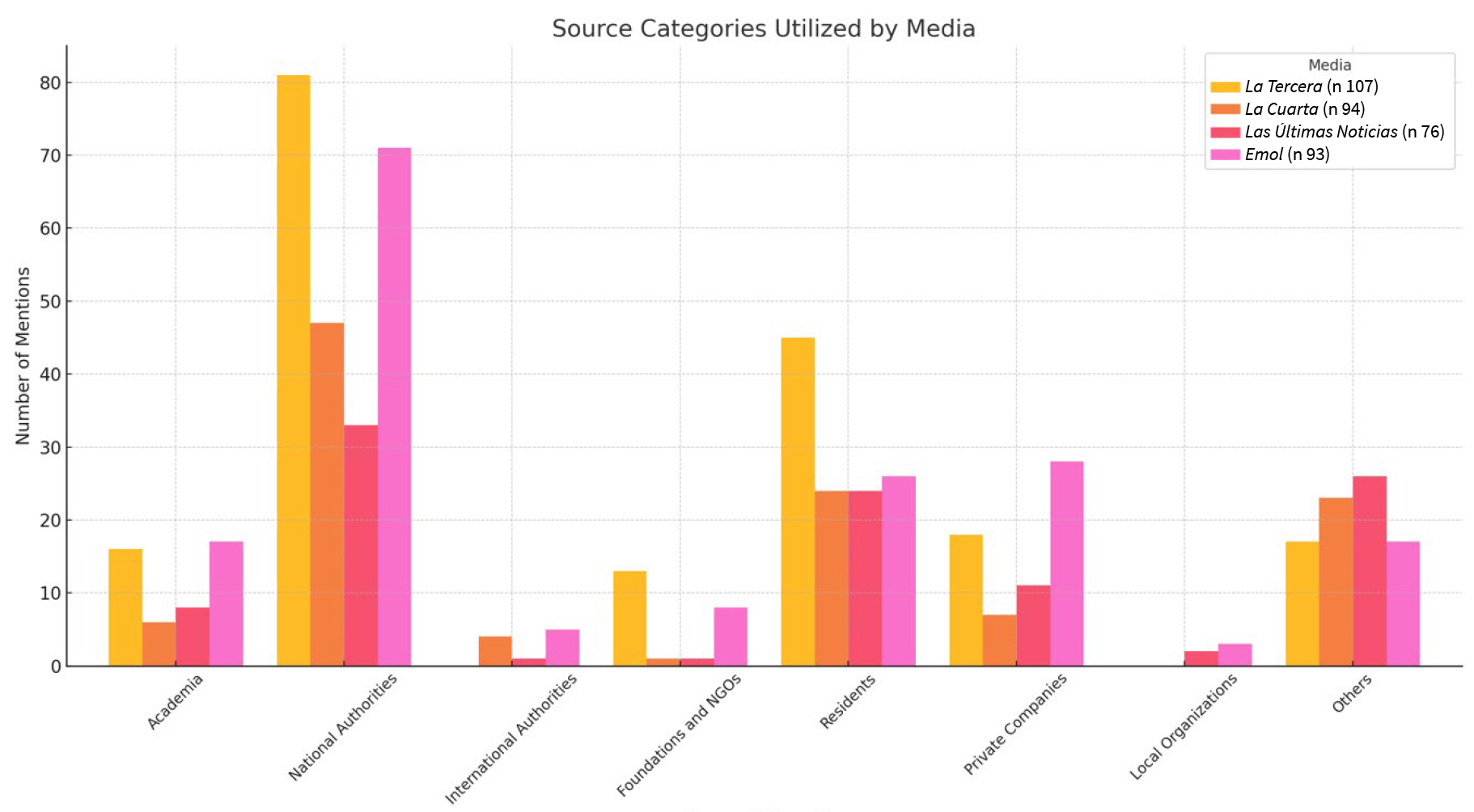
Source Categories
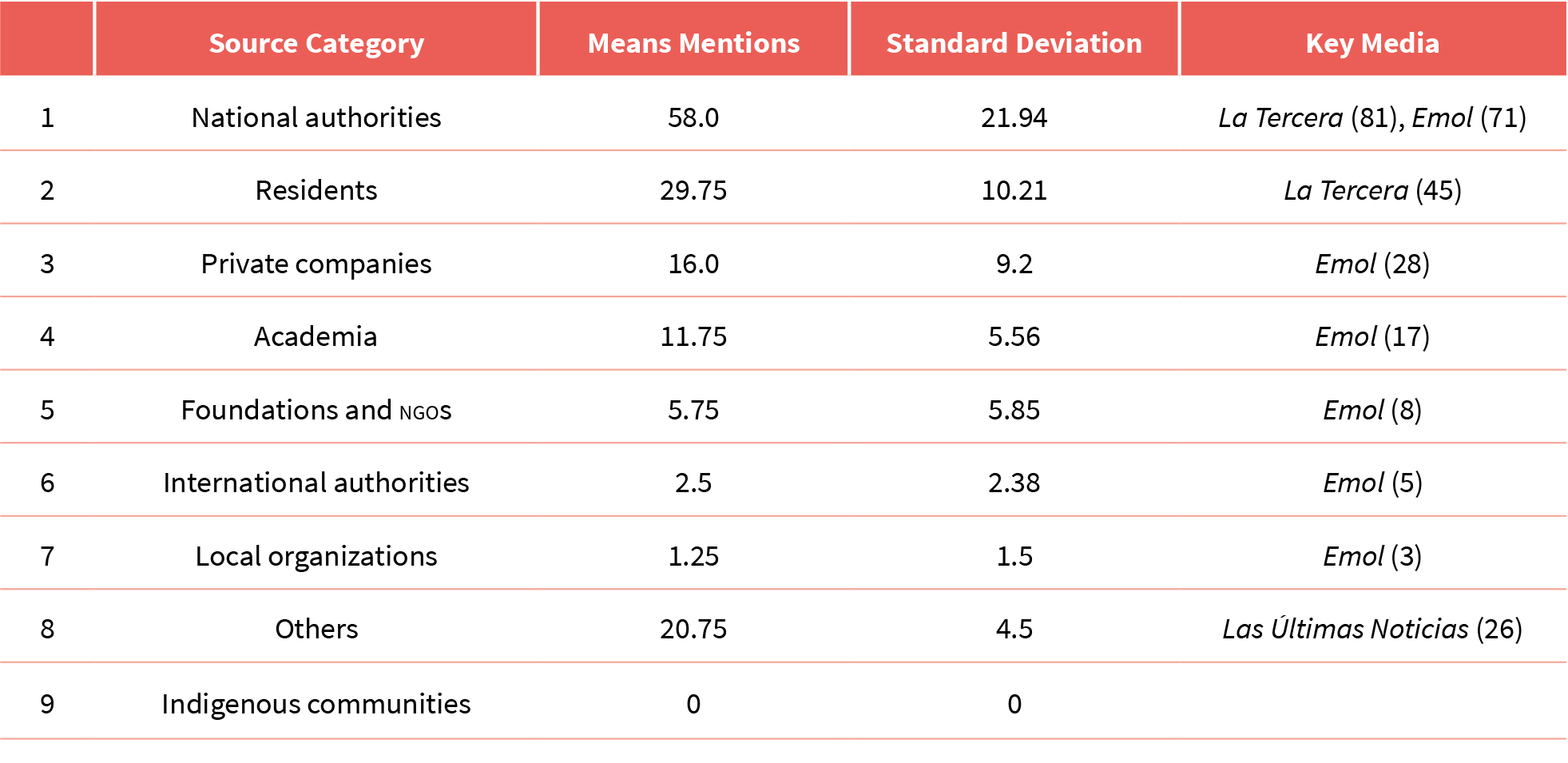
National Authorities are the most cited sources, with an average of 58 mentions and high variability, mostly driven by La Tercera (81 mentions) and Emol (71 mentions). Residents are the second most cited group, averaging 29.75 mentions, with La Tercera (45 mentions) showing a higher reliance on them. Private companies exhibit variability, with an average of 16 mentions, influenced by Emol's higher usage (28 mentions). Academia (11.75 mentions) and Foundations/NGOS (5.75 mentions) also show variability, due to Emol's higher engagement (17 and 8 mentions, respectively). International Authorities (2.5 mentions) and Local Organizations (1.25 mentions) are rarely cited, with Emol again leading (5 and 3 mentions). The "Others" category shows consistent representation across outlets, with Las Últimas Noticias contributing slight variability (26 mentions). Overall, Emol and La Tercera significantly influence these patterns, particularly with official and resident sources. On the other hand, none of the 370 news items collected included sources from indigenous peoples, even though these communities live where the flood occurred. For further details, please refer to the data presented in Table 2.
Table 2. Distribution of Source Mentions by Media Outlet
The news article with the highest number of sources from National Authorities was published by Emol on March 31, 2015, under the title: "Authorities blame each other for not giving flood warning to the affected population". This article includes 12 male and four female sources, who describe the disaster using terms such as "floods", "tons of mud that buried cities and towns", "emergency", and "catastrophe". The piece also highlights the vulnerability of the population and the risks associated with construction in flood-prone areas. For instance, the Undersecretary of Internal Affairs is quoted criticizing mayors for allowing the construction of houses in flood zones, despite regulatory plans.
In principle, the above could be considered a complex news item since it includes several sources. However, all of them represent State entities. This demonstrates that media pluralism is not solely determined by the quantity of sources included. The same is exemplified by the article published by Emol on April 5, 2015, titled "Tragedy in Atacama: 65 % of Companies Not Producing, Region Losing US$111 Million per Week of Stoppage", which features the highest number of sources (22). The article includes 18 sources from businesses and four from national authorities.
From the analyzed corpus, it becomes evident that academia, NGOS, and local organizations remain underutilized, presenting opportunities for more balanced coverage. Additionally, the analysis shows that when the local population is included as a source, they are often framed within the discourse of human drama. For example, news headlines featuring numerous local voices include: "The stories behind the mud" (La Tercera, March 8, with six sources from inhabitants), "Leading characters of the tragedy in the north" (La Tercera, April 25, with seven sources from inhabitants), "My aunt disappeared, her business, her car; everything disappeared" (Emol, March 27, with eight sources from inhabitants), and "The dramatic journey of sportsmen in the catastrophe in the north" (Emol, March 27, with seven sources from inhabitants), among others.
Out of the 119 news items that feature sources from the affected areas, only one includes a time frame before the flood. This news item, titled "Farmer from Taltal dreamed three times about the flood", was published in Las Últimas Noticias on March 29. Although it includes a local source, the article does not address the threats or risks that led to the disaster but rather focuses on a dream, which cannot be considered part of the risk cycle in disaster coverage.
From the analysis, we can conclude that sources representing national authorities consistently dominate across all media, reflecting a reliance on government narratives (42.6 % in La Tercera, 41.9 % in La Cuarta, 31.1 % in Las Últimas Noticias, and 40.6 % in Emol). This pattern highlights a diversity gap and a lack of informational pluralism, as the perspectives of local organizations, international authorities, and academia are underrepresented.
The meaning of speech and rhetoric used to construct press information
In the previous section, we highlighted that the news media used terms such as "catastrophe" (80 times), "tragedy" (64 times), "emergency" (42 times), and "disaster" (35 times) to describe the flood. These terms were primarily used as adjectives to characterize the crisis. However, when examining news items related to the risk cycle, only 4 out of 370 articles mentioned the notion of disaster before the crisis. For example, one headline read, "The alert was released four days before" (La Cuarta, March 27).
In addition, 121 news articles anchor their entire narrative during the crisis. A sample of how this type of news was titled includes: "Heavy rains and floods leave two dead and 22 missing in the north" (La Tercera, March 26); "Radio announcer relates the desperate calls of the flooded" (LUN, March 26); "Baby was born on top of a hill above a refugee camp" (LUN, March 27); "Driver survived on top of a truck full of explosives" (LUN, March 28).
Currently, there are 237 news articles reporting on the aftermath of the emergency. These articles feature headlines like "Vehicle Restrictions Imposed to Aid Cleanup Efforts as Damage in D. de Almagro Estimated at 45 %" (La Tercera, March 30), "Victims Criticize Lack of Coordination and Hoarding" (La Tercera, March 31), "Insurance Claims Follow in the Wake of the Storm" (Emol, March 28), and "Soil Samples Taken to Detect Contamination" (Emol, April 3).
It is worth noting that there are exceptions where distinct stages of the risk cycle are presented together. For instance, six news items highlight both the moment of the crisis and the time after it. One of them is titled "While the government announces measures, the residents of the northern zone evaluate emigrating" (Emol, April 5). Only one news item includes both the time before and after the crisis. It is titled "Chilean cities are not prepared to face climate change" (Emol, April 1).
The previous news item has several distinctive features, approaching the temporality of the disaster in a more complex way. It considers the disaster as a process and situates it within the framework of the risk cycle. At the same time, among the types of speech and shared meanings of disaster, terms such as "climate change", "vulnerability", and "emergency" are mentioned. Although this news piece continues the trend of not including local sources, it has characteristics that we would define as desirable from the perspective of informational pluralism and disaster risk management. For example, it includes two male and one female source, government representatives, and two experts from academia. Moreover, it incorporates the Climate Change Adaptation Plan Report, prepared by the Ministry of the Environment. The previous example suggests that a more comprehensive and systemic approach could be achieved by modifying journalistic practices, integrating the disaster cycle more effectively into news routines.
Temporality based on the notions of the risk cycle
Our approach to disaster management is systemic, meaning we consider communication as a crucial aspect encompassing various dimensions and temporalities. Communication is the space where knowledge, speech, and meanings about disasters circulate and are addressed (Palma, 2021). Therefore, risk communication should not be limited to post-disaster situations. Instead, it should function across various phases, including risk prevention, emergency response, and future actions such as reconstruction, rehabilitation of life, and the development of preventive measures.
However, critical disaster studies literature (Horowitz & Remes, 2021) argues that disasters are "interpretative fictions" because they are social constructions, defined contextually. At the same time, disasters are political events where power struggles shape hegemonic meanings for understanding them. Nonetheless, this perspective does not diminish the materiality of disasters, as they undeniably occur, though the way they unfold depends on the interaction of various levels. In this regard, our analysis of the corpus reveals that 44.5 % of the news items (165 out of 370) openly include contextual facts, incorporating them into the interpretation and framing provided by the consulted media. However, this effort is insufficient to situate news coverage within a systemic understanding of risk.
Figure 4. Temporalities in the news approach by outlet

As illustrated in Figure 4, the temporal scope of most news items shows minimal integration of different phases, concentrating predominantly, as described above, on the crisis itself or the immediate aftermath of the flood.
The analysis of crisis-phase coverage across media outlets reveals notable trends in disaster reporting. On average, 63.29 % of articles focus on the after-crisis phase, with a standard deviation of 16.13 %, indicating some variability among outlets in post-crisis coverage. The during-crisis phase accounts for an average of 33.40 % of articles, with a higher standard deviation of 18.18 %, reflecting significant differences in the prioritization of realtime reporting by the media. Coverage of the pre-crisis phase is minimal, averaging only 1.16 %, with a standard deviation of 1.09 %, which underscores consistently low attention to preparedness across all outlets. Mixed temporalities, such as before/after the crisis and during/after the crisis, show even lower representation, averaging 0.33 % and 1.97 %, respectively, with standard deviations of 0.66 % and 3.95 %. These mixed temporalities appear only in Las Últimas Noticias. These findings highlight a strong editorial focus on reactive post-crisis narratives, moderate variability in real-time crisis reporting, and systemic neglect of preparedness and prevention phases.
Discussion
The results of this study offer a detailed view of how journalistic routines influence disaster coverage, both confirming and expanding upon previous research. As observed in earlier studies (Tuchman, 1983; Wilkins, 2016), journalistic routines predominantly focus on the immediate crisis phase, reflecting the inherently reactive nature of news cycles. This emphasis on emergency events limits consideration of broader phases within the risk cycle, such as mitigation and recovery. These phases are essential for effective risk management, where the media could play a transformative role by expanding the "possible world" through which disasters are understood, moving beyond the narrow scope of the emergency phase.
In terms of source representation, this study reaffirms that national authorities dominate media coverage, consistent with earlier findings that identify a bias toward official voices in disaster reporting (Retegui et al., 2019). However, the novelty of this research lies in its evidence that, while resident voices are included, they are largely framed within narratives of suffering, without addressing the systemic causes of disasters or necessary mitigation measures. This reveals a lack of informational pluralism and critical perspectives in disaster coverage.
Another significant finding is the underrepresentation of women's voices, a persistent trend in the analyzed news. Additionally, Indigenous voices are entirely absent as valid sources for discussing disasters. However, both gender analysis and Indigenous community involvement should not be viewed through a binary lens. Future research must adopt a more inclusive framework that captures the complexity of represented voices in disaster reporting. This calls for the design of methodologies capable of addressing this complexity, moving beyond the simple presence or absence of these voices in news coverage.
Furthermore, the study underscores the inadequacy of media coverage in integrating a comprehensive perspective on the complete risk cycle. This limitation hinders the public's ability to understand disasters beyond the immediate event. Revising journalistic routines to encompass more comprehensive risk coverage —from mitigation to recovery— is critical, as suggested by Wilkins (2016) and Keck & Sakdapolrak (2013). The lack of attention to preparation and recovery phases reflects a disconnect between media coverage and the broader risk cycle, perpetuating an incomplete understanding of disasters and their underlying causes. In line with Wilkins' (2016) framework, this disconnect highlights journalism's failure to fulfill its ethical imperative.
Lastly, the comparison between the temporalities employed by the media and the phases of the risk cycle reveals a pronounced focus on the crisis phase. Coverage of preparation and recovery phases remains marginal at best. This finding underscores the urgent need for a shift in media narratives —from reactive reporting to a more proactive approach. Such a transition would not only inform audiences about the immediate crisis but also contextualize the phases before and after the event, offering a more holistic understanding of disasters. Scientific studies confirm that the regularity of floods in the region necessitates news coverage that provides an informed perspective on the environmental and social context of these phenomena.
This study highlights the importance of adapting journalistic routines to adopt a broader, more systematic approach that considers comprehensive risk management. By doing so, the media could contribute more effectively to building community resilience and preparing for future disasters.
Conclusions
There is an increasing urgency to consider communication, particularly journalism, in conjunction with other disciplines and fields. This interdisciplinary approach can help us better understand the complex nature of communication practices and the broader contexts in which journalism operates. Recognizing the relationship between journalism and other areas of knowledge enhances our understanding of the field and its potential impact.
This study identified a notable lack of media pluralism in the selection of sources and the overrepresentation of government authorities. Although sources from the affected population are considered, they remain vastly underrepresented. Moreover, these sources are predominantly framed within narratives of suffering and the drama of the tragedy. This approach neglects critical discussions on the causes of disasters and potential mitigation or adaptation measures that could be implemented to reduce risks.
Another significant finding is the overwhelming preference for male sources in news coverage. On average, male sources are cited up to three times more often than female sources in the analyzed articles. This disparity varies widely, with some articles featuring significantly more male mentions than the average, while others include very few. Conversely, the consistently low presence of female sources is reflected in their lower standard deviation, indicating minimal variability across media outlets. A detailed analysis of individual outlets confirms the persistence of this trend.
Our study also identified two distinct temporalities that shape disaster coverage. The first is the media temporality of the disaster, which reflects how news outlets structure their reporting timelines. The second is the temporality of the disaster risk cycle, as defined in disaster management. Our findings reveal a disconnect between these two frameworks. Media coverage predominantly focuses on the crisis phase, with limited attention to other phases of the risk cycle, such as prevention, mitigation, and recovery. Despite some incorporation of contextual facts, the media's temporal approach remains largely unchanged, resulting in a repetitive loop of crisis-focused reporting.
Future research should expand to include regional media outlets to examine their practices and timelines in disaster coverage. Additionally, we must deepen our analysis of gender and Indigenous representation, moving beyond binary categorizations of sources. Achieving this requires the development of alternative methodologies and conceptual frameworks that capture the complexity of these categories, particularly in the context of disasters and journalistic practices. Identifying disparities in source representation and understanding the construction of authoritative voices is an essential first step.
Given the pressing challenges posed by climate change and the increasing frequency of global disasters, this study's findings should be incorporated into journalism education. This integration involves critically examining established journalistic practices to gain a deeper understanding of the relationship between media, disasters, and the environment.
References
1. Bretones, M. (2020). Los procesos de producción, las estructuras narrativas y las funciones generales del mensaje de los MCM tradicionales. Universidad de Barcelona. https://hdl.handle.net/2445/154887
2. Consejo Nacional de Televisión (CNTV). (2014). Cobertura televisiva del terremoto en la zona norte e incendio en Valparaíso: percepciones de la audiencia. CNTV.
3. Consejo Nacional de Televisión (CNTV). (2015). Cobertura televisiva de desastres: la visión de periodistas en terreno y editores. CNTV.
4. Díaz, M., & Mellado, C. (2017). Agenda y uso de fuentes en los titulares y noticias centrales de los medios informativos chilenos: un estudio de la prensa impresa, online, radio y televisión. Cuadernos.info, (40), 107-121. https://doi.org/10.7764/cdi.40.1106
5. Horowitz, A., & Remes, J. A. C. (2021). Introducing critical disaster studies. In A. Horowitz & J. A. C. Remes (Eds.), Critical disaster studies (pp. 1-8). University of Pennsylvania Press. https://doi.org/10.2307/'.ctv1f45qvg.3
6. Keck, M., & Sakdapolrak, P. (2013). What is social resilience?: lessons learned and ways forward. Erdkunde, 67(1), 5-19. https://www.jstor.org/stable/23595352
7. Knowles, S. (2014). Learning from disaster?: the history of technology and the future of disaster research. Technology and Culture, 55(4), 773-784.
8. Knowles, S. G., & Loeb, Z. (2021). The voyage of the paragon: disaster as method. In J. A. C. Remes & A. Horowitz (Eds.), Critical disaster studies (pp.11-31). University of Pennsylvania Press. https://doi.org/10.2307/j.ctv1f45qvg.4
9. Lavell, A. (2003). La gestión local del riesgo: nociones y precisiones en torno al concepto y la práctica. Programa Regional para la Gestión del Riesgo en América Central-Cepredenac-PNUD.
10. Lester, L., & Hutchins, B. (2012). Soft journalism, politics and environmental risk: an Australian story. Journalism, 13(5), 654-667. https://doi.org/10.1177/1464884911421706
11. Monckeberg, M. O. (2011). Los magnates de la prensa. Random House Mondadori.
12. O'Connor, C., & Joffe, H. (2020). Intercoder reliability in qualitative research: debates and practical guidelines. International Journal of Qualitative Methods, 19. https://doi.org/10.1177/1609406919899220
13. Palma, K. (2021). Comunicación del desastre. En F. Molina, F. Navarrete & S. Valdivieso (Eds.), Ecologías del desastre (pp. 128-133). Pehuén.
14. Palma, K., & Lieberherr, M. (2022). Conociendo la agenda mediática de la costa central chilena: una caracterización necesaria para promover la gestión participativa del riesgo. En C. Martínez et al. (Eds.), Hacia una ley de costas en Chile: bases para una gestión integrada de áreas costeras (pp. 549-560). Pontificia Universidad Católica de Chile.
15. Palma, K., & Salinas, C. (2024). Rutinas periodísticas y ciclo de los desastres: hacia una comunicación para la reducción del riesgo. Methaodos, revista de ciencias sociales, 12(1), m231201a05. https://doi.org/10.17502/mrcs.v12i1.711
16. Palma, K., & Sánchez, F. (2021). Las reescrituras de la sustentabilidad: comunicación estratégica en el escenario de desastres socioambientales. Anuario Electrónico de Estudios en Comunicación Social "Disertaciones", 14(2). https://doi.org/10.12804/revistas.urosario.edu.co/disertaciones/a.10133
17. Palma, K., Salinas, C., Stange, H., & Valenzuela, M. (2022). Desbordar el enfoque: comunicación y desastre en Latinoamérica. Question/Cuestión, 3(71). https://doi.org/10.24215/16696581e679
18. Puente, S., Pellegrini, S., & Grassau, D. (2013). How to measure professional journalistic standards in television news coverage of disasters?: 27-F earthquake in Chile. International Journal of Communication, (7), 1896-1911.
19. Retegui, L., Carboni, O., Koziner, N., & Aruguete, N. (2019). Fuentes periodísticas, standing y rutinas de trabajo en las noticias de delito, inseguridad y violencia en los noticieros de AMBA. Cuestiones Criminales, 2(4), 236-265.
20. Riorda, S., Fontana, M., & Conrero, S. (2022). La política del riesgo. La Crujía.
21. Rodrigo-Alsina, M. (1989). La construcción de la noticia. Paidós.
22. Romero Sánchez, J. (2016). Crónica de un aluvión. Editorial Cinco Ases.
23. Saldaña, M. (2022). Who is to blame?: analysis of government and news media frames during the 2014 earthquake in Chile. Journalism Studies, 23(1), 25-47. https://doi.org/10.1080/1461670X.2021.1997152
24. Salinas, C., & Stange, H. (2009). Rutinas periodísticas: discusión y trayectos teóricos sobre el concepto y su estudio en la prensa chilena. Universidad de Chile.
25. Salinas, C., & Stange, H. (2015). Burocratización de las rutinas profesionales de los periodistas en Chile (1975-2005). Cuadernos.info, (37), 121-135. http://dx.doi.org/10.7764/cdi.37.703
26. Stange, H., Salinas, C., Yáñez Duamante, C., & Santa Cruz, E. (2018). Pluralismo informativo y burocratización del trabajo periodístico en dos contextos de prensa diaria. Estudios sobre el Mensaje Periodístico, 24(2), 1825-1843. https://doi.org/10.5209/esMP.62249
27. Tuchman, G. (1983). La producción de la noticia: estudio sobre la construcción social de la realidad. Gustavo Gili.
28. United Nations Office for Disaster Risk Reduction (UNISDR). (2009). Terminología sobre reducción de riesgo de desastres. Naciones Unidas.
29. Wilcox, A. C., Escauriaza, C., Agredano, R., Mignot, E., Zuazo, V., Otarola, S., Castro, L., Gironás, J., Cien-fuegos, R., & Mao, L. (2016). An integrated analysis of the March 2015 Atacama floods. Geophysical Research Letters, 43, 8035-8043. https://doi.org/10.1002/2016GL069751
30. Wilkins, L. (2016). Affirmative duties: the institutional and individual capabilities required in disaster coverage. Journalism Studies, 17(2), 216-230. https://doi.org/10.1080/1461670X.2014.974985
CRedit authorship declaration:
Conceptualization: K. P., C. S. L.; Investigation: K. P., C. S. L.; Methodology: K. P., C. S. L.; Funding acquisition: K. P., C. S. L.; Project administration: K. P.; Supervision: K. P.; Writing-original draft: K. P., C. S. L.; Writing-review & editing:
K. P., C. S. L.
This work was supported by the Fund for Studies on Pluralism in the National Information System, provided by the National Agency for Research and Development, under Grant PLU220005. The authors report there are no competing interests to declare.
Appendix. Table of coding for sources and disaster

