
Estudios
BEYOND THE IMAGE AND THE DOLL: BARBIE AS A DEVICE ON INSTAGRAM
Más allá de la imagen y la muñeca: Barbie como dispositivo en Instagram
Além da imagem e da boneca: Barbie como dispositivo no Instagram
Joice Antonelli, University of Brasília (Brasil)
Andrea Versuti, University of Brasília (Brasil)
Anuario Electrónico de Estudios en Comunicación Social "Disertaciones", vol. 17, núm. 2, pp. 1-16, 2024
Universidad del Rosario

Esta obra está bajo una Licencia Creative Commons Atribución-NoComercial 4.0 Internacional.
DOI: https://doi.org/10.12804/revistas.urosario.edu.co/disertaciones/a.13940
Submitted: December 4, 2023
Accepted: March 25, 2024
Date of prepublication: May 28, 2024
ABSTRACT
In 2014, with the release of Barbie’s official profile on Instagram, people felt encouraged to create pages to share images and stories of their own Barbie dolls, creating a doll community on Instagram. The purpose of this work, part of an ongoing PhD research, was to explore this online community, understand how Barbie is portrayed on Instagram, and identify constructions that reflect aspects of our culture. For this investigation, a netnographic study of 100 Instagram profiles was performed. Overall, we found that the images of the doll can be understood as devices, which refers to any artifact capable of capturing and shaping people’s gestures, behavior, and opinions. In general, Barbie is used on Instagram as a protagonist of lifestyle narratives (88 % of the pages). We also found that 11 % of the pages are dedicated to fashion editorials. In both cases, we found consistent similarities between the images and captions shared by users with those posted on the doll’s official profile. Unexpectedly, this study also identified profiles that use images of Barbie to promote discussions of topics related to the black population, comprising 1 % of the total sample, demonstrating a new way of using the doll’s images.
Keywords: Barbie; Instagram; device.
RESUMEN
En 2014, con el lanzamiento del perfil oficial de Barbie en Instagram, las personas se sintieron motivadas a crear páginas para compartir imágenes e historias de sus propias muñecas, lo que llevó a que se creara una comunidad de muñecas en Instagram. El propósito de este trabajo fue explorar esta comunidad, comprender cómo se retrata Barbie en Instagram e identificar construcciones que reflejen aspectos de nuestra cultura. Para esta investigación, se realizó un estudio netnográfico de 100 perfiles de Instagram. En general, las imágenes de la muñeca pueden entenderse como dispositivos, comprendidos como cualquier artefacto capaz de capturar y dar forma a los comportamientos y opiniones de las personas. Con frecuencia, Barbie se utiliza en Instagram como protagonista de narrativas de estilo de vida (88 % de las páginas). También se encontró que el 11 % de las páginas están dedicadas a editoriales de moda. En ambos casos, se evidenciaron similitudes entre las imágenes y leyendas compartidas por los usuarios y las publicadas en el perfil oficial. Inesperadamente, este estudio así mismo identificó perfiles que usan imágenes de Barbie para promover la discusión de temas relacionados con la población negra (1 %), lo que muestra una nueva forma de emplear las imágenes de la muñeca.
Palabras clave: Barbie; Instagram; dispositivo.
RESUMO
Em 2014, com o lançamento do perfil oficial da Barbie no Instagram, as pessoas se sentiram encorajadas a criar páginas para compartilhar imagens e histórias de suas bonecas Barbie, o que criou uma comunidade de bonecas no Instagram. O objetivo deste trabalho, parte de uma pesquisa de doutorado em curso, foi explorar essa comunidade on-line e compreender como a Barbie é retratada no Instagram, identificando também construções que refletem aspectos da nossa própria cultura. Para esta pesquisa, foi realizado um estudo netnográfico de 100 perfis do Instagram. De modo geral, constatamos que as imagens da boneca podem ser entendidas como dispositivos, o que se refere a qualquer artefato capaz de capturar e moldar gestos, comportamentos e opiniões das pessoas. Em geral, a Barbie é utilizada no Instagram como protagonista de narrativas de estilo de vida (88 % das páginas). Verificamos também que 11 % das páginas são dedicadas a editoriais de moda. Em ambos os casos, encontramos semelhanças consistentes entre as imagens e as legendas compartilhadas pelos usuários com as postadas no perfil oficial da boneca. Inesperadamente, este estudo também identificou perfis que utilizam imagens da Barbie para promover discussão de temas relacionados à população negra (1 % do total da amostra), o que demonstra uma nova forma de utilização das imagens da boneca.
Palavras-chave: Barbie; Instagram; dispositivo.
In 2014, Mattel officially published Barbie’s profile on Instagram (@barbiestyle) where pictures of Barbie as a protagonist of lifestyle narratives (Figure 1) are shared with the doll’s followers. Currently, the page has more than 2.6 million followers.
Figure 1. Set of images of Barbie’s official profile on Instagram (@barbiestyle)
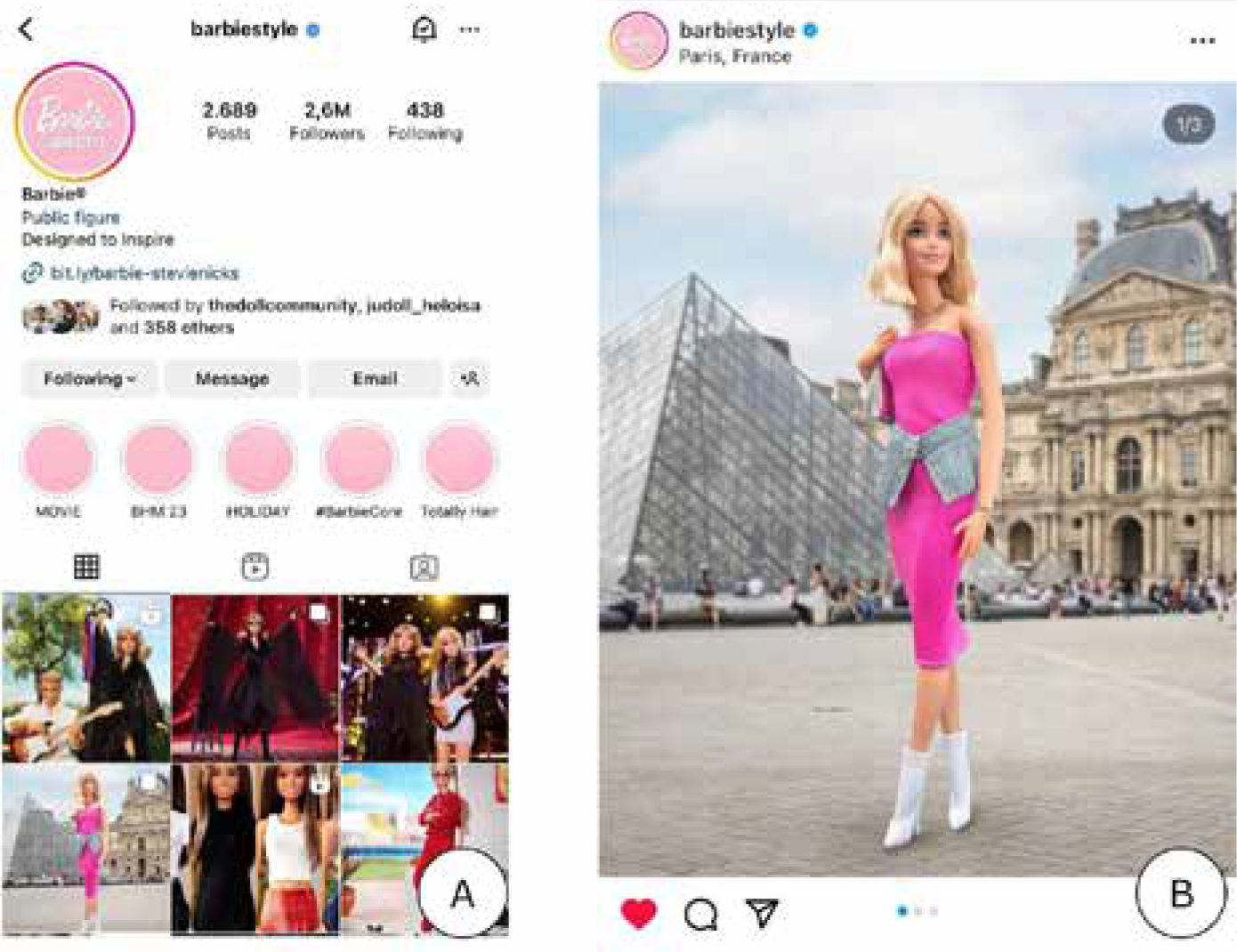
Note: a) Barbie’s official Instagram profile; b) Barbie visits Paris in a picture shared by Barbie Style (2023).
After the release of this profile by Mattel, people of all ages felt encouraged to create pages on Instagram to share images and stories of their own dolls. Currently, there are thousands of profiles, easily found through hashtags such as #barbiedoll (with over 2.7 million posts) or #barbiephotography (with over 700,000 posts).
Instagram, the focus of this research, is an online social networking platform released in 2010 that allows its users to share images, videos, and texts. Since it is a platform exclusively accessible via smartphones (although it is possible to follow updates via desktop computers), it is also referred to as an “app”. Although generally used to refer to online social groupings, the notion of “social networks” actually comes from the Social Sciences to explain certain types of relationships between people. Using this concept in the internet environment means adapting a model of social analysis to the virtual space. Thus, it is important to highlight that social networks and social networking sites (or apps) are different concepts.
Social networking platforms work as metaphors for the structure of social groupings. They are formed by relationships between individuals and serve as a fundamental structure for society. It is by observing these social groups that social relationships and bonds are perceived as connections, and individuals are seen as actors united by these connections, forming the social tissue (Recuero et al., 2015). Social actors are therefore the first element of a social network; they are the people involved in the network being analyzed. As parts of the system, these actors shape social structures through interaction and the formation of social bonds.
Social networks in their representations in cyberspace are somewhat different. By cyberspace, we mean the space of communication opened by the worldwide interconnection of computers, that is, the internet (Lévy, 2010). A sine qua non condition of cyberculture, cyberspace is directly linked to the concept of “digital”, which, in turn, includes everything that can be reduced to a binary code. In cyberspace, social networks are demarcated by the “traces” left by social actors —e. g., a comment on a blog or an image posted on Instagram, for example, remains there until someone deletes them or the website goes offline— and also by their representations, which inevitably highlight the common official values of the society in which they occur (Goffman, 2014). By “representation”, we can understand i) the process of presenting an object to an interpreter of a sign or the connection between the sign and the object (Santaella & Nöth, 1997); or ii) those images that have their own energy to persuade readers or viewers that the real corresponds effectively to what they say or show (Chartier, 2011).
In the case of cyberspace, social networks are primarily represented by social networking sites and apps (such as Facebook, Twitter, Instagram, etc.). According to Recuero et al. (2015, p. 23), the networks represented on these platforms are less affected by the temporality of offline relationships. For instance, their bonds are not worn out by lack of contact. Thus, they are considered more stable networks and, therefore, more complex and larger, comprising a plurality of broader relationships than those in offline networks. Social actors in cyberspace networks are also constructed differently, as the interaction between those involved is marked by their distance from each other, making these actors not immediately discernible (Recuero, 2010). These identity constructions in cyberspace can be represented by a blog, a Twitter account, or even an Instagram profile. These social actors in the digital world are representations of people, but they are also spaces of interaction; places of speech constructed by actors to express elements of their personality or individuality (Recuero, 2010).
According to Manovich (2017), Instagram symbolizes the new era of mobile photography, a counterpart to the early platforms available on desktop computers such as Flickr. The app represents a significant development in the history of modern communication by combining different elements of the history of photography into one app: camera, photographic paper, the darkroom, “galleries”, and dissemination. However, as noted by Jenkins (2009, p. 189), more than just a technological transformation, new media have also allowed a cultural transformation by granting ordinary people the possibility to contribute actively, creating what he calls “participatory culture”. This expression contrasts with older notions about the passivity of media users and even with the idea of “interactivity” (the way technologies were planned to respond to user feedback), highlighting these people’s participation in the production and distribution of cultural goods. As pointed out by Jenkins (2009), computers provided huge opportunities for interacting with media content, and while operating at this level, it was relatively easy for media companies to control what was happening. However, cyberspace has become a site of consumer participation, which includes many unauthorized and unforeseen ways of engaging with all the media content available. In this context, we can include the images of Barbie created and shared through Instagram by people all over the world. By appropriating a product belonging to a major corporation (Mattel), these users are also building a participatory culture.
New Media and the Doll
Manovich (2001) refers to “new media” as the result of the convergence of two previously distinct paths: Computing and traditional media such as cinema and photography. These two paths began almost simultaneously, one in 1833 (with Charles Babbage’s analytical engine) and the other in 1839 (with Louis Daguerre’s daguerreotype). For Jenkins (2009), however, more than a technological process that combines multiple functions within the same device, convergence represents a cultural transformation that occurs within the minds of individual consumers and in their social interactions with others. Technological transformations are embedded in this “convergence”, but, according to the author, the focus is on the flow of content across multiple media platforms, a flow that heavily depends on active user participation. In any case, this convergence has not only enabled the emergence of new cultural forms, such as computer games and metaverses, but also allowed existing cultural artifacts to be redefined, such as the doll.
Like any toy, the doll is a cultural object that reflects the society it is a part of (Benjamin, 2009; Brougère, 2010), and has been present since ancient civilizations. In ancient times, it was an object from the world of adults related to rituals, such as the ushabtis (funerary dolls) of ancient Egypt, which were tasked with replacing relatives and slaves in the pharaoh’s journey to the world of the dead; or dolls dedicated to Aphrodite in ancient Greece. In the eighteenth century, the Industrial Revolution brought changes that redefined the role of the child, who was previously seen as a miniature adult without distinct characteristics or needs (Reis & Carvalho, 2019). From then on, the child began to be perceived as a social individual within the community, to be prepared and educated for that emerging industrial society, and this is how the doll came into the hands of children. According to Benjamin (2009), the dolls that were given to children at that time were dressed as adults; the baby doll, which controlled the market between the nineteenth and mid-twentieth centuries, did not exist. According to the author, the reason for this was because during that period, the baby was unknown as an intelligent being, and therefore, adults were supposed to be the inspiration for children who manipulated the dolls.
According to Brougère (2010), the baby doll was created in the nineteenth-century industrialization process to represent the child more realistically, allowing and encouraging an emotional caring relationship through the representation of nurturing acts such as feeding, comforting, combing, and dressing. These dolls controlled the toy market until the 1950s when the first fashion dolls appeared, which can be understood as dolls with adult clothes that could be changed. However, even though some of them were labeled as teenagers, these early fashion dolls looked more like baby dolls with makeup and styled hair (Gerber, 2023). It was in this scenario that Barbie, the first doll with the features of an adult woman, was released in 1959, revolutionizing both the toy industry and the act of playing since it allowed children to see dolls as themselves and not as daughters (Gerber, 2023). Today, more than 60 years later, Barbie remains the world’s best-selling doll.
New media not only enabled the emergence of new cultural forms but also allowed existing cultural artifacts to be redefined. Therefore, with the advent of computers and smartphones, the doll is no longer confined to activities within four walls: through images, it invades the digital world and is reintegrated into the realm of adults, especially in doll fan communities that inhabit Instagram. Now, the doll is used to exercise creativity and share experiences in cyberspace (Heljakka, 2015), primarily on social media.
Method
The online condition in mobile media technologies has dissolved the boundaries between online and offline (Ferraz, 2019). The empowerment of Information and Communication Technologies (icts) in our lives has repercussions on our attitudes, both at the individual and collective levels, manifesting in various spheres of social relations, to the extent that ignoring the digital condition in the context of contemporary culture is to ignore the social phenomenon of our era (Ferraz, 2019).
Computer-mediated interaction and other mobile media are responsible for generating and maintaining complex relationships in cyberspace (Recuero, 2010), where user interaction and information sharing are central activities in virtual communities (Skågeby, 2011). However, more than a field of social interaction, online networked media produce and reproduce behaviors, values, and principles of control performed by the culture they are subjected (Ferraz, 2019). To observe and classify these social phenomena, it’s necessary to venture into the digital world.
As we highlighted earlier, the release of Barbie’s official Instagram account (@barbiestyle) in 2014 brought visibility to the use of the doll as the protagonist of lifestyle narratives, enabling people worldwide to create profiles on the platform and share photos and stories of their dolls, thus creating the doll community (a community within Instagram dedicated to discussing and sharing doll-related topics and photos and videos). The objective of this work, part of an ongoing PhD research, was to examine this community and understand, through the shared images and texts, how the images of Barbie dolls are used on Instagram, also identifying constructions that reflect aspects of our own culture.
Ferraz (2019) emphasizes that understanding icts requires adaptation of methodological techniques, involving comprehensive engagement with the study field, exploring it to understand how activities unfold on online social networks and what meanings and symbols engage users. Therefore, for this research, due to the need for observational investigation in an online field (Instagram), netnography was chosen.
Kozinets (2014) defines it as participant observational research based on online fieldwork. It uses computer-mediated communications or mobile media as a data source to achieve understanding and ethnographic representation of a cultural or communal phenomenon (Kozinets, 2014). Skågeby (2011), on the other hand, refers to a qualitative approach for data collection in virtual communities as online ethnography. There are, in fact, many terminologies, as rightly indicated by Ferraz (2019), who refers to investigations using ethnographic approaches on the internet as netnography, virtual ethnography, webnography, digital ethnography, social media ethnography, or online ethnography. For this work, the term “netnography” was adopted to emphasize the importance of icts mediation in the social relations object of study.
Besides the online nature of this research, another factor that led to the choice of netnography as the methodology was the understanding of the need for participant observation. Skågeby (2011) considers that entry into an online community can range from simply identifying the group to be studied to effective interaction by the researcher. Furthermore, the type of observation depends, for example, on the type of community where the research is conducted. Online social network communities, despite often being open to the public, are usually a familiar universe to their participants, but outsiders are viewed with suspicion. In the case of the community dedicated to dolls on Instagram, this feeling is intensified by the fact that dolls are cultural objects more recently associated with the world of children (and girls), making the use of these objects by adults (and men) subject to ridicule (Brougère, 2010, p.13). Thus, to approach this desired field, the profile @papodeclarissa was created on April 1, 2022.
While opting for participant observation, Ferraz (2019) emphasizes that the researcher must be careful in constructing their online identity. For immersion in a community that uses Barbie dolls as social actors, the @papodeclarissa profile could not be different: in it, Clarissa is a Barbie doll, and she presents herself as a journalist and photographer. The captions are written in both Portuguese and English to connect with as many people within the doll community as possible.
According to Skågeby (2011), netnographic research begins when the researcher enters an online social group. From that point, data collection can begin. Thus, since April 2022, we have been gathering information about this online community, either through daily observation (online observation) or data collection (screenshots of posts and comments).
Sample
An initial observation of the obtained data, derived from the analysis of 100 profiles selected through @papodeclarissa, provided some insights about the use of the image of the dolls in this online community. For the selection of these profiles, the following criteria were adopted:
1.Public Instagram profiles that use images (their own, not previously used on the @barbiestyle profile) of the Barbie doll;
2.Profiles with a minimum of 50 posts and at least 1,000 followers.
Regarding the second criterion, it is pertinent to note that given how easy it is to create an Instagram page (it just requires a valid email address), these parameters were adopted to include in the analysis only those profiles that are genuinely active in the community.
Results
From the selected profiles, an initial analysis observed that, in general, the images of Barbie shared on Instagram can be understood as devices. Here, we use the concept of “device” proposed by Agamben (2005), meaning any artifact that, in some way, has the ability to capture, guide, determine, intercept, shape, control, and assure the gestures, conduct, opinions, and speeches of people.
According to Santaella and Nöth (1997), the world of images is divided into two domains: i) The immaterial domain, where images are created by our minds and appear as visions, fantasies, and other mental representations; ii) the visual representations domain, where images are material objects, signs that represent the environment around us. In this category, we can include drawings, paintings, prints, sculptures, photographs (analog or digital), or film frames. However, the image is much more than an object; it is the place of a living process, a system of thoughts (Samain, 2012). Besides conveying a figure, the image also conveys the thoughts of its producer and more importantly: the thoughts of all those who look at it.
Deleuze (2013) asserts that every image is inseparable from a before and after peculiar to it. Even though it does not merge with the preceding and subsequent images, this representation is not limited to the present time: it carries the past and also the future. According to Samain (2012), this concept of image-time proposed by Deleuze brings forth an important reflection on the issue of movement in and within the image, whether static or dynamic. Thus, according to Samain (2012), an image is a “form that thinks” (p. 33), in that the ideas conveyed by it and that it awakens within us —when we look at it— are ideas that have become possible only because the image takes part in stories and memories that preceded it, from which it draws nourishment before being reborn, reappearing now in our hic et nunc, and probably in the future, by reformulating itself in other unique directions and forms. The image, then, is part of a system capable of producing thought. This system, in addition to the image itself, includes the one who produced it, the one who observes it, and the support that sustains it.
Barthes (2018) divided images into studium and punctum. According to the author, in the first one, the image is a field of study that includes thousands of photos. Through these photos, one can certainly have a kind of general interest, sometimes emotional, but whose emotion passes through the judicious alternation of a moral and political culture (Barthes, 2018, p. 27). The punctum comes to contradict, to break the studium. In an image, the punctum is what mortifies, wounds, and shakes. Barthes (2018) regrets that many photos remain inert before his gaze, provoking in him only a general and polished interest. In them, no punctum. Those pictures are invested only with studium. Samain (2012, p. 24), in turn, refers to the images that unsettle us, that make us think, as “strong images”. And they can also be found in the material shared in the Barbie doll community on Instagram.
Discussion
Welcome to Barbieland
Skågeby (2011) refers to analytical dimensions as a form to fully envelope the diversity of use qualities that commonly exist in complex information systems such as social media networks. The fundamental structure of this dimension revolves around a polarized conflict, where the primary counterparts form the opposing ends of the spectrum. Once these opposing ends are recognized, researchers have the opportunity to hypothesize, identify, and investigate the activities, concerns, and intentions that lie in between these extremes. When it comes to the doll community, there is a more obvious pole: welcome to Barbie Land!
In the Barbie movie (Gerwig, 2023), Barbie Land, or the place where Barbie dolls live, is portrayed as a (pink) perfect world, where dolls live without worries in what seems like an endless sequence of parties. This carefree world filled with social events can also be found in the images shared on the official Barbie Instagram profile,
@barbiestyle. Despite the color palette used on the online social platform including shades beyond the typical pink of Barbie Land, the images reveal that, just like in Barbie’s fictional world, the doll’s concerns in the “real world” don’t go much beyond her wardrobe and documenting her daily life or her participation in events. However, these images are cherished by the doll community, as 88 % of the profiles analyzed for this study replicate the same narrative.
On these pages, which we will refer to as Avatar Profiles (Figure 2), the doll is the protagonist/social actor, a fact reinforced by the information provided in the profile’s biography (photos, details such as name, age, profession, city of residence, etc.), and she shares images with her followers focusing on fashion and lifestyle.
Figure 2. Set of images of an example of an Avatar Profile
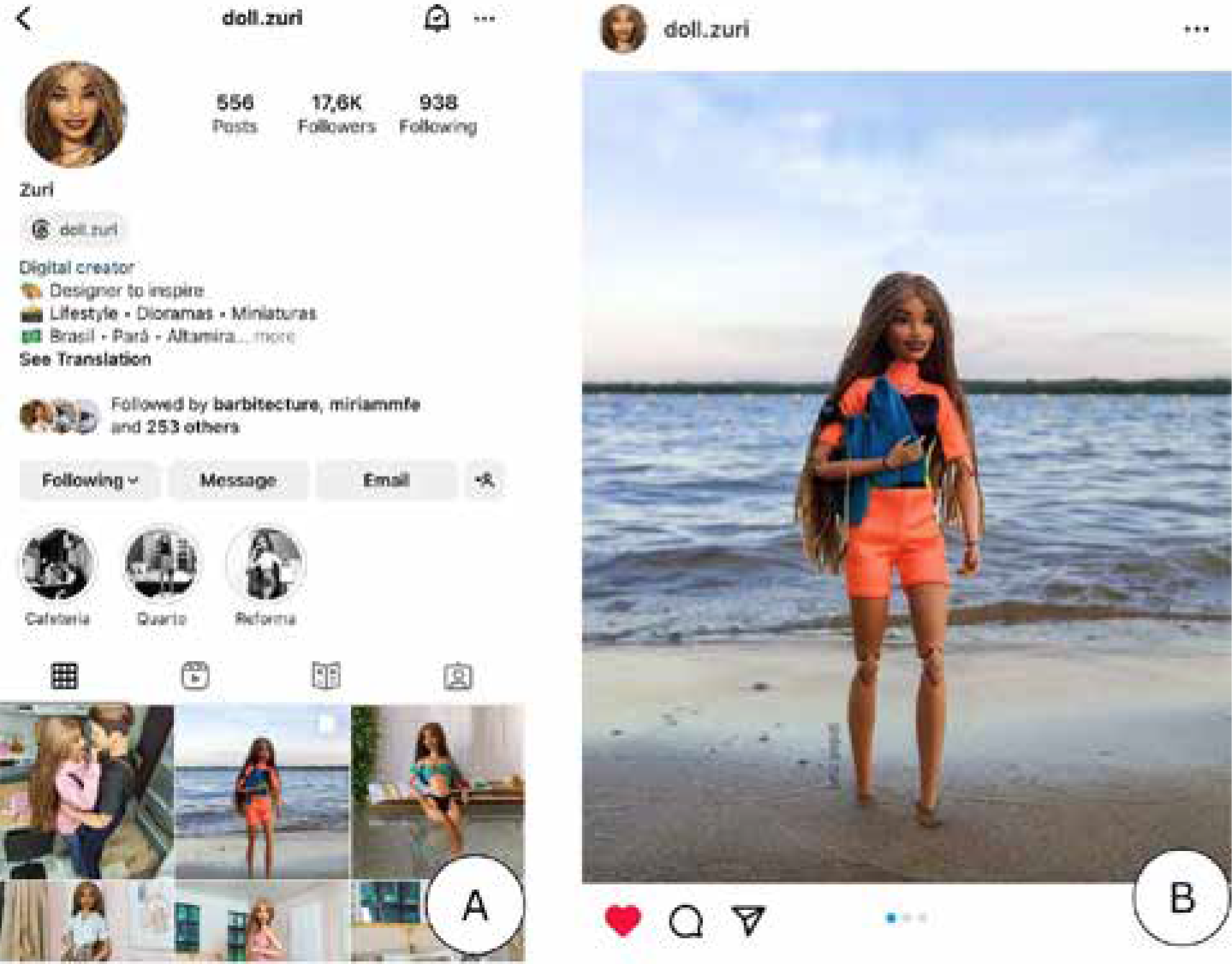
Note: a) An example of an Avatar Profile on Instagram; b) Barbie in the Xingu River (Brazil) in this picture shared by the Instagram profile Doll Zuri (2023).
Furthermore, just like on the @barbiestyle profile where Barbie attends fashion events in Paris, New York, and Milan, the dolls from the profiles analyzed are often seen attending parties, fashion shows, and other events on Instagram, mostly organized by the users themselves. Overall, in these images, one can identify the same carefree attitude found both in Barbie’s official profile and in Barbie Land.
This leads us to what Han (2019) refers to as the society of positivity, where all negativity is unwanted. According to the author, art produced by this society values the “wow”, the likes, where no judgment or interpretation is necessary. Han (2019) states that this society consciously stays in the realms of childishness, banality, undisturbed, relaxing, disarming, and relieving. Nothing in this society should traumatize, hurt, or scare. In essence: in the images produced by this society, there can be no room for what Barthes (2018) called punctum, or those images that have the power to move us.
Similar images to those of the Avatar Profiles were also found on 11 other pages analyzed (11 % of the total), which we will refer to as Collection Profiles (Figure 3). On these profiles, the focus is not on the doll’s narratives, but on the production of fashion editorials where Barbie is the model. It is important to note that Barbie was a pioneer among fashion dolls with bodies representing an adult woman, and this aspect has reinforced the doll’s connection to the fashion world.
Figure 3. Set of images of an example of a Collection Profile
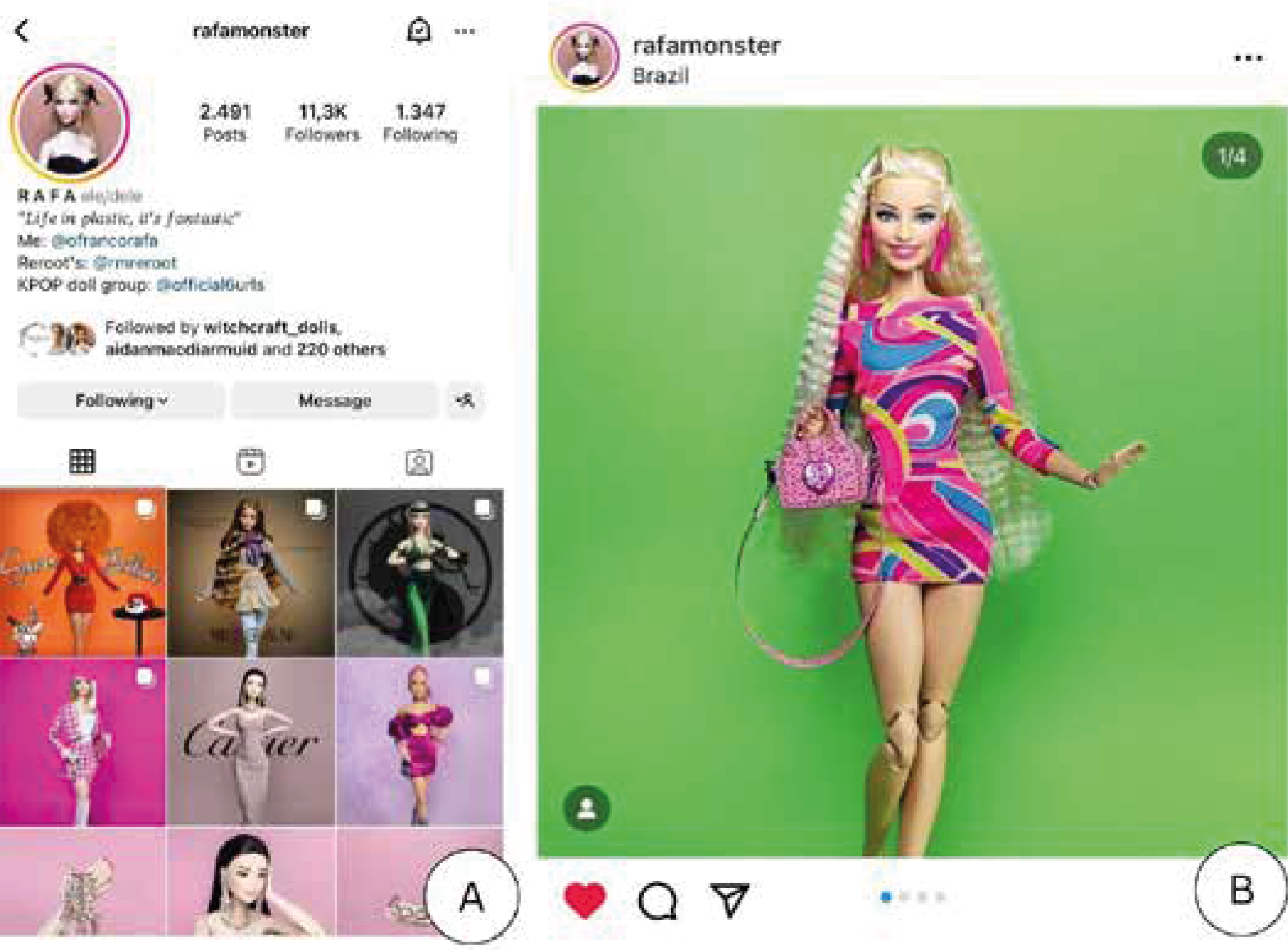
Note: a) An example of a Collection Profile; b) Picture shared by the Instagram profile Rafa Monster (2023). In a Collection Profile, Barbie is used as a model for fashion photoshoots.
In both the Avatar Profile and Collection Profile cases, we found consistent similarities between the images and captions shared by users and those featured on the official Barbie profile. Although beautiful and intriguing, those images lack something that deeply moves or unsettles us. They align with what Barthes (2018) refers to as studium: a vast field of idle desire, diversified interest, and inconsequential taste. This also means that in 99 % of the cases analyzed, we observe a community that reproduces and values this carefree Barbie Land, directly linked to the positivity society described by Han (2019). At this point, we recall Ferraz’s (2019) premise emphasizing the importance of investigating online communities: they possess constructions that reflect strong aspects of our own culture.
“Do you guys ever think about dying?”
In a scene of the Barbie movie (Gerwig, 2023), during a party, the Stereotypical Barbie (the main character played by actress Margot Robbie) asks her guests, “Do you guys ever think about dying?”. Suddenly, music and dance come to a halt, and everyone looks in shock at the protagonist. That moment lasts only a few seconds before the Stereotypical Barbie restores the party atmosphere. However, that brief disruption was enough to start making the carefree pink world of the protagonist fall into pieces.
These ruptures are also found in the Instagram doll community, where 1 % of the selected profiles use Barbie images to promote discussions related to the black community. The profile @bonecapretta, for example, was created in 2017 to use dolls, particularly Barbie, to address issues related to the black community. Currently boasting over 16 000 followers and 300 posts, the profile aims to discuss day-to-day situations experienced by that community and promote Afro-Brazilian culture, history, and art (Figure 4).
Figure 4. Set of images of the Instagram profile @bonecapretta
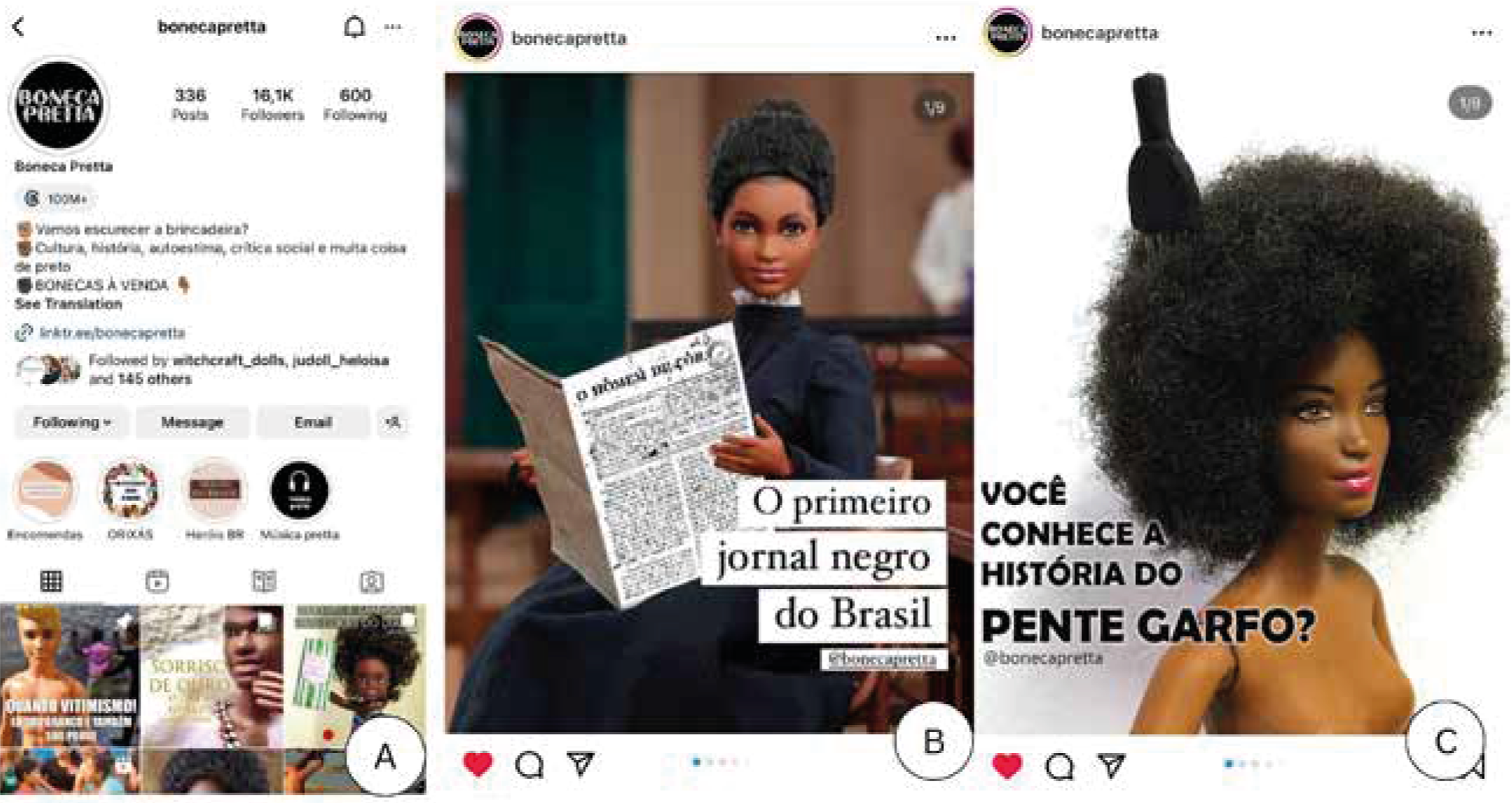
Note: a) The Instagram profile @bonecapretta; b) Picture shared by the Instagram profile Boneca Pretta (2023b): on this post, the profile brings information about the first newspaper in Brazil dedicated to the black community; c) On this post, we can see that the images of the dolls shared by Boneca Pretta (2023a) are different from the traditional figure we have of a Barbie doll.
Although they represent a minority in the doll community, profiles like @bonecapretta constitute a rupture from the patterns of this online community, demonstrating a new way of using Barbie doll images that deserve further study regarding their potential in various fields. However, in these first observations, it was possible to find connections between this profile and ethnic-racial discussions.
After analyzing the doll images shared by @bonecapretta, it can be affirmed that they do not reflect the traditional image of the Barbie doll, which for almost 60 years perpetuated the phenotype of a young, slim, blonde European woman. Silveira (2011) asserts that in various cultures, including Brazil’s, the figure of a woman is represented, much like the Stereotypical Barbie in Gerwig’s (2023) movie, by a young, slim, elegant European-origin woman. The Barbie dolls’ images posted on the @bonecapretta profile, however, are different, featuring black dolls with broad noses and afro hair.
This became possible because, in 2016, the toy company Mattel, the manufacturer of Barbie, released the Fashionistas line, introducing a new variety of skin tones, body types, and face shapes, along with dolls representing albinism, vitiligo, prosthetics, dental braces, among others. Evelyn Mazzocco (in Dockterman, 2023a, p. 24), former director of the Barbie line, acknowledges that these changes came late but emphasizes that changes in a large company take time. With the introduction of the Fashionistas line, individuals who previously didn’t identify with the Stereotypical Barbie became interested in the doll. Actress Margot Robbie herself stated (in Dockterman, 2023b, p. 54) that if Mattel had not released so many different types of Barbie, she would never have participated in a film about the doll.
Strong Images
It is possible to find among the images shared by users in the doll community those that disturb us, make us think, and provoke debates; “strong images”, as Samain (2012) called them. Through an Instagram story (short-duration videos on Instagram that stay online for 24 hours) from @bonecapretta profile, we became aware of two images posted in August 2023 that sparked intense debate, both within the doll community and in other online groups.
The two images were shared on the same day in August by the same profile. In the first image (Figure 5a), two black Barbie dolls share the scene with a monkey figure, in a clear recreation of the traditional Japanese proverb “see no evil, hear no evil, speak no evil”. Traditionally associated with this proverb is the image of three monkeys, which, according to Tendai Buddhist legend, represent the life cycle of man. However, in the image shared on Instagram, two monkeys are replaced by black dolls, which immediately sparked protests from various communities, both doll enthusiasts and those connected to black and Afro-descendant people. “When you see three figures with their mouths, eyes, and ears covered, you know they are monkeys”, pointed out one profile. “Your post illustrated the oldest racial stereotype that exists”, commented another.
After this reaction from the community, the person responsible for the profile removed the photo (which by that time had already been saved and reposted by other profiles) and posted a new image. In the caption of this new post, the user apologized for the previous photo, stating that they had no intention of hurting anyone and that they saw the world in a completely different way, “full of love and equality and without distinctions”. The new image shared (Figure 5b), however, only served to intensify the debate by now depicting not two but three black dolls representing the three monkeys from the Japanese proverb.
Figure 5. Set of images of the black Barbie dolls portrayed as monkeys
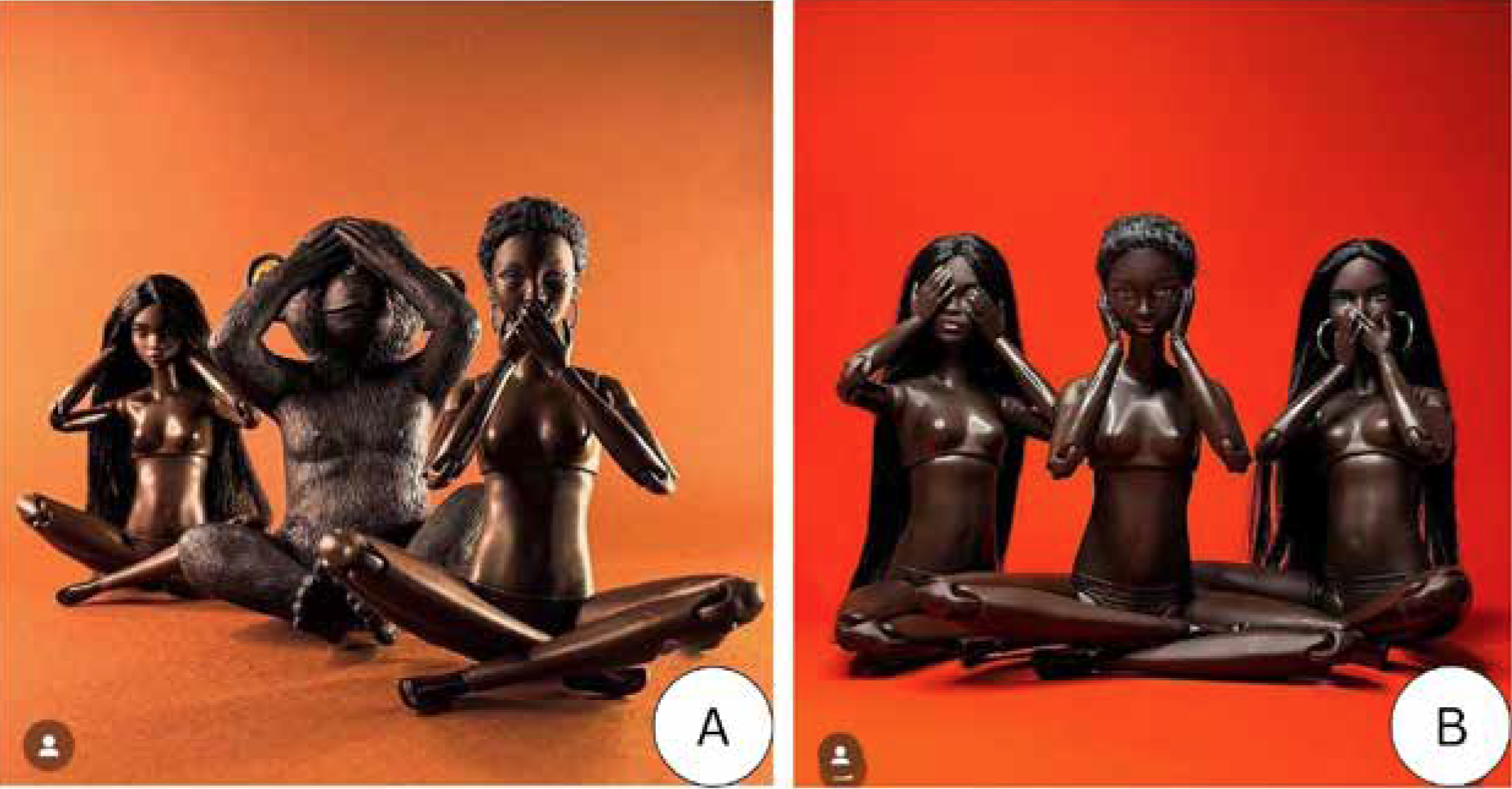
Note: The original pictures of the black dolls portrayed as monkeys were deleted from the profile that first shared them. However, they were saved and reposted on other Instagram profiles. The images of this set were screenshots from the Instagram profile @idolledit4u. a) The first image, where two black Barbie dolls share the scene with a monkey figure (I Doll Edit 4 U, 2023a); b) The second image, now with three black Barbie dolls representing the monkeys (I Doll Edit 4 U, 2023b).
The debate escalated. “So imagine us telling you we are not monkeys and you reposting us as monkeys again after literally us telling you publicly and privately”, wrote one profile. “Black people are being systematically crushed by European nations as I type. […] Black people as monkeys is racism 101”, commented another. Before the end of the day, the new image was deleted (though, once again, it had already been saved and reposted by other profiles), and an apology post was published (still online at the moment), where the person responsible for the photos apologized for what he considered an “incident” and thanked the friends who finally made them understand why the posts had been offensive.
Such images are rare in Barbie’s carefree world on Instagram, but they demonstrate that even something as traditional as a doll’s image can be a provocative device for sparking debates about issues that still permeate our society as profoundly as racism.
Conclusion
With the release of Barbie’s official Instagram profile (@barbiestyle), people of all ages felt encouraged to create pages on the online platform to share images and stories of their own dolls. Currently, this so-called doll community boasts thousands of profiles. The purpose of this study, part of an ongoing PhD research, was to explore this community and understand, through the shared images and texts, how the Barbie doll is used on Instagram. Additionally, it sought to identify constructions that reflect aspects of our own culture. To conduct this investigation in an online field, a netnographic research approach was developed, which included participant observation of 100 Instagram profiles based on the following criteria: i) public Instagram profiles using original Barbie doll images, and ii) profiles with a minimum of 50 posts and at least 1,000 followers.
First observations indicated that, in general, Barbie images shared on Instagram could be understood as devices, which are understood as any artifact that somehow has the ability to capture, guide, determine, intercept, model, control, and ensure people’s gestures, behaviors, opinions, and discourses (Agamben, 2005). Through the observation and analysis of the selected profiles, it was also noted that:
1.88 % of these pages exhibit the characteristics of what we refer to as an Avatar Profile: the doll is the social protagonist and shares images focused on fashion and lifestyle with her followers;
2.11 % of the analyzed pages correspond to what we refer to as Collection Profile: images focused on fashion editorials where the doll is used as a model.
In both cases, consistent similarities were found between the images and captions shared by users and those featured on the official Barbie profile. Although these images arouse interest, including aesthetically, they lack the ability to shake or stir us profoundly. They are what Barthes (2018) calls studium: a vast field of lazy desire, diversified interest, and inconsequential taste. These profiles also reflect the society of positivity described by Han (2019), which values easily consumable images that do not cause discomfort to viewers. According to the author, the art produced by this society values “likes”, where no judgment or interpretation is necessary.
Ferraz (2019) reminds us of the importance of investigating online communities, as they share aspects of our culture. In this case, a more detailed study within Avatar Profiles could bring forth other aspects beyond the positivity theme.
Lastly, among the images shared by users in the doll community, there are those that disturb us, that make us think. In 1 % of the profiles analyzed, we found images of the doll that can provoke debates, constituted by what Barthes (2018) defined as a punctum (what mortifies, wounds, and shakes), disrupting the studium (a kind of general interest). Although they represent a minority within the doll community, these profiles disrupt the standards of this online community, showcasing a completely new way of using doll images. It’s the case of the profile @bonecapretta, that aims to discuss day-to-day situations experienced by the black community and promote Afro-Brazilian culture, history, and art.
We also discussed the intense debate that images of black Barbie dolls portrayed as monkeys (after the Japanese proverb “see no evil, hear no evil, speak no evil”) caused on Instagram, which demonstrates that even something as traditional as a doll’s image can be a provocative device for discussions about issues that permeate our society to this day, such as racism. We must understand that dolls are no longer used only as toys. Through images, medias allowed them to become artifacts for people of all ages to develop new ways of sharing their experiences and exercising creativity, building other forms of relating and connecting to the world around them.
References
1.Agamben, G. (2005). O que é um dispositivo? [What is a device?]. Revista Outra Travessia, 5, 9-16. https://doi.org/10.5007/%25x
2.Barbie Style [@barbiestyle]. (2023, Sept. 30th). May not be at #pfw this season, but always j’adore Paris [image]. Instagram. https://www.instagram.com/p/Cx0f91tLhTJ/?img_index=1
3.Barbie Style [@barbiestyle]. (n. d.). Posts [Instagram profile]. Instagram. https://www.instagram.com/barbiestyle/
4.Barthes, R. (2018). A câmara clara: nota sobre a fotografia. Nova Fronteira.
5.Benjamin, W. (2009). Brinquedos e jogos. In W. Benjamin, Reflexões sobre a criança, o brinquedo e a educação (pp. 95-102). Editora 34.
6.Boneca Pretta [@bonecapretta]. (2023a, July 29th). Mesmo vivendo em um país majoritariamente negro, o item ainda é desconhecido pela população. Ele pode ter diferentes formas, materiais [image]. Instagram. https://www.instagram.com/p/CvSO0P4gipY/?img_index=1
7.Boneca Pretta [@bonecapretta]. (2023b, Sept. 19th). “Todo cidadão pode ser admitido aos cargos públicos, civis, políticos e militares, sem outra diferença que não seja dos seus” [image]. Instagram. https://www.instagram.com/p/CxYAPyBAPFl/?img_index=1
8.Boneca Pretta [@bonecapretta]. (n. d.). Posts [Instagram profile]. Instagram. https://www.instagram.com/bonecapretta/
9.Brougère, G. (2010). Brinquedo e cultura. Cortez.
10.Chartier, R. (2011). A força das representações: história e ficção. Argo.
11.Deleuze, G. (2013). A imagem-tempo. Brasiliense.
12.Dockterman, E. (2023a). Birth of a superstar. Time Special Edition: Barbie, 12-27.
13.Dockterman, E. (2023b). The road to the big screen. Time Special Edition: Barbie, 48-59.
14.Doll Zuri [@doll.zuri]. (2023, Aug. 17th). Nunca morei tão perto de um rio e tô aproveitando para fazer todos os esportes possíveis nele. Esperando ansiosa pela [image]. Instagram. https://www.instagram.com/p/CwEB4ynpaKz/?img_index=1
15.Doll Zuri [@doll.zuri]. (n. d.). Posts [Instagram profile]. Instagram. https://www.instagram.com/doll.zuri/
16.Ferraz, C. P. (2019). A etnografia digital e os fundamentos da antropologia para estudos qualitativos em mídias online [Digital ethnography and the foundations of anthropology for qualitative studies on online media]. Aurora: Revista de Arte, Mídia e Política, 12(35), 46-69. https://doi.org/10.23925/v12n35_artigo3
17.Gerber, R. (2023). Barbie e o império da Mattel: como a criadora da boneca mais famosa do mundo revolucionou a indústria de brinquedos. HarperCollins Brasil.
18.Gerwig, G. (2023). Barbie. Mattel.
19.Goffman, E. (2014). A representação do eu na vida cotidiana. Vozes.
20.Han, B.-C. (2019). A salvação do belo. Vozes.
21.Heljakka, K. (2015). Toys as tools for skill-building and creativity in adult life. International Journal of Media, Technology and Lifelong Learning, 11(2), 134-148. https://doi.org/10.7577/seminar.2356
22.I Doll Edit 4 U [@idolledit4u]. (2023a, Aug. 4th). Yeah […] we saw it! Its gone but we saw it. He was only responding to ppl who praised it [image]. Instagram. https://www.instagram.com/p/CvhzpKVA3is/?img_index=1
23.I Doll Edit 4 U [@idolledit4u]. (2023b, Aug. 4th). So imagine us telling you we are not monkeys and u reposting us as monkeys again after literally us telling [image]. Instagram. https://www.instagram.com/p/CviCZYFJHM1/?img_index=1
24.I Doll Edit 4 U [@idolledit4u]. (n. d.). Posts [Instagram profile]. Instagram. https://www.instagram.com/idolledit4u/
25.Jenkins, H. (2009). Cultura da convergência. Aleph.
26.Kozinets, R. V. (2014). Netnografia: realizando uma pesquisa etnográfica online. Penso.
27.Lévy, P. (2010). Cibercultura. Editora 34.
28.Manovich, L. (2001). The language of new media. mit Press.
29.Manovich, L. (2017). Instagram and contemporary image. http://manovich.net/index.php/projects/instagram-and-contemporary-image
30.Rafa Monster [@rafamonster]. (2023, Sept. 17th). Eu não podia deixar de fazer uma foto da nossa diva sem um dos looks e cabelos mais icônicos de [image]. Instagram. https://www.instagram.com/p/CxTrbrxJCxB/?img_index=1
31.Rafa Monster [@rafamonster]. (n. d.). Posts [Instagram profile]. Instagram. https://www.instagram.com/rafamonster/
32.Recuero, R. (2010). Redes sociais na internet. Sulina.
33.Recuero, R., Bastos, M., & Zago, G. (2015). Análise de redes para mídia social. Sulina.
34.Reis, L. N. G. dos, & Carvalho, D. R. de. (2019). História dos brinquedos: cultura e poder [Toys history: culture and power]. Revista Building the Way, 9(2). https://www.revista.ueg.br/index.php/buildingtheway/article/view/9772
35.Samain, E. (2012). As imagens não são bolas de sinuca: como pensam as imagens. In E. Samain (Org.), Como pensam as imagens (pp. 21-36). Editora da Unicamp.
36.Santaella, L., & Nöth, W. (1997). Imagem: cognição, semiótica, mídia. Iluminuras.
37.Silveira, R. C. P. da. (2011). A representação do feminino em textos multimodais [The representation of the feminine in multimodal texts]. Revista Contemporâneos em Estudo, 1(1), 125-142. https://doi.org/10.26512/discursos.v1i1.0/8269
38.Skågeby, J. (2011). Online ethnographic methods: towards a qualitative understanding of virtual communities practices. igi Global.
To cite this article: Antonelli, J., & Versuti, A. (2024). Beyond the image and the doll: Barbie as a device on Instagram. Anuario Electrónico de Estudios en Comunicación Social “Disertaciones”, 17(2). https://doi.org/10.12804/revistas.urosario.edu.co/disertaciones/a.13940