Gender Quotas, Context, and Substantive Representation: a Literature Review


DOI:
Sabeel Khan: Gender Quotas, Context, and Substantive Representation: a Literature Review


Abstract

This paper provides a comprehensive review of the link between descriptive and substantive representation, as well as the challenges associated with the context in which gender quotas exist. Gender quotas have become a global phenomenon, now extending to sub-national levels, such as provincial and local levels. This review paper evaluates the descriptive-substantive link, explores the concept of women’s interests, and analyzes whether gender quotas produce equal outcomes across different contexts. Drawing from a vast body of literature, this paper delves into multifaceted impacts of gender quotas, assesses different perspectives on women’s interests, and analyzes quota performance across various contexts, including developing countries and sub-national levels, while considering the contextual dynamics involved. The key findings of this review suggest that a higher number of women in parliaments tends to advance women’s interests; however, such gains are not universal and highly context-sensitive. After outlining the temporal and spatial gaps in the research on the substantive representation of women and highlighting the importance of gender quotas at sub-national levels, this review provides several suggestions and identifies some understudied avenues to further deepen the understanding of the contextual dynamics involved in the substantive representation of women.

Keywords:

contextual dynamics, gender quotas, women’s interests, substantive representation, sub-national levels


Resumen

Este artículo ofrece una revisión exhaustiva del vínculo entre la representación descriptiva y sustantiva, y los desafíos asociados con el contexto en el que existen las cuotas de género. Las cuotas de género se han convertido en un fenómeno global, que ahora se extiende a niveles subnacionales, como los niveles provinciales y locales. Este artículo de revisión evalúa el vínculo descriptivo-sustantivo, los conceptos de los intereses de las mujeres y analiza si las cuotas de género producen ganancias sustantivas iguales en todos los contextos. Basándose en una amplia colección de literatura, este artículo profundiza en los impactos multifacéticos de las cuotas de género, evalúa diferentes perspectivas sobre los intereses de las mujeres y analiza el desempeño de las cuotas en varios contextos, incluidos los países en desarrollo y los niveles subnacionales, y la dinámica contextual involucrada. Los hallazgos clave de esta revisión sugieren que el mayor número de mujeres en los parlamentos ayuda a promover los intereses de las mujeres, pero tales ganancias no son universales y altamente sensibles al contexto. Después de esbozar las brechas temporales y espaciales en la investigación sobre la representación sustantiva de las mujeres y la importancia de las cuotas de género a niveles subnacionales, esta revisión proporciona varias sugerencias e identifica algunas vías poco estudiadas para profundizar aún más la comprensión de la dinámica contextual en la representación sustantiva de las mujeres.

Palabras clave:

dinámica contextual, cuotas de género, intereses de las mujeres, representación sustantiva, niveles subnacionales


Resumo

Este artigo oferece uma revisão abrangente da relação entre representação descritiva e representação substantiva e os desafios associados ao contexto em que existem cotas de gênero. As cotas de gênero tornaram-se um fenômeno global, agora se estendendo aos níveis subnacionais, como os níveis provincial e local. Este artigo de revisão avalia o vínculo descritivo-substantivo, os conceitos relacionados aos interesses das mulheres e analisa se as cotas de gênero produzem ganhos substantivos equivalentes em diferentes contextos. Com base em uma extensa coleção de literatura, este artigo investiga os impactos multifacetados das cotas de gênero, avalia diferentes perspectivas sobre os interesses das mulheres e analisa o desempenho das cotas em vários contextos, incluindo países em desenvolvimento e níveis subnacionais, e as dinâmicas contextuais envolvidas. Os principais achados desta revisão sugerem que o aumento do número de mulheres nos parlamentos ajuda a promover os interesses das mulheres, mas esses ganhos não são universais e altamente sensíveis ao contexto. Ao delinear lacunas temporais e espaciais na pesquisa sobre a representação substantiva das mulheres e a importância das cotas de gênero nos níveis subnacionais, esta revisão proporciona sugestões e identifica lacunas ainda pouco exploradas para aprofundar ainda mais a compreensão da dinâmica contextual na representação substantiva das mulheres.

Palavras-chave:

dinâmica contextual, cotas de gênero, interesses das mulheres, representação substantiva, níveis subnacionais


Gender quotas, context, and substantive representation: a literature review

In the aftermath of the 1995 World Conference on Women in Beijing, gender quota laws surged, bringing a wave of women into parliaments. Gender became a central focus in the literature on the concept of representation (Pitkin, 1967), unlike median voter theory (Downs, 1957), where gender remained irrelevant. In this milieu, gender quotas drew the attention of scholars toward investigating the phenomenon of representation and its different manifestations (Hughes et al., 2017). Quotas emerged as a necessary antidote to the soaring gender inequalities at the policy level. Complemented by the theory of presence, critical mass theory, the concept of critical actors, and substantive representation as process and outcomes, the descriptive-substantive saga has undergone modifications, followed by intelligent inquiries to unveil the impacts of gender quotas. Gender quotas have favorable results that transcend descriptive representation, as captured by the expanding literature today.

Gender quotas are introduced at all levels of governance, i.e., national, provincial, and local government levels. Today, 138 countries have one or more of the three types of quotas: candidate quota, reserved quota, and/or party quota. As reflected in Figure 1, 180 countries have women in their lower house, i.e., Vanuatu has the lowest at 2 % and Rwanda top ranked at 63,8 % (IPU, 2024b). There are 89 countries with gender quotas at the sub-national level (IDEAS, 2024). The fast-track policies of gender quotas allowed countries like Rwanda, Mexico, and Andorra to outpace Sweden, Finland, and Denmark-once regarded as champions of gender equality-in record time. This also accounts for the increasing number of women in the rank and files of legislators around the world, which reached 27 % in 2024 (IPU, 2024c). Women’s inclusion in decision-making bodies increased the likelihood that women’s issues would be acknowledged and addressed within legislatures.

Finland, the first country to elect women to its law-making bodies in 1907 (Paxton et al., 2020) and Pakistan, electing the first women to the legislature in 1977 (Bashir & Jan, 2018), depict two different contexts that shape women’s political journeys uniquely. The current research on gender quotas has unfolded through interdisciplinary approaches investigating the substantive benefits of gender quotas in different contexts worldwide. As gender quotas proliferated, research efforts intensified to uncover anomalies regarding their impacts. In the same pursuit, this paper answers the following questions: How does descriptive representation impact substantive representation of women? Are those impacts homogeneous across different regions? How do contextual dynamics influence women’s interests? How does context influence the substantive representation of women?

The subsequent sections of this paper are organized as follows: Section 2 outlines the definition and approaches to women’s political empowerment, traces the origin of research on representation, and presents competing theories. Section 3 constitutes the largest part of this paper and cites a wide range of research on gender quotas from multiple perspectives. This section also provides details on the limitations and instances of backlash. The following section discusses the dilemma of the conceptualization of women’s interests. Section 5 assesses the North-South divide and theoretical imbalance concerning the research on gender quotas. At the end of this section, the researcher pinpoints the under-researched condition of quotas at the sub-national and citizen levels. The final section concludes by underlining some key issues in the literature on gender quotas and sets out suggestions for upcoming research.

Figure 1

Percentage of Women MPs in National Legislatures (Lower/Single House) as of December 1, 2024

0124-4035-desa-37-02-a7-gf1.png

Source: Created by the author using the latest data from IPU

Women’s political empowerment

Women’s political empowerment is a hallmark of democracy that acknowledges and upholds women’s human rights. Although women’s empowerment encompasses a broad spectrum of indicators and determinants, women’s political empowerment is one of its critical dimensions. According to the Varieties of Democracy (V-Dem) project, women’s political empowerment implies elevating women’s capacity, thereby increasing their choices and participation in societal decision-making processes (Sundström et al., 2015). This empowerment bolsters women’s ability to partake in political rallies and protests, exercise their voting rights freely, contest political office, and participate actively in policy deliberations (Adamu, 2023).

Empowerment and gender quota

To acknowledge the indispensable presence of women in policy-making bodies and meet the demands for democratic governance, two approaches are proposed to empower women and advance their participation in the political process: the incremental-track approach and the fast-track approach (Dahlerup & Freidenvall, 2005). Both approaches concur on the common goal of women’s empowerment. However, incremental-track policy believes in slow development in contrast to the fast-track policy that plummets gender inequality by introducing gender quotas. This is also called fast-track empowerment. Gender quotas specify a designated share of women in legislatures, either through selection or election processes (Dahlerup & Gaber, 2017). As noted by Hughes et al. (2019, p. 220), “electoral quotas are policies that specify a threshold- typically a percentage of women that must be selected or nominated to a political decision-making body.”

Quotas have the immediate impact of impelling law-making bodies by, first, stimulating pro-women behavior among lawmakers. This initiative signals that the ongoing gender imbalance in representation is a burning issue requiring immediate attention, referred to as the normative effect (Fernández & Valiente, 2021). Secondly, achieving power through numbers, a defining feature of the democratic process, can not only alter the policy preferences of legislators but also proffer opportunities to achieve favorable legislative outcomes for women (Clayton & Zetterberg, 2018).

Gender quotas enabled countries to make significant strides in women’s political empowerment. In this context, the foundational work of Hanna Pitkin (1967) redirected the epicenter of scholarship toward the dilemma of representation itself. Subsequently, scholars concentrated on studying the different ways in which the interests of women are represented and assessing their effectiveness.

Concepts of Representation

Following Hanna Pitkin’s typology in her seminal work, The Concept of Representation (1967), scholars developed a keen interest in digging into the connection between descriptive and substantive representation, which Pitkin defined as “acting in the interests of the represented in a manner responsive to them” (Pitkin, 1967, p. 209). In the late 20th century, the literature on women’s substantive representation transitioned from theoretical discussions to empirical investigations, partly prompted by Critical Mass Theory (Dahlerup, 1988; Kanter, 1977) and the Theory of Presence (Phillips, 1995). These efforts were intended to gauge the consequences of the increasing number of women in politics (Allen & Cairney, 2015). In her foundational work, Pitkin classified representation into four types: (1) Formal Representation, (2) Symbolic Representation, (3) Descriptive Representation, and (4) Substantive Representation. The former two types received less attention from researchers, whereas the latter two-descriptive and substantive representation-became central to subsequent research. The former refers to the number of representatives holding seats in representative bodies and how they identify with the gender, race, and class of those they represent (Belknap & Kenny, 2023). Descriptive representation is generally expedited through gender quotas, which are classified into three types: voluntary political party, reserved, and legislated candidate quotas. The latter form of representation, known as substantive representation, accounts for the actions taken by legislators to advance the demands and interests of those they represent and translate them into law (Childs & Lovenduski, 2013).

Manifestations of Substantive Representation

Since the introduction of quotas and the growing demand for inclusive democracy, legislatures have seen an increasing number of women-a trend generally referred to as descriptive representation, as shown in Figure 2. As women constitute almost half of the global population, their presence in the decision-making apparatus gained importance. To understand this phenomenon, scholars have become thoroughly interested in investigating the impacts of women’s descriptive presence from multiple perspectives, some of which are analyzed in detail in the following sub-sections.

Substantive representation as process and outcome

In the late 20th and early 21st centuries, substantive representation was largely understood as a process. Franceschet and Piscopo (2008) classified substantive representation under two indicators: process and outcome. In the decisive analysis, they examined bill introduction as the process and legislative success as the outcome in the Argentinian Parliament. Substantive representation as a process involves agenda-setting or the inclusion of women’s interests in the parliamentary agenda, while the outcome manifests as transforming or enacting women-friendly policies.

This classification was followed by a plethora of research exploring the descriptive-substantive link either as a process, an outcome, or both. Such studies focused on legislators’ women-friendly attitudes and behaviors to determine critical actors (Childs & Krook, 2009). In this context, quantitative content analysis of parliamentary speeches in Serbia, accounting for substantive representation as a process, by Đorđević (2023) reported critical actors among male and female Members of Parliament (MPs), focusing more on family and childcare. Surprisingly, this was true for both genders, with male MPs dominating the stage. In contrast, a study analyzing parliamentary speeches from 2000-2018 in five Western European parliaments, i.e., Spain, Germany, Sweden, Ireland, and the Netherlands, reported opposite results. The authors found that women MPs spoke differently than men on issues they often care about, such as health, education, and unemployment, in all five parliaments (Wäckerle & Castanho Silva, 2023). Likewise, another study demonstrated that women are more likely to sponsor bill related to women’s interests in the Chilean Chamber of Deputies. Additionally, women members from the left focused more on feminist women’s interests than rightist women, who prioritized traditional women’s interests (Dockendorff et al., 2022).

Similarly, Lloren’s (2015) study of the MP’s voting behavior on feminist bills reported similar results, with the logistic fixed-effect regression model showing high statistical significance (β = 1.069) at p < 0.001 for gender (female in this case) with the voting behavior. While comparing the plenary debates of the Romanian delegation in the European Union (EU) Parliament and the Romanian National Parliament, Garboni (2015) noted that female MPs in the EU Parliament substantively represented women’s interests more than their male colleagues. However, this pattern receded in the case of the national parliament, citing a lack of critical mass.

While some authors approached the problem of substantive representation through a cross-national analysis, Tusalem (2022) conducted a time-series cross-sectional study of 64 developing countries, understanding substantive representation as an outcome in this milieu. Utilizing data on women’s empowerment and human development from 2005 to 2019, the author demonstrated that the descriptive representation of women is highly correlated and statistically significant (p < ,01) with women’s empowerment, including gender equality, gender equity, social inclusion, poverty reduction, and human resource development. Similar findings were reported by Asiedu et al. (2018) as a result of their cross-national analysis of 159 developing countries. The descriptive representation was found to be highly significant (p < ,01) and positively correlated with gender-sensitive laws in all the countries. As the two aspects of substantive representation remain a point of contention among scholars, a wide range of studies has accounted for both aspects of representation to capture the fuller picture of the impacts of gender quotas.

The difference between these two aspects of representation is vividly reflected in a study conducted by G. Park & Österman (2021) investigating the impacts of descriptive representation in the 20th National Assembly of the Parliament of Korea. The author indicated that female MPs demonstrated greater engagement in initiating bills related to feminist women’s interests than in securing their passage. More robust results were reported in terms of the passage of bills related to traditional women’s interests, even though the introduction of such bills was less consistent (G. Park & Österman, 2021). Even more astonishing results were reported in a recent study by Wang (2023), indicating that only quota women acted in favor of women’s interests-both in initiating and passing bills-while non-quota women showed no such engagement. Given this, S. Park (2023) analysis of 169 countries on the Women Political Empowerment Index (WPEI) and Gender Inequality Index (GII) from 1990 to 2017 found that the output (% of women in legislatures) is positively associated with the outcome, i.e., an upsurge in the WPEI and a decline in the GII were observed across all the countries studied during the period. The above studies give reason to argue that substantive representation fluctuates with the context and the concept of women’s interest which is further analyzed in a latter section.

Apart from studying legislative and non-legislative behaviors of MPs inside the legislative chambers, some authors investigated the experiences of lawmakers to uncover trends related to the impacts of gender quotas. While studying the experiences of Nepali female politicians, Yadav (2024) noted that gender quotas positively affected the perception of women’s participation in politics. It was also observed that women prioritized issues like gender-based violence (GBV), primarily ignored in a patriarchal setup, which is why more GBV cases were reported when women occupied mayoral positions. Similar views were shared by Joshi & Echle (2023) after interviewing women MPs in Japan, noting that female MPs are more likely to represent women’s interests in parliament.

As quota law implementation led to increased inclusion of women in law-making bodies and the passage of pro-women legislation, the focus of empirical studies partially shifted toward examining the tangible impacts of women’s presence-such as government spending priorities on health, education, antenatal and reproductive care, childcare, poverty alleviation, and the gender pay gap.
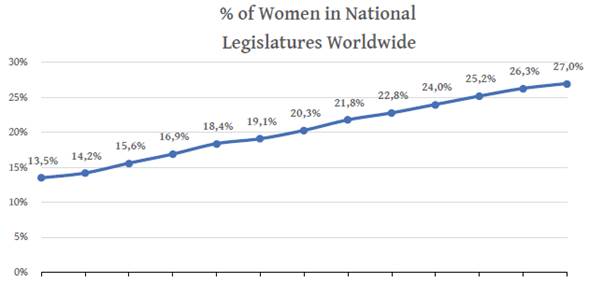
Figure 2

Worldwide Percentage of Women MPs in Lower and Upper Houses Combined (2000-2024)

0124-4035-desa-37-02-a7-gf2.jpg

Source: Created by the author using data from IPU

Funding Women’s Issues

Increased women’s representation and women-friendly policies can translate into greater budgetary priorities centered around women’s issues. Allocating resources to issues related to women promotes equity and closes gender gaps, which is why women are anticipated to favor policies that enhance health, childcare, education, and redistribution (Chen, 2021; Ennser-Jedenastik, 2017; Funk & Philips, 2019). Similarly, Clayton and Zetterberg’s (2018) analysis of a dataset of 139 states from 1995 to 2012 reported a 0,56 % average increase in health spending in countries where women’s representation increased by 10 %. Moreover, a recent study of a global sample of 191 countries spanning from 1990 to 2020 by Acheampong et al. (2024) indicated that a single-point increase in women’s representation increases gender parity in primary, secondary, and tertiary education by 0,4 %, 0,5 %, and 1,7 %, respectively. Other studies also show that a higher number of female legislators is positively associated with greater maternal employment and development aid (Hicks et al., 2015; Weeks, 2017). Another cross-national time-series regression analysis of 49 Sub-Saharan Africa (SSA) countries found a negative association between descriptive representation and infant mortality and child mortality (p < 0,01) based on the years 1958-2015 and 1969-2015, respectively (Mechkova & Carlitz, 2020). Similarly, Cunial (2021) found an inverse relationship between increasing women’s representation-resulting from legislated gender quotas-and infant mortality across the 23 provinces of Argentina.

Furthermore, Baskaran & Hessami (2019) reported similar findings based on a survey conducted across 1 632 municipalities in Bavaria, Germany’s largest state. It was reported that female candidates’ victories pushed childcare provision by 40 % compared to male candidates. Along similar lines, Bhalotra and Clots-Figueras (2014) found that a 10-percentage point rise in women’s representation was associated with a 2,1 % reduction in neonatal mortality across the 16 state legislatures of India. However, this does not absolve India’s health sector from prevailing inequalities, as increased local female political representation did not mitigate male dominance or the pro-male bias within the sector (Dupas & Jain, 2024).

It is important to note that government spending priorities have predominantly been researched in the context of traditional women’s interests (education, public health, childcare and so forth), while feminist policy areas have generally missed the spotlight. It highlights the need for future studies to extend the scope of such investigations to feminist policy areas as well. Moreover, the above findings are not universal and take a flip in regions marked by toxic societal norms and poor governance, further explored in the “Bubble Effects” section.

As a result of gender quotas, women found their roles in democratic political institutions like political parties and women parliamentary organizations, as assessed in the adjacent sub-sections.

The role of political parties

The role of political parties assumed critical importance in enhancing the political visibility of women and became a focal point for empirical studies. Political parties play a crucial role in, both the descriptive and substantive representation of women and in determining their status in androcentric political structures. As noted by Goyal & Sells (2024) in the case of Brazil, the descriptive representation of women helps reduce gender gaps within political parties by increasing female membership. In line with this, Belknap and Kenny (2023) noted positive trends in descriptive feminization: enforcement of rules improving the selection and/ or election of women as candidates and MPs, and substantive feminization: the women-friendliness of the parties’ manifestos and policy pledges, in the 2021 elections to the Scottish Parliament. Generally, the parties sitting on the opposition benches take on the role of preserving women’s interests and keeping the government accountable, as Tam (2019) observed while studying the male-female divide on women’s interests in Singapore’s parliament.

Other studies uncovered contrasting trends while studying the role of party affiliation in the substantive representation of women. Rashkova (2021) indicated that women act more for women’s issues than their male counterparts in Radical Right Parties (RRP) in Slovakia. Meanwhile, Rashkova and Zankina (2017) reported that both genders of RRP acted for women in the Bulgarian Parliament compared to MPs from other parties. On the other hand, Celis and Erzeel (2015) showed opposite results from their analysis of 10 European countries. They indicated that, among the one-third of total members studied, male critical actors affiliated with right and center-right parties outnumbered their female counterparts within the same parties. In contrast, Lambert & Pineda Moquete (2025) noted that female politicians from both center-right and center-left parties, elected as a result of legislative candidate quota at local level in Dominican Republic, showed greater commitment to act for women’s interests than their male counterparts. Moreover, Bektas and Issever-Ekinci (2019) also found that both right-wing and left-wing female MPs sponsored bills related to women’s interests. Right-wing MPs focused more on children and family, while left-wing MPs prioritized women’s rights and equality issues understood with a feminist accent. The difference in the preference of policy issues is also demonstrated within parties, as Slegten and Heyndels (2020) reported in the case of Flanders, Belgium.

This clearly shows that findings from one country could be prone to false generalization if applied to another country. It also indicates that the substantive representation of women can neither be associated with feminist and/or leftist parties nor with a single gender. Furthermore, parties do not always act affirmatively toward the substantive representation of women, which assumes a topic for future study and is explored in the latter section of this review.

Women Parliamentary Organizations (WPOs)

Women Parliamentary Organization (WPO) is defined as: “a regularized but not necessarily formal association of legislators formed to sustain women’s presence in the political institution, and, or to engender women’s representation, descriptive, substantive, and symbolic” (Allen & Childs, 2019, p. 9).

It is a crucial site for critical actors, serving as an arena for the substantive representation of women (ibid). These crucial sites are more likely in countries with gender quotas (Adams et al., 2019). Such bodies, generally called Women Parliamentary Caucuses (WPCs), Women Legislative Caucuses (WLCs), or feminized parliamentary bodies, may exert pressure or influence policymakers in numerous ways, such as through cosponsoring legislation (Barnes, 2016) and engaging with NGOs (Sawer & Turner, 2014) that hold the government accountable directly or indirectly. Notably, the Inter-party Women’s Caucus in Uganda made remarkable efforts by halting all legislation until the government increased the budget for maternal and neonatal health (Clayton, 2021). In another instance, the Status of Women Caucus (SWC) in Australia successfully persuaded a minister to incorporate domestic violence provisions in the “Fair Work Act” (Sawer & Turner, 2016). Such bodies provide a legitimate forum to address issues related to gender, as reported by Sawer et al. (2013) in the case of Sweden. In the US and the UK, the All-Party Parliamentary Group on Women recommended the establishment of Women and Equality Committees (Piscopo, 2014; Sawer & Turner, 2016).

However, these bodies are not immune to backlash, male dominance, and the centripetal forces of political parties (Khan & Naqvi, 2020), particularly in developing countries where women’s agency tends to be weaker. Apart from that, the literature on WPOs provides a collective assessment of pro-women bodies that deviates from the traditional approach to studying individual MPs’ behaviors. Hence, studying the WPOs provides an opportunity to uncover trends that are hidden otherwise. Notably, such bodies have not attracted the desired attention so far, especially the WPOs at sub-national levels, women’s groups in local bodies, and, more importantly, how these relate to the WPOs at a national level, which offers insightful case studies for future investigations.

Women’s Political Leadership

Women’s Political Leadership (WPL) can be instrumental in substantively representing women’s interests in many facets. For instance, women in ministerial positions or serving as committee chairs may redirect the government’s or lawmakers’ focus toward addressing and legislating on women-related issues. Therefore, women attaining leadership roles is construed as a substantive gain that defies the traditional norm that leadership roles are generally reserved for male MPs. In this respect, Joshi and Goehrung (2018) investigated WPL in Asian countries through the Women Political Leadership Index (WPLI). It was found that WPLI positively correlated (r = 0,57) with the number of female members in parliament. It has been observed that citizens in countries that have adopted gender quotas show higher support for increasing women’s political participation (Fernández & Valiente, 2021). Another study analyzing data from 48 democracies around the globe found that citizens living in countries with gender quotas supported women as political leaders 1.99 times more than those where no gender quota is implemented (Allen & Cutts, 2018).

Similarly, it was observed that during gram sabhas meetings-the constitutionally mandated assemblies in rural India-female villagers were more likely to be recognized and receive policy-relevant responses from women council leaders (Parthasarathy et al., 2019). This is why Iyer et al. (2012) found that crimes against women were reported on a larger scale in councils reserved for women in India. They argue that women’s willingness to report such crimes is stipulated by the belief that those crimes will not go unnoticed under the leadership of women. Moreover, O’Brien and Rickne (2014) demonstrated that the perception of female politicians being regarded as qualified for leadership positions increased due to gender quotas on candidate lists in Swedish municipalities.

The above pieces of evidence show the positive effects of women’s ascent to power as a result of gender quotas. However, the descriptive representation is not a win-win game but is contingent on the context and the concept of women’s interests and the consequences vary from salience effects to backlash effects.

Bubble Effect of Gender Quotas

Studies across different regions corroborate the argument that women are more likely than men to support policies related to poverty and healthcare (Bhalotra & Clots-Figueras, 2014; Clayton et al., 2019; Gottlieb et al., 2018; Westfall & Chantiles, 2016). Although in some cases women’s agency can challenge patriarchal norms, it may still leave them unable to survive within male-dominated circles. Women’s attempt to stand against the deep-rooted hegemonic masculinities, powered by gender quotas, can provoke a negative response from men’s quarters, generally referred to as the ‘bubble effect’ (Piscopo, 2006).

Backlash Effect

In this line, Matfess et al. (2023) undertook a quantitative analysis of women’s descriptive representation in Kenya and the instances of political violence. Shockingly, the number of violent events targeting women MPs rose from 1.919 to 19.518 as their representation in parliament increased from 7,14 % to 19,1 %. Moreover, repulsive forces in the form of backlash exist inside the political parties. This situation was observed by Carrión-Yaguana et al. (2023) in the legislative election of 2013 and 2017 in Ecuador. The authors cited bias against women in top placements on ballot-list from party gatekeepers as the driving force behind women electoral fortunes. Radojevic’s (2023) survey study of the subjective effects of gender quotas in Austria, Switzerland, and Germany revealed that the party gatekeepers from radical right parties are not only averse to quotas but also to those entitled to such quotas. Such instances of backlash culminate in Gender-motivated Political Violence (GMPV) (Muhammad et al., 2020), or what is also termed Gender-Based Political Violence Against Women (GBPVAW), especially at the local level in Mexico, where women often lack agency and face structural barriers (Serrano Oswald, 2023). These findings contradict the studies, cited in the previous section, that reported RRP as more women-friendly. Furthermore, Mufti and Jalalzai (2021) indicated that women in Pakistan remain entangled in patriarchal norms, where party gatekeepers often question the qualifications of quota women to contest direct elections on non-reserved seats, which tends to sideline competent women politicians and opens the door for women from influential political families, thereby reinforcing dynastic politics.

Similarly, Turnbull (2021) demonstrated that parties in India tend to limit women candidates to the reservation lists and discourage their attempts to contest elections, especially against male opponents, outside the reserved quota. Moreover, Castorena (2023) found that party decisions undermined the potential impact of role model effects in the candidate selection process during Mexico’s congressional elections. Having said this, women MPs may collaborate with the androcentric behaviors rampant in masculinist political systems and give up the very idea of advocating for women’s interests. This was demonstrated in the recently conducted time-series cross-sectional analysis of 180 countries by Mechkova et al. (2024), reporting that women’s descriptive representation is positively associated with infant mortality rates in countries where corruption is widespread, though the results take an opposite flip in countries where the corruption index is low. Instances of backlash are more pronounced in democracies characterized by dominant patriarchal norms and poor governance. In the case of India, Brulé (2020) indicated that daughters’ and sisters’ inheritance of familial property declined significantly after the reform that reserved village council leadership positions for women. Moreover, women faced hindrances from their political parties regarding spending budgets on issues they preferred at municipal level in the Dominican Republic (Lambert & Pineda Moquete, 2025). Trends parallel to the above studies have also been documented in Morocco, Kuwait, and Jordan (Barnett & Shalaby, 2021; Shalaby, 2016). Such evidence of backlash suggest that descriptive representation does not necessarily guarantee substantive representation (Fokum & Fonjong, 2018).

No Effect

The ineffectiveness of gender quotas is not limited to developing nations. To mention a few, the increase in descriptive representation of women in Sweden failed to change government spending priorities in terms of elderly and childcare, and cultural spending (Högström & Lidén, 2024). Similarly, the 40 % gender quota on local executive boards in Norway led to neither spillover effects nor any additional spending on the policy areas that women tend to prefer, i.e., the social policy area (Geys & Sørensen, 2019). Moreover, a recent study by Yamada (2024) found that the increase in female representation at the municipality level in Japan did not correlate with increased childcare provisions, whereas, the p-value was found to be consistently larger than 0.05 across all models in the multilevel analysis. These findings contradict the insights provided by Joshi and Echle (2023) in case of women MPs in the national parliament of Japan. Astonishingly, a study conducted in Taiwan revealed that non-quota women, unlike their quota counterparts, refrained from advancing women’s issues in the legislative process. Moreover, the implementation of quotas did not produce any spillover effects on male MPs (Wang, 2023).

Similar trends were noted in other regions. For instance, the 18 % increase in the fraction of female local councilors did not result in increased public expenditure in Italy (Baltrunaite et al., 2019). This was also demonstrated in the US and India, where no spillovers were seen as a result of the election of female mayors and female legislators, respectively (Bhalotra et al., 2018; Ferreira & Gyourko, 2011). In Spain, candidate quotas could not ensure women’s ascent to leadership positions, even after three rounds of local elections (Bagues & Campa, 2017).

It is essential to note that instances of extreme backlash are more common in the developing world, particularly in the Global South, where the sociocultural norms of the public-private divide (Bari, 2017; Latif et al., 2015) and dynastic politics and elitism are rampant (Fleschenberg & Bari, 2015), holding prominent insights for upcoming investigations.

Dilemma of Interests

From the late 20th century till date, the debate on the dilemma of women’s interests has occupied a huge part of the literature on substantive representation of women. In the 1980s, Sapiro (1981) argued that women’s interests were inherently and entirely homogeneous. This notion of universal women’s interests was challenged by Phillips (1995), based on the fact that different women have different experiences in different societies, shaping different interests for women (Och & Joshi, 2021). This argument was further supported by Williams (1998), who suggested caution while deciding on the universal interests of women. She further argues that encouraging diverse women’s perspectives in politics can lead to the complete abolishment of gender inequality and greater substantive representation of women in politics (Phillips, 1998; Young, 2000). While scholars have agreed on the idea of the diversity of women’s interests, debate pertaining to women’s interests persists in the 21st century as to which interests are specific to the substantive representation of women. In such a scenario, women’s interests made sense to researchers in terms of the context in which they take shape. Celis and Childs (2012) make an important contribution to this debate. They argued that: “empirical studies often subjectively define women’s issues as either those traditionally associated with women (such as childcare and the family), or those with a ‘feminist accent’ (such as abortion or domestic violence)” (Celis & Childs, 2012, p. 213).

For example, the above literature used diverse interests, such as health and crimes against women in India (Dupas & Jain, 2024; Iyer et al., 2012); gender equality, violence against women, and work-family balance in Italy (Weeks & Masala, 2023); education and welfare in Taiwan (Wang, 2023), child, family (Bektas & Issever-Ekinci, 2019), and the pay gap, and women’s participation in the labor force (Bulut, 2020) in Turkey; gender parity, sexual harassment, and reproductive freedom in Latin America (Vidal-Correa, 2020); infant mortality in Argentine provinces (Cunial, 2021) etc. Some studies undertook a mixed approach to operationalizing women’s interests, including feminist and traditional ones, such as Piscopo and Jennifer M.’s (2014) study of the Mexican parliament and Dockendorff et al.’s (2022) study of the Chilean Chamber of Deputies. Moreover, Gwiazda (2019) also applied a mixed approach, operationalizing childcare and gender pay gap as women’s interests, to study substantive representation in Poland. However, the diversity, heterogeneity, and subjectivity of women’s interests were largely ignored due to insufficient representation of women’s interests in these empirical studies.

As evidenced, the above approaches to understanding women’s interests are less extensive, less representative, and notably vary among different countries. This approach to conceptualizing women’s interests led to three issues. First, it led to group essentialism or homogeneity effect (Celis & Childs, 2012; Đorđević, 2023; Williams, 1998). Second, the less generalizable findings cannot be extended to all the women within the same country, particularly in regions where women live under different socio-cultural conditions and adhere to diverse socio-cultural and political philosophies. Third, the predetermined understanding of women’s interests has compromised women’s subjectivity (Celis & Childs, 2012), privileging the interests of certain women (Childs & Celis, 2018) at the expense of others, thereby increasing the risk of bias (Smooth, 2011). This lack of congruity arises from the neglect of contextual factors that shape women’s experiences, opinions, ideas, and understanding of their interests different from their fellow women in other contexts. Hence, it is essential to note here that the concept of women’s interests is not onesize-fits-all, but contextual dynamics play a greater role in shaping women’s interests (Paxton et al., 2020), as already mentioned in the earlier sections. For Example, the 0,7 % decline in Southern Asia and/or the last rank of MENA countries on the sub-index of Political Empowerment in Global Gender Gap Index as compare to the EU countries ranking at the top reflects completely different experiences of women in those regions that shape women’s idea of their interests differently (World Economic Forum, 2024b).

Even so, the interests dilemma is so subtle that it differs in the context of two developed countries or among MPs in the same parliament, as noted previously in section 3.3. This pattern prompts a question, of whether this divide in the understanding of women’s interests is shaped by the constituents’ subjective preferences or the legislators’ personal choice of what interest they prefer to represent, which constitutes an important point to be considered in the representation research. This discrepancy in the conceptualization of women’s interests underscores the need to consider the specific contexts in which the notion of women’s political empowerment emerges. Considering the contextual dynamics that influence women’s political life will prudently explain the diverse impacts of gender quotas on women living in different social, political, economic, and cultural spectra within a country and around the world.

Global South, Theoretical Imbalance and Sub-national Quotas

Some scholars argue that quotas have accomplished their purpose by propelling women into the legislatures (Barnes & Holman, 2019). This argument can undoubtedly be associated with Western democracies or EU countries, but countries in the developing world tell a different story.

Over the past few decades, research on representation has expanded remarkably, encompassing comprehensive studies from various perspectives. However, the majority of this empirical focus has been on the developed world (Höhmann, 2020). This has led to an imbalance in the two hemispheres, with countries in the Global South, especially Muslim-majority countries (Bulut, 2020) and Asian countries (Shim, 2021), lacking the researchers’ attention.

Recently, the percentage of women in Asian parliaments declined from 21,6 % in 2020 to 21,4 % in 2024. Countries in the Middle East and North Africa (MENA) and South Asia show dismal performance regarding gender parity, ranking lowest among all regions but the Pacific Islands (IPU, 2024a). This disparity was also recently demonstrated in the Global Gender Gap Report, where the MENA region, and Southern Asia fell in the lowest ranks (World Economic Forum, 2024a). On the other hand, European and American countries have achieved the critical mass of 30 %. Especially in Latin America, where many countries have crossed the critical mass threshold after implementing legislative quotas, with Mexico having 50 % of women and Nicaragua 53,8 % women in their legislatures (IDEA, 2024). Sub-Saharan Africa is swiftly heading toward gender parity in its parliaments (Barnes & Burchard, 2013). Rwanda, an SSA country, secures the top spot, with women exceeding the number of male legislators (Dyvik, 2024).

The Asian continent and the MENA region offer great case studies on the plight of women. The diversity and uniqueness in terms of socioeconomic, cultural, and political factors in those regions change women’s experiences compared to their fellow women in developed countries (Paxton et al., 2020). Women’s political visibility in developing countries is often hindered by violence (Joshi et al., 2020), financial constraints (Mufti & Jalalzai, 2021; Piscopo et al., 2022), the political glass ceiling (Handelman Howard, 2019), social stigma (Naz & Ahmad, 2012), discrimination within parliaments (Zakar et al., 2018), and tokenism (Baskaran & Hessami, 2018; Mobrand, 2019), all of which impede women’s political advancement. These factors, accompanied by weak quota provisions (Kim & Fallon, 2023), allow patriarchy to permeate political institutions, thereby transforming legislatures into unequal playing fields (Fernández & Valiente, 2021). Such situations culminate in women discouraging women’s entry into politics (Liu, 2018). For example, Joshi & Echle (2023) demonstrated that none of the women politicians preferred standing for the interests of their fellow women in South Asian countries.

The above situation manifests itself more robustly in crisis-stricken developing countries (Mosier et al., 2022), as mentioned in the case of South Asia. Economic vulnerabilities and political crises make the just allocation of resources almost impossible, further entrenching inequalities among the marginalized sections of society. Asia, home to the world’s largest population, claims a larger share of overall gender inequalities. The patterns of gender discrimination and male dominance continue to obstruct the realization of a more gender-equitable world. Greater representation of women in parliaments is crucial to ensuring an egalitarian society (Syed & Tabassum, 2014) and advancing gender equality (Prihatini, 2019) around the globe. Therefore, it is imperative to divert the focus of upcoming research to the Global South in general, and poverty-stricken nations in particular. Moreover, apart from extending the empirical coverage outward to the developing world, it is also important to expand them internally to subnational levels within the countries.

According to a report, 89 countries have implemented some form of gender quota at the sub-national level-such as candidate quotas, reserved quotas, or combinations thereof (IDEAS, 2024). However, fewer studies have researched the impacts of quotas at the sub-national level. Therefore, we lack an understanding of how those quotas translate into substantive gains in women’s political empowerment (Clayton, 2021), both in the developing world and globally. A comprehensive study on the Quality of Governance (QoG) in 206 regions of the 24 European countries at the sub-national context demonstrated that legislatures at the sub-national level are more prone to masculine norms, bad governance, and corruption in comparison to national legislatures (Charron et al., 2015), as also indicated by Weeks and Masala (2023) in their research on local gender quotas in Italy. In certain cases, national-level quotas cannot signify the complete picture of the activities in the shadow. For example, studying national quotas in countries where states or provinces are autonomous, having devolved the subjects of health, education, childcare, and others to the federating units, cannot uncover, not at least the direct impacts, how the national-level quotas impact those subjects. Therefore, the sub-national quotas assume greater importance in such cases.

Moreover, there is a pressing need to shift the focus toward critical actors outside of national parliaments-particularly within local bodies-where constituents interact directly with their representatives at the municipal or union council level (Björkdahl & Somun-Krupalija, 2020). Empowering women from the grassroots level can serve as an industry for emerging and young female politicians. Local body quotas offer the most favorable opportunity for women to gain political experience, build a voter base, develop social capital, and-most importantly-contest elections without requiring deep financial resources. Additionally, Coffé (2013) found that women are more likely to participate in local politics than their male counterparts. According to UN Women (2024), 35,5 % of seats in local governments are held by women globally. As illustrated in Figure 3, 88 countries have legislated gender quotas at the local government level (UN Women, 2023). This makes the local-level quotas a critical spot for future studies. Next, understanding how quotas interact at different levels of government inside a country requires intranational comparative studies of quotas, to further narrow down the approach to studying the impacts of gender quotas.
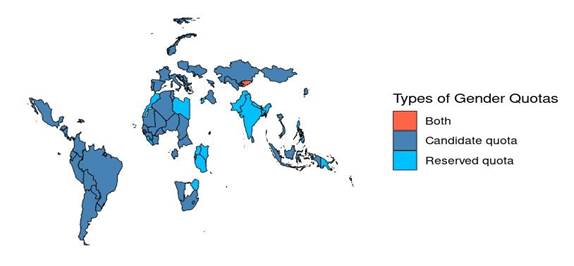
Figure 3

Distribution of Local Elections Gender Quotas Worldwide

0124-4035-desa-37-02-a7-gf3.jpg

Source: Created by the author using data from UN Women

Conclusion

Gender quota laws played a crucial role in increasing women’s participation in politics and government at both national and sub-national levels of government. The diffusion effect of quotas among political parties at the national and local levels, and among nations at regional and international levels, has had a boosting effect on making decision-making bodies more accessible and inclusive to women. Today, more women are serving as heads of states and governments than ever before. This literature review surveyed extensive research on the multifaceted concepts of substantive representation of women in various contexts, such as cross-national, regional, national, and subnational levels. Many studies have sought to address the core of the gender, politics, and representation issue by studying MPs’ attitudes and behaviors in national and cross-national contexts, and policy priorities, by employing observational and quasi-experimental research methods with correlational and causational designs. Nevertheless, the theoretical gaps in research on substantive effects of female representation still remain unfilled, especially in the developing world. This is true for subnational gaps, though globally in this case. These are the two patent avenues for future research to extend current research designs, to collect empirical evidence from other regions of the world and from the lower tiers of governments at national level.

The studies analyzed in this review, however, show some clear patterns. The literature indicates that women MPs prefer women’s issues more than their male counterparts, specifically in case of the five Western European countries of Spain, Germany, Sweden, Ireland, and Netherlands (Wäckerle & Castanho Silva, 2023). A similar pattern follows for Romania (Garboni, 2015), Nepal (Yadav, 2024), Japan (Joshi & Echle, 2023), and Latin America (Cunial, 2021; Dockendorff et al., 2022; Goyal & Sells, 2024; Lambert & Pineda Moquete, 2025), a region that has played a pioneering role in implementing legislated candidate quotas for women. The descriptive representation of females leads to women empowerment in terms of gender-sensitive laws, gender equality, gender equity, social inclusion, poverty reduction, and human resource development in developing countries (Asiedu et al., 2018; Tusalem, 2022). Moreover, the rise in health spendings (Clayton & Zetterberg, 2018), gender parity in education (Acheampong et al., 2024), greater maternal employment, development aid, reduced infant, neonatal and child mortality (Bhalotra & Clots-Figueras, 2014; Mechkova & Carlitz, 2020), and increased childcare in Germany (Baskaran & Hessami, 2019) are obvious substantive effects of the descriptive representation of women. Other impacts of higher female representations are the feminization of political parties (Belknap & Kenny (2023), women parliamentary bodies (Adams et al., 2019), and higher support for women as political leaders (Fernández & Valiente, 2021; Joshi & Goehrung, 2018).

However, these trends are not consistent across all countries and regions. In some countries, the presence of women led male parliamentarians to favor women’s interests far more than their female colleagues, as in the case of Serbia (Đorđević, 2023) and right and center-right parties in 10 European countries (Celis & Erzeel, 2015). In the case of Sweden, Norway, Italy and Japan, the substantive effects were absent at local levels (Baltrunaite et al., 2019; Geys & Sørensen, 2019; Högström & Lidén, 2024; Yamada, 2024), and in the case of Austria, Germany, and Switzerland, male attitudes were found antagonistic to the presence of quota women (Radojevic, 2023). Yet, in the case of Kenya and India, the results turned violent and led to extreme behaviors of backlash (Brulé, 2020; Matfess et al., 2023). These patterns call for an inquiry into what causes male MPs to become highly supportive of women’s interests in some political contexts, while exhibiting hostility toward their female counterparts in others. Moreover, the extreme cases of backlash are more common in developing countries. This has ranged from male-dominant political circles, political glass ceiling, and tokenism, to physical violence against women in politics (Krook & Sanín, 2020). Such instances boldly manifested in countries like Pakistan (Khan & Naqvi, 2020), India (Turnbull, 2021), Nepal, Bangladesh, Sri Lanka (Joshi & Echle, 2023), Afghanistan (Joshi et al., 2020), Kenya, and Cameroon (Fokum & Fonjong, 2018; Matfess et al., 2023). The uniqueness of these countries in socio-cultural aspects requires specific contextual analysis of women’s experiences in these regions.

Such insistencies are also evident in defining and representing the different streams of interests. For example, the above studies conceptualized women’s interests as either feminist, conservative or mixed. In line with this, it is pertinent to explore what prompts women legislators to engage more diligently in pursuing substantive representation-both as a process advancing feminist interests and as an outcome addressing traditional women’s concerns, as mentioned in the case of Korea (G. Park & Österman, 2021). Other than that, the implementation of women-friendly policies and laws shows different patterns than the legislation of the same policy. This was reported by Dupas and Jain (2024) through their inquiry into the health insurance program (Bhamashah Swasthya Bima Yojana) in India. The authors found an enormous gap between legislation and the implementation of the same policy. Therefore, women-friendly legislation needs to be investigated from this dimension as well. Lastly, since citizens form the base of the political stratification pyramid, investigating the impacts of gender quotas through a bottom-up approach-as opposed to a top-down perspective-can offer critical insights into the dynamics of substantive representation.

References

Acheampong, A. O., Opoku, E. E. O., & Rustagi, N. (2024). Gender quota, women in politics, and gender parity in education. Economics and Politics, 36(3), 1223-1260. https://doi.org/10.1111/ecpo.12287

A. O. Acheampong E. E. O. Opoku N. Rustagi 2024Gender quota, women in politics, and gender parity in educationEconomics and Politics36312231260https://doi.org/10.1111/ecpo.12287

Adams, M. J., Scherpereel, J. A., & Wylie, K. N. (2019). The adoption of women’s legislative caucuses worldwide. International Feminist Journal of Politics, 21(2), 249-270. https://doi.org/10.1080/14616742.2018.1543550

M. J. Adams J. A. Scherpereel K. N. Wylie 2019The adoption of women’s legislative caucuses worldwideInternational Feminist Journal of Politics212249270https://doi.org/10.1080/14616742.2018.1543550

Adamu, R. O. (2023). Women participation in Nigerian politics: challenges and prospects to Nigerian democracy. International Journal of Humanity Studies (IJHS), 6(2), 301-314. https://doi.org/10.24071/ijhs.v6i2.5295

R. O. Adamu 2023Women participation in Nigerian politics: challenges and prospects to Nigerian democracyInternational Journal of Humanity Studies (IJHS)62301314https://doi.org/10.24071/ijhs.v6i2.5295

Allen, P., & Cairney, P. (2015). What do we mean when we talk about the “political class”? Political Studies Review, 15(1). https://doi.org/https://journals.sagepub.com/doi/abs/10.1111/1478-9302.12092#tab-contributors

P. Allen P. Cairney 2015What do we mean when we talk about the “political class”?Political Studies Review151

Allen, P., & Childs, S. (2019). The Grit in the Oyster? Women’s Parliamentary Organizations and the Substantive Representation of Women. Political Studies, 67(3), 618-638. https://doi.org/10.1177/0032321718793080

P. Allen S. Childs 2019The Grit in the Oyster? Women’s Parliamentary Organizations and the Substantive Representation of WomenPolitical Studies673618638https://doi.org/10.1177/0032321718793080

Allen, P., & Cutts, D. (2018). How do gender quotas affect public support for women as political leaders? West European Politics, 41(1), 147-168. https://doi.org/10.108 0/01402382.2017.1320082

P. Allen D. Cutts 2018How do gender quotas affect public support for women as political leaders?West European Politics411147168https://doi.org/10.108 0/01402382.2017.1320082

Asiedu, E., Branstette, C., & Malokele, N. (2018). The Effect of Women’s Representation in Parliament and the Passing of Gender Sensitive Policies. https://www.aeaweb.org/conference/2018/preliminary/paper/an5yEb5h

E. Asiedu C. Branstette N. Malokele 2018The Effect of Women’s Representation in Parliament and the Passing of Gender Sensitive Policieshttps://www.aeaweb.org/conference/2018/preliminary/paper/an5yEb5h

Bagues, M., & Campa, P. (2017). Can gender quotas in candidate lists empower women? Evidence from a regression discontinuity design. Centre for Economic Policy Research (CEPR).

M. Bagues P. Campa 2017Can gender quotas in candidate lists empower women? Evidence from a regression discontinuity designCentre for Economic Policy Research (CEPR)

Baltrunaite, A., Casarico, A., Profeta, P., & Savio, G. (2019). Let the voters choose women. Journal of Public Economics, 180. https://doi.org/10.1016/j.jpubeco.2019.104085

A. Baltrunaite A. Casarico P. Profeta G. Savio 2019Let the voters choose womenJournal of Public Economics180https://doi.org/10.1016/j.jpubeco.2019.104085

Bari, F. (2017). Women Parliamentarians: Challenging the Frontiers of Politics in Pakistan. Gender, Technology and Development, 14(3), 363-384. https://doi.org/10.1177/097185241001400304

F. Bari 2017Women Parliamentarians: Challenging the Frontiers of Politics in PakistanGender, Technology and Development143363384https://doi.org/10.1177/097185241001400304

Barnes, T. D. (2016). Gendering Legislative Behavior. Oxford University Press.

T. D. Barnes 2016Gendering Legislative BehaviorOxford University Press

Barnes, T. D., & Burchard, S. M. (2013). “Engendering” Politics: The Impact of Descriptive Representation on Women’s Political Engagement in Sub-Saharan Africa. Comparative Political Studies, 46(7), 767-790. https://doi.org/10.1177/0010414012463884

T. D. Barnes S. M. Burchard 2013“Engendering” Politics: The Impact of Descriptive Representation on Women’s Political Engagement in Sub-Saharan AfricaComparative Political Studies467767790https://doi.org/10.1177/0010414012463884

Barnes, T. D., & Holman, M. R. (2020). Gender quotas, women’s representation, and legislative diversity. Journal of Politics, 82(4), 1271-1286. https://doi.org/10.1086/708336

T. D. Barnes M. R. Holman 2020Gender quotas, women’s representation, and legislative diversityJournal of Politics82412711286https://doi.org/10.1086/708336

Barnett, C., & Shalaby, M. (2021). Success Beyond Gender Quotas: Gender, Local Politics, and Clientelism in Morocco [Program on Governance and Local Development Working Paper No. 48]. http://dx.doi.org/10.2139/ssrn.3947099

C. Barnett M. Shalaby 2021Success Beyond Gender Quotas: Gender, Local Politics, and Clientelism in MoroccoProgram on Governance and Local Development Working Paper No. 48http://dx.doi.org/10.2139/ssrn.3947099

Bashir, H., & Jan, M. A. (2018). Political Oppression, Resistance and Leadership Change: The Rise of Nasim Wali Khan as a Leader. Pakistan Journal of Criminology, 10(2), 15-162.

H. Bashir M. A. Jan 2018Political Oppression, Resistance and Leadership Change: The Rise of Nasim Wali Khan as a LeaderPakistan Journal of Criminology10215162

Baskaran, T., & Hessami, Z. (2018). Does the election of a female leader clear the way for more women in politics? American Economic Journal: Economic Policy, 10(3), 95-121. https://doi.org/10.1257/pol.20170045

T. Baskaran Z. Hessami 2018Does the election of a female leader clear the way for more women in politics?American Economic Journal: Economic Policy10395121https://doi.org/10.1257/pol.20170045

Baskaran, T., & Hessami, Z. (2019). Competitively Elected Women as Policymakers (8005). www.RePEc.org

T. Baskaran Z. Hessami 2019Competitively Elected Women as Policymakerswww.RePEc.org

Bektas, E., & Issever-Ekinci, E. (2019). Who Represents Women in Turkey? An Analysis of Gender Difference in Private Bill Sponsorship in the 2011-15 Turkish Parliament. Politics and Gender, 15(4), 851-881. https://doi.org/10.1017/S1743923X18000363

E. Bektas E. Issever-Ekinci 2019Who Represents Women in Turkey? An Analysis of Gender Difference in Private Bill Sponsorship in the 2011-15 Turkish ParliamentPolitics and Gender154851881https://doi.org/10.1017/S1743923X18000363

Belknap, E., & Kenny, M. (2023). ‘The first, but not the last’: women’s descriptive and substantive representation in the 2021 Scottish Parliament election. British Politics. https://doi.org/10.1057/s41293-023-00246-x

E. Belknap M. Kenny 2023‘The first, but not the last’: women’s descriptive and substantive representation in the 2021 Scottish Parliament electionBritish Politicshttps://doi.org/10.1057/s41293-023-00246-x

Bhalotra, S., & Clots-Figueras, I. (2014). Health and the political agency of women. American Economic Journal: Economic Policy, 6(2), 164-197. https://doi.org/10.1257/pol.6.2.164

S. Bhalotra I. Clots-Figueras 2014Health and the political agency of womenAmerican Economic Journal: Economic Policy62164197https://doi.org/10.1257/pol.6.2.164

Bhalotra, S., Clots-Figueras, I., & Iyer, L. (2018). Pathbreakers? Women’s Electoral Success and Future Political Participation. Economic Journal, 128(613), 1844-1878. https://doi.org/10.1111/ecoj.12492

S. Bhalotra I. Clots-Figueras L. Iyer 2018Pathbreakers? Women’s Electoral Success and Future Political ParticipationEconomic Journal12861318441878https://doi.org/10.1111/ecoj.12492

Björkdahl, A., & Somun-Krupalija, L. (2020). Gender Equality and Local Governance: Global Norms and Local Practices. In S. Cheema (Ed.), Governance for Urban Services: Access, Participation, Accountability, and Transparency (pp. 107-126). Springer Singapore. https://doi.org/10.1007/978-981-15-2973-3_5

A. Björkdahl L. Somun-Krupalija 2020Gender Equality and Local Governance: Global Norms and Local Practices S. Cheema Governance for Urban Services: Access, Participation, Accountability, and Transparency107126Springer Singaporehttps://doi.org/10.1007/978-981-15-2973-3_5

Brulé, R. E. (2020). Reform, representation, and resistance: the politics of property rights’ enforcement. Journal of Politics, 82(4), 1390-1405. https://doi.org/10.1086/708645

R. E. Brulé 2020Reform, representation, and resistance: the politics of property rights’ enforcementJournal of Politics82413901405https://doi.org/10.1086/708645

Bulut, A. T. (2020). What Drives Women’s Substantive Representation in Muslim-Majority Countries? Lessons from Turkey. Political Research Quarterly, 74(4), 913-926. https://doi.org/10.1177/1065912920948135

A. T. Bulut 2020What Drives Women’s Substantive Representation in Muslim-Majority Countries? Lessons from TurkeyPolitical Research Quarterly744913926https://doi.org/10.1177/1065912920948135

Carrión-Yaguana, V., Carrington, S. J., & Velástegui Moya, G. (2023). Female Candidate Performance and Gender Quotas: The Case of Ecuador. Journal of Women, Politics and Policy, 44(2), 152-167. https://doi.org/10.1080/1554477X.2022.2066390

V. Carrión-Yaguana S. J. Carrington G. Velástegui Moya 2023Female Candidate Performance and Gender Quotas: The Case of EcuadorJournal of Women, Politics and Policy442152167https://doi.org/10.1080/1554477X.2022.2066390

Castorena, O. (2023). Female Officeholders and Women’s Political Engagement: The Role of Parties. Political Behavior, 45(4), 1609-1631. https://doi.org/10.1007/s11109021-09765-z

O. Castorena 2023Female Officeholders and Women’s Political Engagement: The Role of PartiesPolitical Behavior45416091631https://doi.org/10.1007/s11109021-09765-z

Celis, K., & Childs, S. (2012). The Substantive Representation of Women: What to Do with Conservative Claims? Political Studies, 60(1), 213-225. https://doi.org/10.1111/j.1467-9248.2011.00904.x

K. Celis S. Childs 2012The Substantive Representation of Women: What to Do with Conservative Claims?Political Studies601213225https://doi.org/10.1111/j.1467-9248.2011.00904.x

Celis, K., & Erzeel, S. (2015). Beyond the usual suspects: non-left, male and non-feminist MPs and the substantive representation of women. Government and Opposition, 50(1), 45-64. https://doi.org/10.1017/gov.2013.42

K. Celis S. Erzeel 2015Beyond the usual suspects: non-left, male and non-feminist MPs and the substantive representation of womenGovernment and Opposition5014564https://doi.org/10.1017/gov.2013.42

Charron, N., Dijkstra, L., & Lapuente, V. (2015). Mapping the Regional Divide in Europe: A Measure for Assessing Quality of Government in 206 European Regions. Social Indicators Research, 122(2), 315-346. https://doi.org/10.1007/s11205-014-0702-y

N. Charron L. Dijkstra V. Lapuente 2015Mapping the Regional Divide in Europe: A Measure for Assessing Quality of Government in 206 European RegionsSocial Indicators Research1222315346https://doi.org/10.1007/s11205-014-0702-y

Chen, L. J. (2021). Female policymakers and educational expenditures: cross-country evidence. European Journal of Law and Economics, 51(1), 129-155. https://doi.org/10.1007/s10657-020-09673-3

L. J. Chen 2021Female policymakers and educational expenditures: cross-country evidenceEuropean Journal of Law and Economics511129155https://doi.org/10.1007/s10657-020-09673-3

Childs, S., & Celis, K. (2018). Conservatism and women’s political representation. Politics and Gender, 14(1), 5-26. https://eprints.bbk.ac.uk/policies.html

S. Childs K. Celis 2018Conservatism and women’s political representationPolitics and Gender141526https://eprints.bbk.ac.uk/policies.html

Childs, S., & Krook, M. L. (2009). Analysing women’s substantive representation: From critical mass to critical actors. Government and Opposition, 44(2), 125-145. https://doi.org/10.1111/j.1477-7053.2009.01279.x

S. Childs M. L. Krook 2009Analysing women’s substantive representation: From critical mass to critical actorsGovernment and Opposition442125145https://doi.org/10.1111/j.1477-7053.2009.01279.x

Childs, S., & Lovenduski, J. (2013). Political Representation. Oxford University Press.

S. Childs J. Lovenduski 2013Political RepresentationOxford University Press

Clayton, A. (2021). How Do Electoral Gender Quotas Affect Policy? Annual Review of Political Science, 24, 47-64. https://doi.org/10.1146/annurev-polisci-041719

A. Clayton 2021How Do Electoral Gender Quotas Affect Policy?Annual Review of Political Science244764https://doi.org/10.1146/annurev-polisci-041719

Clayton, A., O’brien, D. Z., & Piscopo, J. M. (2019). All Male Panels? Representation and Democratic Legitimacy. American Journal of Political Science. 63(1), 113-129 https://doi.org/10.7910/DVN/7190MT

A. Clayton D. Z. O’brien J. M. Piscopo 2019All Male Panels? Representation and Democratic LegitimacyAmerican Journal of Political Science631113129https://doi.org/10.7910/DVN/7190MT

Clayton, A., & Zetterberg, P. (2018). Quota shocks: Electoral gender quotas and government spending priorities worldwide. Journal of Politics, 80(3), 916-932. https://doi.org/10.1086/697251

A. Clayton P. Zetterberg 2018Quota shocks: Electoral gender quotas and government spending priorities worldwideJournal of Politics803916932https://doi.org/10.1086/697251

Coffé, H. (2013). Women Stay Local, Men Go National and Global? Gender Differences in Political Interest. Sex Roles, 69(5-6), 323-338. https://doi.org/10.1007/s11199-013-0308-x

H. Coffé 2013Women Stay Local, Men Go National and Global? Gender Differences in Political InterestSex Roles695-6323338https://doi.org/10.1007/s11199-013-0308-x

CRS. (2024). Statistics on Women in National Governments Around the World.

CRS 2024Statistics on Women in National Governments Around the World

Cunial, S. L. (2021). Do More Female Politicians Translate into Better Health Outcomes? Gender Representation and Infant Mortality in Argentine Provinces. World Medical and Health Policy, 13(2), 349-372. https://doi.org/10.1002/wmh3.411

S. L. Cunial 2021Do More Female Politicians Translate into Better Health Outcomes? Gender Representation and Infant Mortality in Argentine ProvincesWorld Medical and Health Policy132349372https://doi.org/10.1002/wmh3.411

Dahlerup, D. (1988). From a Small to a Large Minority: Women in Scandinavian Politics. Scandinavian Political Studies, 11(4), 275-298. https://doi.org/ https://doi.org/10.1111/j.1467-9477.1988.tb00372.x

D. Dahlerup 1988From a Small to a Large Minority: Women in Scandinavian PoliticsScandinavian Political Studies114275298https://doi.org/10.1111/j.1467-9477.1988.tb00372.x

Dahlerup, D., & Freidenvall, L. (2005). Quotas as a “fast track” to equal representation for women. International Feminist Journal of Politics, 7(1), 26-48. https://doi.org/10.1080/1461674042000324673

D. Dahlerup L. Freidenvall 2005Quotas as a “fast track” to equal representation for womenInternational Feminist Journal of Politics712648https://doi.org/10.1080/1461674042000324673

Dahlerup, D., & Gaber, M. A. (2017). The legitimacy and effectiveness of gender quotas in politics in CE Europe. Teorija in Praksa, 54(2), 336-357.

D. Dahlerup M. A. Gaber 2017The legitimacy and effectiveness of gender quotas in politics in CE EuropeTeorija in Praksa542336357

Dockendorff, A., Gamboa, R., & Aubry, M. (2022). Substantive Representation of Women’s Interests: Chile, 1990-2020. In Representation (Vol. 58, Issue 1, pp. 139-148). Routledge. https://doi.org/10.1080/00344893.2021.1982757

A. Dockendorff R. Gamboa M. Aubry 2022Substantive Representation of Women’s Interests: Chile, 1990-2020Representation581139148Routledgehttps://doi.org/10.1080/00344893.2021.1982757

Đorđević, N. (2023). Substantive Representation of Women: The Case of Serbia. Genero: Časopis Za Feminističku Teoriju i Studije Kulture, 27(1), 111-144. https://doi.org/10.18485/genero.2023.27.1.5

N. Đorđević 2023Substantive Representation of Women: The Case of SerbiaGenero: Časopis Za Feminističku Teoriju i Studije Kulture271111144https://doi.org/10.18485/genero.2023.27.1.5

Downs, A. (1957). An economic theory of democracy. Happer & Row.

A. Downs 1957An economic theory of democracyHapper & Row

Dupas, P., & Jain, R. (2024). Women left behind: Gender disparities in utilization of government health insurance in India [Working Paper No.10]. https://doi.org/DOI:10.1257/aer.20230521

P. Dupas R. Jain 2024Women left behind: Gender disparities in utilization of government health insurance in India[Working Paper No.10]https://doi.org/DOI:10.1257/aer.20230521

Dyvik, E. H. (2024). Share of women in selected national parliaments (lower or single House) as of December 2023. https://www.statista.com/statistics/267028/women-in-selected-national-parliaments/

E. H. Dyvik 2024Share of women in selected national parliaments (lower or single House) as of December 2023https://www.statista.com/statistics/267028/women-in-selected-national-parliaments/

Ennser-Jedenastik, L. (2017). How Women’s Political Representation affects Spending on Family Benefits. Journal of Social Policy, 46(3), 563-581. https://doi.org/10.1017/ S0047279416000933

L. Ennser-Jedenastik 2017How Women’s Political Representation affects Spending on Family BenefitsJournal of Social Policy463563581https://doi.org/10.1017/ S0047279416000933

Fernández, J. J., & Valiente, C. (2021). Gender quotas and public demand for increasing women’s representation in politics: An analysis of 28 European countries. European Political Science Review, 13(3), 351-370. https://doi.org/10.1017/S1755773921000126

J. J. Fernández C. Valiente 2021Gender quotas and public demand for increasing women’s representation in politics: An analysis of 28 European countriesEuropean Political Science Review133351370https://doi.org/10.1017/S1755773921000126

Ferreira, F., & Gyourko, J. (2011). Does Gender Matter for Political Leadership? The Case of U.S. Mayors [Working paper 17671]. http://www.nber.org/papers/w17671

F. Ferreira J. Gyourko 2011Does Gender Matter for Political Leadership? The Case of U.S. Mayors[Working paper 17671]http://www.nber.org/papers/w17671

Fleschenberg, A., & Bari, F. (2015). Unmaking Political Patriarchy Through Gender Quotas? [Policy Brief, Publication Series “Reviewing Gender Quotas in Afghanistan and Pakistan”]. Heinrich Böll Stiftung. https://www.boell.de/sites/default/files/unmaking_political_patriarchy_through_gender_quotas1.pdf

A. Fleschenberg F. Bari 2015Unmaking Political Patriarchy Through Gender Quotas?[Policy Brief, Publication Series “Reviewing Gender Quotas in Afghanistan and Pakistan”]Heinrich Böll Stiftunghttps://www.boell.de/sites/default/files/unmaking_political_patriarchy_through_gender_quotas1.pdf

Fokum, V. Y., & Fonjong, L. N. (2018). Increasing women’s representation in the Cameroon parliament: do numbers really matter? Sociology International Journal, 2(6). https://doi.org/10.15406/sij.2018.02.00134

V. Y. Fokum L. N. Fonjong 2018Increasing women’s representation in the Cameroon parliament: do numbers really matter?Sociology International Journal26https://doi.org/10.15406/sij.2018.02.00134

Fokum, V. Y., Fonjong, L. N., & Adams, M. J. (2020). Increasing women’s representation in the Cameroon parliament: Do numbers really matter? Women’s Studies International Forum, 80. https://doi.org/10.1016/j.wsif.2020.102369

V. Y. Fokum L. N. Fonjong M. J. Adams 2020Increasing women’s representation in the Cameroon parliament: Do numbers really matter?Women’s Studies International Forum80https://doi.org/10.1016/j.wsif.2020.102369

Franceschet, S., & Piscopo, J. M. (2008). Gender Quotas and Women’s Substantive Representation: Lessons from Argentina. Politics and Gender, 4(3), 393-425. https://doi.org/10.1017/S1743923X08000342

S. Franceschet J. M. Piscopo 2008Gender Quotas and Women’s Substantive Representation: Lessons from ArgentinaPolitics and Gender43393425https://doi.org/10.1017/S1743923X08000342

Funk, K. D., & Philips, A. Q. (2019). Representative Budgeting: Women Mayors and the Composition of Spending in Local Governments. Political Research Quarterly, 72(1), 19-33. https://doi.org/10.1177/1065912918775237

K. D. Funk A. Q. Philips 2019Representative Budgeting: Women Mayors and the Composition of Spending in Local GovernmentsPolitical Research Quarterly7211933https://doi.org/10.1177/1065912918775237

Garboni, E. S. (2015). The Impact of Descriptive Representation on Substantive Representation of Women at European and National Parliamentary Levels. Case Study: Romania. Procedia - Social and Behavioral Sciences, 183, 85-92. https://doi.org/10.1016/j.sbspro.2015.04.849

E. S. Garboni 2015The Impact of Descriptive Representation on Substantive Representation of Women at European and National Parliamentary Levels. Case Study: RomaniaProcedia - Social and Behavioral Sciences1838592https://doi.org/10.1016/j.sbspro.2015.04.849

Geys, B., & Sørensen, R. J. (2019). The impact of women above the political glass ceiling: Evidence from a Norwegian executive gender quota reform. Electoral Studies, 60. https://doi.org/10.1016/j.electstud.2019.102050

B. Geys R. J. Sørensen 2019The impact of women above the political glass ceiling: Evidence from a Norwegian executive gender quota reformElectoral Studies60https://doi.org/10.1016/j.electstud.2019.102050

Gottlieb, J., Grossman, G., & Robinson, A. L. (2018). Do Men and Women Have Different Policy Preferences in Africa? Determinants and Implications of Gender Gaps in Policy Prioritization. British Journal of Political Science, 48(3), 611-636. https://doi.org/10.1017/S0007123416000053

J. Gottlieb G. Grossman A. L. Robinson 2018Do Men and Women Have Different Policy Preferences in Africa? Determinants and Implications of Gender Gaps in Policy PrioritizationBritish Journal of Political Science483611636https://doi.org/10.1017/S0007123416000053

Goyal, T., & Sells, C. (2024). Descriptive Representation and Party Building: Evidence from Municipal Governments in Brazil. American Political Science Review, 118(4), 1840-1855. https://doi.org/10.1017/S0003055423001168

T. Goyal C. Sells 2024Descriptive Representation and Party Building: Evidence from Municipal Governments in BrazilAmerican Political Science Review118418401855https://doi.org/10.1017/S0003055423001168

Gwiazda, A. (2019). The Substantive Representation of Women in Poland. Politics & Gender, 15(2), 262-284. https://doi.org/https://doi.org/10.1017/S1743923X18000909

A. Gwiazda 2019The Substantive Representation of Women in PolandPolitics & Gender152262284https://doi.org/https://doi.org/10.1017/S1743923X18000909

Handelman Howard, B. R. (2019). Challenges of the Developing World (Ninth). Rowman & Littlefield.

B. R. Handelman Howard 2019Challenges of the Developing World (Ninth)Rowman & Littlefield

Hicks, D. L., Hicks, J. H., & Maldonado, B. (2015). Women as Policy Makers and Donors: Female Legislators and Foreign Aid. Social Science Research Network. https://ssrn.com/abstract=2435342

D. L. Hicks J. H. Hicks B. Maldonado 2015Women as Policy Makers and Donors: Female Legislators and Foreign AidSocial Science Research Networkhttps://ssrn.com/abstract=2435342

Högström, J., & Lidén, G. (2024). Does the level of descriptive representation of women have any consequences for policy spending? International Journal of Comparative Sociology. https://doi.org/10.1177/00207152241263493

J. Högström G. Lidén 2024Does the level of descriptive representation of women have any consequences for policy spending?International Journal of Comparative Sociologyhttps://doi.org/10.1177/00207152241263493

Höhmann, D. (2020). When Do Female MPs Represent Women’s Interests? Electoral Systems and the Legislative Behavior of Women. Political Research Quarterly, 73(4), 834-847. https://doi.org/10.1177/1065912919859437

D. Höhmann 2020When Do Female MPs Represent Women’s Interests? Electoral Systems and the Legislative Behavior of WomenPolitical Research Quarterly734834847https://doi.org/10.1177/1065912919859437

Hughes, M. M., Paxton, P., Clayton, A. B., & Zetterberg, P. (2019). Global Gender Quota Adoption, Implementation, and Reform. Comparative Politics, 51(2), 219-238. https://doi.org/10.5129/001041519x15647434969795

M. M. Hughes P. Paxton A. B. Clayton P. Zetterberg 2019Global Gender Quota Adoption, Implementation, and ReformComparative Politics512219238https://doi.org/10.5129/001041519x15647434969795

Hughes, M. M., Paxton, P., & Krook, M. L. (2017). Gender Quotas for Legislatures and Corporate Boards. Annual Review of Sociology, 43, 331-352. https://doi.org/10.1146/annurev-soc-060116

M. M. Hughes P. Paxton M. L. Krook 2017Gender Quotas for Legislatures and Corporate BoardsAnnual Review of Sociology43331352https://doi.org/10.1146/annurev-soc-060116

IDEA, I. (2024). Gender Quotas Database: Countries Overview. https://www.idea.int/data-tools/data/gender-quotas-database/countries

I. IDEA 2024Gender Quotas Database: Countries Overviewhttps://www.idea.int/data-tools/data/gender-quotas-database/countries

IPU. (2024a). Global and regional averages of women in national parliaments. https://data.ipu.org/women-averages/?date_year=2024&date_month=09

IPU 2024aGlobal and regional averages of women in national parliamentshttps://data.ipu.org/women-averages/?date_year=2024&date_month=09

IPU. (2024b). Monthly ranking of women in national parliaments. https://data.ipu.org/women-ranking/?date_year=2024&date_month=12

IPU 2024bMonthly ranking of women in national parliamentshttps://data.ipu.org/women-ranking/?date_year=2024&date_month=12

IPU. (2024c). Super Election Year Sees Few Gains for Women MPs so far. ipu.org

IPU 2024cSuper Election Year Sees Few Gains for Women MPs so faripu.org

Iyer, L., Mani, A., Mishra, P., & Topalova, P. (2012). The power of political voice: Women’s political representation and crime in India. American Economic Journal: Applied Economics, 4(4), 165-193. http://www.vakilno1.com/bareacts/indianpenalcode/indianpenalcode.htm,

L. Iyer A. Mani P. Mishra P. Topalova 2012The power of political voice: Women’s political representation and crime in IndiaAmerican Economic Journal: Applied Economics44165193http://www.vakilno1.com/bareacts/indianpenalcode/indianpenalcode.htm

Joshi, D. K., & Echle, C. (Eds.). (2023). Analyzing an impressive array of countries, ‘Substantive Representation of Women in Asian Parliaments’. Taylor & Francis. https://doi.org/10.4324/9781003275961

D. K. Joshi C. Echle 2023Analyzing an impressive array of countries, ‘Substantive Representation of Women in Asian Parliaments’Taylor & Francishttps://doi.org/10.4324/9781003275961

Joshi, D. K., & Goehrung, R. (2018). Conceptualizing and Measuring Women’s Political Leadership: From Presence to Balance. Politics and Gender, 14(3), 350-375. https://doi.org/10.1017/S1743923X18000120

D. K. Joshi R. Goehrung 2018Conceptualizing and Measuring Women’s Political Leadership: From Presence to BalancePolitics and Gender143350375https://doi.org/10.1017/S1743923X18000120

Joshi, D. K., Hailu, M. F., & Reising, L. J. (2020). Violators, virtuous, or victims? How global newspapers represent the female member of parliament. Feminist Media Studies, 20(5), 692-712. https://doi.org/10.1080/14680777.2019.1642225

D. K. Joshi M. F. Hailu L. J. Reising 2020Violators, virtuous, or victims? How global newspapers represent the female member of parliamentFeminist Media Studies205692712https://doi.org/10.1080/14680777.2019.1642225

Kanter, R. M. (1977). Some Effects of Proportions on Group Life: Skewed Sex Ratios and Responses to Token Women. American Journal of Sociology, 82(5), 965-991.

R. M. Kanter 1977Some Effects of Proportions on Group Life: Skewed Sex Ratios and Responses to Token WomenAmerican Journal of Sociology825965991

Khan, A., & Naqvi, S. (2020). Dilemmas of representation: women in Pakistan’s assemblies. Asian Affairs, 51(2), 286-306. https://doi.org/10.1080/03068374.2020.1748414

A. Khan S. Naqvi 2020Dilemmas of representation: women in Pakistan’s assembliesAsian Affairs512286306https://doi.org/10.1080/03068374.2020.1748414

Kim, J., & Fallon, K. M. (2023). Making Women Visible: How Gender Quotas Shape Global Attitudes toward Women in Politics. Politics and Gender, 19(4), 981-1006. https://doi.org/10.1017/S1743923X23000089

J. Kim K. M. Fallon 2023Making Women Visible: How Gender Quotas Shape Global Attitudes toward Women in PoliticsPolitics and Gender1949811006https://doi.org/10.1017/S1743923X23000089

Krook, M. L., & Sanín, J. R. (2020). The Cost of Doing Politics? Analyzing Violence and Harassment against Female Politicians. Perspectives on Politics, 18(3), 740-755. https://doi.org/10.1017/S1537592719001397

M. L. Krook J. R. Sanín 2020The Cost of Doing Politics? Analyzing Violence and Harassment against Female PoliticiansPerspectives on Politics183740755https://doi.org/10.1017/S1537592719001397

Lambert, P., & Pineda Moquete, M. A. (2025). Gender Quotas and Women’s Substantive Representation: Evidence from Municipal Governments in the Dominican Republic. Journal of Women, Politics and Policy, 46(3), 207-226. https://doi.org/10.1080/1554477X.2025.2507551

P. Lambert M. A. Pineda Moquete 2025Gender Quotas and Women’s Substantive Representation: Evidence from Municipal Governments in the Dominican RepublicJournal of Women, Politics and Policy463207226https://doi.org/10.1080/1554477X.2025.2507551

Latif, A., Usman, A., Kataria, J. R., & Abdullah, M. (2015). Female Political Participation in South Asia: A Case Study of Pakistan. South Asian Studies A Research Journal of South Asian Studies, 30(2), 201-213.

A. Latif A. Usman J. R. Kataria M. Abdullah 2015Female Political Participation in South Asia: A Case Study of PakistanSouth Asian Studies A Research Journal of South Asian Studies302201213

Liu, S. J. S. (2018). Are Female Political Leaders Role Models? Lessons from Asia. Political Research Quarterly, 71(2), 255-269. https://doi.org/10.1177/1065912917745162

S. J. S. Liu 2018Are Female Political Leaders Role Models? Lessons from AsiaPolitical Research Quarterly712255269https://doi.org/10.1177/1065912917745162

Lloren, A. (2015). Women’s Substantive Representation: Defending Feminist Interests or Women’s Electoral Preferences? Journal of Legislative Studies, 21(2), 144-167. https://doi.org/10.1080/13572334.2014.966643

A. Lloren 2015Women’s Substantive Representation: Defending Feminist Interests or Women’s Electoral Preferences?Journal of Legislative Studies212144167https://doi.org/10.1080/13572334.2014.966643

Matfess, H., Kishi, R., & Berry, M. E. (2023). No safety in numbers: political representation and political violence targeting women in Kenya. International Feminist Journal of Politics, 25(3), 506-528. https://doi.org/10.1080/14616742.2022.2045618

H. Matfess R. Kishi M. E. Berry 2023No safety in numbers: political representation and political violence targeting women in KenyaInternational Feminist Journal of Politics253506528https://doi.org/10.1080/14616742.2022.2045618

Mechkova, V., & Carlitz, R. (2020). Gendered accountability: When and why do women’s policy priorities get implemented? European Political Science Review, 13(1), 3-21. https://doi.org/10.1017/S1755773920000272

V. Mechkova R. Carlitz 2020Gendered accountability: When and why do women’s policy priorities get implemented?European Political Science Review131321https://doi.org/10.1017/S1755773920000272

Mechkova, V., Dahlum, S., & Petrarca, C. S. (2024). Women’s political representation, good governance and human development. Governance, 37(1), 19-38. https://doi.org/10.1111/gove.12742

V. Mechkova S. Dahlum C. S. Petrarca 2024Women’s political representation, good governance and human developmentGovernance3711938https://doi.org/10.1111/gove.12742

Mobrand, E. (2019). On Parties’ Terms: Gender Quota Politics in South Korea’s Mixed Electoral System. Asian Studies Review, 43(1), 114-131. https://doi.org/10.1080/1 0357823.2018.1512554

E. Mobrand 2019On Parties’ Terms: Gender Quota Politics in South Korea’s Mixed Electoral SystemAsian Studies Review431114131https://doi.org/10.1080/1 0357823.2018.1512554

Mosier, A. E., Pietri, E. S., & Johnson, I. R. (2022). Inspiring visibility: Exploring the roles of identification and solidarity for alleviating Black women’s invisibility in politics. Group Processes & Intergroup Relations, 26(6). https://doi.org/https://doi.org/10.1177/13684302221105426

A. E. Mosier E. S. Pietri I. R. Johnson 2022Inspiring visibility: Exploring the roles of identification and solidarity for alleviating Black women’s invisibility in politicsGroup Processes & Intergroup Relations266https://doi.org/https://doi.org/10.1177/13684302221105426

Mufti, M., & Jalalzai, F. (2021). The Importance of Gender Quotas in Patriarchal and Clientelistic Polities: The Case of Pakistan. Journal of Women, Politics and Policy, 42(2), 107-123. https://doi.org/10.1080/1554477X.2021.1882826

M. Mufti F. Jalalzai 2021The Importance of Gender Quotas in Patriarchal and Clientelistic Polities: The Case of PakistanJournal of Women, Politics and Policy422107123https://doi.org/10.1080/1554477X.2021.1882826

Muhammad, S., Awan, M. W., & Hussain, M. (2020). Violence against Women in Politics: A Study of Backlash Effect of Gender Quota in Parliament of Pakistan. Research Journal of Social Sciences and Economics Review (RJSSER), 1(4), 361-367. https://doi.org/10.36902/rjsser-vol1-iss4-2020(361-367)

S. Muhammad M. W. Awan M. Hussain 2020Violence against Women in Politics: A Study of Backlash Effect of Gender Quota in Parliament of PakistanResearch Journal of Social Sciences and Economics Review (RJSSER)14361367https://doi.org/10.36902/rjsser-vol1-iss4-2020(361-367)

Naz, A., & Ahmad, W. (2012). Socio-cultural impediments to women political empowerment in Pakhtun society. www.savap.org.pkwww.journals.savap.org.pk

A. Naz W. Ahmad 2012Socio-cultural impediments to women political empowerment in Pakhtun societywww.savap.org.pkwww.journals.savap.org.pk

Och Malliga, & Joshi Devin K. (2021). Women Representatives, Left-Right Ideology and Gendered Pathways to Parliament in Asia and Europe. Asian International Studies Review, 22(2), 171-188. https://doi.org/https://doi.org/10.1163/2667078Xbja10009

Och Malliga K. Joshi Devin 2021Women Representatives, Left-Right Ideology and Gendered Pathways to Parliament in Asia and EuropeAsian International Studies Review222171188https://doi.org/https://doi.org/10.1163/2667078Xbja10009

Park, G., & Österman, M. (2021). Do Women Legislators Represent Women? The Effect of Women Legislators and Gender Quotas on the Substantive Representation of Women in the 20th National Assembly of the Republic of Korea.

G. Park M. Österman 2021Do Women Legislators Represent Women? The Effect of Women Legislators and Gender Quotas on the Substantive Representation of Women in the 20th National Assembly of the Republic of Korea

Park, S. (2023). Quota Effects Moderated by Descriptive Gender Representation Within Legislatures: A Cross-national Analysis. Representation, 59(4), 659-681. https://doi.org/10.1080/00344893.2022.2096683

S. Park 2023Quota Effects Moderated by Descriptive Gender Representation Within Legislatures: A Cross-national AnalysisRepresentation594659681https://doi.org/10.1080/00344893.2022.2096683

Parthasarathy, R., Rao, V., & Palaniswamy, N. (2019). Deliberative democracy in an unequal world: A text-as-data study of South India’s Village Assemblies. American Political Science Review, 113(3), 623-640. https://doi.org/10.1017/S0003055419000182

R. Parthasarathy V. Rao N. Palaniswamy 2019Deliberative democracy in an unequal world: A text-as-data study of South India’s Village AssembliesAmerican Political Science Review1133623640https://doi.org/10.1017/S0003055419000182

Paxton, P. M. M., Hughes, M., & Barnes, T. D. (2020). Women, Politics, and Power: A Global Perspective. Rowman & Littlefield Publishers. https://doi.org/10.4135/9781452225944

P. M. M. Paxton M. Hughes T. D. Barnes 2020Women, Politics, and Power: A Global PerspectiveRowman & Littlefield Publishershttps://doi.org/10.4135/9781452225944

Phillips, A. (1995). The Politics of Presence. Oxford University Press. https://doi.org/10.1093/0198294158.001.0001

A. Phillips 1995The Politics of PresenceOxford University Presshttps://doi.org/10.1093/0198294158.001.0001

Phillips, A. (1998). Feminism and Politics. Oxford University Press.

A. Phillips 1998Feminism and PoliticsOxford University Press

Piscopo, J. M. (2006). Engineering Quotas in Latin America. https://escholarship.org/uc/item/7j05q10b

J. M. Piscopo 2006Engineering Quotas in Latin Americahttps://escholarship.org/uc/item/7j05q10b

Piscopo, J. M. (2014, July). Committees and Caucuses: How Legislative Institutions Shape Substantive Representation in Latin America.

J. M. Piscopo 2014Committees and Caucuses: How Legislative Institutions Shape Substantive Representation in Latin America

Piscopo, J. M., Hinojosa, M., Thomas, G., & Siavelis, P. M. (2022). Follow the Money: Gender, Incumbency, and Campaign Funding in Chile. Comparative Political Studies, 55(2), 222-253. https://doi.org/10.1177/00104140211024300

J. M. Piscopo M. Hinojosa G. Thomas P. M. Siavelis 2022Follow the Money: Gender, Incumbency, and Campaign Funding in ChileComparative Political Studies552222253https://doi.org/10.1177/00104140211024300

Piscopo, & Jennifer M. (2014). Beyond hearth and home: Female legislators, feminist policy change, and substantive representation in Mexico. Revista Uruguaya de Ciencia Política, 23, 87-110. http://rucp.cienciassociales.edu.uy/index.php/rucp/article/view/88.

Jennifer M. Piscopo 2014Beyond hearth and home: Female legislators, feminist policy change, and substantive representation in MexicoRevista Uruguaya de Ciencia Política2387110http://rucp.cienciassociales.edu.uy/index.php/rucp/article/view/88

Pitkin, H. F. (1967). The Concept of Representation. University of California Press.

H. F. Pitkin 1967The Concept of RepresentationUniversity of California Press

Prihatini, E. S. (2019). Women’s representation in Asian parliaments: a QCA approach. Contemporary Politics, 25(2), 213-235. https://doi.org/10.1080/13569775.2018.152 0057

E. S. Prihatini 2019Women’s representation in Asian parliaments: a QCA approachContemporary Politics252213235https://doi.org/10.1080/13569775.2018.152 0057

Radojevic, M. (2023). The Subjective Effects of Gender Quotas: Party Elites Do Not Consider Quota Women to Be Less Competent. Politics and Gender, 19(2), 349-372. https://doi.org/10.1017/S1743923X22000137

M. Radojevic 2023The Subjective Effects of Gender Quotas: Party Elites Do Not Consider Quota Women to Be Less CompetentPolitics and Gender192349372https://doi.org/10.1017/S1743923X22000137

Rashkova, E. R. (2021). Gender Politics and Radical Right Parties: An Examination of Women’s Substantive Representation in Slovakia. East European Politics and Societies, 35(1), 69-88. https://doi.org/10.1177/0888325419897993

E. R. Rashkova 2021Gender Politics and Radical Right Parties: An Examination of Women’s Substantive Representation in SlovakiaEast European Politics and Societies3516988https://doi.org/10.1177/0888325419897993

Rashkova, E. R., & Zankina, E. (2017). Are (populist) radical right parties Männerparteien? Evidence from Bulgaria. West European Politics, 40(4), 848-868. https://doi.org/10.1080/01402382.2017.1285580

E. R. Rashkova E. Zankina 2017Are (populist) radical right parties Männerparteien? Evidence from BulgariaWest European Politics404848868https://doi.org/10.1080/01402382.2017.1285580

Sapiro, V. (1981). When Are Interests Interesting? The Problem of Political Representation of Women. American Political Science Review, 75(3), 701-716. https://doi.org/10.2307/1960962

V. Sapiro 1981When Are Interests Interesting? The Problem of Political Representation of WomenAmerican Political Science Review753701716https://doi.org/10.2307/1960962

Sawer, M., Freidenvall, L., & Palmieri, S. (2013, March 21). Playing their part? Parliamentary institutions and gender mainstreaming. https://doi.org/ https://dx.doi.org/10.2139/ssrn.2488867

M. Sawer L. Freidenvall S. Palmieri 2013Playing their part? Parliamentary institutions and gender mainstreaminghttps://dx.doi.org/10.2139/ssrn.2488867

Sawer, M., & Turner, A. (2014). A Bunch of Feisty Females-An Inquiry into the Functions of the Status of Women Caucus Committee of the Federal Parliamentary Labor Party. ANU.

M. Sawer A. Turner 2014A Bunch of Feisty Females-An Inquiry into the Functions of the Status of Women Caucus Committee of the Federal Parliamentary Labor PartyANU

Sawer, M., & Turner, A. (2016). Specialised parliamentary bodies: Their role and relevance to women’s movement repertoire. Parliamentary Affairs, 69(4), 763-777. https://doi.org/10.1093/pa/gsw003

M. Sawer A. Turner 2016Specialised parliamentary bodies: Their role and relevance to women’s movement repertoireParliamentary Affairs694763777https://doi.org/10.1093/pa/gsw003

Serrano Oswald, S. E. (2023). Gender based political violence against women in Mexico from a regional perspective. Asia-Pacific Journal of Regional Science, 7(1), 135-157. https://doi.org/10.1007/s41685-022-00271-6

S. E. Serrano Oswald 2023Gender based political violence against women in Mexico from a regional perspectiveAsia-Pacific Journal of Regional Science71135157https://doi.org/10.1007/s41685-022-00271-6

Shalaby, M. (2016). Women’s Political Representation and Authoritarianism in the Arab World. Project on Middle East Political Science (POMEPS) Studies, (23), 28-32.

M. Shalaby 2016Women’s Political Representation and Authoritarianism in the Arab WorldProject on Middle East Political Science (POMEPS) Studies232832

Shim, J. (2021). Gender and Politics in Northeast Asia: Legislative Patterns and Substantive Representation in Korea and Taiwan. Journal of Women, Politics and Policy, 42(2), 138-155. https://doi.org/10.1080/1554477X.2021.1888677

J. Shim 2021Gender and Politics in Northeast Asia: Legislative Patterns and Substantive Representation in Korea and TaiwanJournal of Women, Politics and Policy422138155https://doi.org/10.1080/1554477X.2021.1888677

Slegten, C., & Heyndels, B. (2020). Within-Party Sex Gaps in Expenditure Preferences among Flemish Local Politicians. Politics and Gender, 16(3), 768-791. https://doi.org/10.1017/S1743923X18000685

C. Slegten B. Heyndels 2020Within-Party Sex Gaps in Expenditure Preferences among Flemish Local PoliticiansPolitics and Gender163768791https://doi.org/10.1017/S1743923X18000685

Smooth, W. (2011). Standing for women? Which women? The substantive representation of women’s interests and the research imperative of intersectionality. Politics and Gender, 7(3), 436-441. https://doi.org/10.1017/S1743923X11000225

W. Smooth 2011Standing for women? Which women? The substantive representation of women’s interests and the research imperative of intersectionalityPolitics and Gender73436441https://doi.org/10.1017/S1743923X11000225

Sundström, A., Paxton, P., Wang, Y.-T., & Lindberg, S. I. (2015). Women’s Political Empowerment: A New Global Index, 1900-2012 (2015:19). www.v-dem.net.

A. Sundström P. Paxton Y.-T. Wang S. I. Lindberg 2015Women’s Political Empowerment: A New Global Index, 1900-20122015:19www.v-dem.net

Syed, N. T., & Tabassum, H. (2014). Women’s Political Participation in Pakistan. Pakistan Journal of Gender Studies, 8(1) 131-143. https://doi.org/10.46568/pjgs.v8i1.339

N. T. Syed H. Tabassum 2014Women’s Political Participation in PakistanPakistan Journal of Gender Studies81131143https://doi.org/10.46568/pjgs.v8i1.339

Tam, W. (2019). Women’s political representation in a hybrid and patriarchal regime: Evidence from Singapore. Parliamentary Affairs, 73(4), 759-789. https://doi.org/10.1093/pa/gsz019

W. Tam 2019Women’s political representation in a hybrid and patriarchal regime: Evidence from SingaporeParliamentary Affairs734759789https://doi.org/10.1093/pa/gsz019

Turnbull, B. (2021). Quotas as Opportunities and Obstacles: Revisiting Gender Quotas in India. Politics and Gender, 17(2), 324-348. https://doi.org/10.1017/S1743923 X19000722

B. Turnbull 2021Quotas as Opportunities and Obstacles: Revisiting Gender Quotas in IndiaPolitics and Gender172324348https://doi.org/10.1017/S1743923 X19000722

Tusalem, R. F. (2022). Does gendered representation in national legislatures promote substantive representation and human development? Evidence from the developing world. Southeastern Political Review, 26(1), 45-77. https://doi.org/10.1111/j.1747-1346.1998.tb00471.x

R. F. Tusalem 2022Does gendered representation in national legislatures promote substantive representation and human development? Evidence from the developing worldSoutheastern Political Review2614577https://doi.org/10.1111/j.1747-1346.1998.tb00471.x

UN Women. (2023). Legislated Gender Quotas for Local Governments. https://localgov.unwomen.org/access-quota-information

UN Women 2023Legislated Gender Quotas for Local Governmentshttps://localgov.unwomen.org/access-quota-information

UN Women. (2024, September 10). Why so few women are in political leadership, and five actions to boost women’s political participation. https://www.unwomen.org

UN Women 2024Why so few women are in political leadership, and five actions to boost women’s political participationhttps://www.unwomen.org

Vidal-Correa, F. (2020). Transitioning from Descriptive to Substantive Representation: A Study of the Mexican Congress. Institute of Political Studies. https://scripta.up.edu.mx/entities/publication/a0024431-7a9d-492f-b873-97c99cdcc9e1

F. Vidal-Correa 2020Transitioning from Descriptive to Substantive Representation: A Study of the Mexican CongressInstitute of Political Studieshttps://scripta.up.edu.mx/entities/publication/a0024431-7a9d-492f-b873-97c99cdcc9e1

Wäckerle, J., & Castanho Silva, B. (2023). Distinctive Voices: Political Speech, Rhetoric, and the Substantive Representation of Women in European Parliaments. Legislative Studies Quarterly, 48(4), 797-831. https://doi.org/10.1111/lsq.12410

J. Wäckerle B. Castanho Silva 2023Distinctive Voices: Political Speech, Rhetoric, and the Substantive Representation of Women in European ParliamentsLegislative Studies Quarterly484797831https://doi.org/10.1111/lsq.12410

Wang, S. (2023). Do Women Always Represent Women? The Effects of Gender Quotas on Substantive Representation. Political Behavior, 45(4), 1979-1999. https://doi.org/10.1007/s11109-022-09808-z

S. Wang 2023Do Women Always Represent Women? The Effects of Gender Quotas on Substantive RepresentationPolitical Behavior45419791999https://doi.org/10.1007/s11109-022-09808-z

Weeks, A. C. (2017). Quotas matter: The impact of gender quota laws on work-family policies.

A. C. Weeks 2017Quotas matter: The impact of gender quota laws on work-family policies

Weeks, A. C., & Masala, F. (2023). Still “the Domain of Men?” Gender Quotas and Women’s Inclusion in Local Politics in Italy. Legislative Studies Quarterly, 48(3), 503-534. https://doi.org/10.1111/lsq.12405

A. C. Weeks F. Masala 2023Still “the Domain of Men?” Gender Quotas and Women’s Inclusion in Local Politics in ItalyLegislative Studies Quarterly483503534https://doi.org/10.1111/lsq.12405

Westfall, A., & Chantiles, C. (2016). The Political Cure: Gender Quotas and Women’s Health. Politics and Gender, 12(3), 469-490. https://doi.org/10.1017/S1743923X16000167

A. Westfall C. Chantiles 2016The Political Cure: Gender Quotas and Women’s HealthPolitics and Gender123469490https://doi.org/10.1017/S1743923X16000167

Williams, M. S. (1998). Voice, Trust, and Memory: Marginalized Groups and the Failings of Liberal Representation. Princeton University Press. https://doi.org/doi:10.1515/9781400822782

M. S. Williams 1998Voice, Trust, and Memory: Marginalized Groups and the Failings of Liberal RepresentationPrinceton University Presshttps://doi.org/doi:10.1515/9781400822782

World Economic Forum. (2024a). Global Gender Gap Report. https://www.weforum.org/

World Economic Forum 2024aGlobal Gender Gap Reporthttps://www.weforum.org/

World Economic Forum. (2024b). Global Gender Gap Report 2024. https://www.weforum.org/publications/global-gender-gap-report-2024/

World Economic Forum 2024bGlobal Gender Gap Report 2024https://www.weforum.org/publications/global-gender-gap-report-2024/

Yadav, P. (2024). Do political quotas work? Gender quotas and women’s political participation in Nepal. European Journal of Politics and Gender, 7(2), 143-161. https://doi.org/10.1332/251510821X16746560835644

P. Yadav 2024Do political quotas work? Gender quotas and women’s political participation in NepalEuropean Journal of Politics and Gender72143161https://doi.org/10.1332/251510821X16746560835644

Yamada, A. (2024). Does increased local female representation result in expanded childcare provisions? Implications from Japan. Social Science Japan Journal. https://doi.org/10.1093/ssjj/jyae016

A. Yamada 2024Does increased local female representation result in expanded childcare provisions? Implications from JapanSocial Science Japan Journalhttps://doi.org/10.1093/ssjj/jyae016

Young, I. M. (2000). Inclusion and democracy. Oxford University Press.

I. M. Young 2000Inclusion and democracyOxford University Press

Zakar, R., Zakar, M. Z., & Hamid, N. (2018). Gender mainstreaming in politics: Perspective of female politicians from Pakistan. Asian Journal of Women’s Studies, 24(2), 224-245. https://doi.org/10.1080/12259276.2018.1464109

R. Zakar M. Z. Zakar N. Hamid 2018Gender mainstreaming in politics: Perspective of female politicians from PakistanAsian Journal of Women’s Studies242224245https://doi.org/10.1080/12259276.2018.1464109

[1] Sabeel Khan, M. (2025). Gender quotas, context, and substantive representation: a literature review. Desafíos, 37(2), 1-33. https://doi.org/10.12804/revistas.urosario.edu.co/desafios/a.15452