
10.12804/revistas.urosario.edu.co/desafios/a.15378
SECCIÓN GENERAL
Érica Raschendorfer 1
Ariane Cristine Roder Figueira 2
1 PhD in Business Administration, Universidade Federal do Rio de Janeiro (UFRJ).
Researcher of the Instituto coppead de Administração, Cidade Universitária Rio de Janeiro RJ.
 0000-0002-8253-2128
 professoraericavon@gmail.com
2 PhD in Business Administration-Universidade Federal do Rio de Janeiro UFRJ.
Researcher of COPPEAD de Administração Rua Pascoal Lemme355,Cidade Universitária-Rio de Janeiro -RJ,CEP 21941-918
0000-0002-2900-3040
ariane.roder@coppead.ufrj.br
Submission date: March 29, 2025
Acceptance date: November 24, 2025
Para citar este artículo: Raschendorfer, Érica, & Roder Figueira, A. C. (2026). Meta-governance and Collaborative Networks in the Defense Sector: The Case of the Rio de Janeiro Naval Technology Cluster. Desafíos, 38(1), 1-28. https://doi.org/10.12804/revistas.urosario.edu.co/desafios/a.15378
ABSTRACT
Motivated by the challenges inherent to integration and coordination in collaborative public governance—particularly in sectors traditionally focused in state actors, such as National Defense—this article aims to analyze how relationships are configured among actors operating under different logics and embedded in distinct institutional arrangements, across multiple decision-making layers. To this end, a case study was conducted in the Rio de Janeiro Naval Technology Cluster, Brazil. The research findings indicate the need to consider new structures capable of shaping actors' behavior and decision-making processes, emphasizing the importance of participatory and effective government, where collaboration plays a central role in constructing socially shared values. Furthermore, the study highlighted that leadership plays a crucial role in addressing structural gaps in managing actors' activities, providing tools for their organization and coordination, and guiding actions within governance arrangements and subsystems. In this context, the research contributes to advancing knowledge on public governance mechanisms, with meta-governance, institutional leadership, and political entrepreneurship emerging as essential foundations for strengthening intersectoral relations.
Keywords: public governance; collaboration; leadership; meta-governance; defense.
RESUMEN
Motivado por los desafíos inherentes a la integración y coordinación en la gobernanza pública colaborativa, particularmente en sectores tradicionalmente concentrados en actores estatales, como la Defensa Nacional, este artículo busca analizar cómo se configuran las relaciones entre actores que operan bajo diferentes lógicas e insertos en distintos arreglos institucionales, a través de múltiples niveles de toma de decisiones. Para ello, se realizó un estudio de caso en el Clúster Tecnológico Naval de Río de Janeiro, Brasil. Los hallazgos de la investigación indican la necesidad de considerar nuevas estructuras capaces de moldear el comportamiento y los procesos de toma de decisiones de los actores, enfatizando la importancia de un gobierno participativo y efectivo, donde la colaboración juega un papel central en la construcción de valores socialmente compartidos. Además, el estudio destacó que el liderazgo juega un papel crucial para abordar las brechas estructurales en la gestión de las actividades de los actores, proporcionando herramientas para su organización y coordinación, y guiando las acciones dentro de los arreglos y subsistemas de gobernanza. En este contexto, la investigación contribuye al avance del conocimiento sobre los mecanismos de gobernanza pública, donde la metagobernanza, el liderazgo institucional y el emprendimiento político emergen como bases esenciales para fortalecer las relaciones intersectoriales.
Palabras clave: Gobernanza pública; colaboración; liderazgo; metagobernanza; defensa.
RESUMO
Motivado pelos desafios inerentes à integração e à coordenação da governança pública colaborativa, especialmente em setores tradicionalmente concentrados em atores estatais, como a Defesa Nacional, este artigo busca analisar como se configuram as relações entre atores que operam sob diferentes lógicas e que estão inseridas em diferentes arranjos institucionais, por meio de múltiplos níveis de tomada de decisões. Para isso, foi realizado um estudo de caso no Cluster de Tecnológico Naval do Rio de Janeiro, Brasil. Os resultados da pesquisa indicam a necessidade de considerar novas estruturas capazes de moldar o comportamento e os processos de tomada de decisão dos atores, enfatizando a importância de uma governança eficaz e participativa, na qual a colaboração desempenha um papel central na construção de valores socialmente compartilhados. Além disso, o estudo destacou que a liderança desempenha um papel crucial no enfrentamento de lacunas estruturais na gestão das atividades dos atores, o que fornece ferramentas para sua organização e coordenação, além de orientar as ações dentro dos arranjos e subsistemas de governança. Nesse contexto, a pesquisa contribui para o avanço do conhecimento sobre mecanismos de governança pública, em que a metagovernança, a liderança institucional e o empreendedorismo político emergem como bases essenciais para fortalecer as relações intersetoriais.
Palavras-chave: governança pública; colaboração; liderança; metagovernança; defesa.
Introduction
How can governance arrangements effectively design, present, and implement solutions to complex and transversal problems involving multiple actors across diverse arenas and decision-making levels? What public governance criteria should be adopted to ensure the effectiveness of policy outcomes? These questions have mobilized governments and non-state actors in engaging with public agendas within an increasingly complex context, shaped by political, social, and economic changes. At the heart of this debate is the concept of public value creation, whose fundamental premise rests on multi-actor and multi-level collaboration within a process of co-production of public policies (Ansell & Gash, 2008; Osborne, 2013; S0rensen & Torfing, 2012).
This collaborative approach, associated with public governance, imposes significant challenges in terms of integration and coordination. While network articulation, mobilized across different layers and subsystems, is a core theoretical premise, these practices do not always function as planned in practice. The situation becomes even more complex when addressing sensitive issues involving traditionally isolated bureaucratic structures, such as national defense. In this context, governance can be described, on the one hand, as a set of rules and policies aimed at ensuring the implementation of policies of interest, promoting security, and ensuring sustainable development. On the other hand, it appears as a means to achieve desirable outcomes, proposing a collaborative vision that contributes to strengthening strategic aspects of the country (Ferreira, 2019).
Thus, contemporary times demand to rethink governance, "not necessarily a new model of government" (Pereira & Ckagnazaroff, 2021, p. 119). This perspective requires a view not considered by traditional management models, with an emphasis on participatory and effective governance, where collaboration becomes the means for constructing socially defined values (S0rensen & Torfing, 2021). In this sense, this article analyzes the operational logic of a public governance arrangement involving defense organizations, investigating how relationships are structured among actors operating under different logics and embedded in distinct institutional arrangements, acting across multiple decision-making layers. Thus, the article reflects the potential peculiarities presented by a sector that traditionally concentrates decision-making and implementation processes within state actors for strategic reasons (Christiansson, 2020).
The empirical case selected for analysis is the Cluster Technological of Rio de Janeiro (CTNRJ), Brazil. Established in November 2019, CTNRJ is a non-profit association aimed at promoting and facilitating the organized and structured interaction of public and private entities based in Rio de Janeiro. The central objective of CTNRJ'S activities is to bring together different actors in order to offer technological solutions to defense-related issues. The cluster seeks to establish a common language among companies, defense institutions, universities, non-governmental organization, and other stakeholders, focusing on Brazil's technological, economic, and social development, contributing to the strengthening of the Defense Industrial Base and the Brazil's naval capabilities.
The creation of CTNRJ preceded the publication of the Navy's Strategic Plan for the period 2020-2040 (PEM 2040), which recorded the major programs and projects, and where it is mentioned. It is noteworthy that PEM 2040 is a document from the senior management of the Brazilian Navy and contains elements typical of public policy documents.
Academic production in this area is scarce, as defense studies are typically technical in nature and offer limited articulation between different theoretical foundations aimed at advancing public administration as a vector of transformation in the defense sector. Additionally, there is an abundance of strategic studies but a lack of research focused on the challenges of involving the participation of civilian actors in the formulation of defense policies and strategies, as seen in defense governance analyses (Hákenstad & Larsen, 2012; Medeiros & Moreira, 2017; De Andrade da Silva et al., 2019).
In this sense, this article aims to contribute to the theoretical and empirical advancement of the topic, expanding the understanding of how public governance structures can be more effective in integrating different levels of government and non-state actors. Furthermore, by highlighting the importance of cooperative processes among public, private, and civil actors in the co-production of public policies, the research offers insights on how public administrations can strengthen their practices, promoting more effective and socially relevant outcomes.
The paper follows this logical structure: the Introduction contextualizes the research, identifies gaps, and presents the problem. The Theoretical Background section discusses governance aspects and provides a theoretical foundation for actor interaction. The Methods section details the case study and data techniques. The Discussion section interprets results, and the final section revisits objectives and highlights theoretical implications.
Theoretical Background
Aspects and Dimensions of Public Governance
Public governance represents the contemporary model of public administration, whose evolution has been driven by the growing need to overcome dysfunctions and introduce new debates on the role of governmental and non-governmental actors, the productive sector, universities, and citizens in the formulation of effective public policies (Hartley; S0rensen; Torfing, 2012; Osborne, 2013; S0rensen; Torfing, 2021).
In this context, the literature suggests that an effective governance model consists of structures composed of arrangements and subsystems, which operate as multi-actor configurations. These structures bring together public and private organizations to design public policies within their respective areas of action through collaboration among the various actors involved.
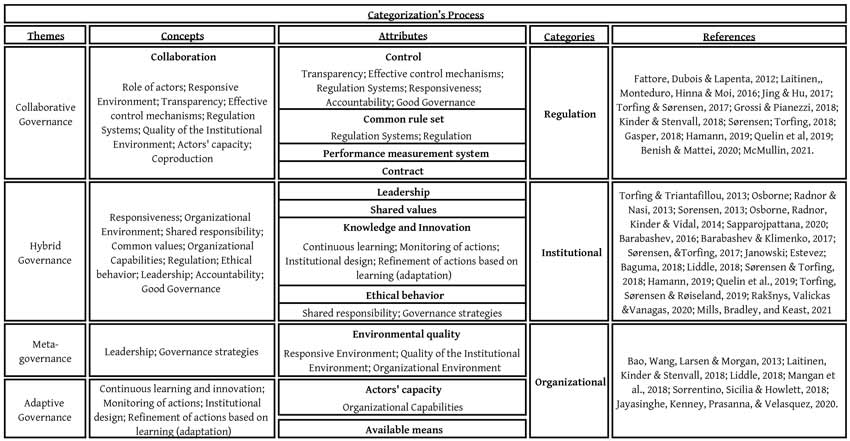
One of the dimensions of this debate concerns regulatory aspects, encompassing attributes related to promoting an environment that fosters the sustainable participation of actors. This dimension combines legal and control aspects, expressed through the establishment of a shared language, multifunctional rules, control systems, accountability structures, and performance evaluation mechanisms. These tools aim to structure a common ground that facilitates consensus on the agenda among participants (Benish; Mattei, 2020; Hamann, 2019; McMullin, 2021; Quelin et al., 2019).
Another dimension highlighted in the literature is the institutional element, which involves the construction of organizational architecture for the conduct of public policies. Following this reasoning, this dimension includes fundamental attributes such as shared values, ethical behavior, continuous development and training of knowledge, and institutional leadership (S0rensen, 2013; Torfing; Triantafillou, 2013; Mills; Bradley; Keast, 2021; S0rensen; Torfing, 2021). Knowledge, in this context, is represented by the flow of information that fosters the participation and engagement of actors, as well as by the quality of the institutional environment. Attention is thus directed to decision-making processes, autonomy, and innovation within the network. The knowledge generated results from the interaction among various actors in subsystems and requires structured processes to generate information and innovation (Laitinen; Kinder; Stenvall, 2018a; Mills; Bradley; Keast, 2021).
Another key aspect in the debate is the organizational dimension, which focuses on the attributes necessary for interactions among participating organizations. This includes issues such as the capacity of actors, available resources, and the quality of the organizational environment. The attributes within this dimension delineate the arena where negotiations take place, signaling the need for greater or lesser degrees of regulation. In this context, these attributes aim to identify the contributions of actors based on their expertise, available knowledge, levels of technological development, physical and procedural infrastructure, and the degree of governance and control applied.
The structure of the model individualizes governance subsystems and provides arrangements from a procedural perspective, demonstrating the interdependence of sub-elements within categories, with collaboration emerging because of the interaction between structural elements (Bao et al., 2013; Laitinen; Kinder; Stenvall, 2018a; Liddle, 2018). Finally, the governance system integrates cultural aspects, norms, laws, and higher-level policies that influence actions and their implementation. The table below summarizes the theoretical framework, dimensions, and related attributes.
Table 1. Elements of the Theoretical-Analytical Model of Governance with a Focus on Collaboration
Source: Raschendorfer & Roder (2024, pp. 15-16).
Governance in Defense
Norheim-Martinsen (2016) points out that the evolution of Defense encompasses the notion of predictability within the structures of large armies and progresses toward the context ofglobal warfare. This shift incorporates notions of efficiency, effectiveness, and coherence within democratic structures, encouraging decisions circumscribed by transparency, debate, oversight, and control in the face of budgetary austerity.
Pot (2021) argues that the most relevant issues in the field of defense governance involve understanding how to create effective armed forces in a dynamic, highly complex environment. This entails engaging actors from different rationales in a complex decision-making system, not only from the perspective of appropriate civilian control but essentially through the shared responsibilities, risks, and roles among actors (Ratchev, 2009; Norheim-Mar-tinsen, 2016; Christiansson, 2020; Soares et al., 2022).
According to Howlett, Kekez, and Poocharoen (2017) and Bandeira and Ferraro (2017), the complexity of the topic underpins the new systems of governance, which involve more horizontal relationships, coordination, negotiation, and persuasion, replacing direct command and control from traditional public administration. Similarly, contemporary defense governance structures emphasize the need for more relational models that stimulate interaction between structures and processes (Ratchev, 2009; Norheim-Martinsen, 2016; Christiansson, 2020).
Governance-based models have collaboration at their core as a pathway to institutional development (Janowski; Estevez; Baguma, 2018; Quelin et al., 2019; Raksnys; Valickas; Vanagas, 2020). The relationship between governance and collaboration is addressed by S0rensen and Torfing (2012) as an interdependent concept. For actors, public governance structures entail overlapping layers in a system formed by overarching policies and subsystems or arrangements, emphasizing the importance of coordinated efforts within the network.
Complementing Torfing's perspective, S0rensen and R0iseland (2019), along with Gjaltema, Biesbroek, and Termeer (2020), discuss coordination under the aegis of meta-governance. This involves a set of practices mainly led by state leadership, coordinating one or more governance modes using different instruments, methods, and strategies.
In the context of defense organizations, meta-governance aligns with what Christiansson (2020) defines as the governance of relationships. For Christiansson, governance translates into a plurality of processes that connect state actors with private, voluntary actors through networks and partnerships. However, the critique is that genuine collaboration—where power relations are balanced and there is joint meaning-making among a variety of actors—is rare and presents significant challenges. These include collaborative inertia, inter-agency conflicts, disagreements among groups and agendas, and diverse forms of governance, patterns, and agendas that actors are subjected to, leading to conflicting and incompatible responses (Grossi; Pianezzi, 2018; Howlett; Kekez; Poocharoen, 2017).
Additionally, the literature identifies different motivations for developing a country's defense structures. Ratchev (2009) suggests that such developments are influenced not only by the strategic environment but also by a set of factors involving the country's political, administrative, and cultural realities, closely related to public administration reforms and their associated models and structures.
In this context, Brazil, as the selected national context for analysis, faces significant challenges. These include expanding national capabilities to enhance the country's international projection, involving society as an active participant in national defense policy and market decisions, and producing high-value goods and services with dual applications that contribute to the nation's economic and technological development.
To address these challenges, Brazil has invested in protection and research programs aimed at economic, technological, and social development related to maritime activities. A key milestone was the expansion of its maritime area, formalized in 1993 through Law No. 8.617/1993 (Brasil, 1993). The "Blue Amazon," an "oceanopolitical" concept (Brasil, 2020, p. 21) encompassing Brazil's territorial sea, contiguous zone, exclusive economic zone, and continental shelf, includes biodiversity conservation, water preservation, and the sustainability of economic activities conducted at sea, requiring coordinated and communicative efforts (Barbosa Júnior, 2012)
In addition, Brazil has the National Maritime Policy (PMN),an instrument that guides the full and sustainable use of Brazilian maritime spaces in accordance with national interests (Brasil, 1994). The PMNoutlines a multi-stakeholder vision directed towards the management of maritime sector activities, including cultural, economic, technological, research and development, infrastructure, environmental, and human aspects. These are applied in times of peace, aiming to achieve security and sovereignty objectives, as well as national economic and technological development through interaction and cooperation.
The PMN was structured by establishing objectives and identifying actors responsible for its execution, including the responsibilities of the Brazilian Maritime Authority, represented by the Commander of the Brazilian Navy (MB). The MB's role, within the PMN context, involves coordinating multiple actors and promoting technology development, focusing efforts on advancing scientific institutions, personnel training, and regulating maritime activities.
Shneider and Teske (1992) and McCaffrey and Salerno (2011) provide a perspective on political entrepreneurs, who take on leadership roles in contexts requiring the articulation of actors. According to these authors, the political entrepreneur exercises a form of entrepreneurial leadership, represented by an individual, group, or institution that analyzes its scenario to (a) identify political preferences and needs, as well as those of decision-makers; (b) identify, select, and frame problems and solutions; (c) disseminate and mediate ideas across various social networks and epistemic communities, such as between science and policy; (d) mobilize political support to form coalitions across different layers; (e) introduce innovative institutional proposals to political decision-makers' agendas; and (f) ensure agenda continuity—an essential aspect for project sustainability.
Materials and Methods
This research adopts a qualitative approach, utilizing a single case study method to reflect on how to present and implement solutions to complex and cross-cutting issues involving multiple actors operating in different arenas and decision-making levels.
The case study was conducted to identify the governance dimensions of the theoretical model and compare them with elements from the empirical case. The central objective was to analyze the dimensions and elements of the theory alongside the underlying mechanisms involved in the creation of the Rio de Janeiro Naval Technology Cluster (CTNRJ), using public governance as a theoretical lens applied to the defense context in Brazil. The ctnrj is part of the Strategic Program for the Construction of the Core of Naval Power, a derivative of the National Defense Policy, as outlined in the Strategic Plan of the Brazilian Navy (PEM 2040) for the 2020-2040 period. This plan aims to enhance the Brazilian Navy's (BN) capabilities, promote industrial development, generate employment and income, and foster the establishment of maritime clusters as strategic instruments to achieve these goals (Brasil, 2020).
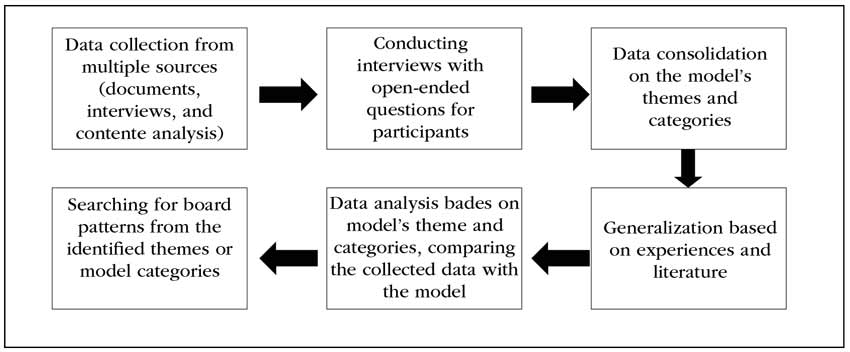
The results were analyzed collectively and compared with categories emerging from the literature, as presented in Section 3. Data collection was conducted concurrently and non-sequentially, as shown in Figure 1, below.
Figure 1. Data Collection Process
Source: Developed by the authors, adapted from Creswell (2010, p. 92).
The selected case for analysis holds potential for both theoretical and empirical contributions, as it is embedded in a context characterized by significant administrative, operational, and strategic challenges. Additionally, it aligns with themes gaining prominence on the international agenda, such as the Blue Economy and the 2030 Agenda of the United Nations, inviting collaboration from actors operating under different logics at global, national, and regional levels through governance systems and subsystems.
Case Study Structure and Data Collection Process
The case study was structured into three sequential stages. The first stage involved the collection of data on the processes underlying the creation of the CTNRJ, with the objective of highlighting its operational context, mission, future vision, and engaged actors. This phase resulted in the identification of 41 pieces of evidence that served as the foundation for qualifying the case study and identifying the main actors. The second stage consisted of semi-structured interviews with key stakeholders, site visits to the CTNRJ facilities, and participation in the International Seminar on the Blue Economy, held on November 17 and 18, 2022.
The seminar was organized by the CTNRJ in collaboration with the Brazilian Navy, representatives of the Legislative Branch, the productive sector of the State of Rio de Janeiro, and national and international organizations. The event aimed to promote inter-institutional communication and identify opportunities to advance key strategic topics. The third stage involved Content Analysis (CA)based on the data collected in the previous stages (documents, interviews, observations, and seminar panel transcriptions). Subsequently, Descending Hierarchical Classification (DHC)and Similarity Analysis (SA)were performed using the IRAMUTEQ® software.
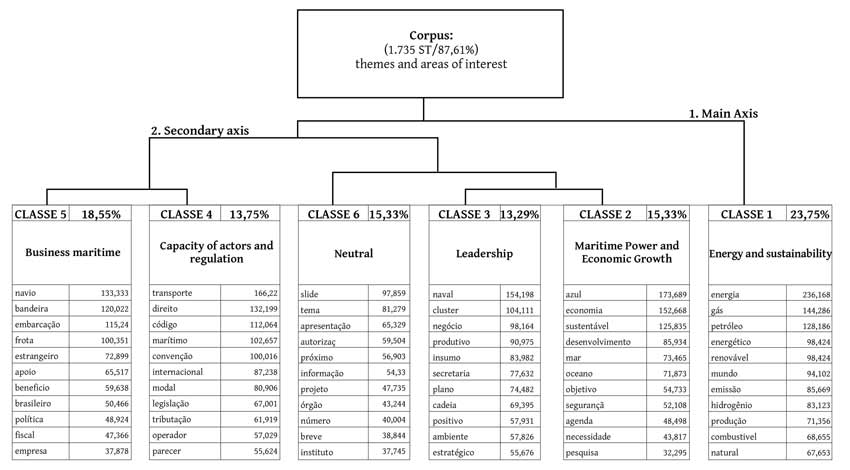
The preliminary frequency analysis identified 63,326 occurrences across 1,735 text segments, of which 1,520 were validated, resulting in a utilization rate of 87.61%. This rate is considered consistent and reliable for subsequent analyses (Souza et al., 2018). The validated segments corresponded to relevant words selected based on a chi-square (X2) value ¿ 3.84 and p s 0.05 (Medeiros et al., 2022).
Based on these data, a triangulation strategy was proposed for a combined analysis of the collected information (Creswell, 2014).
To identify and analyze the relevant aspects explaining why collaboration is effective and which elements it organizes in each context, the following parameters were adopted (Raza, 2012; Howlett, Kekez & Poocharoen, 2017; S0rensen & Torfing, 2021): (i) Evidence of existing interorganizational relationships; (ii) Combinations of different types of organizational architectures among various actors; (iii) Interactions and exchanges between these actors; (iv) Initiatives aimed at building consensus and integrated solutions that consider multiple and equally legitimate interests; and (v) Legal considerations in the definition of strategic objectives.
Results
The data revealed a historical pathway, encompassing international initiatives and their reflections on Brazilian defense policies. On the international stage, three milestones were identified that shaped major changes in structuring Brazil's foreign and defense policies. These milestones influenced the design of regulations and relationships between state and non-state actors, namely: the United Nations Convention on the Law of the Sea (1982); the UN Sustainable Development Agenda (2010) combined with the publication of the first European Union Blue Economy Report (2018); and the launch of the UNDecade of Ocean Science for Sustainable Development (2021). These milestones informed the proposal and consolidation of public defense policies in Brazil.
In analyzing the governance model, a layered approach was applied, beginning with governance subsystems. The first layer, identified as the sectoral policy conception level, established the design of policies. In this study, multiple layers were recognized through the unfolding of international organizations' objectives, the National Maritime Policy (PMN),and the National Marine Resources Policy, leading to the Sectoral Policy for Marine Resources and the Strategic Plan of the Navy for the 2020-2040 period. These plans were translated into structured actions aligned with high-level regulatory frameworks.
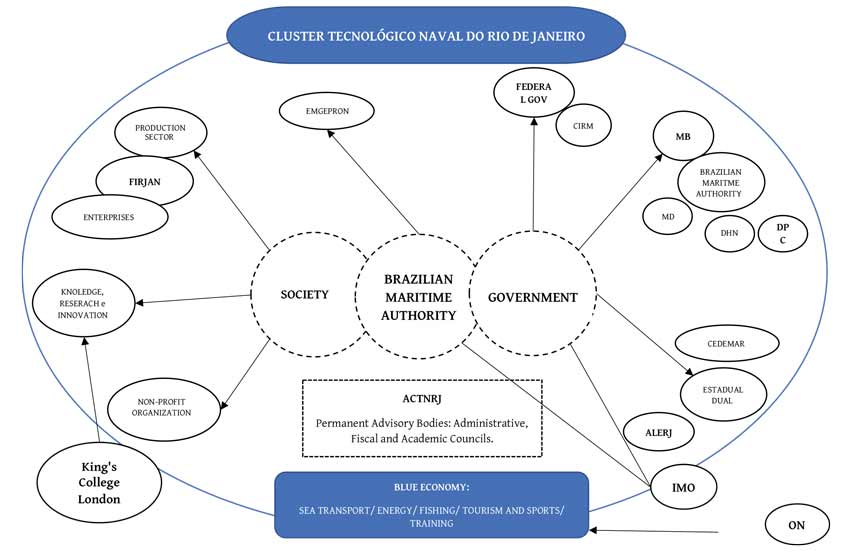
A total of 32 actors were identified, including governmental organizations, labor unions, international organizations, banks, research institutions, foundations, clubs, and tourism-related entities. Prominent examples include: (i) International Context: The International Maritime Organization (IMO) and King's College London. (ii) Brazilian Context: The Federation of Industries of Rio de Janeiro State (FIRJAN),representatives of the Legislative Assembly of Rio de Janeiro State (ALERJ),the State Commission for Maritime Economy Development (CEDEMAR),the Brazilian Navy (Directorate of Ports and Coasts - DPC, Directorate of Hydrography and Navigation - DHN),the Naval Projects Management Company (EMGEPRON),and the Brazilian Maritime Authority, in addition to companies associated with CTNRJ. These actors and their relationships are visually mapped in Figure 2: CTNRJ Ecosystem.
Figure 2. CTNRJ Ecosystem
Source: Developed by the authors.
The thematic axes identified through content analysis revealed five key themes of interest to the actors, with the protection of oceans as the central axis. Two other thematic clusters emerged: the maritime context and energy production, with the maritime context being the most encompassing. The consistency of these identified themes was verified through DHC, which highlighted how actors' interests are interconnected. Additionally, these themes showed a close relationship with the PMN, the Blue Economy, and economic development initiatives, as illustrated in Figure 3 - Similarity Analysis.
Figure 3. Similarity Analysis - Themes and Areas of Interest
Source: Developed by the authors
What is can be observed is that the developments of the National Defense Policy (PMN), the National Defense Strategy, and the Navy's Strategic Plan 2040 (PEM-2040) align, within the domestic context, with the purpose of advancing the defense sector—whether in its economic, social, or operational dimensions. These aspects are consistent with the National Defense Policy (Brasil, 2005), although they gain greater political relevance through their linkage to international agendas (e.g., the Sustainable Development Goals, the Decade of Ocean Science, and the Blue Economy), which serve as guiding frameworks for policies within governance systems and arrangements.
The table 2 below summarizes the relationships identified within governance system, arrangements, and subsystems underlying the creation of the Rio de Janeiro Naval Technology Cluster (CTNRJ). It outlines, on a smaller scale, the articulation within the subsystems over time, with: (1) the outermost layer being directed toward international norms and treaties of influence; (2) the macro layer, representing national policies, guidelines, and targets; and (3) the internal regional layer, represented by actions within state and municipal subsystems, focusing on the State of Rio de Janeiro and the CTNRJ.
Table 2. Summary of Relationships Evidenced in Governance Arrangements and Subsystems
Instancy |
Governance |
Resume of International Standards and Agreements |
International |
Sistema de Governança |
United
Nations Convention on the Law of the Sea (1982) |
National |
Subsystem |
National Maritime Policy (1994) |
Regional |
Subsystem |
Resumption of the Naval Industry in Rio d Janeiro (2019) |
Source: Development of the authors.
Inter- and intrasectoral relationships were identified, evidenced by interactions at various institutional levels, including ministerial and international spheres. These connections involve international actors such as the International Maritime Organization (imo), the Ministry of Defense, and EMGEPRON; at the state level, institutions like ALERJ, FIRJAN, and CEDEMAR; and, at the federal level, entities such as the Brazilian Navy and Petrobras, in addition to nonprofit organizations and professional associations.
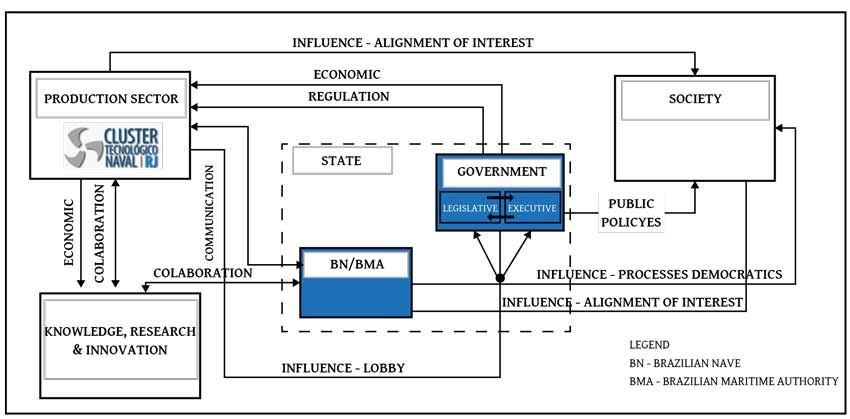
This ecosystem aligns with what the literature defines as a coproduction process of policies, practices, and outcomes (Osborne, Radnor & Strokosch, 2016; Bitencourt Neto, 2017; Young, Wiley & Searing, 2020). In other words, it is a framework that brings together diverse interests and influences from various actors in an ongoing coproduction process, structured around public policies and internationally established commitments, as depicted in the following Relationship Diagram.
Figure 4. Relationship Diagram - Cluster Tecnológico Naval do Rio de Janeiro
Source: Development by the authors.
The analysis of the actors involved in CTNRJ reveals a complex network of interactions between government, industry, academia, and society, which mutually influence policy formulation and practices. CTNRJ seeks to align public policies with its economic and institutional interests, fostering coalitions that encourage dialogue and the pursuit of joint solutions. Both state and federal governments play a crucial regulatory role, interacting with entities like ALERJand the Ministry of Defense, which directly impacts inter-institutional relationships. The productive sector influences CTNRJ'S economic and technological strategies, collaborating with companies of various sizes to achieve common goals such as technological development. Academia significantly contributes by conducting research and developing specialized human capital, as well as promoting innovation through events and research groups. Society, through professional associations, legitimizes political power and exerts influence on decision-making, reflecting the interaction between social needs and CTNRJ'S interests. This integrated governance network fosters economic, social, and institutional benefits within the context of defense and Brazil's naval sector.
Discussion of Results
The data analysis highlighted the convergence of different and simultaneous themes driving relationships among actors, such as maritime transportation, oil and gas, clean energy production, capacity building, and foreign trade. These themes emerged from the synergy between the objectives of actors from different sectors and layers (intersectoral relationships). In the case study, two types of relationships were identified: spontaneous and forced, underscoring the importance of leadership for actor engagement, adaptations, and knowledge management within the network, especially for spontaneous connections.
The significance of these relationship types within governance systems contributes to understanding leadership's role in fostering engagement, particularly in interactions between actors from different layers, forced connections are those formally established through norms and shared cultural aspects among actors within the same sector. These connections result from institutional and regulatory relationships between groups, individuals, or organizations. Conversely, spontaneous connections arise within the system as a result of momentum, requiring leadership (individual or entity) to employ a degree of planning.
The internal layers of the arrangements revealed more forced relationships. In analyzing CTNRJ as a governance system, alignment was observed between CTNRJ'S objectives, the Brazilian Navy's Strategic Programs, and the National Maritime Policy, illustrating the role of institutional leadership in coordinating actions with a focus on national development while maintaining adherence to national objectives.
Relationship with Theoretical Categories
The analysis of governance and organizational structure at CTNRJ highlights the importance of several key elements that sustain its functioning and development. The first category examined is regulation, which provides greater legal security to the actors involved, encourages participation, and helps create a favorable environment for negotiations. This category includes sub-elements such as contracts, which establish common and formal rules through cooperation terms, agreements, and contracts; common sets of rules, involving multipurpose standards and fiscal incentives; performance measurement systems, indicating ways to achieve policy objectives; and control, represented by governance systems, internal controls, and common accountability rules. Evidence showed the alignment of CTNRJ'S objectives with defense policies, such as the National Marine Resources Policy and PEM-2040. Moreover, regulatory updates like the BR do Mar Law, which modernized cabotage navigation, demonstrate efforts to connect policies, strategies, and plans to improve actor participation. However, no clear methodologies for implementing flexible performance measurement systems were identified in CTNRJ, which is still in its formative phase (three years of operation). This limits the ability to fully assess its outcomes. Additionally, the concept of the Blue Economy, still in an early stage of definition, makes it difficult to establish well-defined performance indicators.
The second category focuses on institutional aspects, represented by leadership, shared values, capacity building, and ethical behavior. Leadership is the most prominent element, serving as the primary mechanism to integrate actors' efforts, promote their participation in decision-making processes, and foster more horizontal relationships among sectors to collaboratively address problems. Leadership at CTNRJ is evident in the presence of leaders working across different layers of governance, facilitating coordination, fostering synergy, and engaging actors in non-competitive objectives. This type of leadership, described as political entrepreneurship, aligns with historical examples from the Brazilian Navy, such as the creation of EMGEPRON and efforts to promote the Brazilian nuclear program. Leadership was also central in revising the National Marine Resources Policy to incorporate the Blue Economy as a thematic area. Programs like the Brazil's naval capacities Core in PEM-2040 and the modernization of Niterói-class frigates are examples of this leadership, as well as the creation of maritime clusters aimed at stimulating regional economic growth. Promoting the Blue Economy and modernizing regulatory frameworks, such as the BR do Mar Law, further highlight leadership's role.
Shared values are articulated through ethics codes and norms that align the interests of the actors with institutional principles. At CTNRJ, this is reflected in ethics codes, company participation rules, and governance structures such as fiscal and administrative councils. Examples include the Local Content Policy for Navy vessels and direct communication with the productive sector through open letters. Capacity building, represented by the management of knowledge and intellectual capital within the network, was partially identified at CTNRJ, through initiatives like the creation of the Blue Economy Research Group and the organization of seminars and academic events. However, the absence of an information system that centralizes the generated knowledge and supports decision-making processes highlights an area for improvement. Ethical behavior is supported by normative and governance frameworks, reinforcing integrity, accountability, and internal controls, as evidenced in CTNRJ'S founding documents and in EMGEPRON'S Integrated Report.
Regarding organizational aspects, the capacity of the actors plays a central role in fostering innovation within the network. CTNRJ has brought together companies of different sizes and experiences, organizing them with the support of the cluster and promoting knowledge exchange. Technological development, central to economic advancement, is reflected in seminar proposals to discuss new naval construction projects, as well as in connections established between the National Maritime Policy and the Blue Economy. These actions emphasize economic and technological development and align with the next sub-element, environmental quality. The quality of the environment is reflected in actions that promote sustainability and continuity, creating a collaborative and coordinated atmosphere. The synergy between the Brazilian Maritime Authority and different sectors of the Navy was evident in the revision of navigation and cabotage regulations (like BR do Mar), along with the revitalization of the naval industry involving various organizations. These aspects align with theoretical considerations on environmental quality and are observed in the case study.
The available resources were also highlighted, particularly in the projects prioritized by the Navy and technological innovations resulting from collaborations with the productive sector. A long-term vision supporting activity sustainability and actor participation was identified. Policies complementing Rio de Janeiro's development as a hub for the Blue Economy were coordinated through the Legislative Assembly of Rio de Janeiro (ALERJ). Seminars provided a platform for discussing challenges, opportunities, and setting a common agenda for shared interests. CTNRJ has made efforts to expand corporate membership and engage more academic institutions, adopting a more integrative approach. However, political entrepreneurship proved essential in driving activities within the network, identifying actor needs and preferences, capitalizing on political opportunities, and fostering innovation in governance structures. Institutional leadership was also key, generating synergies across different groups and governance layers. Initiatives related to the Blue Economy, renewable energy, and regulatory modernization further underscore leadership's central role. These findings highlight CTNRJ as a critical link among actors, organizing their interests and creating a favorable environment for relationship-building. The orchestration of actors, though challenging in competitive settings like the business environment, demonstrates that despite formal mandates outlined in regulations, political entrepreneurship was crucial to the functionality of the governance system.
Conclusion
This article sought to analyze multi-actor and multi-layer relationships through the lens of public governance, specifically focusing on the Rio de Janeiro Naval Technology Cluster (CTNRJ). The study aimed to contrast attributes identified in governance literature with those observed in the empirical case.
The most contemporary paradigm of public administration considers interdependence among actors as a stimulus for greater dialogue. This dialogue fosters efforts in communication and collaboration to promote integrated actions and solutions for complex problems across diverse interests. From this actor synergy emerges the need to design governance structures that balance the elements required for implementing actions involving multiple policies.
The study highlighted the centrality of transversal actions, expressed through a multidimensional, integrative, and collaborative perspective aimed at coordinating diverse actors and fostering dialogue platforms between public and private organizations. Beyond structural aspects, the study emphasized the importance of regulation in actor relationships, offering a perspective that moves away from compartmentalized, non-interactive frameworks.
Institutional aspects of governance were also explored, focusing on shared values, capacity building, ethical behavior, and leadership—the latter being the most prominent. The centrality of leadership in public governance became more evident in situations requiring the political organization of actors and the promotion of development objectives embedded within policies, corroborating studies on political entrepreneurship and meta-governance.
This analysis reinforces the necessity of governance models that articulate shared values and risks, establish boundaries and responsibilities, and define common rules to enable effective collaboration. These findings align with previous studies on the subject (for example: Ratchev, 2009; Norheim-Martinsen, 2016; Christiansson, 2020; Soares et al., 2022).
In this logic, governance structures are essential for bridging gaps caused by institutional silos stemming from sectoral perspectives. These structures should form the foundation for fostering collaboration. Governance systems must promote transversal actions, moving away from non-interactive perspectives and functioning as structured platforms for multisectoral communication to co-produce results, confirming findings from earlier research (for example: Pereira; Ckagnazaroff, 2021; Quelin et al., 2019; Christiansson, 2020). The orchestration of actors in the context of Defense governance contributes to advancing dual-use technologies, strengthening partnerships, increasing national representation, and reinforcing regional leadership.
Leadership emerges as a tool for organizing and coordinating actors, primarily by inducing actions within governance arrangements and subsystems. As a result of this observation, the study revealed that the less regulated the operational environment of the actors, the greater the demand for institutional aspects (leadership), as well as its influence on organizational aspects (actors' capacity), reinforcing the interdependence of dimensions within the intersectoral model in the case of CTNRJ.
The empirical context revealed that even in institutions endowed with legal capacity and resources, the role of the political entrepreneur was essential to reducing communication barriers, uniting purposes, and building outcomes involving different organizations that could not be achieved unilaterally.
In the Brazilian context of collaboration, leadership was conceived as a driver of actors' participation, promoting closer ties between organizations and institutions around a common purpose, whose precursor directly points to relevant themes or areas of interest. The role of the leader becomes particularly prominent when the fundamental guidelines for collaboration are not fully consolidated.
The selection of the National Defense Policy (PND) proved useful in this case, as it is characterized as a plan of action and a course of decisions that expresses the selection of strategic themes, objectives, and actions aimed at ensuring national security and defense, while also fostering economic, social, and technological development opportunities for the country. In this logic, it guides the planning of actions directed at defense, also encompassing objectives for preparing and employing the expressions of National Power, reaching society at large.
The rationale underlying its formulation addresses diplomatic aspects, the constitutional principles of non-intervention, and the promotion of technological and productive autonomy, involving governmental actors, the productive sector, and educational and research institutions. The PND has a history of evolving toward its consolidation as a public policy, following the development of Brazilian strategic thought.
The motivations behind its development are not attributed solely to strategic environmental issues but also to a broader set of factors involving Brazil's political, administrative, and cultural realities, culminating in the vision embodied in the Defense-Diplomacy-Development triad.
Strengthening this agenda can be achieved by incorporating proposals for new governance models focused on collaboration, citizen engagement in political decisions, and the participation of actors from different logics in defense-related decisions as vectors for strengthening democratic values.
This approach encourages decisions grounded in transparency, debate, oversight, and control.
As a theoretical contribution, the study demonstrated that an effective governance model balances the integration of structures and processes with the creation of synergies aligned to the efficient, transparent, and responsive use of public resources across multiple layers. Empirically, the study showed that leadership addresses structural gaps in managing actor activities by offering tools for organization and coordination while also guiding actions within governance arrangements and subsystems.
Limitations and Proposals for Future Research
The case study employed diverse data collection and analysis techniques, enhancing reliability through verification methods. However, CTNRJ'S recent establishment overlap limited observable policy outcomes, highlighting challenges in assessing public policies comprehensively. Testing a complex model within this framework is further complicated by variable interconnections and external factors, requiring careful scenario considerations. Future research should explore the model's applicability in different contexts to expand insights.
Declaration of Conflicting Interests
The author(s) declared no potential conflicts of interest with respect to the research, authorship, and/or publication of this article.
References
Ansell, C., & Gash, A. (2008). Collaborative governance in theory and practice. Journal of Public Administration Research and Theory, 18(4), 543-571. https://doi.org/10.1093/jopart/mum032
Bandeira, P., & Ferraro, A. (2017). Integrating participatory institutions into the traditional representative and bureaucratic model of public governance. International Political Science Review, 38(5), 642-658. https://doi.org/10.1177/0192512116646822
Bao, G., Wang, X., Larsen, G. L., & Morgan, D. F. (2013). Beyond New Public Governance. Administration & Society, 45(4), 443-467. https://doi.org/10.1177/0095399713481601
Barbosa Júnior, I. (2012). Oceanopolítica: conceitos fundamentais - Amazonia Azul. Amazônia Azul: Política Estratégica e Direito para o Oceano do Brasil (pp. 205-231). Fundação de Estudos do Direito Marítimo.
Benish, A., & Mattei, P. (2020). Accountability and hybridity in welfare governance. Public Administration, 98(2), 281-290. https://doi.org/10.1111/padm.12633
Bitencourt Neto, E. (2017). Transformações do Estado e a administração pública no século XXI. Revista de Investigações Constitucionais, 4(1), 207-220. https://doi.org/10.5380/rinc.v4i1.49773
Brasil. (1993). Lei n° 8.617, de 4 de janeiro de 1993. Dispõe sobre o mar territorial, a zona contígua, a zona económica exclusiva e a plataforma continental brasileiros. Disponível em: https://www.planalto.gov.br/ccivil_03/LEIS/L8617.htm
Brasil. (1994). Decreto n° 1.265, de 11 de outubro de 1994. Política Marítima Nacional (PMN). https://www.icmbio.gov.br/cepsul/images/stories/legislacao/Decretos/1994/dec_1265_1994_politicamaritimanacional.pdf
Brasil. (2005). Decreto n° 5.484, de 30 de junho de 2005. Política de Defesa Nacional. https://www.planalto.gov.br/ccivil_03/_ato2004-2006/2005/decreto/d5484.htm
Brasil. (2020). Plano Estratégico da Marinha (PEM 2040). Brasília, DF: Marinha do Brasil. https://www.marinha.mil.br/sites/all/modules/pub_pem_2040/book.html
Christiansson, M. (2020). Defense planning beyond rationalism: The third offset strategy as a case of metagovernance. In Defence Planning as Strategic Fact (pp. 10-26). Routledge. https://doi.org/10.1080/14702436.2017.1335581
Creswell, J. W. (2014). Investigação qualitativa e projeto de pesquisa: Escolhendo entre cinco abordagens. Penso Editora.
De Andrade da Silva, L. M., Medeiros, S. E., & Queiroz, M. P. (2019). Innovation and decision-making in defense: Introductory considerations to the capability-based planning. Revista de Relaciones Internacionales, Estrategia y Seguridad, 14(1), 189-203.
Gjaltema, J., Biesbroek, R., & Termeer, K. (2020). From government to governance...to meta-governance: A systematic literature review. Public Management Review, 22(12), 1760-1780. https://doi.org/10.1080/14719037.2019.1648697
Grossi, G., & Pianezzi, D. (2018). The new public corruption: Old questions for new challenges. In Accounting Forum (pp. 86-101). https://doi.org/10.1016Zj.accfor.2016.05.002
Hamann, R. (2019). Dynamic de-responsibilization in business-government interactions. Organization Studies, 40(8), 1193-1215. https://doi.org/10.1177/0170840618815927
Hákenstad, M., & Larsen, K. K. (2012). Long-term defence planning: A comparative study of seven countries. Defence Studies.
Hartley, J., S0rensen, E., & Torfing, J. (2013). Collaborative innovation: A viable alternative to market competition and organizational entrepreneurship. Public Administration Review, 73(6), 821-830.
Howlett, M., Kekez, A., & Poocharoen, O. O. (2017). Understanding co-production as a policy tool: Integrating new public governance and comparative policy theory. Journal of Comparative Policy Analysis: Research and Practice, 19(5), 487-501. https://doi.org/10.1080/13876988.2016.1217903
Janowski, T., Estevez, E., & Baguma, R. (2018). Platform governance for sustainable development: Reshaping citizen-administration relationships in the digital age. Government Information Quarterly, 35(4), S1-S16.
Laitinen, I., Kinder, T., & Stenvall, J. (2018a). Local public service productivity and performance measurement. International Journal of Knowledge-Based Development, 9(1), 49.
Laitinen, I., Kinder, T., & Stenvall, J. (2018b). Street-level new public governances in integrated services-as-a-system. Public Management Review, 20(6), 845-872.
Liddle, J. (2018). Aligning vertical structures and horizontal relationships: Collaborative leadership and accountability mechanisms to enhance economic growth in England. International Review of Administrative Sciences, 84(4), 659-674.
Mangan, A., et al. (2018). The challenges of police-community collaboration: Identity manoeuvres and power struggles in a neighbourhood-based meeting. Public Management Review, 20(9), 1353-1373.
McCaffrey, M., & Salerno, J. T. (2011). A theory of political entrepreneurship. Modern Economy, 2(4), 552-560. https://doi.org/10.1177/0170840618815927
McMullin, C. (2021). Challenging the necessity of New Public Governance: Co-production by third sector organizations under different models of public management. Public Administration, 99(1), 5-22. https://doi.org/10.1111/padm.12672
Medeiros, S. E., & Moreira, W. S. (2017). Maritime co-operation among South Atlantic countries and repercussions for the regional community of security practice. Contexto Internacional, 39(2), 281-304.
Medeiros, F., et al. (2022). O IRAMUTEQ como ferramenta no processamento de dados em pesquisa qualitativa. Revista Diálogos em Saúde Pública, 1(2), e000026-e000026.
Mills, D. E., Bradley, L., & Keast, R. (2021). NPG and stewardship theory: Remedies for NPM privatization prescriptions. Public Management Review, 23(4), 501-522.
Norheim-Martinsen, P. M. (2016). New sources of military change-armed forces as normal organizations. Defence Studies, 16(3), 312-326. https://doi.org/10.1080/14702436.2016.1195234
Osborne, S. P., & Strokosch, K. (2013). It takes two to tango? Understanding the co-production of public services by integrating the services management and public administration perspectives. British Journal of Management, 24(S1), S31-S47.
Osborne, S. P., Radnor, Z., & Strokosch, K. (2016). Co-production and the co-creation of value in public services: A suitable case for treatment? Public Management Review, 18(5), 639-653.
Pereira, B. A. D., & Ckagnazaroff, I. B. (2021). Contribuições para a consolidação da New Public Governance: Identificação das dimensões para sua análise. Cadernos EBAPE.BR 19, 111-122.
Pot, W. D. (2021). The governance challenge of implementing long-term sustainability objectives with present-day investment decisions. Journal of Cleaner Production, 280, 124475. https://doi.org/10.1016/j.jclepro.2020.124475
Raksnys, A. V., Valickas, A., & Vanagas, R. (2020). Challenges of creation and implementation of collaborative innovations in public sector organisations. Public Policy and Administration, 19(1), 9-21.
Ratchev, V. (2009). Gobernanza, gestión, mando, liderazgo: Fijando el contexto para estudios de la gestión de la defensa. In H. Bucur-Marcu, P. Fluri, & T. Tagarev (Eds.), Gestión de la defensa: Una introducción (pp. 13-32). Centro de Ginebra para el Control Democrático de Fuerzas Armadas (DCAF).
Raschendorfer, E. V., & Roder Figueira, A. (2024). New Paths for Public Governance: Literature Review, Content Analysis, and Proposed Conceptual Framework for an Integrative View. Administration & Society, 56(7), 803-829.
Raza, S. (2012). Cooperação interagências: Porque e como funciona um estudo de modelos organizacionais nas relações internacionais? Brazilian Journal of International Relations, 1(1), 6-37. https://doi.org/10.36311/2237-7743.2012.v1n1.p06-37
Soares, J., et al. (2022). The defence performance measurement framework: Measuring the performance of defence organisations at the strategic level. Defence Studies, 22(1), 99-122.
S0rensen, E., & Torfing, J. (2012). Introduction: Collaborative innovation in the public sector. The Innovation Journal, 17(1), 1-16. https://doi.org/10.1093/acprof:oso/9780199596751.003.0001
S0rensen, E., & Torfing, J. (2021). Accountable government through collaborative governance? Administrative Sciences, 11(4), 127. https://doi.org/10.3390/admsci11040127
Souza, M. A. R., et al. (2018). O uso do software IRAMUTEQ na análise de dados em pesquisas qualitativas. Revista da Escola de Enfermagem da USP, 52, e03353. https://doi.org/10.1590/s1980-220x2017015003353
Stenvall, J., Kinder, T., & Laitinen, I. (2018). Unlearning and public services—A case study with a Vygotskian approach. Journal of Adult and Continuing Education, 24(2), 188-207.
Torfing, J., & Triantafillou, P. (2013). What's in a name? Grasping New Public Governance as a political-administrative system. International Review of Public Administration, 18(2), 9-25.
Torfing, J., S0rensen, E., & R0iseland, A. (2019). Transforming the public sector into an arena for co-creation: Barriers, drivers, benefits, and ways forward. Administration & Society, 51(5), 795-825.
Young, S. L., Wiley, K. K., & Searing, E. A. M. (2020). "Squandered in real time": How public management theory underestimated the public administration-politics dichotomy. The American Review of Public Administration, 50(6-7), 480-488.

Todos los textos publicados en esta revista se distribuyen, a partir del año 2015,
bajo una licencia de Creative Commons Reconocimiento-NoComercial 4.0 Internacional
https://creativecommons.org/licenses/by-nc/4.0/