Introduction
How does public debt affect the electoral success of incumbent governors and their successors in federal systems? This article argues that the dynamics of subnational elections in Brazil offer an ideal setting for examining this question. Specifically, we demonstrate that the timing of fiscal developments is not only relevant but essential to understanding the relationship between economic conditions and electoral outcomes at the state level
Our first hypothesis posits that debt expansion stimulates demand for goods and services by increasing the policy flexibility of subnational governments, thereby enhancing the electoral resilience of incumbent (or traditional) candidates. Our second hypothesis suggests that in times of debt distress, when revenues are heavily committed to debt servicing, governments are forced to adopt austerity measures-including delays in paying public servants -which in turn create political opportunities for outsider candidates. Thus, debt may initially reinforce the dominance of established political actors (Hypothesis 1), but later become a catalyst for political change (Hypothesis 2).
We examine the relationship between fiscal policy and elections in the Brazilian federation, focusing on how state-level debt impacts the electoral performance of governors and their political successors. The relationship between fiscal management and state policy in Brazil is frequently discussed, considering how relevant it is to examine contexts in which governments face significant financial challenges (Amorim Neto & Borsany, 2004; Arvate et al., 2008). However, to date, the literature has not carried out a detailed analysis of how factors such as accumulated interest on public debt influence governors’ reelection in their states or the fate of their successors. This study fills that gap by analyzing whether state interest payments on public debt (1) and governors’ decisions in response to fiscal pressures (2) influence electoral outcomes.
Brazil is a particularly relevant case due to its history of recurring fiscal crises and the implementation of austerity measures to manage debt (Barbosa et al., 2019). Furthermore, Brazil’s federal structure grants state significant financial autonomy (Abrucio, 2022). Based on this autonomy, debt decisions and their consequences become central to understand the debate on the ability of governors to maintain popular support, -especially as state dependence on federal transfers grows.
Research on debt generally focuses on the economic consequences of state public debt. However, as we said, there is a significant gap regarding the influence of debt in the electoral field. This study aims to analyze the relationship between state debt and the electoral success of incumbent governors in reelection campaigns, as well as that of their successors when incumbents are term-limited.
In fact, there is no unified database on the debt rates of Brazilian states since 1998, and considering that this data only became available after the enactment of the Fiscal Responsibility Law in 2000, we use the indicator of interest and charges on state debt as a proxy for fiscal distress. Interest payments reflect financial pressure, as higher borrowing costs emerge when creditors demand greater compensation for risk. Therefore, using the indicator of interest and charges on state debt offers an indirect assessment of the financial health of states and possible fiscal crises, filling the gap in the absence of direct data on debt and allowing a more robust analysis of the relationship between the fiscal situation and the electoral success of governors and their successors.
The use of debt as a mechanism to stimulate the state’s economy -and, through this, increase the likelihood of reelection or the victory of an ally- will serve as the test of our first hypothesis. State/year is our unit of analysis, with level of debt (x1) and vote share (y1) being the variables of interest.
In a second stage, we analyze municipal-level vote shares in the 2018 election (y2), a period marked by the intensification of the fiscal crisis in several states. The key independent variable is whether there were delays in the payment of public servants’ salaries (our new x2), with such delays resulting from the implementation of strict fiscal adjustment policies in the preceding years (Barbosa et al., 2019).This design allows us to test our second hypothesis.
The argument is dynamic: public debt may generate good electoral results for incumbents (H1), given the possible increase in public spending (Nordhaus, 1975; Shmuel, 2025). However, the level of debt, can also lead to austerity measures (including salary delays). These measures generate electoral backlash for incumbents and is more pronounced in contexts of greater economic vulnerability and where dependence on public administration is high (Grittersova et al., 2016) (H2).
There are studies on the electoral impact of state debt that reveal how it is directly related to austerity policies, often adopted in response to contexts of fiscal crisis. According to Hübscher et al. (2023), austerity measures adopted by governments have significant effects on electoral behavior. Indebtedness, which frequently leads to public spending cuts and strict tax reforms, can intensify voter discontent. This translates into backlash against incumbents, higher electoral abstention, and increased support for non-traditional parties; especially when mainstream center-right and center-left parties propose similar measures. In situations where debt results in austerity, voters disillusioned with the responses of more established actors tend to seek alternatives in radical alternatives-such as Podemos in Spain or Bloco de Esquerda in Portugal (Hübscher et al., 2023).
Fiscal crises, therefore, especially those that result in the adoption of austerity policies, have a profound impact on the room for maneuver of governments, limiting their political and strategic options (Grittersova et al., 2016). During periods of austerity, governments are often forced to prioritize economic stability, which leads them to adopt unpopular measures such as spending cuts and tax increases. These decisions, although necessary to avoid financial collapse, restrict the ability of governments to institute expansive policies or to respond flexibly to social demands. However, as pointed out by Grittersova et al. (2016), the centralization of economic issues in the political debate favors traditional parties, which are perceived as more capable of dealing with fiscal crises, to the detriment of niche groups, which are less familiar with these issues (Grittersova et al., 2016). Furthermore, the study reveals that the specific nature of the austerity measures adopted can have a different impact on different segments of the electorate and, consequently, on the room for maneuver of the government. Austerity based on spending cuts, for example, tends to affect support for niche parties less than tax increases, suggesting that voters may be more willing to accept certain forms of austerity over others. This further limits the flexibility of policymakers, who must balance the need for fiscal reforms with maintaining sufficient political support to continue governing effectively. In short, fiscal crises narrow the scope for action of governments, forcing them to make decisions that can reduce political diversity and consolidate power in traditional parties (Grittersova et al., 2016) as opposed to niche parties, which are defined as those outside major party families (e.g., conservative, social democratic, liberal, Christian democratic), including green, communist, and radical right parties (Grittersova et al., 2016).
Although our study does not directly address the rise of outsider parties/ candidates or the increase in polarization, it directly contributes to resolving this possible mismatch arising from comparative literature. By using the time factor, dividing the context into a moment of expansion and another of outbreak and intensification, we solve a possible puzzle around the opposing effects of the fiscal crisis on the electoral prospects of incumbents. Our results indicate that, firstly, public debt benefits incumbent candidates or parties. Second, we show that fiscal austerity measures harm this same type of candidate depending on the context: in municipalities that are more dependent on public services, the backlash is greater for incumbents who delayed paying public servants’ salaries.
These findings open avenues for research on the political effects of fiscal crises and adjustment policies. They also contribute to the theory of retrospective voting (Healy & Malhotra, 2013). In the short term, we found evidence supporting the hypothesis that traditional parties/candidates become stronger in contexts marked solely by the need for debt management. In the medium term, however, as the impacts of austerity policies intensify-even leading to the suspension of salary payments-the electoral performance of incumbents suffers significant deterioration. Future research could explore which parties or candidates benefit from this shift.
The paper proceeds as follows: Section 2 outlines the theoretical context and hypotheses. Section 3 presents Study 1 on interest rates and incumbent performance. Section 4 details Study 2 on salary delays and electoral outcomes. Section 5 offers concluding remarks.
Study Context and Hypotheses
Political and economic federalism in Brazil experienced a deep crisis in the 1990s, a period of economic instability that marked the beginning of the process of indebtedness of the states, that is, of its federative units. This period, sometimes called the “second lost decade” (Pinheiro et al., 1999), featured modest growth and high inflation. The Real Plan (1994) stabilized the currency but exposed structural fiscal weaknesses. The expansionary fiscal policy adopted in several states associated with a high interest rate exacerbated public debt, particularly in states that were already facing financial difficulties since the 1988 Constitution, a new legal framework of the re-democratized country, which decentralized the collection of revenue without corresponding expenditure responsibilities (Arretche, 2010; Abrucio, 2022).
This combination of factors led to a significant increase in state debt, reflecting the growing general inability of states to meet their financial obligations, especially in the face of increased public spending and deteriorating revenue collection (Pinheiro et al., 1999).
The process of state indebtedness in the 1990s was intensified by the fiscal crisis the country was facing. With the monetary stabilization provided by the Real Plan, states began to face greater difficulties in maintaining their balanced budgets, especially due to the drop in revenue and the increase in expenses, such as social security spending and the readjustment of the minimum wage. The fiscal deterioration of the states was exacerbated by the need to renegotiate debts with the Union, which resulted in agreements that, although they brought some temporary relief, ended up prolonging the debt cycle. This dynamic created a scenario where states became increasingly dependent on federal transfers and new financing, seriously compromising their investment capacity and, in many cases, leading to a financial crisis that lasted for decades to come (Pinheiro et al., 1999).
From 1998 onwards, there was a significant increase in the public debt of the federative units (states), which generated numerous concerns of a fiscal and political nature, given the greater commitment of state revenues and the resulting reduction in investments in public policies essential to maintaining social order. In response to these challenges, the Fiscal Responsibility Law (LRF, in Portuguese) was enacted in 2000, establishing standards for responsible fiscal management. LRF imposes limits on expenses such as personnel costs and public debt, establishes targets for controlling revenue and expenses, and emphasizes transparency and balance in public accounts. This legislation aimed to contain the uncontrolled increase in debt, providing guidelines for a more careful management of public resources, crucial to ensuring fiscal sustainability and long-term economic development (Mello & Stomski, 2009).
Scholars such as Mello and Slomski (2009) and Arvate et al. (2008) investigated the phenomenon of indebtedness, even in the face of the LRF, from different angles. The former emphasized the effect of debt on the capacity to invest in social welfare. They add that some rulers used this form of obtaining resources irrationally, leaving their state with debts that were difficult to manage. The results revealed that the main determinants of indebtedness would be transfer revenues, per capita income, and overall current coverage, with a negative effect on indebtedness. Additionally, it was observed that the level of debt in the previous period exerted a significant positive influence on the current level, characterizing a strong component of path dependency (Mello & Slomski, 2009).
In turn, Arvate et al. (2008) investigated the relationship between party ideology and the fiscal performance of Brazilian state governments from 1986 to 2005. Using ideology to represent both the Executive and Legislative branches, the study identifies three main results. Firstly, it is noted that party ideology exerted a significant influence in determining the fiscal result of state governments. Second, governments classified as right-wing demonstrated better fiscal performance due to increased revenues. Furthermore, they concluded that institutional changes introduced by the federal government in the 1990s altered the relationship between ideology and fiscal results: left-wing governments presented fiscal improvements after restructuring their debts, while left-leaning legislatures began supporting fiscal improvements with the adoption of the Fiscal Responsibility Law (Arvate et al., 2008).
The seriousness of the problem reaches a new level in the second decade of the new century. After years of positive GDP performance and controlled inflation, the Brazilian economy entered a severe recession in 2015 and 2016, with rising prices and a federal deficit. This context had a direct impact on the financial health of several states, this time with direct consequences for the payment of public servants (Barbosa et al., 2019). Delays in paying public servants’ salaries were common in countless states between 2015 and 2018. Amid the economic and political crisis of the period, governors delayed salaries under the justification of falling revenue (especially of the main state tax: ICMS: Tax on Operations related to the Circulation of Goods and on the Provision of Interstate and Intermunicipal Transportation and Communication Services). Media reports documented severe consequences: civil servants faced financial distress, family debt, depression, and even suicide. Economically, delayed payments slowed local economies, particularly in public-sector-dependent regions. As Edson Freitas, president of the Boa Vista Chamber of Commerce, stated in 2018: “Any problem in their payroll directly affects the economy and the market as a whole. Anyone who runs a business feels it immediately”.
The current situation is still uncertain. The debt renegotiation agreements with the Union, signed by some states, were considered insufficient by several entities to resolve long-term fiscal imbalances. Governors, such as the one from the State of Rio Grande do Sul, argued that, although the temporary suspension of the debt with the federal government provided some relief-BRL 4.6 billion over two years, in the case of Rio Grande do Sul-, it did not compensate for the structural deficits that some states faced, which exceeded the amount of the debt with the federal government. The monthly deficit in Rio Grande do Sul, for example, was around BRL 550 million, while the monthly debt with the federal government was approximately BRL 270 million (G1, 2016).
Two studies analyzed the economic performance of states to estimate the electoral performance of incumbents and challengers, considering the new debt scenario. Barbieri at al. (2019), found that state-level economic indicators-such as GDP growth and unemployment-affect governors’ reelection prospects, especially in labor-intensive economies. This effect is particularly evident in states with labor-intensive economies, where the direct impact of public policies on employment and income would become more noticeable to the electorate. Thus, governors who succeed in improving or stabilizing local economic conditions are often rewarded with reelection, while those who fail to meet economic expectations face greater difficulties in remaining in office.
Furthermore, states’ fiscal autonomy emerged as a crucial factor in voters’ ability to hold their rulers accountable. In states with a greater capacity to generate their own revenue, that is, less dependent on federal transfers, voters would be better able to evaluate the performance of governors based on local economic results (Barbieri et al., 2019). This suggests that, in contexts where governors have more control over economic policies, electoral accountability is more evident, reinforcing the importance of fiscal decentralization as a mechanism to increase the accountability of political leaders.
The study by Avelino Filho et al. (2021) analyzed the incumbency effect in Brazilian state elections. Controlling for several variables, they found the incumbent had advantages, contrary-to the most common expectations in the literature-, especially in less developed districts and in situations of weak parties and high intra-party competition (Avelino et al., 2021). The analysis is relevant to understand how the specific characteristics of the Brazilian electoral context can influence the advantage of incumbents. By exploring variation in incumbent advantage across regions and in relation to factors such as party strength and intra-party competition, the study offers detailed insights into the elements that can benefit incumbents in their campaigns and public administration. However, debt rate management does not appear in their theoretical model.
Barbieri et al. (2019) provide a crucial foundation: voters reward governors who improve economic conditions. This suggests financial management- including debt and interest-may influence electoral outcomes. This theoretical and empirical basis is crucial to understanding how economic factors directly impact voting, which paves the way for more specific investigation of the effect of financial variables, such as interest on public debt, on voters’ assessments. The relevance of the work of Barbieri et al. (2021), therefore, lies in its ability to contextualize the importance of local economic conditions for electoral behavior, which is fundamental to the analysis proposed in this article. By identifying that voters hold governors accountable for their economic performance, the study suggests that more specific aspects of financial management, such as the management of public debt and its interest, may also be determining factors for electoral success.
However, no study treats debt as a lens to analyze a governor’s policy trajectory, especially regarding the state’s economic performance under their administration. By drawing on international literature, promising analytical paths emerge about the impact of fiscal crises and containment measures, such as austerity, as central elements for explaining political results at the subnational level. Two of the most cited studies with such an approach led to contrasting conclusions: Hübscher et al. (2023) link the adoption of austerity policies, because of fiscal crisis scenarios, to a breakdown in trust in traditional parties, an increase in levels of fragmentation and polarization in the party system and in politics as a whole. Grittersova et al. (2016), in turn, argue that crisis contexts make the political and party system and electoral behavior hostage to traditional parties, seen as the only ones capable of managing economies in a chaotic state from a financial point of view. What varies in this study are the effects of the policies adopted on different groups-increasing taxes would impose costs on different segments of the population vis-à-vis expenditure containment. Even though both works do not specifically address voting for incumbents, their findings generate insights for our discussion. In times of crisis, the response of a significant portion of the electorate may be to opt for options “outside” the system, which will harm incumbent candidates.
In the following sections, we test the hypotheses derived from the central argument of this article: the effects of the fiscal crisis at the subnational level vary depending on when they are observed. In the initial stage of indebtedness (moment 1), this can be understood as an instrument used by the governor to boost the state economy by increasing demand. However, as the crisis worsens (moment 2), and depending on the degree to which revenues are committed to debt servicing, governors tend to adopt austerity policies, which may culminate in the state’s inability to pay civil servants’ salaries (Figure 1).
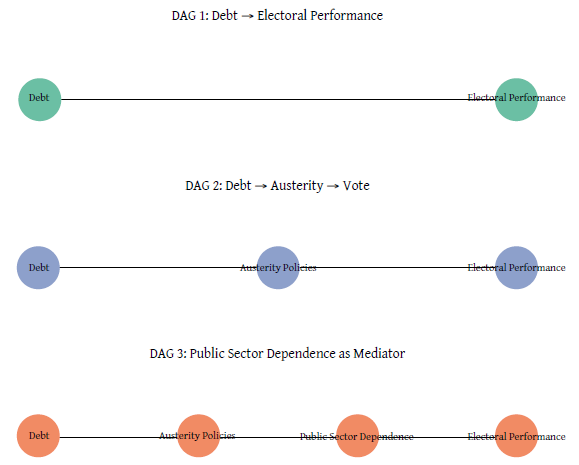
Our hypothesis 1 therefore predicts a positive and significant effect of debt on the electoral performance of governors. Hypothesis 2 establishes that after the outbreak of the debt crisis, conditioned on the adoption of austerity policies with resulting delay in civil servants’ salaries, performance will be negative and significant (for a comparative, cross-national test of the electoral effects arising from the greater or lesser economic fragility of countries, see Baccini, L., & Sattler, T. (2023)). To test the hypotheses, they require different research designs, the content of which we will now describe, as well as the results of each study.
Relationship between interest and incumbent performance (Study 1)
Database
In this subsection, we describe the construction of our database and operationalization of our variables, for the first empirical test (hypothesis 1). We established, based on the research question, that our independent variable is the state debt rate and the dependent variable is the vote share of incumbent governors and their successors.
The independent variable is state debt interest and charges , sourced from the National Treasury (Tesouro Transparente, n.d.). The dependent variable is the vote share of incumbent governors or their successors. Electoral data on the vote share received by candidates, their names and respective political parties are available in the open data section of the Superior Electoral Court. However, the data regarding the relationship between the incumbent governor and the candidates were constructed qualitatively, case by case. The need to construct this data in this way was due to our understanding that there is a variety of intra and interparty relationships in Brazil, especially when we analyze different regions. Therefore, we opted for a manual and careful process in collecting and analyzing data, ensuring that all regional nuances and particularities were duly considered.
In cases where reelection is not possible due to legal constraints limiting executive office holders to two consecutive terms, it was necessary to understand, among the candidates, who would be the successor to the incumbent. As a first strategy, we analyzed, for each electoral year, who was the incumbent governor and whether their political party had any candidate for state governor. If so, the candidate from the incumbent party was classified as a successor and, therefore, their vote share fulfilled the variable that we used as a parameter to measure success conditioned on the level of debt. If not, we searched for the party coalition to which the incumbent governor’s party belonged and whether it had a candidate. There were still cases in which the previous strategies did not apply, so we looked to see whether the incumbent, individually-without the participation of their party-declared support for any of the candidates.
Given that we are testing the relationship between two variables without random assignment to treatment (level of debt), our identification strategy is selection on observables (Keele, 2015). Therefore, we include control variables that can affect both the independent and dependent variables (state Gross Domestic Product), as well as those that, as we point out, affect electoral performance (candidate’s gender, number of candidates in the district, and party ideology). We do not interpret the results of the variables in the body of the article, but for greater transparency, the complete models are available in the appendices.
The annual GDP of each Federative Unit of Brazil is available on the website of the Institute of Applied Economic Research (IPEA, in Portuguese). After collecting this data, we calculated the average GDP of each state based on the time frames we used in the research, that is, the governors’ terms of office. Therefore, the result of this variable corresponds to the arithmetic mean of the state’s annual GDP over four years, with no expected direction of effect. Based on the literature on gender and political representation, we consider that female candidates have electoral disadvantages (whether in access to financing or in relation to voter stereotypes) (Araújo, 2005; Barbieri et al., 2019; Gatto & Wylie, 2022; Sacchet, 2009; Speck & Mancuso, 2014; Wylie & Santos, 2016; Wylie, Santos & Marcelino, 2019). Therefore, we expect men to have a higher vote share in gubernatorial races. The ideological positions of incumbent governors’ political parties during elections used in this article were taken from the research by Bolognesi et al. (2022) which used expert surveys. It is expected that the further to the right, the better the candidates’ performance (Power & Rodrigues-Silveira, 2019). Finally, we consider that the greater the number of candidates, the lower the vote share for each of the candidates in the first round.
Empirical Strategy
Our identification strategy is selection of observables (Keele, 2015). We seek to control the relationship between interest rates, incumbency, and electoral performance using a series of control variables, as well as the inclusion of fixed effects for election year and federative unit.
Analysis of Results
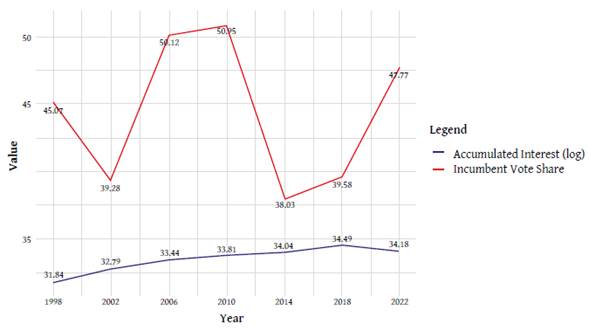
First, we present descriptive statistics of the relationship between incumbent performance and accumulated interest (after logarithmic transformation) (Figure 2). As expected, the value of accumulated interest grows steadily over the period. The average vote share of incumbents in the first round varies consistently between elections, with the lowest values in the series in the 2014 and 2018 elections, amid the political and economic crisis that Brazil was facing at that time.
Figure 2:
Evolution of Accumulated Interest (log) and Incumbent Vote Share (%)
Source: prepared by the author
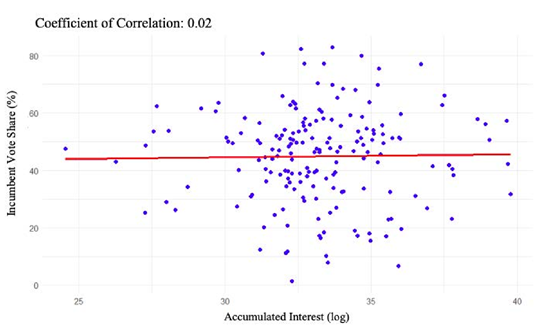
In Figure 3, we estimate the correlation between the log of accumulated interest and the incumbent vote share in the first round. The extremely low value (r² = 0.02) indicates that there is no statistically significant correlation between the variables. However, it is more appropriate not to compare only incumbents by cumulative interest level, but also to include the degree of political competition within the district. In this way, compare incumbents and challengers based on the level of interest. In other words, this is a conditional test.
Figure 3
Relationship between Accumulated Interest (log) and Incumbent Vote Share (%)
Source: prepared by the author
We carried out the comparative exercise in Table 1, testing six different specifications of the relationship between interest and incumbent vote share. In the first, we used the entire database (per candidacy) and tested the interaction between accumulated interest and incumbency (X) on the vote share (Y). Model 1 includes the interaction term and the constitutive terms of the interaction. Model 2 includes the control variables previously described. In Models 3 and 4, we consider only the two most competitive candidates in the district in the database, in order to remove candidates with very low performance from the analysis. In Models 5 and 6, we keep only the two most competitive candidates, but one of them should be the incumbent. In all models, the coefficient of interest is the value of the interaction term (full models are in the appendices).
The results consistently indicate that higher values of accumulated interest benefit incumbents. In the most “demanding” specification, Model 6, the coefficient 0.05 means that for incumbent candidates, a 1% increase in accumulated interest is associated with an increase of approximately 0.05% in log vote share in the district. For larger increases, such as 10% or 20% in accumulated interest, the impact on vote share would be 0.49% and 0.98%, respectively.
Table 1
Models Hypothesis 1 (Interest and votes for incumbents)
What do the results tell us? Basically, debt situations do not necessarily lead to the strengthening of challengers. In many cases, debt may reflect strategies adopted by subnational governments-such as Brazilian states-to expand their political and administrative room for maneuver.
However, the question of heterogeneous effects remains. That is, first, what incumbents do about accrued interest and, second, the effect of the type of decision according to the context. Amid rising interest rates-used here as a proxy for public debt-the incumbent’s decision may be to impose fiscal restrictions (austerity) or to reinforce a political-budgetary cycle (Nordhaus, 1975). On the one hand, this means reducing public spending and/or increasing taxes. On the other hand, fiscal expansion (especially in electoral periods). In Latin America, and in Brazil in particular, the response of governments to fiscal crises and rising debt has been fiscal restraint, especially through spending cuts. In other words, austerity.
To address fiscal austerity, we follow Baccini & Sattler (2024, p. 03), who define it as: “(...) a government decision to adjust fiscal policy to reduce the public deficit, that is, the difference between public expenditures and revenues.” Based on the same authors, the restriction of public spending has different effects depending on the economic vulnerability of regions and voters. Generally, the backlash against a government that implements austerity policies will be stronger the more vulnerable and dependent on state spending the region is. To test these propositions (hypothesis 2), we conducted a second study, considering the 2018 general election, a context in which several state governments reached the point of delaying public servant salaries in response to the fiscal crisis (Barbosa et al, 2019).
Salary Delays, Context, and Incumbent Performance (Study 2)
Database
To test the contextual effects of governors’ decisions on fiscal austerity, we constructed a municipality-level database for the year 2018. Our dependent variable is local vote share (log-transformed). Our independent variables are: being incumbent (whether they are governors seeking a second term or successors); adopting austerity, in this case, delaying the payment of salaries to state public servants throughout the term (2015 until the 2018 election). We identified, through newspaper articles and other references (Barbosa et al., 2019), nine states that recorded constant delays in the payment of salaries to their public servants (“AC”, “RR”, “RN”, “MG”, “RJ”, “RS”, “PE”, “DF”, “MT”); and finally, we considered the dependence of the local economy on public administration. We calculate the variable by dividing the GVA (Gross Value Added) of the administration, public health and education, and social security by the total GVA of the municipality. In addition to public administration, the Brazilian Institute of Geography and Statistics (IBGE, in Portuguese) includes sectors such as services, industry, and agriculture. We consider that the greater the dependence on the public administration, the stronger the effect of spending restriction policies on electoral behavior (Baccini & Sattler, 2023). As control variables, we included gender, ideology, and municipal GDP per capita.
Empirical strategy
As in the previous study, our empirical strategy is selection on observables. We seek to control the relationship between the independent and dependent variables through a series of controls and fixed effects. In this case, since we are working with data from only one year (2018) and the dataset is structured at the municipal level, the fixed effects are defined by the names of the municipalities (5570 in total).
Analysis of Results
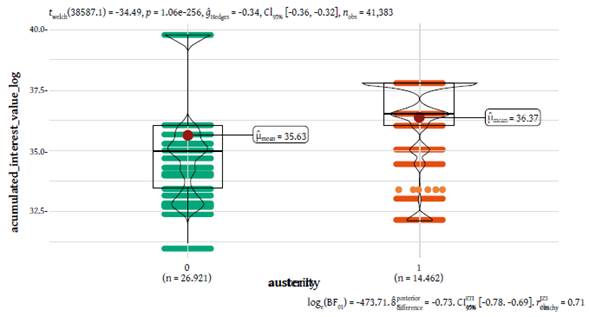
First, we demonstrate in Figure 4 the statistically significant difference between salary delays (a binary variable) and the accumulated debt interest (log-transformed) throughout the gubernatorial term. Governors who delayed salaries had higher average levels of accumulated interest. If we consider this variable as a proxy for debt, as we have argued throughout, it is possible to link public debt to greater fiscal restriction.
Figure 4
Difference in debt interest between states that delayed (1) and that did not delay (0) public servants’ salaries.
Source: prepared by the author
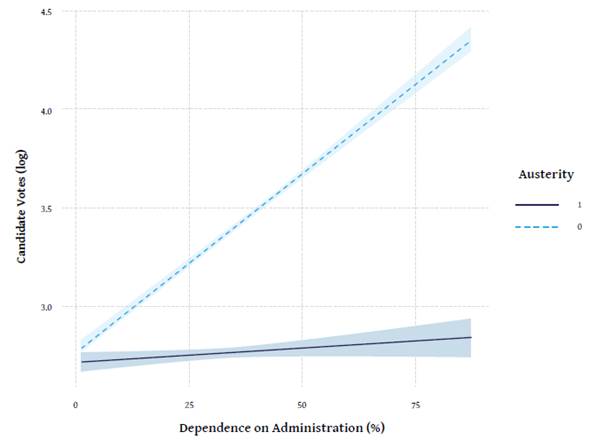
To test the interaction between context, decision (to delay the payment of salaries) and incumbent performance, we first tested an OLS regression model considering only incumbent candidates in the dataset. Figure 5 shows the interactive effect. The results show that incumbents who did not delay the salaries of state employees over the period from 2015 to 2018 (line 0) had better electoral performance where public administration accounted for a greater share of the local economy (dependence on public administration). The coefficient value is -0.016 (full model in the appendices). Since the voting variable was transformed into a logarithm, the interpretation of the results is as follows: in states where there was a delay in the payment of salaries by the governor, the vote of the governor himself or his successor decreased by approximately 1.6% for each additional unit of dependence of the local economy on the public administration (measured at the municipal level).
Figure 5
Interaction between dependence on public administration at the local level and delays in paying salaries (austerity) on incumbent vote share (log-transformed)
Source: prepared by the author
To advance the analysis-and not only compare the performance of incumbents who delayed (1) or that did not delay (0) salaries-, we considered a triple interaction. In Table 2, we tested two specifications. In Model 7, we included the triple interaction between being an incumbent or not (1 or 0), delaying salaries (1 or 0), and the level of local dependence on public administration (ranging from 0 to 100), along with the constitutive terms. In Model 8, we include the set of controls previously mentioned (gender, ideology, and per capita municipal GDP). The unit of analysis is the municipality in the 2018 election. Therefore, we included fixed effects at this level.
The coefficient value of -0.01 means that for incumbent candidates in places with salary delays, a one-unit increase in dependence on public administration results in an approximately 1% reduction in vote share. In Model 8, the coefficient of -0.03 indicates that for non-incumbent candidates in locations with salary delays, a one-unit increase in dependence on public administration results in a reduction of approximately 3% in vote share.
Table 2
Models Hypothesis 2 (relationship between austerity, dependence on public resources, and vote share for incumbents)
To facilitate the interpretation of the results, we tested the models considering the dependent variable in its original format ( vote share in the municipality), excluded the fixed effects, and simulated a series of scenarios. Dependence on public administration varies from 1.28% to over 87% (mean of 30.58% and median of 26.75%). In a city with dependence on administration on the average distribution, where the governors did not delay salaries, the predicted vote share (or that of their successor) was 32.59% of the votes. In a city with the same dependence on public administration, but in a state that delays salaries, the predicted vote share was 19.32%- a drop of more than 13 percentage points (or about 60%). In contexts of greater dependence on public administration, the difference becomes even greater. In a scenario where more than 50% of the added value of its economy comes from public administration, the difference in vote share between the incumbents who delayed salaries and those who did not delay salaries is more than 20 percentage points. In other words, we found that in contexts of greater economic vulnerability (and/or dependence on the State), there is greater punishment for austerity policies (Baccini & Sattler, 2023).
What do we learn from the results? First, salary delays were more common in more indebted states, based on our proxy. Secondly, this measure generates negative effects for incumbents. And finally, the negative effect of austerity is greater in contexts of dependence on the public sector. Municipalities with a higher share of GVA coming from the public administration penalize more severely incumbents who adopted salary delays, and this result is consistent across different specifications.
Final Considerations
The objective of this article was to analyze the possible relationship between state debt and the electoral success of incumbent governors in cases of reelection, and of their successors when reelection is not an option. To answer the research question, namely, whether state interest rates on public debt impact the electoral success of incumbent governors and their successors, we assembled an unprecedented database on the debt and electoral performance of incumbents and their successors in Brazilian states, covering the elections from 1998 to 2022. We conducted two empirical studies: the first focused on the state as the unit of analysis with temporal variation; the second focused on the 2018 election-a context of economic crisis-in which we analyzed heterogeneous effects at municipal level.
Our findings reveal that state debt has heterogeneous political effects. In early stages, debt can benefit incumbents by enabling economic stimulus (Hypothesis 1). However, when indebtedness reaches a critical point and state revenues are compromised, governors end up adopting austerity measures that negatively impact their popularity. Policies such as delaying the payment of public servants’ salaries have a particularly severe effect on the electoral performance of incumbents, especially in contexts of greater economic vulnerability and where dependence on public administration is high (Hypothesis 2).
Our findings contribute to the theoretical debate on the impact of austerity and indebtedness policies on elections and the party system Contrary to expectations of polarization, incumbents can retain popular support in contexts of indebtedness, as long as they are able to mitigate its negative effects. However, when fiscal containment policies directly affect voters-as in the case of salary delays-incumbents suffer significant electoral losses. New research could explore which parties or candidates benefit from this scenario. In a broader sense, we also contribute to the discussion on retrospective voting (Healy & Malhotra, 2013), by demonstrating that different decisions regarding public debt generate heterogeneous effects. A rich research agenda opens to investigate the consequences of electoral results on the future of currently adopted policies.
Finally, our results suggest that the relationship between fiscal policy and elections is mediated by contextual factors, such as the degree of dependence on public administration and the type of austerity measures adopted. Governors facing fiscal crises must balance the need for fiscal reforms with preserving their electoral base, especially in more vulnerable settings.