Vulnerabilities and Sexual Education at School: A Qualitative Study with Parents, Teachers, and Adolescents


DOI: https://doi.org/10.12804/revistas.urosario.edu.co/apl/a.14095


Abstract

Based on the relational approach of gender, we sought to understand the generation of vulnerabilities in sex education at school from the perspective of students, parents, and teachers. This qualitative study included 20 adolescents in focus groups as well as 10 parents and 12 teachers participating in interviews, from five public schools in São Leopoldo and Porto Alegre, Brazil, whose reports were subjected to thematic analysis. In the category "(Mis)informed education and immature dialogues on sexuality," the weaknesses of sex education initiatives in elementary school are discussed, which are articulated with everyday relationships permeated by adult-centered ideas of adolescent immaturity, individual responsibility, and rationality. In "The Role of the heterocisnormativity in the construction of vulnerabilities across generations", it is discussed how the naturalization of gender and sexual orientation increased exposure to risks and obstructed discussions about desire, intimacy, violence, and diversity in the school context. It is concluded that sexual education is fundamental to guarantee citizenship rights and to promote social justice, which requires increasing adolescents' access to information, resources, and decision-making instances.

Keywords:

health vulnerability, adolescent, sexual education, primary education, secondary education


Resumen

Desde el enfoque relacional de género, se buscó comprender el surgimiento de vulnerabilidades en la educación en sexualidad en la escuela desde la perspectiva de estudiantes, padres y profesores. El estudio cualitativo incluyó 20 adolescentes en grupos focales, así como 10 padres y 12 maestros que participaron en entrevistas, de cinco escuelas públicas en São Leopoldo y Porto Alegre/RS, Brasil. Los relatos fueron sometidos a un análisis temático. En la categoría "Educación (mal)informada y diálogos inmaduros sobre sexualidad", se discuten las fragilidades de las acciones de educación en sexualidad en la escuela primaria en relación con las ideas adultocéntricas de inmadurez adolescente, responsabilidad individual y racionalidad que atraviesan las relaciones cotidianas. En "El papel de la heterocisnormatividad en el surgimiento de vulnerabilidades entre generaciones", se debate cómo la naturalización del género y de la orientación sexual ampliaba la exposición a riesgos y obstaculizaba las discusiones sobre el deseo, la intimidad, la violencia y la diversidad en los espacios escolares. Se concluye que la educación en sexualidad es fundamental para garantizar los derechos de ciudadanía y promover la justicia social, lo que exige aumentar el acceso de los adolescentes a información, recursos y espacios de toma de decisiones.

Palabras clave:

vulnerabilidad en salud, adolescente, educación sexual, educación primaria, educación secundaria


Resumo

A partir da abordagem relacional de gênero, buscou-se compreender a produção de vulnerabilidades na educação sexual na escola, sob a perspectiva de estudantes, pais e professores. O estudo qualitativo incluiu 20 adolescentes, organizados em grupos focais, bem como 10 pais e 12 professores que participaram de entrevistas, de cinco escolas públicas de São Leopoldo e Porto Alegre (Rio Grande do Sul, Brasil). Os relatos foram submetidos a uma análise temática. Na categoria "Educação (des) informada e diálogos imaturos sobre sexualidade", são discutidas as fragilidades das ações de educação sexual no ensino fundamental, associadas às ideias adultocên-tricas de imaturidade adolescente, responsabilidade individual e racionalidade que permeiam as relações cotidianas. Em "O papel da heterocisnormatividade na produção de vulnerabilidades entre gerações", discute-se como a naturalização de gênero e a orientação sexual ampliaram a exposição a riscos e dificultaram discussões sobre desejo, intimidade, violência e diversidade nos espaços escolares. Conclui-se que a educação sexual é essencial para garantir os direitos de cidadania e promover a justiça social, o que requer ampliar o acesso dos adolescentes à informação, a recursos e a espaços de tomada de decisão.

Palavras-chave:

vulnerabilidade em saúde, adolescente, educação sexual, ensino fundamental, ensino médio


Sexuality education (SE) in Brazilian schools remains a topic subject to constant debate and necessity. Despite being an integral aspect of human life and citizenship, its approach often leans towards an urgent focus on challenges related to diseases and population control in the Brazilian school context (Dinis & Asinelli-Luz, 2007; Ribeiro, 2013). Historically, SE projects and legislation in Brazilian schools have been battlegrounds for conservative and emancipatory positions, with Christian-Catholic morality and the family's significance invoked to counter perceived threats from feminist and progressive ideas (Ribeiro, 2013).

The reopening of Brazilian politics in the 1980s and 1990s reignited old struggles and debates surrounding SE in schools. This era saw the onset of the AIDS pandemic, shifts in sexual behaviors, and the widespread use of oral contraception (Dinis & Asinelli-Luz, 2007; Ribeiro, 2013). In the states of Rio Grande do Sul and São Paulo, sexual education projects were initiated in the early 1990s, solidifying in 1996 with the approval of the national law of guidelines and Bases for Education (LDB) and the establishment of national curricular parameters (PCN). These parameters dictated that sexuality should be addressed comprehensively across all subjects (Bueno & Ribeiro, 2018).

However, SE faces substantial programmatic and social challenges. Issues include the inadequate preparation and training of teachers, a shortage of resources and teaching materials, the absence of inclusive policies and programs, discrimination, and societal resistance (Vieira & Matsukura, 2017). Cultural and political factors, compounded by a recent surge in conservatism and societal setbacks, lead most school communities to resist addressing sexuality (Alves & Rossi, 2020; Magno et al., 2023). The imposition of conservative policies and social discourses, emphasizing adultcentrism and heterocisnormativity as universal standards, contributes to the erosion of rights and actions against gender-based violence and discrimination in schools. Additionally, the spread of false information about alleged indoctrination related to gender ideology has fueled moral panic, fostering discriminatory and violent behavior toward social minorities in Brazil (Furlani, 2022). While studies on sexual and gender diversity in schools align with Brazilian authors' defense of human rights, the practices observed in schools still fall short of promoting inclusive education (Marcon et al., 2016).

Therefore, this study aims to examine how vulnerabilities in SE are constructed in public elementary schools from the perspectives of students, parents, and teachers, considering the intersection of gender, age, sexual orientation, and other sociocultural markers. This exploration is specifically grounded in a relational approach to gender and the conceptual framework of vulnerability, as proposed by Ayres et al. (2006). This approach contextualizes life situations as contributors to varying levels of susceptibility to suffering, diseases, and violence, as well as the resources available to protect individuals or cope with the consequences. Vulnerability construction encompasses interconnected subjective, social, and programmatic dimensions.

In the context of SE with adolescents, the individual/subjective scope refers to the degree and quality of information that each person has, their capacities, and the material and emotional resources available to process and apply this information in daily life. This includes the presence and quality of family and affective relationships, as well as the values, beliefs, and interests guiding their behaviors. The social dimension of vulnerability is linked to social norms, including religious norms related to gender, age group, race, social class, and sexual orientation. These norms play a role in determining inequalities in access to information and resources necessary for a protected and dignified living, such as health services, cultural goods, forms of political participation, housing conditions, education, and work. Programmatic vulnerability, on the other hand, refers to the existence, implementation, and sustainability of organized policies and actions-whether public, private, or civil society-driven-committed to the promotion and prevention of sexual health among adolescents and young people (Ayres et al., 2006).

We adopted the relational gender approach (Connell, 2002; Louro, 2014), considering gender identities and sexual orientation as permanently constructed within social relationships involving complex systems of power intersected by markers including, but not limited to, race, socioeconomic status, and age (Collins & Bilge, 2021). In this approach, heterocisnormativity is assumed as a social power structure that legitimizes individuals based on gender and sexual orientation binarism. It assumes that sexual and romantic desire only occurs between men and women, with each pole having roles naturally designated by biological sex (Louro, 2014). This norm, hegemonic in society, is reinforced by various social institutions, including the family, school, religion, and the media, implying that any other gender identity or sexual orientation is considered abnormal or inferior (Butler, 2015).

In previous studies on SE, a systematic review of 24 studies in Brazilian schools revealed a lack of consistent initiatives, as most were implemented sporadically and were not part of the schools' routine practices (Furlanetto et al., 2018). Another narrative review of SE for teenagers in Colombia, Chile, Mexico, and Uruguay highlights that despite progress in areas such as hygiene, health, and population control, significant gaps persist in fully acknowledging sexual diversity and gender equality. Many of the reviewed studies continue to report frequent cases of LGBTphobia and gender-based violence in schools (Moreno Vargas & Santibañez Bravo, 2021). Vélez de la Calle and Santamaría-Vargas (2023) examined 50 studies on SE policies in Latin American public schools, revealing ongoing deficiencies in teacher training and the continued prevalence of moralistic and heterocisnormative frameworks that overlook gender diversity and sexual rights. Therefore, this study is grounded in the theoretical framework of critical social psychology (e.g., gender relational approach, intersectionality, adultcentrism, and health vulnerabilities), and aims to examine how vulnerabilities in SE are socially constructed in the school context from the perspectives of students, parents, and teachers.

Method

This qualitative exploratory study was undertaken as part of a broader project that encompassed a previous quantitative phase. Approval for the research was secured from the municipal Department of Education of São Leopoldo, the State Department of Education of Rio Grande do Sul, and the Research Ethics Committee of Unisinos. All participants provided their consent by signing an Informed Consent Form (ICF) or a study consent form.

Participants were recruited by convenience sampling during the quantitative phase, conducted in two municipal schools in São Leopoldo/RS and four state schools in Porto Alegre/RS (Furlanetto, Ghedin et al., 2019; Furlanetto, Marin et al., 2019). Three schools were located in the central regions of the cities, two in neighborhoods with a high level of urban infrastructure (paved streets, a sewage system, and piped water), and one in a socioeco-nomically disadvantaged region with limited infrastructure. The sample included 20 ninth-grade elementary school students (from two schools), 10 parents or guardians (from four schools), and 12 teachers (from five schools). Although the recruitment strategy sought to ensure some gender diversity and representation across schools, no formal procedures were adopted to achieve theoretical saturation.

Among the interviewed parents or guardians, seven were mothers, one father, one grandmother, and one godmother, ranging from 37 to 64 years of age. Among the teachers, nine were women, and three were men, aged between 30 and 62 (with half aged 50 years or older). Additional information about parents, guardians, and teachers is presented in Table 1.

Two focus groups were conducted, involving 12 adolescents from a school in São Leopoldo (FG1) and eight from a Porto Alegre school (FG2), comprising 11 girls and 9 boys. FG1's school was situated in the city's largest neighborhood, while FG2's school was in a middle-class neighborhood, both in regions with a high degree of urbanization. The adolescents were under 18 years of age and had no special educational needs. The groups lasted approximately 50 minutes each and were held in a reserved room at the school, moderated by one of the researchers and accompanied by an observer.

Table 1

General characteristics of parents and teachers

Parents
ID Code Age Marital status Education
FWE2 44 Married High school
FWE5 37 Married Elementary school
FWE3 34 Married Incomplete higher education
FWE2 NI Divorced NI
FWE5 64 Married Incomplete elementary school
FWE2 56 Married Higher education
FWE1 48 Divorced Higher education
FWE2 45 Married Higher education
FWE2 51 Married Higher education
FME2 44 Divorced Higher education
Teachers
ID Code Age Marital status Education Subject taught
TWE1 35 Married Postgraduate degree Math
TME2 30 Married Postgraduate degree History
TWE3 53 Single Higher education Math
TME3 33 Single Higher education Arts
TWE4 50 Married Higher education Science, Religious Education
TWE3 50 Married Higher education Science
TWE4 42 Married Higher education Geography
TWE1 62 Widow Postgraduate degree English, Religious Education
TWE2 59 Single Postgraduate degree Arts, Religious Education
TWE5 54 Single Postgraduate degree Sciences, Math
TME3 33 Single Higher education History, Geography, Religious Education
TWE4 43 Single Postgraduate degree Arts

[i]Note: ID Code: F=family; T=teacher; W=woman; M=man (self-designated); school number=E1, E2, E3, E4. NI=Not informed.

A script of topics guided the discussion (Barbour, 2009), informally exploring adolescents' opinions on sexual behaviors, sexuality, family relationships, and SE actions implemented at school. The script and group dynamics were tested in a pilot focus group with students from different classes in a third school, indicating the necessity of conducting groups with adolescents from the same grade level to facilitate discussions.

All adolescents who participated in the quantitative phase of the larger project were encouraged to involve their guardians in the qualitative phase. Some parents initiated direct contact through the provided phone number, while in other instances, adolescents indicated their parents' or guardians' interest, leading to scheduled meetings. In the case of teachers, the research was typically introduced in the teachers' room during breaks or meetings, with everyone being invited to participate.

Parents and teachers engaged in semi-structured interviews, delving beyond general sociodemographic characteristics to explore perceptions of sex and sexuality in adolescence, communication strategies, and SE actions in the school environment. These interviews, conducted at schools, averaged 50 minutes in duration. Both focus groups and interviews were recorded for verbatim transcription in Portuguese.

The produced data was analyzed using thematic content analysis (Minayo, 2014). Analytical categories were constructed based on the vulnerability concept and its dimensions (Ayres et al., 2006), cross-referenced with emic elements provided by the interlocutors. Collaborative reading and discussion among researchers aimed to uncover nuances and commonalities in the reports, deepening the understanding of vulnerability construction in the intersubjective scenarios of social and everyday life. Microsoft Excel software was used to organize the coding process. The vignettes used to illustrate the categories were translated from Portuguese to English. Figure 1 illustrates the theoretical-conceptual model developed through the analyses.
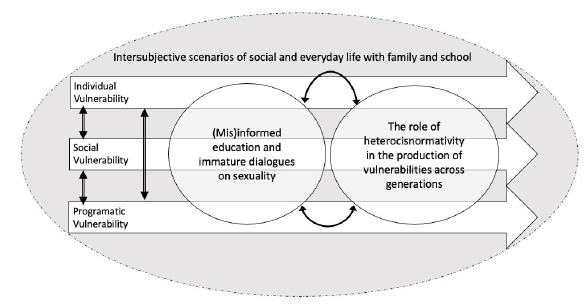
Figure 1

Theoretical-conceptual model produced in data analysis

2145-4515-apl-43-01-a14095-gf1.png

Results and Discussion

(Mis)informed Education and Immature Dialogues in Sexuality

This category focused on participants' stories about how SE was handled at home and school, and how adolescents applied this information. It linked thinking and behavior to SE shortcomings in elementary school, emphasizing institutional and policy issues. Table 2 provides examples for each theme, considering individual, social, and programmatic vulnerabilities.

Table 2

Themes and vignettes illustrating the category "(Mis)informed education and immature dialogues in sexuality"

Themes Vignettes
Individual Vulnerability
Shame, discomfort Nadia: I don't talk to my mother (...). Because my mother would kill me.
Gisele: I feel kinda embarrassed and just don't really like to talk about it.
Maria Eduarda: I don't feel comfortable either.
Rui: It's just that people generally don't feel very comfortable discussing this stuff.
Karine: Especially with parents.
Maria: Yeah, my mom is more open about it, but it's still awkward for me to share with her.
Laura: I only talk to my mom, not the whole family. I don't trust my grandma and uncles. And sometimes, not even my mom. (FG1)
Recrimination/ mistrust At that time one [student] said: - "Oh 'teach' my mom had a fight with me because she found some condoms in my closet." (TWE4, 42 years old)
Lack of genuine dialogue with parents I see parents like that, there's just no time. It's either they provide what the children need or they spend time with them and offer guidance. I've worked with families like that. They complain about the kids grabbing their food and heading straight to their rooms to eat, just to avoid having to explain their day to their parents. Not many families gather for dinner anymore. [...] do not meet. Then, on weekends, everyone is tired, you must clean the house, and going shopping. (TWE3, 50 years old)
Insufficient information and focusing on the biology; banking education Luís: But if those [images of the disease] were effective, no one would smoke.
Lívia: Just picture if it happened to us...
Luis: They already put the image on the cigarette packs, and it doesn't make a difference.
Lívia: Yeah, it's not just the image.
Eva: It's because, like, they think it's just an image.
Lívia: Yeah, you don't think that could happen.
Eva: if they see that it can really happen, they wouldn't want to. (FG2)
Precarious affective life They seek sexuality as a form of emotional connection, it is not even a physical or biological satisfaction, it is through physical contact, a yearning for affection that might be lacking from parents or the family. They look for this in their partner. (TWE4, 50 years old)
Social Vulnerability
Adolescent "immaturity"/need to control versus autonomy Most of the time [parents] say, "it's your conscience, if you want to do it, do it." (Ana, FG2)
I even asked sometimes, but I kept circling. She'd say, "Dad, I didn't have sex with the guy, you know?" (laughter). Until the end of last year, I don't think it had happened. Now already in the summer holidays and as she says, she is already 14 years old and can do anything. (FTE2, 44 years old)
Stigma about STIs (sexually transmitted infections) L. [one of the sons] got the syphilis part. Then I helped him. I explained what it was, gathered all the information from the internet, and showed him some pictures. Then he went crazy when he saw the pictures: “I don’t want to see it, I don’t want to see it.” I said: “This is what happens, I`m telling you, and this is the least of it, there are even worse diseases worse than this”. He had to take a poster to the class [...] He said: “I’m not going to take it there, it’s horrifying”. (FWE2, 56 years old)
Conservatism of communities There`s a risk that parents won`t like it, won`t accept it, and it becomes a problem. So, they avoid taking risks, avoid taking positions. (FWE2, 56 years old).
They distributed a condom to each of them. The kids making a balloon with a condom and everything, and then some parents complained: “How are you giving a condom
Programmatic Vulnerability
Low family participation in school There`s less and less participation. We don`t have a family party anymore, oh my!!! The whole school used to participate years ago, it was a party that yielded a lot, had a lot of involvement. Nowadays, only a handful participate, mostly the younger ones. [...]the school is missing a bit in pulling families into school events, not just when there’s a disciplinary issue or a grade problem. (TWE4, 50 years)
School “avoids” SE I think that if we talked about it more at school it would be better. Our high school kind of forbids us to know what sex is, they’re like, “Oh my god it’s such a horrible subject!” (Livia, FG2)
Rui: They only explain the basics. I wanted to talk deeper.
Maria: I think it shouldn’t be such a mechanical thing: only the teacher speaks, and the students listen. I think there should be an interchange of ideas.
Karine: like the conversation we’re having here. (FG1)
Lack of consistent SE strategies Within our curricular plan I know that they [teachers] give some guidance around the fifth grade something and someone comes to give a lecture. Then I’m only going to work with it there in the eighth grade, because it’s human body and such. I think that in that period they are learning the wrong thing. [...] I find it very disturbing that there is such a void [...]. When I was the principal, there was a group connected to the Secretary of Education that came to schools to talk about sexuality, but my god, people, they came here with some old, moldy, bad posters and those people said that and I kept thinking: “My God, of course, children are not going to be engaged with that”. (TWE3, 50 years old)
Critical aspects of SE worked on in personal initiatives It was my choice, with the permission of the school, but the syllabus is not like that, you know? The programmatic content is super open if you go to see it, like solidarity, culture. Especially in the seventh grade, there is the middle age, the question of the role of women in the Middle Ages and everything else is discussed a lot. And there I began to realize that they had a desire to talk about it, but they had no space to do it. Then I went to give history and religion and from there I implemented it. So, it works out what’s moral, what’s ethical, it involves sexuality but it doesn’t involve the examples of sexuality, which is political. (TME2, 30 years old)
Insufficient training of teachers I don’t even go too deep into it, because I don’t think that I’m a well prepared person to talk to them about it, so I try not to go too deep. But, when a student comes to me, because we know that they have parents, there are times when they do not have a father, nor do they have a mother. So, when they come looking to talk about something, I try to guide, or say: “Oh, look for that person to guide you better”. (TWE1, 35 years old)
Insecurity and lack of policy support to address SE The other science teacher had a problem with a mother last year because in sixth grade he was talking something about sexuality and that mother thought it was too early and didn’t like it. She came here and complained to the principal. The board called and told him not to talk, that it was not the year, that it was not ‘whatever’, and he obeyed because he did not want to bother with a complaint from the Department of Education. He spoke no more. (TWE3, 50 years)
Ambivalence about the inclusion of SE as a transversal axis of the curriculum I teach mathematics, so I don’t have to educate children, because that is the job of the father and the mother. A priori, this information had to be given at home. (... I shouldn’t, a math teacher, talking about sex education. (TWE1, 35 years)
Sexuality [...] it is part of the formation, of the creation of this integral being, not a robotic being that will learn to calculate and write and will have problems. What’s the point of teaching a girl who’s going to get pregnant at the age of 15 to calculate and write? (TME3, 33 years old)
Inappropriate handling of situations There was a situation that the students were asking to go out for water, but they were matching on their cell phones, whatever, and they were doing things in the bathroom downstairs. It was just a rumor, I don’t know if it was real. And the attitude of the school: instead of guiding or doing anything, it was to lock the bathroom. And then, I think like, “Did you kill the situation?” No, you killed the room where they could do something, but it did not change anything at all, and now people have to wait to use the toilet when they want to pee. (TME3, 33 years old)

[i]Note: Coding for the participants: F=family; T=teacher; W=woman; M=man (self-designated); School: E1, E2, E3, E4.

Feelings like shame and discomfort act as barriers to discussions about sexuality, underscoring the persistent taboo nature of the subject (Louro, 2014). Adolescents expressed dissatisfaction with the lack of authentic dialogues, particularly with their parents, which they believed would contribute to the development of their sexual identities and practices. Parents and teachers noted that conversations about the subject within families often escalated into conflicts, causing adolescents to avoid such discussions. One teacher noted that, in some families, adolescents faced reproach for taking preventive measures like having condoms. Despite their skepticism, teenagers hoped that the school could act as a mediator and bridge the communication gap with families. The lack of trust in peers, family members, or teachers was identified as a barrier to accessing information about sex and sexuality.

Parents acknowledged that a lack of time and communication could make adolescents vulnerable. Conversely, teachers highlighted various obstacles in SE, such as low family involvement in the school routine, emotional neglect, insufficient family interaction, and a lack of fundamental information on SE. While recognizing the challenge of fostering meaningful dialogues, an adult-centered idea emerged among parents and teachers regarding the immaturity of adolescents. This notion tended to attribute the main obstacles to adolescents, highlighting the intersubjective nature of the immaturity discourse. While teenagers were considered immature in assessing the risks associated with sexual life, there was a belief that they possessed enough information to make rational decisions. The prevailing view was that adolescents were aware of the "theory" but lacked the maturity to evaluate the potential consequences of their behaviors. The knowledge transmitted in the classroom or acquired from peers, family, or the internet was seen as insufficient to guide proper risk assessment, as mentioned earlier (Magno et al., 2023). Teachers observed that adolescents tended to trivialize the non-use of protection in sexual relations, the use of the morning-after pill, and retained misconceptions linking condom use to the loss of sexual sensations ("eating candy with the wrapper" -TWE3, 50 years).

The concept of adolescence, as a social category, arises from the naturalization of age as a structuring element of power dynamics that oppress young people (Cavalcante, 2021). This conceptualization implies a deficit in managing their sexuality, as disclosed by adolescents. Blaming adolescents and disclaiming adults hinder the construction of relationships during SE, which could otherwise serve as a protective passage to adult life. Adolescents frequently expressed how the required maturity could be nurtured through daily interactions in both family and school settings, enhancing the quality of dialogues. They mentioned that SE contents in school predominantly focused on biological aspects of the reproductive cycle, pregnancy prevention, and STIs, highlighting the superficiality and lack of time to discuss their doubts and concerns. In FG2, adolescents reported that even basic prevention information was not provided, and they felt that the school actively avoided SE topics.

The coverage of STI prevention perpetuated certain stigmas, often eliciting fear, discomfort, and even disgust among students. Social stigma, especially linked to STIs like HIV, is acknowledged as a significant factor influencing infections, creating obstacles to both prevention and treatment (Parker, 2013). Hence, it's crucial to formulate prevention strategies that incorporate an understanding of how inequalities and power dynamics contribute to portraying STIs as afflictions affecting "others" (Parker, 2013). Generally, SE interventions presuppose adolescents' agency and control for rational decision-making, often detached from the context of their emotional relationships (Shoveller & Johnson, 2006; Spencer et al., 2012). Rather than considering the socio-affective contexts in which sexual practices occur, discourses defining safe and healthy behaviors tend to marginalize those deviating from these norms, impeding access to health information, and services and widening inequalities (Shoveller & Johnson, 2006).

Adolescents highlighted the absence of school-led initiatives to prevent or address bullying situations on social media, particularly those related to the non-consensual sharing of erotic content, often involving girls. Patrocínio and Bevilacqua (2023) underscore the severe psychological repercussions associated with media exposure incidents. Additionally, a teacher reported the lack of actions and policies to ensure adolescents' access, and responsible use of the morning-after pill, a common non-prescribed practice among them. While teachers mentioned occasional lectures with guests from the Municipal Department of Education, the Health at School Program, or other renowned educators with specific training, these initiatives were sporadic or discontinued due to management changes or resource shortages.

It is observed that SE tends to adopt a banking education approach, focusing on content and distancing itself from the social reality of adolescents, as conceptualized by Paulo Freire (1987). Drawing on bell hooks' ideas (2013), the experience of the body and affections is inseparable from this oppressive knowledge and values transmission, eliciting distrust and disengagement. Consequently, health prevention used to be presented in a manner that induced fear in adolescents, perceived as ineffective by them.

Considering the immature dialogues between adults and adolescents, peers emerged as a primary source for practical information on sexuality. However, parents and teachers viewed this as dangerous, given the perceived immaturity of adolescents, fearing that it might encourage behaviors challenging authority or seeking peer approval, coupled with the risk of obtaining incorrect information. An illustrative example is when someone advised a girl to take two packs of birth control for an abortion, leading to hospitalization and a potential miscarriage, as reported by a teacher (TWE2, 59 years old).

The connection between adolescents' sexual life and their emotional well-being remained unexplored. However, health obstacles were identified in promiscuity, the absence of intimacy, and the lack of emotional bonds in sexual relationships. Conversely, a teacher highlighted that some adolescents engage in sexual activities to compensate for a deficient affective life (see Table 2).

Parents recounted instances of harassment, physical violence, suspected sexual abuse by family members, excessive alcohol consumption, unprotected sex, and association with older and unfamiliar individuals within their social networks. In reporting a case involving potential prostitution and incest, a teacher exposed the lack of preparedness to handle such situations in the school context: She was my student at the beginning of the Magisterium. I was inexperienced. I didn't even know I could have reported it. I didn't know how to act, and I only learned about it after a long time, after the year was over. Although it wasn't 100% proven, it's alarming that her mother may have engaged in prostitution. Can you imagine subjecting a teenager to that? It's illegal! She could lose custody of the child. (TME3, 33 years old) bell hooks (2013) argues that students should be viewed as complete individuals, and the learning process should encompass life skills and the intricate experiences of everyone involved. In this approach, educators and their experiences are essential, turning the classroom into a space for ongoing education that demands a readiness for self-reflection. However, our analysis uncovered a lack of social and institutional support, combined with inadequate technical training for teachers and schools to implement comprehensive prevention and promotion actions in sexual health beyond a biological model focused on early pregnancy and STIs (Vieira & Matsukura, 2017).

While some teachers initiated isolated efforts in history and religion classes to address sexual education more comprehensively-engaging in debates on consent, violence, gender inequalities, and homophobia-these initiatives were often individual. For example, a teacher in a central region school successfully partnered with an NGO to tackle homophobia and transphobia, and another teacher implemented a strategy using an anonymous question box, garnering support from students. However, teachers expressed concerns that addressing such topics wasn't an explicit demand for the entire school community, leading to a sense of insecurity. Many teachers faced conflicts with parents when addressing sexual health, with one teacher formally warned by the board for this reason. Consequently, teachers felt the need for parental permission, explaining why they often conveyed content without engaging in effective dialogue with students, despite the enthusiasm and students' evident need to learn. Furthermore, the lack of preparation and training, coupled with inadequate support from both the school and the health network in handling sensitive issues like rape, abortion, sexual orientation, and violence, remained significant challenges recognized by both parents and teachers.

All participants unanimously agreed that SE needed more comprehensive attention, emphasizing its inclusion across disciplines, and prioritizing open, non-judgmental dialogues on diverse topics. However, there was a divide among teachers, with some perceiving sexuality as an integral aspect of the development of children and adolescents, while others failed to recognize this dimension in their work. Additionally, some were uninformed about SE being a cross-cutting theme in the National Curricular Parameters, and even those who were aware often did not integrate it into their teaching practices. This ambiguity highlights the political challenge associated with addressing SE in the routine school practices (Vieira & Matsukura, 2017) and underscores the significance of successful implementation depending on the quality of relationships within the school community.

The programmatic shortcomings of SE within schools, coupled with minimal investment in teacher training, were reflected in the inadequate handling of situations related to sex and sexuality, perpetuating prejudices. Reports also highlighted variations in the timing and approach to sexual health in more socially vulnerable contexts. In these settings, issues were addressed early and more emphatically due to elevated rates of pregnancy and STIs. Although this denotes the ability of the local education system to tailor approaches to each school's unique characteristics, solely biomedical actions focused on individuals may inadvertently exacerbate existing inequities: "They are children raised in the slum, so there are a lot of pregnant teenagers, that is a whole different thing. So, I think they work because this problem is already more common (...) in those areas" (FWE3, godmother).

The role of the heterocisnormativity in the construction of vulnerabilities across generations

Within this category, we delve into the social and contextual aspects that emerged from narratives of adolescents, parents, and teachers regarding SE for elementary school students. These aspects intersect with the individual and programmatic vulnerabilities as outlined above. The analyzed reports shed light on how entrenched heterocis-normative attitudes and beliefs pose a challenge to deconstruct that heighten exposure to various risks, hindering discussions about desire, intimacy, and violence from the perspective of the human right to sexual and gender diversity. Table 3 outlines the key themes identified, along with representative vignettes.

Table 3

Themes and vignettes illustrating the category "The role of the heterocisnormativity in the construction of vulnerabilities across generations"

Themes Vignettes
Individual Vulnerability
Girls Seen as more mature Greater judgment and culpability Intimate exposure Usually, girls are more mature. That’s a fact right!? The guys keep joking, and the girls go crazy. Now, in the final stretch, the 6th grade girls walk around everyday kissing and hugging the 8th and 9th grade boys. In the hall, so, on fire! (TWE4, 42 years old) The boy said to her, “you are always with a different man, with a different boy. I don’t want a woman who makes out with everyone.” He said things like that to her. I think he told a friend of hers. And then she liked him, and he said, “I just didn’t make out with you because of that.” Then it dropped like a bomb to her. (FWE3, godmother)
Boys Low self-care Infantilization Affective inhibition More violent behaviors He is more immature; it takes him time to understand certain things and we are working hard on it. [...] The guys make fun of him and are even making fun of him. I said, “You can’t! Now you’re here at home, do you want to cry? Then cry, it’s your problem, but not the problem at school.” He must impose himself. One of these days they said some bad words to him, some very bad things, and then he came home telling me and I said: “and what did you answer?”; “Nothing, I kept quiet.”; “But L. You must answer: ‘it’s you, you idiot’. ‘It’s you, you imbecile’”. (FWE2, 56 years old) Girls are much more open. At the time of speaking in the classroom on the subjects, I have like 90% of girls speaking and 10% of boys. They have a much harder time saying. [...] Girls are much more enlightened. Boys are too embarrassed to talk. I don’t know how they act, but I think very few talk to their parents. (TWE1, 62 years old)
Intergenerational taboo on sexuality Nowadays people will [have sex] just for the pleasure of it, I think in the old days it was for something more important, for love. They don’t even know the guy and “come on then.” I think my mother doesn’t talk [about sexuality] because she said my grandmother was never much of a talker, so I believe my mother never talked to me because her upbringing was like that. (Gisele, FG1) I came from a family where this issue of sex was veiled, it was not open, and his [husband’s] family too. No one ever talked to him about it, about sex. I remember my mom talking to me and my sister and her saying, “Let’s talk today about where babies come from,” you know? And until a certain age I thought that couples only had sex to have children. I didn`t understand at that time that it was also for pleasure. (FWE2, 51 years old)
Gender inequalities
Gender inequalities Karine: the guy can take a girl home and the girl can’t. Gisele: my mom wouldn’t let me go to a party, so I said, “why Mom?” She said, “Because there are only boys.” I said, “What’s wrong with that?” Then she said, “If I let you go to that party, they’d call you a slut.” Slut for girls is to hook up with everyone and slut for boys is... Evaldo: fag (FG1)
Hegemonic masculinity My father always says, “He who eats quietly eats twice”. “Sleep with everyone, just don’t get anyone pregnant” (imitating someone from his family). (Naldo, FG1) I see it`s more exposed at least [with the girls]. Suddenly the guys do, but do not speak. Girls don’t mind saying they`re dating girls too. Girl, yes [seeks to talk], boy, quite difficult. Ah, they are self-sufficient. (TWE4, 42 years old)
Heteronormative pattern This is normal, despite being subjective too. Some girls take much longer - it depends on each one. I’ve seen it before and it’s normal, natural, you know? Especially because girls are brought up with romanticized ideas, like having a partner, getting married, creating a home, and all that. Boys are taught only to play ball, so, naturally, they express it later. (TWE4, 43 years old) Many girls get pregnant, in my opinion, because they give too much meaning to sex. I`ve heard this in the classroom from girls who believe that the big dream is to be a mother because, by being a mother, they`ll have a part of the boy they love. [...] There is a void for many of them because that girl who wanted to have the guy’s child believed it would give meaning to her life. (TME2, 30 years old)
LGBTphobia I’m not against [homosexual relationships], I just think it’s weird, okay?! (...) I find it strange, not that I`m against it, but the guy sees...I don’t know, man! It’s just like you said: it’s her life, got it? I was going to say something, but never mind [...]. My family is biased about this. (Evaldo, FG1) Besides telling us on protection, I would like that they were more respectful of people`s sexual choices. (Paula, FG1) All this transgender stuff, it’s everywhere, on TV and all. I think we need to coexist with all of them. I have a brother who`s gay, and we don’t get along, you know? I think these things, these issues, should be handled carefully. (FWE1, 48 years old) When that scene happened [in the soap opera] that the girl tells her family that she`s not a girl anymore and that she`s a boy, the other day a girl came dressed as a boy. I thought that was too much... even shocking, because, like that, I think the media exploits this without any responsibility and it messes with people. In the old days, when I was a kid this didn`t happen, not that it`s either bad or good, I don’t know! It`s not that being homosexual is bad or anything, but the way it happens, you know? Oh, this girl seems to date girls too. I don’t know, sometimes she dresses normal and sometimes she comes dressed as a boy. Because then they don’t have the maturity to know what`s happening to them. (TWE1, 35 years old)
Programmatic Vulnerability
Inappropriate handling of situations and cases In a council situation people were commenting, but then you see people commenting as a joke. She [a student] got involved, had sex with two, three students, older, eighth graders. She was in sixth grade. Then I don’t know if it was something with a photo or if they told everyone and stuff. The girl no longer had the environment to go to school, she had to be transferred. She didn’t get pregnant. It was just a story like: “Oh, so-and-so...” it was just a rumor. (TME3, 33 years old)

[i]Note: Coding for the participants: F=family; T=teacher; W=woman; M=man (self-designated); School: E1, E2, E3, E4.

Adolescents and parents presented contrasting perspectives on desirable or expected behaviors for girls and boys, giving rise to distinct generational positions between parents/teachers and children. The perpetuation of discourses that emphasized greater freedom and even encouragement for boys to attend parties, bring girlfriends home, engage in sexual relations with multiple partners, and neglect self-care further reinforced the hegemonic masculinity norms that prize dominant virility, emotional detachment, and a willingness to take sexual risks (Connell, 2002). In contrast, girls were closely monitored, and their behavior and attire became subjects of moral scrutiny, with blame assigned when situations of defamation occurred. Variations in dialogues between parents and children were noted based on the child's gender.

Girls were often perceived as more mature and responsible, a presumption rooted in assumptions about their engagement in sexual relations at an earlier age. However, epidemiological data contradict this perception, indicating that males typically experience their first sexual intercourse earlier in Brazil (Felisbino-Mendes et al., 2021; Felisbino-Mendes et al., 2018; Oliveira-Campos et al., 2014). This contrast raises the possibility that the perceived maturity of the girls might have led to an unequal distribution of responsibilities for safe sex and contraception onto them, assuming they were already well-informed about STIs and pregnancy. This dynamic, however, may overshadow other legitimate needs and demands of women regarding sexuality. Concurrently, boys were often characterized as immature, expressing doubts, or sharing experiences at school, underscoring how the naturalization of heteronormativity renders both girls and boys vulnerable in different ways.

The influence of heteronormativity on the adoption of other preventive behaviors was highlighted by a teacher who described an idealized concept of romantic love, motherhood, and trust versus intimacy. This normative ideal, particularly, seemed to affect girls with lower self-confidence and self-esteem. Despite observations of submissive behavior in some girls, teachers reported that others demonstrated greater empowerment regarding their sexual desire and ways of being. However, this empowerment appeared to hinder boys from engaging in debates about sexuality at school, leading them to suppress their opinions. In this process, it is argued that some men, perceiving themselves as part of the spectrum of subaltern masculinities due to their social marker of difference (e.g., race/ethnicity, social status, sexual orientation), tend to experience feelings of inferiority attributed to women, fueling misogynistic resentment (Lima-Santos & Santos, 2022).

I notice that girls who think they're more clued in about their sexuality are way more chill with guys, in the sense of not feeling ashamed to chat about their sexuality or embarrassed to say that they checked a hot boy on the street. They are not ashamed to say that they were at the party and made out with three boys. They don't feel ashamed to say that they are dating or that they do not wear a bra and that they do not give a damn if the guy cares or not. [... Whenever we dive into sex stuff in the class, I feel like I'm only teaching the girls...] "I think that a girl who arrives at a party and makes out with 8 guys I don't want to be the eighth because I don't want to kiss the mouth of others" [reproducing student speech]. If he says it in class, and there's been a few who have said wooooooooowwww!!!! Even those who usually keep things low-key spill everything! So, they know they can't talk, but it doesn't mean they agree or disagree. It's just super hard to get the opinion of the boys. (TME2, 30 years old)

Although students, parents, and teachers occasionally questioned societal discourses dictating the behaviors and expectations for girls and boys, the reports indicate limited possibilities for challenging these norms. Paradoxically, this situation can facilitate misogynistic and homophobic practices. For instance, one teacher highlighted a case of a student's intimate exposure, a problem exacerbated by inadequate handling at school, which underlines the institutional perpetuation of gender violence and rape culture (Silva & Soares, 2022).

Aligned with the reproduction of heterocisnor-mativity, generational differences emerged as a pervasive element influencing the construction of social vulnerabilities in SE within schools. These differences tended to reiterate gender inequalities and shape perspectives on sexual orientation from an adult-centric viewpoint (Cavalcante, 2021). Parents shared personal experiences from their adolescence, recalling the generational challenges they faced in attempting to comprehend their children's current experiences and provide support. Consequently, the taboo surrounding sexuality persisted, and meaningful dialogues with substantial information remained lacking.

The excessive exposure to digital media and the increasing representation oftransgender people, homosexuals, and marginalized populations were viewed with suspicion and concern by many teachers and parents. There was a fear that this exposure might be stimulating sexuality among adolescents. This apprehension was linked to the perception that the current generation of adolescents was engaging in sexual activities at younger ages, and the prevailing sentiment was they were becoming "more libertine and liberated." Interestingly, one teacher noted a shift in the students' attitudes toward discussions on gender and sexual orientation. She observed that students who used to inquire about these topics now seemed uncomfortable, describing the situation as: "very closeted" (TWE3, 50 years). Subtle expressions of LGBT-phobic views emerged in the reports, as parents and teachers expressed concerns about the perceived immaturity of adolescents to understand different expressions of sexuality and gender that were being commercially exploited by the media. It is worth noting that LGBT-phobic discourses generate a context of permissiveness that fosters discriminatory and violent behaviors (Furlani, 2022). This is further exacerbated by the absence of sexual diversity themes in educational activities (Matta et al., 2021). Additionally, languages and forms of expression that could facilitate reflective dialogue with adolescents, such as Funk, were morally depreciated.

[Regarding Funk] I think it's vulgar as hell. I hear it and I'm embarrassed, you know? Because I see some little princesses, like you know, at a debutante ball, 15th birthday, twerking, and I'm like, does that even make sense? Who is she, anyway? She's dressed like one thing but moving like something else... Hypersexualization? Hypersexualization, and, honestly, I don't know if that turns into a more sexual vibe towards the end of the party or if it's just meant to be a joke. (TWE4, 43 years old)

Conclusion

Sexuality education (SE) is a fundamental right for adolescents and plays a crucial role in both prevention and promotion of sexual health. Ensuring this right requires creating inclusive school environments that foster open dialogue and acknowledge the diversity of sexualities. This entails moving beyond prevailing adult-centric and heteronormative perspectives that overlook the socially situated knowledge and lived experiences of adolescents. Promoting autonomy and self-care in sexual matters calls for more balanced relationships between adolescents and adults, grounded in mutual trust, shared aspirations, and collaborative responsibilities across schools, families, and health services.

Our findings revealed marked tensions among parents, teachers, and adolescents regarding gender and sexuality, which hinder the implementation of effective SE. While adolescents sought open, non-judgmental discussions, many adults maintained heteronormative views and perceived youth as immature. This disconnection was most evident in debates on gender roles, with parents and teachers reinforcing traditional norms-greater freedom for boys, stricter control for girls-while adolescents advocated for equity and inclusion. Although some teachers recognized the need to address sexual diversity and consent, others avoided such topics due to fear of parental backlash or insufficient institutional support. Bridging these generational and ideological divides is essential for SE to reflect adolescents' realities and respond to their evolving needs.

This shift in approach is also critical to dismantling discriminatory barriers rooted in hetero-cisgender norms embedded in everyday school discourses and practices. Public policies on SE still face substantial challenges, including restrictive pedagogical approaches that overemphasize risk and focus narrowly on the biological aspects of sexuality. Such approaches can individualize blame, normalize adult-centric behaviors, and perpetuate perceptions of adolescent immaturity.

Addressing these limitations requires urgent investment in building relational spaces within schools that validate the desires, aspirations, and agency of young people, spaces that move beyond the technical transmission of content. By ensuring access to information, resources, and meaningful participation in decision-making, SE can safeguard adolescents' citizenship rights and advance social justice.

Finally, these findings should be interpreted with caution given the scope and limitations of the sampling design and the absence of formal procedures to ensure theoretical saturation. Future research should explore underrepresented perspectives, particularly those of fathers and LGBTQ+ students, to inform more comprehensive and inclusive SE policies and practices.

Acknowledgements:

The authors would like to thank the adolescents, parents, and teachers who participated in the research. Funding: This work was supported by funding provided by the Fundação de Amparo à Pesquisa do Rio Grande do Sul (reference number: 17/2551-001 - 093-0).

References

Alves, J., & Rossi, C. (2020). Políticas públicas de gênero e sexualidade na educação: breve análise sobre a "ideologia de gênero". Educação: Teoria e Prática, 30(63), 1-15. https://doi.org/10.18675/1981-8106.v30.n.63.s13771

J. Alves C Rossi 2020Políticas públicas de gênero e sexualidade na educação: breve análise sobre a "ideologia de gênero"Educação: Teoria e Prática3063115https://doi.org/10.18675/1981-8106.v30.n.63.s13771

Ayres, J., Franca Junior, I., Calazans, G., & Saletti Filho, H. (2006). O conceito de vulnerabilidade e as práticas de saúde: novas perspectivas e desafios. In D. Czeresnia & C. Freitas (Eds.), Promoção da saúde: conceitos, reflexões, tendências. Fiocruz.

J. Ayres I. Franca Junior G. Calazans H Saletti Filho 2006O conceito de vulnerabilidade e as práticas de saúde: novas perspectivas e desafios D Czeresnia C Freitas Promoção da saúde: conceitos, reflexões, tendênciasFiocruz

Barbour, R. (2009). Grupos focais. ArtMed.

R Barbour 2009Grupos focaisArtMed

Bueno, R., & Ribeiro, P. (2018). História da educação sexual no Brasil: apontamentos para reflexão. Revista Brasileira de Sexualidade Humana, 29(1), 49-56. https://doi.org/10.35919/rbsh.v29i1.41

R. Bueno P Ribeiro 2018História da educação sexual no Brasil: apontamentos para reflexãoRevista Brasileira de Sexualidade Humana2914956https://doi.org/10.35919/rbsh.v29i1.41

Butler, J. (2015). Problemas de gênero: feminismo e subversão de identidade. Civilização Brasileira.

J Butler 2015Problemas de gênero: feminismo e subversão de identidadeCivilização Brasileira

Cavalcante, E. (2021). O conceito de adultocentrismo na história: diálogos interdisciplinares. Fronteiras, 23(42), 196-215. https://doi.org/10.30612/frh.v23i42.15814

E Cavalcante 2021O conceito de adultocentrismo na história: diálogos interdisciplinaresFronteiras2342196215https://doi.org/10.30612/frh.v23i42.15814

Collins, P., & Bilge, S. (2021). O que é intersec-cionalidade? In P. Collins & S. Bilge (Eds.), Interseccionalidade (pp. 15-49). Boitempo.

P. Collins S Bilge 2021O que é intersec-cionalidade? P Collins S Bilge Interseccionalidade1549Boitempo

Connell, R. (2002). On hegemonic masculinity and violence: Response to Jefferson and Hall. Theoretical Criminology, 6(1), 89-99. https://doi.org/10.1177/136248060200600104

R Connell 2002On hegemonic masculinity and violence: Response to Jefferson and HallTheoretical Criminology618999https://doi.org/10.1177/136248060200600104

Dinis, N., & Asinelli-Luz, A. (2007). Educação sexual na perspectiva histórico-cultural. Educar em Revista, 30(30), 77-87. https://doi.org/10.1590/S0104-40602007000200006

N. Dinis A Asinelli-Luz 2007Educação sexual na perspectiva histórico-culturalEducar em Revista30307787https://doi.org/10.1590/S0104-40602007000200006

Felisbino-Mendes, M., Araújo, F., Oliveira, L., Vasconcelos, N., Vieira, M., & Malta, D. (2021). Sexual behaviors and condom use in the Brazilian population: Analysis of the National Health Survey, 2019. Revista Brasileira de Epidemiologia, 24(Supplement 2), Article E210018. https://doi.org/10.1590/1980-549720210018.supl.2

M. Felisbino-Mendes F. Araújo L. Oliveira N. Vasconcelos M. Vieira D Malta 2021Sexual behaviors and condom use in the Brazilian population: Analysis of the National Health Survey, 2019Revista Brasileira de Epidemiologia24https://doi.org/10.1590/1980-549720210018.supl.2

Felisbino-Mendes, M., Paula, T., Machado, Í., Oliveira-Campos, M., & Malta, D. (2018). Análise dos indicadores de saúde sexual e reprodutiva de adolescentes brasileiros, 2009, 2012 e 2015. Revista Brasileira de Epidemiologia, 21(Supplement 1), Article E180013. https://doi.org/10.1590/1980-549720180013.supl.1

M. Felisbino-Mendes T. Paula Í. Machado M. Oliveira-Campos D Malta 2018Análise dos indicadores de saúde sexual e reprodutiva de adolescentes brasileiros, 2009, 2012 e 2015Revista Brasileira de Epidemiologia211https://doi.org/10.1590/1980-549720180013.supl.1

Freire, P. (1987). Pedagogia do oprimido (17th ed.). Paz e Terra.

P Freire 1987Pedagogia do oprimido17Paz e Terra

Furlanetto, M., Ghedin, D., Gonçalves, T., & Marin, A. (2019). Individual and contextual factors associated with sexual initiation among adolescents. Psicologia: Reflexão e Crítica, 32(1), Article 25. https://doi.org/10.1186/s41155-019-0138-z

M. Furlanetto D. Ghedin T. Gonçalves A Marin 2019Individual and contextual factors associated with sexual initiation among adolescentsPsicologia: Reflexão e Crítica321https://doi.org/10.1186/s41155-019-0138-z

Furlanetto, M., Marin, A., & Gonçalves, T. (2019). Acesso e qualidade da informação recebida sobre sexo e sexualidade na perspectiva adolescente. Estudos e Pesquisas em Psicologia, 19(3), 644-664. http://pepsic.bvsalud.org/scielo.php?script=s-ci_arttext&pid=S1808-42812019000300006&n-rm=iso

M. Furlanetto A. Marin T Gonçalves 2019Acesso e qualidade da informação recebida sobre sexo e sexualidade na perspectiva adolescenteEstudos e Pesquisas em Psicologia193644664http://pepsic.bvsalud.org/scielo.php?script=s-ci_arttext&pid=S1808-42812019000300006&n-rm=iso

Furlanetto, M., Lauermann, F., Costa, C., & Marin, A. (2018). Educação sexual em escolas brasileiras: revisão sistemática da literatura. Cadernos de Pesquisa, 48(168), 550-571. https://publica-coes.fcc.org.br/cp/article/view/5084

M. Furlanetto F. Lauermann C. Costa A Marin 2018Educação sexual em escolas brasileiras: revisão sistemática da literaturaCadernos de Pesquisa48168550571https://publica-coes.fcc.org.br/cp/article/view/5084

Furlani, J. (2022). A narrativa "ideologia de gênero": impactos na educação brasileira e nas políticas da identidade. In F. Seffner & J. Felipe (Eds.), Educação, gênero e sexualidade: (Impertinências) (pp. 335-361). Editora Vozes.

J Furlani 2022A narrativa "ideologia de gênero": impactos na educação brasileira e nas políticas da identidade F Seffner J Felipe Educação, gênero e sexualidade: (Impertinências)335361Editora Vozes

hooks, b. (2013). Ensinando a transgredir: a educação como prática da liberdade. Martins Fontes.

b hooks 2013Ensinando a transgredir: a educação como prática da liberdadeMartins Fontes

Lima-Santos, A., & Santos, M. (2022). Incels e misoginia on-line em tempos de cultura digital. Estudos e Pesquisas em Psicologia, 22(3), 1081-1102. https://doi.org/10.12957/epp.2022.69802

A. Lima-Santos M Santos 2022Incels e misoginia on-line em tempos de cultura digitalEstudos e Pesquisas em Psicologia22310811102https://doi.org/10.12957/epp.2022.69802

Louro, G. (2014). Gênero, sexualidade e educação: uma perspectiva pós-estruturalista (16th ed.). Editora Vozes.

G Louro 2014Gênero, sexualidade e educação: uma perspectiva pós-estruturalista16Editora Vozes

Magno, L., Marinho, L., Zucchi, E., Amaral, A., Lobo, T., Paes, H., Lima, G., Nunes, C., Pereira, M., & Dourado, I. (2023). School-based sexual and reproductive health education for young people from low-income neighbourhoods in Northeastern Brazil: The role of communities, teachers, health providers, religious conservatism, and racial discrimination. Sex Education, 23(4), 409-424. https://doi.org/10.1080/14681811.2022.2047017

L. Magno L. Marinho E. Zucchi A. Amaral T. Lobo H. Paes G. Lima C. Nunes M. Pereira I Dourado 2023School-based sexual and reproductive health education for young people from low-income neighbourhoods in Northeastern Brazil: The role of communities, teachers, health providers, religious conservatism, and racial discriminationSex Education234409424https://doi.org/10.1080/14681811.2022.2047017

Marcon, A., Prudêncio, L., & Gesser, M. (2016). Políticas públicas relacionadas à diversidade sexual na escola. Psicologia Escolar e Educacional, 20(2) 291-301. https://doi.org/10.1590/2175-353920150202968

A. Marcon L. Prudêncio M Gesser 2016Políticas públicas relacionadas à diversidade sexual na escolaPsicologia Escolar e Educacional202291301https://doi.org/10.1590/2175-353920150202968

Matta, T., Taquette, S., Souza, L., & Moraes, C. (2021). Diversidade sexual na escola: estudo qualitativo com estudantes do ensino médio do município do Rio de Janeiro, Brasil. Cadernos de Saúde Publica, 37(11) Article e00330820. https://doi.org/10.1590/0102-311X00330820

T. Matta S. Taquette L. Souza C Moraes 2021Diversidade sexual na escola: estudo qualitativo com estudantes do ensino médio do município do Rio de Janeiro, BrasilCadernos de Saúde Publica3711https://doi.org/10.1590/0102-311X00330820

Minayo, M. (2014). O desafio do conhecimento: pesquisa qualitativa em saúde (14th ed.). Hucitec/Abrasco.

M Minayo 2014O desafio do conhecimento: pesquisa qualitativa em saúde14Hucitec/Abrasco

Moreno Vargas, S., & Santibañez Bravo, M. A. (2021). Educación sexual en América Latina: una revisión del estado del arte en Colombia, Chile, México y Uruguay. Revista Educación las Américas, 11(1), 57-77. https://doi.org/10.35811/rea.v11i1.145

S. Moreno Vargas M. A Santibañez Bravo 2021Educación sexual en América Latina: una revisión del estado del arte en Colombia, Chile, México y UruguayRevista Educación las Américas1115777https://doi.org/10.35811/rea.v11i1.145

Oliveira-Campos, M., Nunes, M., Madeira, F., Santos, M., Bregmann, S., Malta, D.., Barreto, S. (2014). Sexual behavior among Brazilian adolescents: National adolescent school-based health survey (PeNSE 2012). Revista Brasileira de Epidemiologia, 17(Supplement 1), 116-130. https://doi.org/10.1590/1809-4503201400050010

M. Oliveira-Campos M. Nunes F. Madeira M. Santos S. Bregmann D Malta S Barreto 2014Sexual behavior among Brazilian adolescents: National adolescent school-based health survey (PeNSE 2012)Revista Brasileira de Epidemiologia171116130https://doi.org/10.1590/1809-4503201400050010

Parker, R. (2013). Interseções entre estigma, preconceito e discriminação na saúde pública mundial. In S. Monteiro and W. V. Villela (Eds.), Estigma e Saúde (pp. 25-46). Editora Fiocruz.

R Parker 2013Interseções entre estigma, preconceito e discriminação na saúde pública mundial S Monteiro W. V. Villela Estigma e Saúde2546Editora Fiocruz

Patrocino, L., & Bevilacqua, P. (2023). O que nudes e divulgação não autorizada de imagens íntimas têm a lembrar à escola? Educação e Pesquisa, 49, Article e259986. https://doi.org/10.1590/ S1678-4634202349259986por

L. Patrocino P Bevilacqua 2023O que nudes e divulgação não autorizada de imagens íntimas têm a lembrar à escola?Educação e Pesquisa49https://doi.org/10.1590/ S1678-4634202349259986por

Ribeiro, P. (2013). Revisitando a história da educação sexual no Brasil. In P. Ribeiro (Ed.), Corpos, gêneros e sexualidades: questões possíveis para o currículo escolar (pp. 11-16). FURG.

P Ribeiro 2013Revisitando a história da educação sexual no Brasil P Ribeiro Corpos, gêneros e sexualidades: questões possíveis para o currículo escolar1116FURG

Shoveller, J., & Johnson, J. (2006). Risky groups, risky behaviour, and risky persons: Dominating discourses on youth sexual health. Critical Public Health, 16(1), 47-60. https://doi.org/10.1080/09581590600680621

J. Shoveller J. Johnson 2006Risky groups, risky behaviour, and risky persons: Dominating discourses on youth sexual healthCritical Public Health1614760https://doi.org/10.1080/09581590600680621

Silva, R., & Soares, R. (2022). O gênero e a sexualidade na educação em tempos violentos. In F. Seffner and J. Felipe (Eds.), Educação, gênero e sexualidade: (im)pertinências (pp. 314-334). Editora Vozes.

R. Silva R Soares 2022O gênero e a sexualidade na educação em tempos violentos F Seffner J Felipe Educação, gênero e sexualidade: (im)pertinências314334Editora Vozes

Spencer, G., Doull, M., & Shoveller, J. A. (2012). Examining the concept of choice in sexual health interventions for young people. Youth & Society, 46(6), 756-778. https://doi.org/10.1177/0044118X12451277

G. Spencer M. Doull J. A Shoveller 2012Examining the concept of choice in sexual health interventions for young peopleYouth & Society466756778https://doi.org/10.1177/0044118X12451277

Vélez de la Calle, C., & Santamaría-Vargas, J. (2023). Políticas, saberes y relatos de Educación Sexual: una revisión de la literatura latinoamericana 2000-2022. Educación y Ciudad, (45), Article e2870. https://doi.org/10.36737/01230425.n45.2023.2870

C. Vélez de la Calle J Santamaría-Vargas 2023Políticas, saberes y relatos de Educación Sexual: una revisión de la literatura latinoamericana 2000-2022Educación y Ciudad45https://doi.org/10.36737/01230425.n45.2023.2870

Vieira, P., & Matsukura, T. (2017). Modelos de educação sexual na escola: concepções e práticas de professores do ensino fundamental da rede pública. Revista Brasileira de Educação, 22(69), 453-474. https://doi.org/10.1590/S1413-24782017226923

P. Vieira T Matsukura 2017Modelos de educação sexual na escola: concepções e práticas de professores do ensino fundamental da rede públicaRevista Brasileira de Educação2269453474https://doi.org/10.1590/S1413-24782017226923

[4] Upon acceptable reason, data can be requested from the first author by the e-mail address listed in the contact details.

[5] The study was approved by the Research Ethics Committee of Vale do Rio dos Sinos University, under CAAE No. 66618717.9.0000.5344. All the ethical considerations required for studies with human subjects were followed, according to Resolution 510/16 of the National Health Council. Competing interests: The authors declare that they have no competing interests.

[6] Ribeiro Gonçalves, T., Fontana Furlanetto, M., Béria, M., Tavares, G., Luiz Guimarães, N., & Marin, A. H. (2025). Vulnerabilities and Sexual Education at School: A Qualitative Study with Parents, Teachers, and Adolescents. Avances en Psicología Latinoamericana, 43(1), 1-18. https://doi.org/10.12804/revistas.urosario.edu.co/apl/a.14095

Authors' contributions - CRediT Taxonomy:

[7] Conceptualization, Data curation, Methodology, Writing - original draft, Writing - original draft, Writing - review & editing.

[8] Conceptualization, Investigation, Data curation, Project administration, Writing - original draft, Writing - review & editing.

[9] Formal Analysis, Writing - original draft, Writing - review & editing.

[10] Formal Analysis, Writing - original draft, Writing - review & editing.

[11] Formal Analysis, Writing - original draft, Writing - review & editing.

[12] Conceptualization, Funding acquisition, Methodology, Project administration, Supervision, Writing - review & editing.