10.12804/revistas.urosario.edu.co/apl/a.13724
Artículos
Cristian Mora-Micán 1
Laura Rojas-Gaitán 2
Margarita Villota-Benítez 3
Luisa Ramírez 4
1.  0000-0002-9947-7751, Escuela de Medicina y Ciencias de la Salud, Universidad del Rosario
2 0000-0001-8717-2531, Escuela de Medicina y Ciencias de la Salud, Universidad del Rosario
3. 0000-0002-6451-4364, Escuela de Medicina y Ciencias de la Salud, Universidad del Rosario
4. 0000-0002-5094-7898, Escuela de Medicina y Ciencias de la Salud, Universidad del Rosario
Correspondence concerning this article should be addressed to
Cristian Mauricio Mora-Micán.  cristianmoramican@gmail.com.
Laura Rojas-Gaitán. laurata.rojas@urosario.edu.co.
Submitted: February 16, 2024
Accepted: March 8, 2025
To cite this article: Mora-Micán, C., Rojas-Gaitán, L., Villota-Benítez, M., & Ramírez, L. (2024). Psychological processes in the acceptance of Covid- 19 fake news: A scoping review. Avances en Psicología Latinoamericana, 42(3), 1-18. https://doi.org/10.12804/revistas.urosario.edu.co/apl/a.13724
Abstract
The Covid-19 pandemic challenged the world in several ways that required global efforts to adapt and respond to minimize its impact. The existential threat posed by the pandemic, the global increase of people's reliance on social networks, and the desperate need for information created an infodemic scenario, i. e., the proliferation of fake news. This paper aims to contribute to an understanding of the psychological processes involved in the propagation of fake news. To this end, we conducted a PRISMA-based scoping review of empirical literature on the psychological processes related to the acceptance of Covid-19 fake news. Articles were searched in five databases for relevant and potentially eligible studies realized between January of 2020 and December of 2021 in English and Spanish. This led to the identification of 223 studies, which, after eligibility checks, resulted in 18 articles meeting the criteria. Selected articles were empirical papers that focused on exploring psychological processes and their relations with fake news. Our results showed that: a) evidence on the relationship between the consistency of conspiracy theories, beliefs of Covid-19 and acceptance of fake news is mixed, b) emotions such as anger and fear partially predict information sharing behaviors, c) intuitive cognitive styles were associated with higher endorsement of fake news, and d) there is no clear evidence of a relationship between political orientation and the endorsement to fake news. We discuss the implications of our findings and highlight the urgent need for further research on this increasingly problematic aspect of human communication.
Keywords: psychological processes; acceptance of fake news; Covid-19; cyberpsychology.
Resumen
La pandemia de Covid-19 desafió al mundo de varias maneras que exigieron esfuerzos globales de adaptación y respuesta para minimizar su impacto. La amenaza existencial planteada por la pandemia, el aumento global de la dependencia de la gente a las redes sociales y la necesidad desesperada de información, crearon un escenario de proliferación de noticias falsas. Este artículo pretende contribuir a la comprensión de los procesos psicológicos implicados en la propagación de noticias falsas. La metodología fue una revisión de literatura empírica de alcance según lineamientos PRISMA sobre los procesos psicológicos relacionados con la aceptación de noticias falsas sobre Covid-19. Se buscaron artículos en cinco bases de datos publicados entre enero de 2020 y diciembre de 2021 en inglés y español. Esto condujo a la identificación de 223 estudios, que después de las comprobaciones de elegibilidad resultaron en 18 artículos. Nuestros resultados mostraron que: a) no está clara la relación entre la consistencia de las teorías conspirativas, las creencias de Covid-19 y la aceptación de las fake news, b) existen evidencias de que emociones como la ira y el miedo predicen parcialmente las conductas de compartir información, c) los estilos cognitivos intuitivos están asociados con una mayor aceptación de las noticias falsas, y d) no es clara la relación entre la orientación política y el respaldo a las fake news, Discutimos las implicaciones de nuestros hallazgos y destacamos la necesidad urgente de investigar sobre este aspecto cada vez más problemático de la comunicación humana.
Palabras clave: procesos psicológicos; aceptación de fake news; Covid-19; ciberpsicología.
Resumo
A pandemia da covid-19 impôs desafios globais que exigiram esforços coletivos de adaptação e resposta. A ameaça existencial da pandemia, o aumento global da dependência das redes sociais e a necessidade urgente de informações favoreceram a proliferação de notícias falsas. Este artigo tem o objetivo de contribuir para a compreensão dos processos psicológicos envolvidos na disseminação de notícias falsas. A metodologia consistiu em uma revisão de escopo da literatura empírica, seguindo o escopo Prisma as diretrizes PRISMA, sobre os processos psicológicos relacionados à aceitação de notícias falsas sobre a covid-19. A busca foi realizada em cinco bancos de dados por artigos publicados entre janeiro de 2020 e dezembro de 2021 em inglês e espanhol. Foram identificados 223 estudos, dos quais 18 atenderam aos critérios de elegibilidade. Os resultados indicam que a) a relação entre a consistência das teorias da conspiração, as crenças sobre a covid-19 e a aceitação de notícias falsas não é clara; b) há evidências de que emoções como ira e medo predizem parcialmente os comportamentos de compartilhamento de informações; c) os estilos cognitivos intuitivos estão associados à maior aceitação de notícias falsas; e d) a relação entre a orientação política e o endosso de notícias falsas não é clara. Discutimos as implicações de nossas descobertas e destacamos a necessidade urgente de mais pesquisas sobre esse aspecto cada vez mais problemático da comunicação humana.
Palavras-chave: processos psicológicos; aceitação de notícias falsas; covid-19; ciberpsicologia.
The Covid-19 pandemic demanded worldwide important efforts to face health, social, and economic challenges (Panneer et al., 2022). Social media has played an important role in providing relevant information, including early alerts, news, and in general, the rapid dissemination of information during the Covid-19 health crisis (Abbas et al., 2021; Madziva et al., 2022). Unfortunately, the dissemination of fake news (i.e., misinformation) increased amid the uncertainty and the need for knowledge experienced by people regarding the treatment and cure of Covid-19 (PAHO, 2020; Madziva et al., 2022). The amount of available information and the difficulty in assessing its quality added another layer of complexity for those seeking credible information (Horesh & Brown, 2020; Huang & Zhao, 2020). Soon after the beginning of the pandemic, the World Health Organization (2020), hereinafter WHO, raised the alarms on the possibility of an infodemic scenario.
The combination of a health crisis posing an existential threat, heightened anxiety levels increasing people's need for information and certainty, and a rapid shift toward greater reliance on the internet in order to continue with human activity created a novel scenario that requires further exploration by researchers. Even if some authors wrote about the acceptance of fake news and misinformation (Pennycook & Rand, 2021; Greifenender et al., 2021), and others developed systematic literature reviews focused on specific psychological aspects involved in the process (individual differences, political orientation, beliefs, biases, and attitudes) (van Mulukom et al., 2022), the potential for a negative impact of misinformation through fake news circulating on social media on people's lives and wellbeing (WHO, 2020) suggests the necessity of deepening our understanding of the psychological processes underlying the audience's readily acceptance of fake news and participation in disinformation and misinformation-sharing during the pandemic. To this aim, we conducted a PRISMA scoping review of empirical articles offering a psychological explanation of the disinformation and misinformation-sharing behaviors, analyzing data collected between January 2020 and December 2021 and published before August 2022, when this systematic review was performed. Our review provides empirical evidence of psychological processes, defined as a "series of steps or mechanisms that occur in a regular manner—not necessarily a deterministic one—to bring about changes in behavior, emotion, or thought" (Tamayo, 2011, p. 323), associated with the acceptance of fake news and misinformation in social networks about Covid-19 during the pandemic. Consistently, we set out to identify empirical evidence that contributes to a better understanding of people's acceptance of fake news and misinformation including, for the most part, behavioral and self-report measures like sharing fake news, engaging in self and others-protective behavior and/or believing in, trusting in, willingness to share fake news, to give some examples.
In past decades, people worldwide have increasingly relied on the internet to mediate their relationship with the world (McKenna & Bargh, 2009); however, the recent Covid-19 pandemic created a novel context. The pandemic required people from all over the world to adopt the tendency to rely on the internet for solving daily life situations, connecting with others, and seeking information (Anderson et al., 2021; McClain et al., 2021), while simultaneously experiencing feelings of threat and uncertainty (Koffrian et al., 2020). At the same time, people's reliance on social networks for information raised concerns about the evident lack of critical thinking among the general audience, reflected, among other things, in their mistrust of scientific information (Dillon, & Avraamidou, 2020; Puig et al., 2021). Understanding how people select relevant information to inform their behavior in such a novel context is still a matter of inquiry. Next, we will briefly review some empirical evidence that may contribute to this goal.
Motivated Thinkers Using Online Information Resources to Alleviate Their Uncertainty in the Face of an Existential Threat
People are motivated thinkers. They constantly seek and build naive (lay) theories to explain what happens around them and attribute causes to events (Manusov & Spitzberg, 2008; Heider, 1958). Despite being based on common sense, these theories help lay people make sense of complex and ambiguous information (Plaks et al., 2009), and have significant consequences on their lives (Ramírez & Levy, 2010; Zedelius et al., 2017). Lay theories act in association with other belief systems like social and political ideologies (Cichocka & Dhont, 2018) in ways that reinforce people's sense of accuracy and effectiveness in dealing with their lives (Hong et al., 2006; Plaks et al., 2009). Consistently, despite efforts to find accurate information, people are not neutral when searching or interpreting available information. This may lead them to credit inaccurate information (Anspach & Carlson, 2020) while distrusting and rejecting other, more accurate sources (Anspach & Carlson, 2020).
According to empirical evidence, some of the reasons associated with the evident lack of critical thinking in the face of potentially fake news include pre-existing individual preferences and belief systems, emotional processing, motivation, and cognitive load. First, pre-existing belief systems serve as cognitive maps that represent reality and guide their social functioning (Sarmiento, 2020). Some evidence suggests that people's readiness to accept information in social networks may be consistent with their pre-existing social (Moravec et al., 2018), political (Kahan, 2017; van Bavel & Pereira, 2018), and conspirative beliefs (Freeman et al., 2022; Mulukom et al., 2022). Second, other empirical evidence suggests that people process less critical messages that elicit high-arousal emotional responses like fear, disgust, or surprise, in comparison with low-arousal emotional responses like sadness or joy elicited by verified news (Martel et al., 2020; Mills et al., 2019; Vosoughi et al., 2018). Third, additional evidence suggests that people's motivation or ability to thoroughly process information may vary depending on their goals. This occurs when individuals approach information with a hedonistic mindset, have low levels of knowledge on the subject, or face an overwhelming amount of available information that exceeds their capacity to process it. In these situations, people tend to process information heuristically and be less critical of it (Moravec et al., 2018). Also, people process information less critically when they lack the motivation to corroborate the source (Moravec et al., 2018), or already trust in its sources (Przemyslaw Majerczak & Artur Strzelecki, 2022). In the same line of reasoning, people are less critical when information sounds familiar to them (induced truth effect) even in the face of incentives to carefully process information (Speckmann & Unkelbach, 2022).
In contrast with the above, additional empirical evidence suggests that some individual traits may also hold some explanatory power in predicting acceptance and rejection of fake news. Consistently, people with high emotional intelligence (Beauvais, 2022; Preston et al., 2021) and cognitive ability (Wang et al., 2022) may more easily identify and reject fake news. In fact, it is possible that corrections to incorrect information don't work for everyone. Wang et al. (2022) tested Petty and Cacioppo's (1986) Elaboration Likelihood Model (ELM) value in understanding people's acceptance of rebuttal news. Findings suggest that cognitive ability does play a role in predicting rebuttal acceptance. According to their findings, information readability, argument quality (central route processing), and source influence (peripheral route) positively predict rebuttal acceptance regarding information received in social media. In contrast, source authority predicts rejection of rebuttal news, possibly reflecting some reactance among social network users.
To synthesize, the world is going through a process of rapid transformation pushed forward, among other things, by current existential threats like the Covid-19 Pandemic. Human society has undoubtedly faced Pandemics before, but some argue that, to the extent that it may be associated with global warming (another existential threat), there is potential for more frequent Pandemics in the near future (Gupta et al., 2021). In the context of the Covid-19 Pandemic, technological advances like online communication supported two important aspects of human life: information transmission and behavior coordination (Tomasello, 2009). Nevertheless, relying on online communication during the Pandemic also made evident the risks associated with the uncontrolled dissemination of misinformation or fake news in the health domain. While there is abundant research in psychology on persuasion and communication processes, the Pandemic and online communication pose a novel scenario, and more research is needed to understand the role of critical thinking and the acceptance of fake news. To this end we conducted a systematic literature review of empirical literature focused on studying the psychological processes associated with the acceptance of fake news regarding Covid-19.
Method
Search Strategy
We conducted a PRISMA (Preferred Reporting Items for Systematic Reviews and Meta-Analyses) scoping review (Moher et al., 2015) of empirical literature on psychological processes associated with the acceptance of fake news regarding Covid 19, written in English and Spanish. First, we conducted a search on the following databases: Web of Science, Apa PsycInfo, ERIC, Psicodoc, Pubmed and Scopus. We searched to find relevant and potentially eligible studies realized between January-27-2020 and December-04-2022. Our search strategy aimed to combine key terms relevant to our objective. Although databases normally store key terms in the original language and in English, we conducted specific searches in Spanish considering the possibility that this is not always the case. Also, it should be noted that English and Spanish key terms are not necessarily direct translations. This is because of language variability in the use of vocabulary in relation to our goal (Table 1 shows the key terms used in our search).
Table 1. English and Spanish key terms
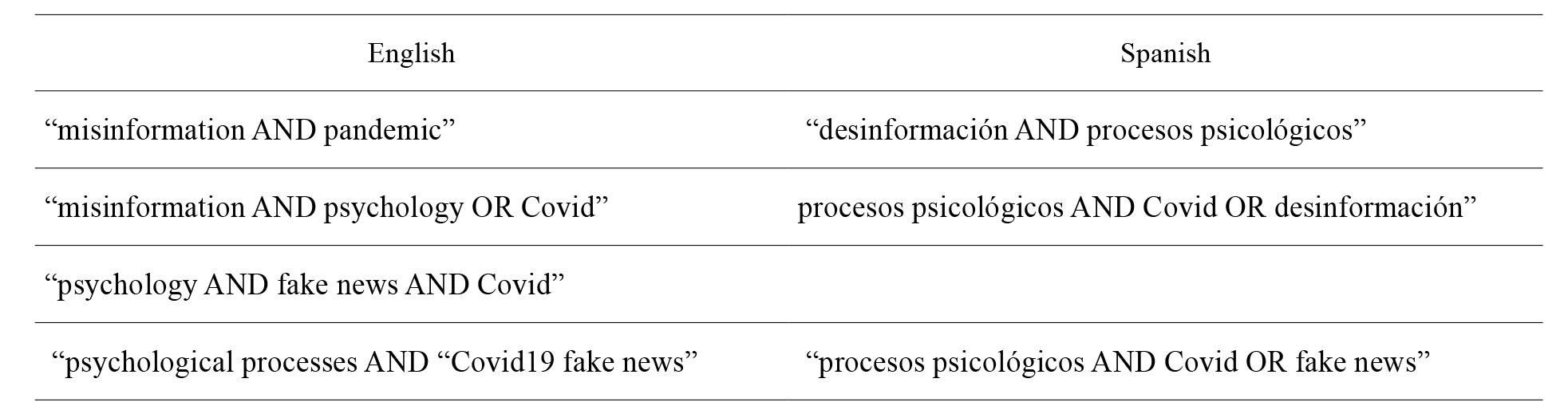
Note. This table describes the combinations of keywords searched in Databases.
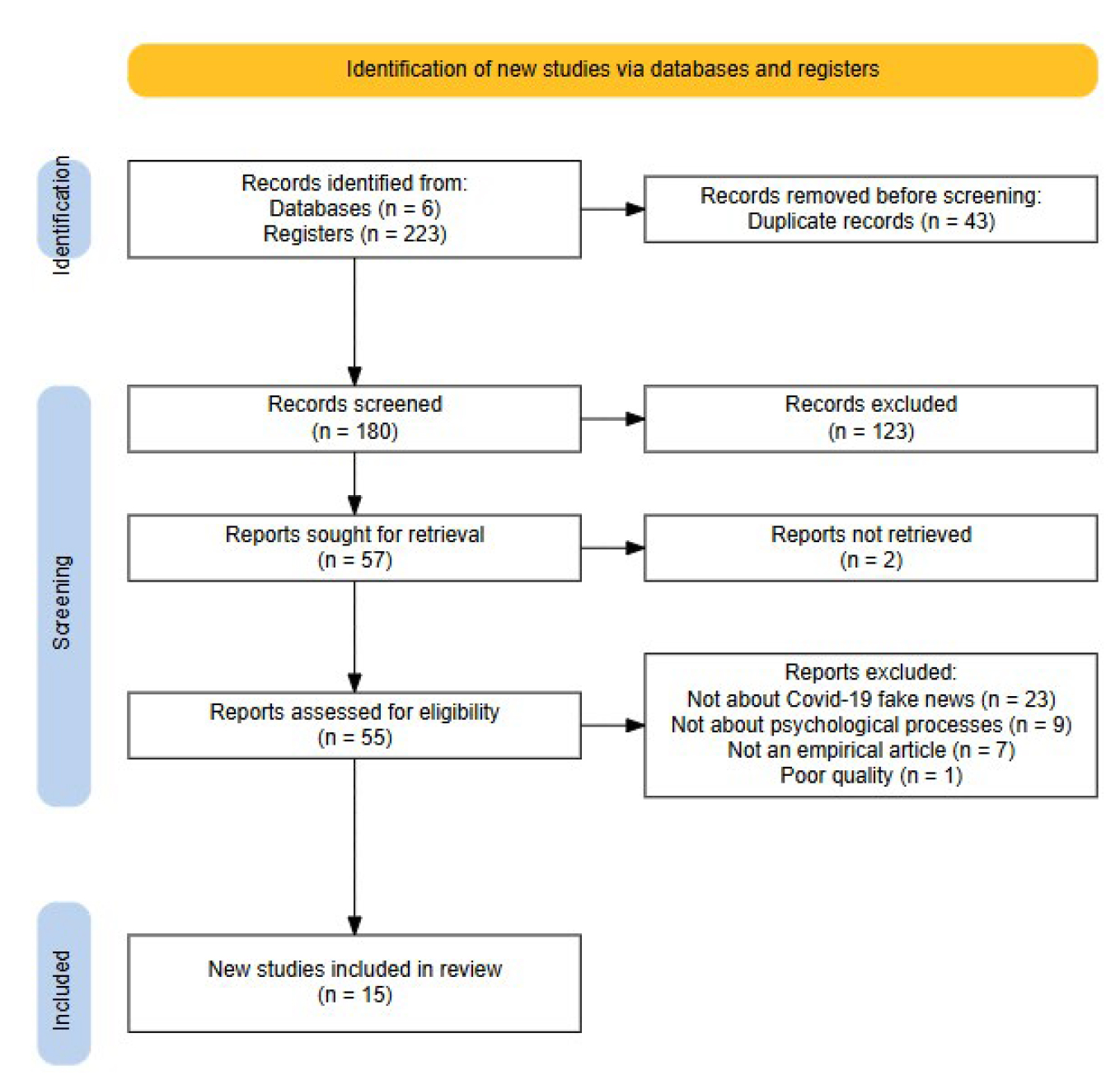
Next, in step 2, on our initial search, 223 articles (see Figure 1) were retrieved: 84 from Web of Science, 1 from Apa PsycInfo, 38 from ERIC, 8 from Psicodoc, 23 from Pubmed, and 69 from Scopus. All articles were subsequently exported and stored in a Zotero file and reviewed by title in order to identify and delete duplicates. A total of 189 articles remained after this.
Search Strategy and Inclusion Criteria
In step 3, at least three researchers gathered in groups according to our inclusion criteria to conduct title and abstract screening. Articles that met the inclusion criteria (Table 2) were included for full text screening. A total of 123 articles were excluded from the analysis in this step. In step 4, 57 studies went through full-text screening on the same three criteria of step 3, 2 of which could not be retrieved. This led to a final list of 18 articles meeting criteria (see Figure 1).
Table 2 Inclusion and exclusion criteria
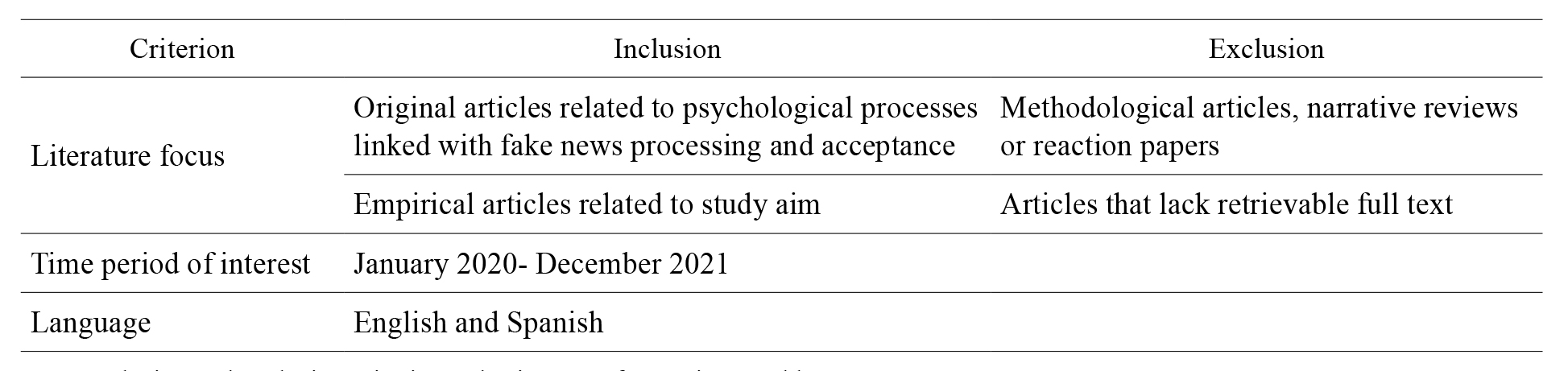
Note. Inclusion and exclusion criteria used: Literature focus, time, and language.
Figure 1. PRISMA Flowchart selection process
Data Extraction
Two reviewers independently coded articles in an Excel matrix by author, sample, study design, data collection method, psychological process linked with acceptance of fake news (e.g., irrational beliefs may predict less Covid-19 preventive behaviors), interacting variables, and main findings.
Results
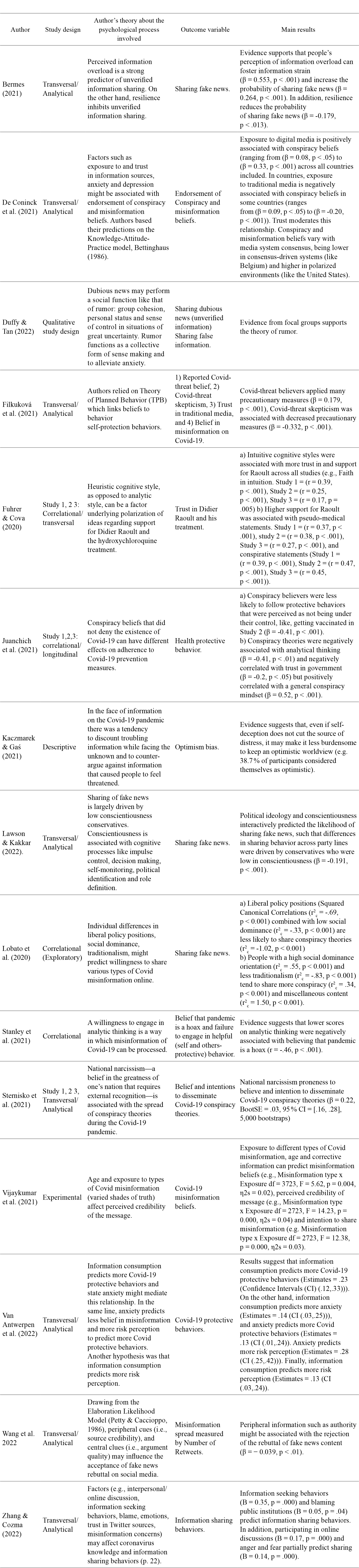
We will briefly describe the characteristics of the studies that are relevant to our goal. Also, we included a resume table (See Table 3) of authors, design, author's theory, dependent variable, and main results regarding psychological processes and acceptance of fake news.
Table 3 Author's theory
Year of Publication and Country
There were 1 out of15 studies conducted in 2020, 9 out of 15 conducted in 2021, and 5 out of 15 conducted in 2022. Studies were conducted in the United States (n = 5), Germany (n = 1), Norway (n = 1), UK (n = 1), Poland (n = 1), Singapore (n = 1), other studies had samples from multiple countries (n = 5).
Study Design
Studies reported in this review include quantitative (n = 14) and qualitative studies (n = 1). Among those of quantitative design, one was descriptive (n = 1), some were correlational (n = 12), and one consisted of an online experiment (n = 2).
Sample and Data Collection Strategy
Some studies collected data directly from participants (n = 14) using data collection procedures like online survey questionnaires (n = 12), semi structured interviews (n = 1), and a study reported in-person and online focus groups (n = 1), and indirectly from content posted by fuse databases (n = 1). Direct data collection included data collection from platforms such as Amazon's Mechanical Turk (n = 4), Qualtrics (n = 2) and Polling firms (n = 2), and Prolific (n = 1). Other direct data collection strategies (i.e., Telephonically, through social media) were through mails (n = 1), telephonically (n = 1), social media (n = 1), and websites (n = 2).
Discussion
This scoping review aimed at exploring and synthesizing the emerging body of literature that investigated psychological processes associated with the acceptance of fake news in the context of the Covid-19 pandemic. The Covid-19 pandemic is a novel scenario combining a health crisis and an existential threat with a sudden increase of interactions mediated by social networks as a result of containment policies all over the world. The WHO recognized the dangers of an infodemic (WHO, 2020), which, within the context of a global health crisis led to incorrect interpretations of health information, affecting people's health and the efficacy of the health system in relaying the provision of health care, and offering an scenario for the dissemination of a rhetoric of hate and division (Borges do Nascimento, 2022). Beyond the pandemic, it could be argued that the preexisting tendency toward the mediation of social interactions through virtual means was significantly increased and consolidated under the pressure of the pandemic (Perez-Brumer et al., 2022; Willermark & Gellerstedt, 2022). This created new challenges and deepened already existing ones in terms of dealing with misinformation; challenges that transcend the scope of the Pandemic.
A recent review by Borges do Nascimento (2022) aimed at comparing and summarizing the available literature on infodemics during the pandemic analyzed 31 studies; however, none of them specifically focused on psychological aspects that facilitate the spread of misinformation. Thus, despite existing research on the circulation and spread of misinformation in general, research considering psychological aspects of the general audience associated with the spread of misinformation through social networks in the context of an existential threat is scarce. This is important given not only the increasing mediation of social interaction by social networks but also that similar or related existential threats where infodemics continue to have an important potential for harm are part of today's global reality. This review contributes to filling the knowledge gap by focusing on research on psychological aspects associated with the spread of misinformation. More specifically, we reviewed a total of 14 (out of 223 screened) articles that met criteria for inclusion conducted between January 2020 to December 2022, that investigated psychological aspects related to the behavior of fake news acceptance and willingness to share misinformation.
Brief Description of Empirical Articles
Individual Differences
Other individual variability aspects that may play a role in the endorsement of conspiracy beliefs about the pandemic are sociodemographic characteristics and social context. First, belief in misinformation can be affected by age, such that younger adults may be more willing to endorse and share Covid-19 misinformation than older adults (Vijaykumar et al., 2021). Second, the reviewed evidence suggests that individuals with lower formal education (van Prooijen, 2017, cited in Juanchich et al., 2021), greater exposure to digital media, and lower exposure to traditional media (De Coninck et al., 2021) are more likely to believe in fake news compared to than others. Consistently, social media consumption is associated with greater beliefs in general conspiracy theories and more Covid conspiracy theories (Xiao, Borah & Su, 2021).
Evidence before the pandemic suggests an association between conspiracy beliefs and the endorsement of fake news, which seems to be stronger among more conservative people (Bruder et al., 2013, cited in Juanchich et al., 2021). Consistently, an exploratory survey conducted by Lobato et al. (2020) suggested that individual differences (e.g., more liberal policy positions and lower social dominance orientation) can predict less willingness to share conspiracy content (e.g., "5G cellular service technology is linked to cause of the coronavirus"). Other findings suggest that higher social dominance orientation and less traditionalism can predict more willingness to share conspiracy content and miscellaneous content (e.g., "Idris Elba and other celebs have been paid to say they have coronavirus"). Also, national narcissism, defined as the individual tendency to believe in "the greatness of one's nation that requires external recognition" (p. 1), appears to predict more spread of Covid misinformation (Sternisko et al., 2021), as well as with lower trust in the government (Juanchich et al., 2021). Some evidence suggests that fake news may find greater support in contexts with a more polarized political and media environment (De Coninck et al., 2021). In contrast, evidence like that of Fuhrer and Cova (2020) suggest that there is no robust association of political orientation and endorsement of conspiracy beliefs about Covid-19 pandemic and other beliefs (e.g., Truth is political, pseudo-medical beliefs). Hence, an aspect that needs further exploration.
Evidence from Lawson & Kakkar (2022) suggests that there is an interaction between consciousness and political ideology when predicting the probability of sharing fake news. Lower conscientiousness and conservative ideology predict more likelihood of sharing fake news.
Belief Consistency
A belief system is defined here as a cognitive map that represents and structures our reality, guiding individuals in their relational functioning (Bernal Sarmiento, 2020). Empirical evidence from before the pandemic had already demonstrated the impact of belief consistency on individual's willingness to accept information (Vijaykumar et al., 2021). Seven articles highlighting the association between the endorsement of conspiracy theories and fake news provide additional evidence of this relationship. The evidence reviewed here suggests that the endorsement of conspiracy theories predicts support for information suggesting less compliance with social regulations, less support to health public policies (Sternisko et al., 2021). Nevertheless, evidence from Juanchich et al. (2021) suggests that despite rejecting Covid testing and vaccination, believers in conspiracy theories may defend the adoption of other self-protective behavior and be willing to endorse adherence to other guidelines like hand-washing and social distancing. In the same line of reasoning, conspiracy theories can predict more support and willingness to engage in pseudo-medical treatments (Fuhrer & Cova, 2020), less willingness to install a contact tracing app (Juanchich et al., 2021), and finally, more dissemination of Covid-19 misinformation (Juanchich et al., 2021; Sternisko, 2021), and predict less Covid threat appraisal and less trust in Covid information sources (Surina et al., 2021).
Emotional Experience
Findings from van Antwerpen et al. (2021) suggest that beliefs in misinformation may act as a mediator variable in the relationship between anxiety and Covid-protective behaviors. Higher anxiety can lead to reduced belief in misinformation, while lower belief in misinformation may predict fewer Covid-19 protective behaviors in a U.S.-based model. However, in Australia samples, such mediational relationships were not found (van Antwerpen et al., 2021). Other findings suggest that people motivated to avoid the painful implications of the information may be more willing to endorse deceitful information if it gives them hope. This leads to the reinforcement of a tendency to self-deception because it enables a sense of well-being, even if self-deception does not cut the source of distress (Kaczmarek & Gas, 2021). Other empirical findings suggest that emotions such as anger and fear partially provoke information sharing behaviors (Zhang & Cozma, 2022). Also, there is some evidence from Zhang y Cozma (2022) that suggests that blame to public institutions can predict more information sharing behaviors.
Regarding stress, people tend to share less misinformation when their capacity to process the large quantity of information online is overloaded and when they perceive it as a strain. On the other hand, resilience, or the ability to bounce back can inhibit is probability to share information (Bermes, 2021). Duffy and Tan (2022) suggested motivations in which people share dubious news. Dubious news refers to sharing false news content, but the sharer does not know about its veracity. Motivation to share dubious news are to build relationships, as a form of self-presentation (or personal status), and as a form of collective sense-making.
Cognitive Styles
Regarding cognitive styles, evidence suggests that less analytical cognitive processing can lead to more endorsement of fake news. Wang et al. (2022) suggest that there are systematic and heuristic processing factors in the acceptance of fake news. Fuhrer and Cova (2020) found evidence of cognitive styles and the endorsement of fake news. Intuitive cognitive styles were associated with grater trust and support for hydroxychloroquine treatments as advocate by the French doctor Di-dier Raoult. Third, Stanley et al. (2021) suggest that less engagement in analytic thinking were more associated with believing that the pandemic is a hoax. Other cognitive factors are related to endorsement of fake news. More extreme views (underestimation and overestimation) on threat assessment were associated with confidence in Covid-19-related misinformation. The association was particularly strong for participants who were more skeptical about the seriousness of the Covid-19 threat (Filkuková et al., 2021).
Conclusions, Limitations, and Recommendations
This article aimed to conduct a scoping review focused on studying the psychological processes associated with the acceptance of fake news about Covid-19. The scoping review suggests that there are many psychological factors associated with acceptance of Covid-19 fake news on belief consistency, emotional experience, individual differences, and traits and cognitive styles.
In relation to belief consistency, evidence regarding the relationship between the consistency of conspiracy theories, beliefs about Covid-19 and acceptance of fake news is mixed and more research is needed to clarify the nature of this relationship. Regarding emotional experience, there is evidence that emotions such as anger and fear partially predict information sharing behaviors (Zhang & Cozma, 2022). However, other evidence suggests that anxiety can provoke less endorsement in misinformation beliefs (van Antwerpen et al., 2021), and more research is needed on the role of emotions in predicting. On the other hand, perceiving information overload of Covid-19 fake news and experiencing it as a strain can lead to increased sharing of fake news, as people tend to process it less critically (Bermes, 2021).
Considering individual differences and traits, the scoping review suggests that existing research suggests that age (e.g., younger adults) (Vijayku-mar et al., 2021), lower education (van Prooijen, 2017, cited in Juanchich et al., 2021), and higher exposure to digital media (De Coninck et al., 2021) may play a role in predicting acceptance and sharing of fake news. In addition to this, evidence on the relationship between political conservatism and the endorsement of fake news is not clear (Fuhrer & Cova, 2020), and further research is needed to establish the existence of an empirical relationship between political orientation and the endorsement of fake news.
Finally, regarding cognitive styles, intuitive cognitive styles were more associated with higher endorsement of fake news (Fuhrer & Cova, 2020; Stanley et al., 2021; Wang et al., 2022). There are other explanatory variables, such as content, in the systematic processing side that predicts endorsement (Wang et al., 2022). This scoping review also highlights that, beyond hedonistic mentality, there are other motivations for sharing misinformation. These align with the theory of rumor and information processing, suggesting that engaging in rumor serves additional purposes, such as building relationships, gaining status, and participating in collective sense-making (Duffy & Tan, 2022). This might lead to the hypotheses that fake news is more than creating false content to deceive.
In all, further research is needed to understand the psychological processes involved in the transmission of information through social networks. In particular, fake news and misinformation are especially concerning due to their potential to influence health and other critical outcomes during times of crisis and existential threats.
References
Abbas, J., Wang, D., Su, Z., & Ziapour, A. (2021). The role of social media in the advent of Covid-19 pandemic: Crisis management, mental health challenges and implications. Risk Management and Healthcare Policy, 14, 1917-1932. https://doi.org/10.2147/RMHP.S284313
Alvi, I., & Saraswat, N. (2020). Information processing-heuristic vs systematic and susceptibility of sharing Covid-19-related fake news on social media. Journal of Content, Community and Communication, 12, 42-56. https://doi.org/10.31620/JCCC.12.20/06
Anderson, J., Rainie, L., & Vogels, E. A. (2021). Experts say the 'new normal' in 2025 will be far more tech-driven, presenting more big challenges. PewResearch Center, https://www.pewresearch. org/internet/2021/02/18/experts-say-the-new-normal-in-2025-will-be-far-more-tech-driven-presenting-more-big-challenges/
Anspach, N. M., & Carlson, T. N. (2020). What to believe? Social media commentary and belief in misinformation. Political Behavior, 42(4), 697-718. https://doi.org/10.1007/s11109-018-9515-z
Beauvais, C. (2022). Fake news: Why do we believe it? Joint Bone Spine, 89(4), Article 105371. https://doi.org/10.1016/jjbspin.2022.105371
Bermes, A. (2021). Information overload and fake news sharing: A transactional stress perspective exploring the mitigating role of consumers' resilience during Covid-19. Journal of Retailing and Consumer Services, 61, Article 102555. https://doi.org/10.1016/j.jretconser.2021.102555
Bernal Sarmiento, L. A. (2020). Validación psicométrica del inventario sistemas de creencias en el Ecuador. Psychology, Society & Education, 12(2), 33-47. https://doi.org/10.25115/psye.v12i2.2741
Cichocka, A., & Dhont, K. (2018). The personality bases of political ideology and behavior. In V. Zeigler-Hill & T. K. Shackelford (Eds.), The SAGE handbook of personality and individual differences (Vol. 3, pp. 323-351). SAGE.
De Coninck, D., Frissen, T., Matthijs, K., d'Haenens, L., Lits, G., Champagne-Poirier, O., & Généreux, M. (2021). Beliefs in conspiracy theories and misinformation about Covid-19: Comparative perspectives on the role of anxiety, depression and exposure to and trust in information sources. Frontiers in Psychology, 12, Article 646394. https://doi.org/10.3389/fpsyg.2021.646394
Dhanani, L. Y., & Franz, B. (2020). The role of news consumption and trust in public health leadership in shaping Covid-19 knowledge and prejudice. Frontiers in Psychology, 11, Article 560828. https://doi.org/10.3389/fpsyg.2020.560828
Dillon, J., & Avraamidou, L. (2020). Towards a viable response to Covid-19 from the science education community. Journal of Activist Science & Technology Education, 11 (2), 1-6. https://doi.org/10.33137/jaste.v11i2.34531
Duffy, A., & Tan, N. N. (2022). Dubious news: The social processing of uncertain facts in uncertain times. Digital Journalism, 10(3), 395-411. https://doi.org/10.1080/21670811.2021.1953390
Fernández, F. R. (2020). Comunicación y noticias falsas en relación al Covid-19: algunas reflexiones sobre la información, la desinformación y propuestas de mejora. Revista Española de Comunicación en Salud, Suppl. 1, 253-264. https://doi.org/10.20318/recs.2020.5375
Filkuková, P., Ayton, P., Rand, K., & Langguth, J. (2021). What should I trust? Individual differences in attitudes to conflicting information and misinformation on Covid-19. Frontiers in Psychology, 12, Article 588478. https://doi.org/10.3389/fpsyg.2021.588478
Freeman, D., Waite, F., Rosebrock, L., Petit, A., Causier, C., East, A., & Lambe, S. (2022). Coronavirus conspiracy beliefs, mistrust, and compliance with government guidelines in England. Psychological Medicine, 52(2), 251-263. https://doi.org/10.1017/S0033291720001890
Fuhrer, J., & Cova, F. (2020). "Quick and dirty": Intuitive cognitive style predicts trust in Didier Raoult and his hydroxychloroquine-based treatment against Covid-19. Judgment & Decision Making, 15(6) 889-908. https://doi.org/10.1017/S1930297500008123
Greene, C. M., & Murphy, G. (2021). Quantifying the effects of fake news on 'font-family:"Verdana",sans-serif'>https://doi.org/10.1037/xap0000371
Greifeneder, R., Jaffe, M., Newman, E., & Schwarz, N. (2021). The psychology of fake news: Accepting, sharing, and correcting misinformation. Routledge.
Gupta, S., Rouse, B. T., & Sarangi, P. P. (2021). Did climate change influence the emergence, transmission, and expression of the Covid-19 pandemic? Frontiers in Medicine, 8, Article 769208. https://doi.org/10.3389/fmed.2021.769208
Haddaway, N. R., Page, M. J., Pritchard, C. C., & McGuinness, L. A. (2022). PRISMA2020: An R package and Shiny app for producing PRISMA 2020-compliant flow diagrams, with interactivity for optimised digital transparency and open synthesis. Campbell Systematic Reviews, 18, Article e1230. https://doi.org/10.1002/cl2.1230
Hadlington, L., Harkin, L. J., Kuss, D., Newman, K., & Ryding, F. C. (2023). Perceptions of fake news, misinformation, and disinformation amid the Covid-19 pandemic: A qualitative exploration. Psychology of Popular Media, 12(1), 40-49. https://doi.org/10.1037/ppm0000387
Hong, Q. N., Gonzalez-Reyes, A., & Pluye, P. (2018). Improving the usefulness of a tool for appraising the quality of qualitative, quantitative and mixed methods studies: The mixed methods appraisal tool (MMAT). Journal of Evaluation in Clinical Practice, 24, 459-467. https://doi.org/10.1111/jep.12884
Horesh, D., & Brown, A. D. (2020). Covid-19 response: Traumatic stress in the age of Covid-19: A call to close critical gaps and adapt to new realities. Psychological Trauma: Theory, Research, Practice, and Policy, 12(4), 331-335. https://doi.org/10.1037/TRA0000592
Huang, Y., & Zhao, N. (2020). Mental health burden for the public affected by the Covid-19 outbreak in China: Who will be the high-risk group? Psychology, Health & Medicine, 26(1), 23-34. https://doi.org/10.1080/13548506.202 0.1754438
Juanchich, M., Sirota, M., Jolles, D., & Whiley, L. A. (2021). Are Covid-19 conspiracies a threat to public health? Psychological characteristics and health protective behaviours of believers. European Journal of SocialPsychology, 51(6), 969-989. https://doi.org/10.1002/ejsp.2796
Kaczmarek, B. L., & Gas, Z. B. (2021). The power of self-deception: Psychological reaction to the Covid-19 threat. Acta Neuropsychologica, 19(3), 319-328. https://doi.org/10.5604/01.3001.0015.0613
Kahan, D. M. (2017, May 24). Misconceptions, misinformation, and the logic of identity-protective cognition. Cultural Cognition Project Working Paper Series No. 164, Yale Law School, Public Law Research Paper No. 605, Yale Law & Economics Research Paper No. 575. https://doi.org/10.2139/ssrn.2973067
Kim, S., & Kim, S. (2020). The crisis of public health and infodemic: Analyzing belief structure of fake news about Covid-19 pandemic. Sustainability, 12(23), Article 9904. https://doi.org/10.3390/su12239904
Koffman, J., Gross, J., Etkind, S. N., & Selman, L. (2020). Uncertainty and Covid-19: How are we to respond? Journal of the Royal Society of Medicine, 113(6), 211-216. https://doi.org/10.1177/0141076820930665
Lawson, M. A., & Kakkar, H. (2022). Of pandemics, politics, and personality: The role of conscientiousness and political ideology in the sharing of fake news. Journal of Experimental Psychology: General, 151(5), 1154-1177. https://doi.org/10.1037/xge0001120
Levy, S. R., Chiu, C., & Hong, Y. (2006). Lay theories and intergroup relations. Group Processes & Intergroup Relations, 9(1), 5-24. https://doi.org/10.1177/1368430206059855
Lobato, E. J., Powell, M., Padilla, L. M., & Holbrook, C. (2020). Factors predicting willingness to share Covid-19 misinformation. Frontiers in Psychology, 11, Article 566108. https://doi.org/10.3389/fpsyg.2020.566108
Madziva, R., Nachipo, B., Musuka, G., Chitungo, I., Murewanhema, G., Phiri, B., & Dzinamarira, T. (2022). The role of social media during the Covid-19 pandemic: Salvaging its 'power' for positive social behavior change in Africa. Health Promotion Perspectives, 12(1), 22-27. https://doi.org/10.34172/hpp.2022.03
Manusov, V., & Spitzberg, B. H. (2008). Attribution theory: Finding good cause in the search for theory. Routledge.
Nan, X., Wang, Y., & Thier, K. (2022). Why people believe health misinformation and who are at risk? A systematic review of individual differences in susceptibility to health misinformation. Social Science & Medicine, 14, Artcile 115398. https://doi.org/10.1016/j.socscimed.2022.115398
Martel, C., Pennycook, G., & Rand, D. G. (2020). Reliance on emotion promotes belief in fake news. Cognitive Research: Principles and Implications, 5, Article 47. https://doi.org/10.1186/s41235-020-00252-3
McClain, C., Vogels, E. A., Perrin, A., Sechopoulos, S., & Rainie, L. (2021). The internet and the pandemic. Pew Research Center. https://www.pewresearch.org/internet/2021/09/01/the-internet-and-the-pandemic/
Mills, A. J., Pitt, C., & Ferguson, S. L. (2019). The relationship between fake news and advertising: Brand management in the era of programmatic advertising and prolific falsehood. Journal of Advertising Research, 59(1), 3-8. https://doi.org/10.2501/JAR-2019-007
Moher, D., Shamseer, L., Clarke, M., Ghersi, D., Liberati, A., Petticrew, M., & Stewart, L. A. (2015). Preferred reporting items for systematic review and meta-analysis protocols (PRISMA-P) 2015 statement. Systematic Reviews, 4(1), Article 1. https://doi.org/10.1186/2046-4053-4-1
Moravec, P., Minas, R., & Dennis, A. (2018). Fake news on social media: People believe what they want to believe when it makes no sense at all. Kelley School of Business Research Paper No. 18-87. https://doi.org/10.2139/ssrn.3269541
Panneer, S., Kantamaneni, K., Palaniswamy, U., Bhat, L., Pushparaj, R. R. B., Nayar, K. R., & Rice, L. (2022, April). Health, economic, and social development challenges of the Covid-19 pandemic: Strategies for multiple and interconnected issues. Healthcare, 10(5), Article 770. https://doi.org/10.3390/healthcare10050770
Pennycook, G., & Rand, D. G. (2021). The psychology of fake news. Trends in Cognitive Sciences, 25(5), 388-402. https://doi.org/10.1016/j.tics.2021.02.007
Perez-Brumer, A., Balasa, R., Doshi, A., Brogdon, J., Doan, T., & Oldenburg, C. E. (2022). Covid-19 related shifts in social interaction, connection, and cohesion impact psychosocial health: Longitudinal qualitative findings from Covid-19 treatment trial engaged participants. International Journal of Environmental Research and Public Health, 19(16), Article 10264. https://doi.org/10.3390/ijerph191610264
Petty, R. E., & Cacioppo, J. T. (1986). The elaboration likelihood model of persuasion. In R. E. Petty, & J. T. Cacioppo (Eds.), Communication and persuasion (pp. 1-24). Springer. https://doi.org/10.1007/978-1-4612-4964-1_1
Plaks, J. E., Levy, S. R., & Dweck, C. S. (2009). Lay theories of personality: Cornerstones of meaning in social cognition. Social and Personality Psychology Compass, 3, 1069-1081. https://doi.org/10.1111/j.1751-9004.2009.00222.x
Preston, S., Anderson, A., Robertson, D. J., Shephard, M. P., & Huhe, N. (2021). Detecting fake news on Facebook: The role of emotional intelligence. PLOS ONE, 16(3), Article e0246757. https://doi.org/10.1371/journal.pone.0246757
Majerczak, P., & Strzelecki, A. (2022). Trust, media credibility, social ties, and the intention to share towards information verification in an age of fake news. Behavioral Sciences, 12(2), Article 51. https://doi.org/10.3390/bs12020051
Puig, B., Blanco-Anaya, P., & Pérez-Maceira, J. J. (2021). "Fake news" or real science? Critical thinking to assess information on Covid-19. Frontiers in Education, 6, Article 646909. https://doi.org/10.3389/feduc.2021.646909
Quinn, E. K., Fazel, S. S., & Peters, C. E. (2021).
The Instagram infodemic: Cobranding of conspiracy theories, coronavirus disease 2019 and authority-questioning beliefs. Cyberpsychology, Behavior, and Social Networking, 24(8), 573-577. https://doi.org/10.1089/cyber.2020.0663
Ramírez, L. F., & Levy, S. (2010). Sentido común y conflicto: impacto de las teorías legas sobre relaciones intergrupales. Universitas Psychologica, 9(2), 331-344. https://doi.org/10.11144Javeriana.upsy9-2.scci
Rizal, A. R. A., Nordin, S. M., Ahmad, W. F. W., Khiri, M. J. A., & Hussin, S. H. (2022). How does social media influence people to get vaccinated? The elaboration likelihood model of a person's attitude and intention to get Covid-19 vaccines. International Journal of Environmental Research and Public Health, 19(4), Article 2378. https://doi.org/10.3390/ijerph19042378
Shih, H.-P., Lai, K.-H., & Cheng, T. C. E. (2023). Compiled by belief consistency: The cognitive-information lens of user-generated persuasion. Journal of Theoretical and Applied Electronic Commerce Research, 18(1), 372-393. https://doi.org/10.3390/jtaer18010020
Souza, M. T. D., Silva, M. D. D., & Carvalho, R. D. (2010). Integrative review: What is it? How to do it? Einstein (São Paulo, Brazil), 8, 102-106. https://doi.org/10.1590/s1679-45082010rw1134
Stanley, M. L., Barr, N., Peters, K., & Seli, P. (2021). Analytic-thinking predicts hoax beliefs and helping behaviors in response to the Covid-19 pandemic. Thinking & Reasoning, 27(3), 464-477. https://doi.org/10.1080/13546783.2020.1813806
Sternisko, A., Cichocka, A., Cislak, A., & Van Bavel, J. J. (2023). National narcissism predicts the belief in and the dissemination of conspiracy theories during the Covid-19 pandemic: Evidence from 56 countries. Personality and Social Psychology Bulletin, 49(1), 48-65. https://doi.org/10.1177/01461672211054947
Surina, S., Martinsone, K., Perepjolkina, V., Kolesnikova, J., Vainik, U., Ruza, A., Vrublevska, J., Smirnova, D., Fountoulakis, K., & Rancans, E. (2021). Factors related to Covid-19 preventive behaviors: A structural equation model. Frontiers in Psychology, 12, Article 676521. https://doi.org/10.3389/fpsyg.2021.676521
Tamayo, R. (2011). A checklist to define the psychological processes. Revista Colombiana de Psicología, 20(2), 321-327. http://www.scielo.org.co/scielo.php?script=sci_arttext&pid=S0121-54692011000200013&lng=en&tlng=en
Tomasello, M. (2009). Why we cooperate. The MIT Press.
Xiao, X., Borah, P., & Su, Y. (2021). The dangers of blind trust: Examining the interplay among social media news use, misinformation identification, and news trust on conspiracy beliefs. Public Understanding of Science, 30(8), 977-992. https://doi.org/10.1177/0963662521998025
Van Antwerpen, N., Turnbull, D., & Searston, R. A. (2022). The role of anxiety in mediating the relationship between information consumption and Covid-19 protective behaviors. Psychology,Health & Medicine, 27(9), 2043-2056. https://doi.org/10.1080/13548506.2021.2008994
Van Bavel, J. J., & Pereira, A. (2018). The partisan brain: An identity-based model of political belief. Trends in Cognitive Sciences, 22(3), 213224. https://doi.org/10.1016/j.tics.2018.01.004
Van Huijstee, D., Vermeulen, I., Kerkhof, P., & Droog, E. (2022). Continued influence of misinformation in times of Covid-19. International Journal ofPsychology, 57(1), 136-145. https://doi.org/10.1002/ijop.12805
Van Mulukom, V., Pummerer, L. J., Alper, S., Bai, H., Cavojová, V., Farias, J., Kay, C., Lazarevic, L., Lobato, E., Marinthe, G., Banai, I., & Zezelj, I. (2022). Antecedents and consequences of Covid-19 conspiracy beliefs: A systematic review. Social Science & Medicine, 301, Article 114912. https://doi.org/10.1016/j.socscimed.2022.114912
Vijaykumar, S., Jin, Y., Rogerson, D., Lu, X., Sharma, S., Maughan, A., Fadel, B., Silva de Oliveira, M., Pagliari, C., & Morris, D. (2021). How shades of truth and age affect responses to Covid-19 (mis) information: Randomized survey experiment among WhatsApp users in UK and Brazil. Humanities and Social Sciences Communications, 8, Article 88. https://doi.org/10.1057/s41599-021-00752-7
Vosoughi, S., Roy, D., & Aral, S. (2018). The spread of true and false news online. Science, 359, 1146-1151. https://doi.org/10.1126/science.aap9559
Wang, X., Chao, F., Yu, G., & Zhang, K. (2022). Factors influencing fake news rebuttal acceptance during the Covid-19 pandemic and the moderating effect of cognitive ability. Computers in Human Behavior, 130, Article 107174. https://doi.org/10.1016/j.chb.2021.107174
Willermark, S., & Gellerstedt, M. (2022). Facing radical digitalization: Capturing teachers' transition to virtual classrooms through ideal type experiences. Journal of Educational Computing Research, 60(6), 1351-1372. https://doi.org/10.1177/07356331211069424
Williams, J. C., & Lynn, S. J. (2011). Acceptance: An historical and conceptual review. Imagination, Cognition and Personality, 30(1), 5-56. https://doi.org/10.2190/IC.30.1.c
Zedelius, C. M., Müller, B. C. N., & Schooler, J. W. (Eds.). (2017). The science of lay theories: How beliefs shape our cognition, behavior, and health. Springer International Publishing. https://doi.org/10.1007/978-3-319-57306-9
Zhang, X. A., & Cozma, R (2022). Risk sharing on Twitter: Social amplification and attenuation of risk in the early stages of the Covid-19 pandemic. Computers in Human Behavior, 126, Article 106983. https://doi.org/10.1016/j.chb.2021.106983