Children's mental health is a growing concern globally (IDB et al., 2022; WHO, 2020). Currently, depression is considered one of the most prevalent mental disorders (Racine et al., 2021) and is the leading cause of disability worldwide (WHO, 2020), especially in developing countries such as Ecuador (Muñoz et al., 2021). Although the prevalence of depression in children and adolescents is influenced by various factors, it is estimated to affect between 0.6 % and 3 % of the child population (Ghandour et al., 2019; Merikangas et al., 2009; Polanczyk et al., 2015). Additionally, a recent study conducted in a sample of 1350 children and adolescents aged 6 to 18 years in Ecuador found that around 11.7 % of participants had psychological problems (anxiety, internalizing problems, obsessive-compulsive, and thought) (Romo, 2020). Specifically, between 11.2 % and 12.6 % of children and adolescents had internalizing problems (Romo, 2020). Despite this, no studies have directly examined the prevalence of depressive disorders in childhood and adolescence in Ecuador.
On the other hand, depressive symptoms can manifest in early stages such as childhood and adolescence, and the presence of depression can predict the onset of future psychological disorders, as well as worsen symptoms over time (Avenevoli et al., 2015; Bufferd et al., 2012; Lewis et al., 2020; Luby et al., 2014; Muñoz et al., 2021; Rudolph et al., 2009). Therefore, it is essential to have assessment instruments that enable the early detection of the disorder and, in turn, prevent future psychological conditions (Canals-Sans et al., 2018; Luby, 2010; Wesselhoeft et al., 2013).
The participation of community populations in psychometric studies is particularly relevant, as it allows for the evaluation of the utility and applicability of instruments in everyday contexts, facilitating their implementation in preventive and clinical interventions (Lau et al., 2016). Additionally, working with this population provides an opportunity to identify specific needs and adapt assessment tools to the characteristics of the community, contributing to equality in mental health. Multi-informant assessment, including parental reports, has proven useful for accurately evaluating children's internalizing problems (Figueras, 2006; Izquierdo-Sotorrío et al., 2016; Kerr et al., 2007; Sarmento-Henrique et al., 2017). Parents are a particularly valuable source of information in the case of preadolescent and younger children (Dougherty et al., 2008; Rey et al., 2015). This perspective complements children's self-assessments and provides a more comprehensive understanding of the manifestation of the problem.
One of the most widely used and effective questionnaires for assessing depressive symptoms in children and adolescents is the Short Mood and Feelings Questionnaire (SMFQ; Angold et al., 1995). This questionnaire consists of 13 items, making it brief, simple, and easy to complete. Additionally, it is available for free. The SMFQ has demonstrated good psychometric properties and a unifactorial structure in various studies (Banh et al., 2012; Deeba et al., 2015; Rhew et al., 2010; Schlechter et al., 2023; Sharp et al., 2006; Talja et al., 2022; Thapar & McGuffin, 1998), making it a reliable assessment tool. Compared to other scales, such as the Children's Depression Inventory (CDI; Kovacs, 1981) and the Revised Children's Manifest Anxiety Scale (RCMAS; Reynolds & Richmond, 1978), the SMFQ stands out for its brevity and high specificity in detecting depressive symptoms (Lawton & Moghraby, 2016, Table 1).
The SMFQ has been validated and translated for populations in various countries, such as Serbia (Stevanovic, 2012), Norway (Lundervold et al., 2013), Bangladesh (Deeba et al., 2015), Brazil (Pinto, 2014), China (Yu et al., 2017), New Zealand (Thabrew et al., 2018), Thailand (Lerthattasilp et al., 2020), and Spain (Espada et al., 2022). There is also a parent version of the SMFQ, where parents report on their children's depressive symptoms (Creswell et al., 2020; Tennant et al., 2017). This type of assessment has been supported by numerous studies, as parents serve as a valuable source of information for preadolescent children (Dougherty et al., 2008), and the use of multiple informants provides a more comprehensive assessment of the problem's manifestation (Izquierdo-Sotorrío et al., 2016; Kerr et al., 2007). However, there are no studies validating this version of the questionnaire for Latin American populations.
For this reason, this study expands the literature by examining for the first time the properties of the scores and the factorial structure of the parent version of the SMFQ in a sample of Ecuadorian parents of children aged 8 to 12 years. Specifically, the study evaluated: 1) the prominence of a general factor underlying the SMFQ items using confirmatory factor analysis (CFA); 2) evidence of internal consistency; 3) convergent validity of the instrument; 4) factorial invariance by gender and age group of the children; and 5) potential differences in the SMFQ parent version's total mean scores by gender and age of the children. Based on previous studies: a) unifactorial structure of the SMFQ-P, is expected; b) the SMFQ-P will exhibit high internal consistency (alpha coefficient >0.90); c) the SMFQ-P will show evidence of convergent validity with measures of childhood anxiety; d) the instrument will show factorial invariance by gender and age group; and e) significant differences in mean scores will be observed based on the children's age and gender.
Table 1 shows the sociodemographic data of the sample. Participants were the parents of 276 children of Ecuadorian children aged 8 to 12 years (M = 9.3; SD = 1.36); 163 (59.06 %) belonged to the age group 8 to 9 years, while 113 (40.94 %) belonged to the age group 10 to 12 years. The gender distribution of the sample was as follows: 125 girls (45.29 %) and 151 boys (54.71 %). About the informants, 87 % were mothers (n = 240) and 13 % other family members (n = 36). Most of the mothers were between 35 and 44 years of age. In terms of family status, 72.1 % of the participants were married, 14.1 % were separated or divorced and 13.8 % were single. In addition, 27.2 % had a doctorate or master's degree, 46.7 % had a bachelor's degree, 14.1 % had secondary education, and 10.9 % had primary education, and only 1.1 % of the informants were students. Regarding the employment status of the informants, most were employed full-time (32.6 %) or self-employed (32.6 %); 12 % had a part-time job, 20.7 % were unemployed, and 2.1 % were housewives. Finally, although the majority of participants (25.2 %) did not wish to report their socioeconomic status, more than 50 % had an income of less than €2000.
The inclusion criteria for participation in the study were that the children be between 8 and 12 years of age and that informed parental consent be obtained.
Regarding the sociodemographic variables of the children included in the study, age and sex were evaluated. For the parents, the following variables were reported: age, family situation, education, work situation, and socioeconomic level. The characteristics of the sample are described in Table 1.
SMFQ (Angold et al., 1995) adapted for parents to report their children's depressive symptoms. The SMFQ-P is a questionnaire developed to measure depressive symptomatology in children and adolescents aged 8 to 16 years, assessing both cognitive and affective symptoms. The questionnaire consists of 13 items, which are scored on a 3-point Likert-type scale (0 = not true, 1 = sometimes true, 2 = true), with a total score ranging from 0 to 26. The correction of the questionnaire is based on the raw total score, whereby higher scores indicate greater severity of depressive symptoms. The questionnaire has shown good reliability and validity, with internal consistency ranging from 0.84 to 0.87 in previous studies (Angold et al., 1995; Rhew et al., 2010).
This scale is a parental version of the Spence Children Anxiety Scale (Spence, 1998) where parents respond about their children's anxious symptomatology. The SCAS-P-8 is composed of 8 items that assess the anxious symptomatology of children and adolescents aged 8 to 12 years. Responses are collected using a 4-point Likert-type scale (0: never, 1: sometimes, 2: often, 3: always) with a total score ranging from 0 to 24; the higher the score the greater the severity of the symptoms. In this study we used the validated version of the scale for the Ecuadorian population (Orgilés et al., in review). The SCAS-P-8 showed adequate psychometric properties, with a high ordinal alpha (α = 0.85), and corrected item-total correlations ranging from 0.41 to 0.61, indicating an acceptable level of homogeneity.
The present study was approved by the Ethics Committee of the Miguel Hernández University (Ref. ADH.DES.MAIG.MAIG.23). First, since the original English version of the SMFQ was translated into European Spanish, it was necessary to confirm that the items were valid for the Ecuadorian population. To this end, a native psychologist affiliated with a university in Ecuador reviewed the items in the Spanish version of the SMFQ to determine whether any adaptations were needed to fit the cultural context. After thorough analysis, it was concluded that the items retained their validity in the Ecuadorian context, as the concepts assessed were culturally relevant and understandable. For this reason, no additional adaptations to the content of the scale were considered necessary. Subsequently, a pilot test of the scale was conducted with five parents of children aged 8 to 12 years to ensure that the items were understood. This pilot test confirmed that the instructions and language used were clear to the participants, and no modifications were required.
For data collection, the study sample was recruited through social media platforms (Facebook, Twitter, and Instagram). An online survey was created using Google Forms and distributed using the non-probabilistic snowball sampling method. To minimize potential biases associated with online administration, the following measures were implemented: 1) the instructions were designed to be clear and detailed, reducing the risk of misinterpretation; 2) participants were provided with an email address for the research team to contact in case of questions or technical difficulties; and 3) parents were reminded of the importance of responding honestly and thoughtfully, without being influenced by their own perceptions.
In this study, the informants of the children's emotional symptoms were the parents, who completed the assessment online. Before completing the survey, parents were informed about the study's content, procedure, and objectives, and their informed consent was obtained. Participation was voluntary and anonymous. Sociodemographic data of the families were collected, and no incentives were offered for participation. The estimated time to complete the questionnaires was approximately 10 minutes.
The sample size (N = 276) was based on recommended subject-to-item ratios for scale validation (Costello & Osborne, 2005; Nunnally & Bernstein, 1994), exceeding the minimum suggested. The unidimensional model and sample size also meet CFA criteria (Hair et al., 2010). Additionally, according to Monte Carlo simulations by Wolf et al. (2013), sample sizes between 90 and 200 participants are generally sufficient for one-factor models with moderate-to-high loadings (≥00.60), supporting the adequacy of the sample for this type of analysis.
SPSS v25 for Mac was used to analyze the sample characteristics and other descriptive analyses (e. g., means, standard deviations, etc.). Confirmatory factor analysis (CFA) and ordinal alpha were run with R Studio-2022.02.2-485 for Mac. Diagonally weighted least squares (DWLS), an estimator using polychoric correlations, was used following previous validation studies of the SMFQ (Espada et al., 2022; Fernández-Martínez, Morales, Espada et al., 2020; Fernández-Martínez, Morales, Méndez et al., 2020). Due to the ordinal nature of the items, the DWLS was considered a better estimator than the maximum likelihood estimator (Forero et al., 2009). The goodness-of-fit of the model was assessed by the following indices and values: CFI and TLI ≥00.95, RMSEA and SRMR <0.08 (Barrett, 2007; Hu & Bentler, 1999; Kenny et al., 2015; MacCallum et al., 1996). Evidence of internal consistency was provided by ordinal alpha, an index appropriate for ordinal items included in one-factor instruments (Gadermann et al., 2012). Multiple Group Confirmatory Factor Analyses (MG-CFA) were conducted to study the parent version of the SMFQ-P on children's gender ("male" and "female") and age ("8 to 9 years old" and "10 to 12 years old"). Spearman's rank correlation and the Mann-Whitney U test were applied. These non-parametric techniques are appropriate for assessing relationships between variables and comparing independent groups, respectively.
First, we examined configurational invariance, where parameters are free to vary between comparison groups. This analysis is theoretically justified based on the observed differences in depression prevalence between boys and girls, as well as the differential impact that developmental changes may have on the expression of depressive symptoms in these two age groups (Petersen et al., 1993; Zahn-Waxler et al., 2008). Next, we calculated weak invariance, in which factor loadings were constrained to be the same across groups. Next, strong invariance was calculated, in which both factor loadings and item intercepts were constrained across groups. The highest level of invariance was strict invariance, in which factor loadings, item intercepts, and residuals were restricted across groups. In accordance with classical recommendations (Chen, 2007; Cheung & Rensvold, 2002; Timmons, 2010), measurement invariance was established when changes in CFI/TLI ≤0.01 and RMSEA ≤0.015 across models. In addition, scores on the parent version of the SMFQ (SMFQ-P) were compared by sex and age group of children using Mann-Whitney U test. Finally, the convergent validity of the SMFQ-P was assessed by calculating Spearman's correlation with the SCAS-P-8 total score. A post-hoc statistical power analysis was conducted using G*Power version [3.1] (Faul et al., 2007) to ensure that the sample size used in this study was adequate. With an effect size of 0.5 (medium effect size according to Cohen, 1988), an alpha level of 0.05, and a desired power of 0.80, the analysis indicated that a minimum sample size of 184 participants per group was required. The sample used in this study [N = 276] was sufficient to detect significant effects in the analyses performed.
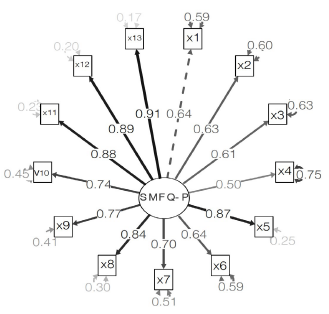
The original one-factor model of the SMFQ-P provided a good fit in the Ecuadorian sample. The single-factor solution provided an adequate fit, X2 = 109.27, df = 65, x2/df = 1.68, CFI = 0.99, TLI = 0.99, and RMSEA = 0.05, 90 % CI [0.03, 0.06]; SRMR = 0.06. The factor loadings shown in Figure 1 are all statistically significant with standardized loading values above 0.49, ranging from 0.50 (Item 4) to 0.91 (Item 13).
Table 2 shows descriptive statistics of the SMFQ-P, including means, standard deviations, corrected item-test correlations, and ordinal alphas for the total sample and the four subsamples analyzed: boys, girls, 8-9 year-olds, and 10-12 year-olds. The mean SMFQ-P was 8.60 (SD = 6). The total ordinal alpha was adequate (α = 0.94) including all 13 items. All items were retained because, except item 8, they showed an adequate corrected item-factor correlation value (>0.50) and their elimination did not imply an increase in the internal consistency of the total scale.
Overall, the results indicate that girls tend to report a greater number of depressive symptoms than boys. However, most item differences were not significant, except for item 6 (s/he cried a lot; girls M = 0.74; boys M = 0.52), and in item 12 (s/he thought s/he could never be as good as other kids, girls M = 0.77; boys M = 0.66). In addition, boys scored higher than girls on item 4 (s/he was very restless; girls M = 0.86; boys M = 1.12).
Likewise, the results show that children aged 10 to 12 years present higher depressive symptomatology than children aged 8-9 years. Specifically, this result is observed in items 2, 3, 5, 8, 9, 11, 12, and 13. Likewise, it was found that in item 4 (s/he was very restless), children aged 8 to 9 years had a higher score than those aged 10 to 12 years (M = 1.08; 10-12 years M = 0.88).
To evaluate the convergent validity of the SMFQ, the SCAS-P-8 was administered. The results indicate that the correlation between the two scales is 0.64 (p <0.01), suggesting evidence of convergent validity between the instruments. These results suggest that both instruments measure in part the same construct or dimension.
Table 3 shows the fit statistics of the multigroup confirmatory factor analysis by sex and age of the children. Considering the values of ΔCFI (≤0.01), ΔTLI (≤0.01), and ΔRMSEA (≤0.015), the Ecuadorian version of the SMFQ-P reached partial measurement invariance. For sex, although configural invariance showed a good fit, the difference in RMSEA between configural and weak invariance (ΔRMSEA = 0.03) exceeded the recommended cutoff, indicating that weak invariance was not fully achieved. Despite this, strong and strict invariance showed aceptable differences in fit indices, allowing for cautious comparisons between boys and girls. For age, all levels of invariance were supported, as ΔCFI, ΔTLI, and ΔRMSEA remained within the established thresholds, demonstrating strict invariance across age groups. These results suggest that the Ecuadorian versión of the SMFQ-P allows for reliable comparisons by age, while comparisons by sex should be interpreted with caution due to the lack of weak invariance.
The SMFQ-P scores were compared between girls and boys, as well as between 8-9 year-olds and 1012 year-olds, as acceptable measurement invariance of the SMFQ-P across sex and age had been previously established. No differences in SMFQ-P score were observed between girls (M = 8.59, SD = 5.73) and boys (M = 8.60, SD = 6.23),Mann-Whitney U test = 9280.50, p = 0.81, and between 8- to 9-year-olds (M = 8.17; SD = 5.84) and 10- to 12-year-olds (M=9.20; SD=6.19),Mann-Whitney U test = 8280.50, p = 0.15). These results suggest that the level of depression is similar by sex and age group in Ecuadorian children aged 8 to 12 years, as assessed by their parents. A small and direct correlation was found between the SMFQ-P and the age of the children (rho = 0.12; p <0.05), suggesting that older children tended to show a higher level of depressive symptoms.
The SMFQ-P is a short, free, and easy-to-use self-report questionnaire used as a screening tool to obtain information about depressive symptoms in childhood and adolescence. Given its advantages, the main objective of this study was to examine the psychometric properties and factor structure of the parental version of the SMFQ in a sample of Ecuadorian parents with children aged 8 to 12 years.
The internal consistency of the scale was high, both for the total sample (α = 0.94) and as a function of sex and age, being over 0.93 in all cases. These results are consistent with previous studies that showed reasonable reliability indices for the questionnaire, both for those self-reported (Karevold, 2017; Sucupira et al., 2017; Tennant et al., 2017) and for those reported by the parents (Angold et al., 1995; Deeba et al., 2015; Olsen, 2015; Rhew et al., 2010; Stevanovic, 2012). Compared to previous studies, the internal consistency coefficient of the Ecuadorian version is one of the highest reported, highlighting the robustness of this adaptation and its potential usefulness in the Latin American context.
Also, as expected, a moderate correlation was found between the SMFQ and the SCAS-P supporting the convergent validity of the instrument given the high comorbidity between anxiety and depressive symptoms, (González et al., 2011; Acosta et al., 2010; Lamers et al., 2011; Wu & Fang, 2014). These results are consistent with previous research conducted in European and Asian contexts, highlighting that the comorbidity between anxiety and depression is a transnational phenomenon that can be assessed using similar tools across different countries.
The confirmatory analysis shows that the SMFQ-P's original one-factor model provided a reasonable fit to the Ecuadorian sample, measuring the underlying factor of depression. The one-factor solution found in this study is consistent with previous research supporting the unidimensional structure of the scale (Angold et al., 1995; Fernández-Martínez, Morales, Espada et al., 2020; Karevold, 2017). This difference could be explained by the socioeconomic and cultural context of Ecuador, where levels of childhood depression might be influenced by external factors such as family instability and limited access to mental health resources. Factor loadings, ranging from 0.50 to 0.91, suggests that they are positively related to the latent factor of the test. Although most items had an adequate corrected item-test correlation (>0.50), item 4 ("I was very restless") had a below expected item-factor correlation (0.41), consistent with previous studies (Lundervold et al., 2013; Sucupira et al., 2017). Although item 4 had a lower correlation, it was not removed from the assessment because it is useful in identifying patients who report low scores on the SMFQ (Sharp et al., 2006). Additionally, item 4 assesses "Restlessness", which has been shown to be related to changes in sleep-wake patterns in children and adolescents (Gradisar et al., 2011). Analysis also suggest that all the items should be retained, as eliminating one item would not significantly improve the properties of the scale.
The mean total depression score found in the sample was 8.6, with a standard deviation of 6, indicating significant variability in participants' responses. These results are above the range found in other studies of the SMFQ-P (Rhew et al., 2010; Tennant et al., 2017). This difference could be explained by the socioeconomic and cultural context of Ecuador, where levels of childhood depression might be influenced by external factors such as family instability and limited access to mental health resources. Regarding the measurement invariance, the Ecuadorian version of the SMFQ-P demonstrated strict invariance by age and partial invariance by sex, suggesting that comparisons of mean scores are valid between age groups (aged 8 to 9 years and 10 to 12 years), but should be interpreted with caution between boys and girls. According to previous studies (Canals-Sans et al., 2018), the level of depression in children is similar by gender and age, although a positive correlation was found between the value of the SMFQ-P and age. This finding suggests that older children tend to have more depressive symptoms, confirming that depressive symptoms increase during adolescence (Huberty, 2012; Zahn-Waxler et al., 2008).
This study has some limitations that should be acknowledged when interpreting the results. The first limitation is that the sample belongs to a community population, so the findings may not be generalizable to clinical samples. Secondly, the sample size is small, which suggests that conclusions should be taken with caution, although the sample in this study is larger than that included in the original validation study of the scale (Angold et al., 1995). The online administration method could have introduced biases, such as the possible exclusion of participants without internet access or the impact of parental presence during the assessment, which might influence the responses. The evaluation was primarily completed by mothers (87 %), so it would be advisable to assess responses from both parents to identify potential differences between informants. Finally, the study did not analyze the divergent validity or test-retest reliability of the scale, which should be addressed in future research.
In summary, despite certain limitations, this study contributes to the scientific literature by demonstrating appropriate psychometric properties and a unidimensional factor structure of the SMFQ-P, supporting its use to identify depressive symptoms in Ecuadorian children. The present study adds to the scientific literature, highlighting the usefulness of the parental version of the SMFQ for children aged 8 to 12 years, as a useful assessment tool that allows for rapid and effective assessment of depressive symptoms in children.
Angold, A., Costello, E. J., Messer, S. C., Pickles, A., Winder, F., & Silver, D. (1995). Development of a short questionnaire for use in epidemiological studies of depression in children and adolescents. International Journal of Methods in Psychiatric Research, 5(4), 237-249.
A. Angold E. J. Costello S. C. Messer A. Pickles F. Winder D Silver 1995Development of a short questionnaire for use in epidemiological studies of depression in children and adolescentsInternational Journal of Methods in Psychiatric Research54237249
Avenevoli, S., Swendsen, J., He, J.-P., Burstein, M., & Merikangas, K. R. (2015). Major depression in the national comorbidity survey-adolescent supplement: Prevalence, correlates, and treatment. Journal of the American Academy of Child & Adolescent Psychiatry, 54(1), 37-44.e2. https://doi.org/10.1016/j.jaac.2014.10.010
S. Avenevoli J. Swendsen J.-P. He M. Burstein K. R Merikangas 2015Major depression in the national comorbidity survey-adolescent supplement: Prevalence, correlates, and treatmentJournal of the American Academy of Child & Adolescent Psychiatry5413744.e2https://doi.org/10.1016/j.jaac.2014.10.010
Banh, M. K., Crane, P. K., Rhew, I., Gudmundsen, G., Stoep, A. Vander, Lyon, A., & McCauley, E. (2012). Measurement equivalence across racial/ethnic groups of the mood and feelings questionnaire for childhood depression. Journal of Abnormal Child Psychology, 40(3), 353-367. https://doi.org/10.1007/s10802-011-9569-4
M. K. Banh P. K. Crane I. Rhew G. Gudmundsen A. Vander Stoep A. Lyon E McCauley 2012Measurement equivalence across racial/ethnic groups of the mood and feelings questionnaire for childhood depressionJournal of Abnormal Child Psychology403353367https://doi.org/10.1007/s10802-011-9569-4
Barrett, P. (2007). Structural equation modelling: Adjudging model fit. Personality and Individual Differences, 42, 815-824. https://doi.org/10.1016/j.paid.2006.09.018
P Barrett 2007Structural equation modelling: Adjudging model fitPersonality and Individual Differences42815824https://doi.org/10.1016/j.paid.2006.09.018
Bufferd, S. J., Dougherty, L. R., Carlson, G. A., Rose, S., & Klein, D. N. (2012). Psychiatric disorders in preschoolers: Continuity from ages 3 to 6. American Journal of Psychiatry, 169(11 ), 1157-1164. https://doi.org/10.1176/appi.ajp.2012.12020268
S. J. Bufferd L. R. Dougherty G. A. Carlson S. Rose D. N Klein 2012Psychiatric disorders in preschoolers: Continuity from ages 3 to 6American Journal of Psychiatry1691111571164https://doi.org/10.1176/appi.ajp.2012.12020268
Canals-Sans, J., Hernández-Martínez, C., Sáez-Carles, M., & Arija-Val, V. (2018). Prevalence of DSM-5 depressive disorders and comorbidity in Spanish early adolescents: Has there been an increase in the last 20 years? Psychiatry Research, 268, 328-334. https://doi.org/10.1016/j.psychres.2018.07.023
J. Canals-Sans C. Hernández-Martínez M. Sáez-Carles V Arija-Val 2018Prevalence of DSM-5 depressive disorders and comorbidity in Spanish early adolescents: Has there been an increase in the last 20 years?Psychiatry Research268328334https://doi.org/10.1016/j.psychres.2018.07.023
Chen, F. F. (2007). Sensitivity of goodness of fit indexes to lack of measurement invariance. Structural Equation Modeling: A Multidisciplinary Journal, 14(3), 464-504. https://doi.org/10.1080/10705510701301834
F. F Chen 2007Sensitivity of goodness of fit indexes to lack of measurement invarianceStructural Equation Modeling: A Multidisciplinary Journal143464504https://doi.org/10.1080/10705510701301834
Cheung, G. W., & Rensvold, R. B. (2002). Evaluating goodness-of-fit indexes for testing measurement invariance. Structural Equation Modeling: A Multidisciplinary Journal, 9(2), 233-255. https://doi.org/10.1207/S15328007SEM0902_5
G. W. Cheung R. B Rensvold 2002Evaluating goodness-of-fit indexes for testing measurement invarianceStructural Equation Modeling: A Multidisciplinary Journal92233255https://doi.org/10.1207/S15328007SEM0902_5
Creswell, C., Violato, M., Cruddace, S., Gerry, S., Murray, L., Shafran, R., Stein, A., Willetts, L., McIn-tosh, E., & Cooper, P. J. (2020). A randomised controlled trial of treatments of childhood anxiety disorder in the context of maternal anxiety disorder: Clinical and cost-effectiveness outcomes. Journal of Child Psychology and Psychiatry, 61(1), 62-76. https://doi.org/10.1111/jcpp.13089
C. Creswell M. Violato S. Cruddace S. Gerry L. Murray R. Shafran A. Stein L. Willetts E. McIn-tosh P. J Cooper 2020A randomised controlled trial of treatments of childhood anxiety disorder in the context of maternal anxiety disorder: Clinical and cost-effectiveness outcomesJournal of Child Psychology and Psychiatry6116276https://doi.org/10.1111/jcpp.13089
Deeba, F., Rapee, R. M., & Prvan, T. (2015). Psychometric properties of two measures of childhood internalizing problems in a Bangladeshi sample. British Journal of Clinical Psychology, 54(2), 214-232. https://doi.org/10.1111/bjc.12071
F. Deeba R. M. Rapee T Prvan 2015Psychometric properties of two measures of childhood internalizing problems in a Bangladeshi sampleBritish Journal of Clinical Psychology542214232https://doi.org/10.1111/bjc.12071
Dougherty, L. R., Klein, D. N., Olino, T. M., & Lap-took, R. S. (2008). Depression in children and adolescents. In J. Hunsley & E.J. Mash (Eds.), A guide to assessments that work (pp. 69-95). Oxford University Press. https://doi.org/10.1093/med:psych/9780195310641.003.0004
L. R. Dougherty D. N. Klein T. M. Olino R. S Lap-took 2008Depression in children and adolescents J Hunsley E.J Mash A guide to assessments that work6995Oxford University Presshttps://doi.org/10.1093/med:psych/9780195310641.003.0004
Espada, J. P., Gonzalvez, M. T., Fernández-Martínez, I., Orgilés, M., & Morales, A. (2022). Spanish validation of the Short Mood and Feelings Questionnaire (SMFQ) in children aged 8-12. Psicothema, 34(4), 610-620. https://doi.org/10.7334/psicothema2022.54
J. P. Espada M. T. Gonzalvez I. Fernández-Martínez M. Orgilés A Morales 2022Spanish validation of the Short Mood and Feelings Questionnaire (SMFQ) in children aged 8-12Psicothema344610620https://doi.org/10.7334/psicothema2022.54
Faul, F., Erdfelder, E., Lang, A.-G., & Buchner, A. (2007). G*Power 3: A flexible statistical power analysis program for the social, behavioral, and biomedical sciences. Behavior Research Methods, 39, 175-191. http://dx.doi.org/10.3758/BF03193146
F. Faul E. Erdfelder A.-G. Lang A Buchner 2007G*Power 3: A flexible statistical power analysis program for the social, behavioral, and biomedical sciencesBehavior Research Methods39175191http://dx.doi.org/10.3758/BF03193146
Fernández-Martínez, I., Morales, A., Espada, J. P., & Orgilés, M. (2020). Psychometric properties and factorial structure of the Spanish version of the parent-report Mood and Feelings Questionnaire (MFQ-P). Clinical Child Psychology and Psychiatry, 25(2), 533-544. https://doi.org/10.1177/1359104519897939
I. Fernández-Martínez A. Morales J. P. Espada M Orgilés 2020Psychometric properties and factorial structure of the Spanish version of the parent-report Mood and Feelings Questionnaire (MFQ-P)Clinical Child Psychology and Psychiatry252533544https://doi.org/10.1177/1359104519897939
Fernández-Martínez, I., Morales, A., Méndez, F. X., Espada, J. P., & Orgilés, M. (2020). Spanish adaptation and psychometric properties of the parent version of the Short Mood and Feelings Questionnaire (SMFQ-P) in a non-clinical sample of young school-aged children. The Spanish Journal of Psychology, 23, Article e45. https://doi.org/10.1017/SJP.2020.47
I. Fernández-Martínez A. Morales F. X. Méndez J. P. Espada M Orgilés 2020Spanish adaptation and psychometric properties of the parent version of the Short Mood and Feelings Questionnaire (SMFQ-P) in a non-clinical sample of young school-aged childrenThe Spanish Journal of Psychology23https://doi.org/10.1017/SJP.2020.47
Figueras, A. (2006). Evaluación multimétodo y mul-tiinformante de la sintomatologia depresiva en niños y adolescentes [Unpublished doctoral dissertation]. Universitat de Barcelona.
A Figueras 2006Evaluación multimétodo y mul-tiinformante de la sintomatologia depresiva en niños y adolescentesUnpublished doctoral dissertationUniversitat de Barcelona
Forero, C. G., Maydeu-Olivares, A., & Gallardo-Pujol, D. (2009). Factor analysis with ordinal indicators: A Monte Carlo study comparing DWLS and ULS estimation. Structural Equation Modeling: A Multidisciplinary Journal, 16(4), 625-641. https://doi.org/10.1080/10705510903203573
C. G. Forero A. Maydeu-Olivares D Gallardo-Pujol 2009Factor analysis with ordinal indicators: A Monte Carlo study comparing DWLS and ULS estimationStructural Equation Modeling: A Multidisciplinary Journal164625641https://doi.org/10.1080/10705510903203573
Gadermann, A. M., Guhn, M., & Zumbo, B. D. (2012). Estimating ordinal reliability for Likert-type and ordinal item response data: a conceptual, empirical, and practical guide. Practical Assessment, Research & Evaluation, 17(3), 1-13. https://doi.org/10.7275/n560-j767
A. M. Gadermann M. Guhn B. D Zumbo 2012Estimating ordinal reliability for Likert-type and ordinal item response data: a conceptual, empirical, and practical guidePractical Assessment, Research & Evaluation173113https://doi.org/10.7275/n560-j767
Ghandour, R. M., Sherman, L. J., Vladutiu, C. J., Ali, M. M., Lynch, S. E., Bitsko, R. H., & Blumberg, S. J. (2019). Prevalence and treatment of depression, anxiety, and conduct problems in US children. The Journal of Pediatrics, 206, 256-267.e3. https://doi.org/10.10167j.jpeds.2018.09.021
R. M. Ghandour L. J. Sherman C. J. Vladutiu M. M. Ali S. E. Lynch R. H. Bitsko S. J Blumberg 2019Prevalence and treatment of depression, anxiety, and conduct problems in US childrenThe Journal of Pediatrics206256267.e3https://doi.org/10.10167j.jpeds.2018.09.021
González, C. E., Greif E. A., & Avendaño, B. L. (2011). Comorbilidad entre ansiedad y depresión: evaluación empírica del modelo indefensión-desesperanza. Psychologia, Avances de la Disciplina, 5(1), 45-61.
C. E González E. A Greif B. L Avendaño 2011Comorbilidad entre ansiedad y depresión: evaluación empírica del modelo indefensión-desesperanzaPsychologia, Avances de la Disciplina514561
Gradisar, M., Gardner, G., & Dohnt, H. (2011). Recent worldwide sleep patterns and problems during adolescence: A review and meta-analysis of age, region, and sleep. Sleep Medicine, 12(2), 110-118. https://doi.org/10.1016/j.sleep.2010.11.008
M. Gradisar G. Gardner H Dohnt 2011Recent worldwide sleep patterns and problems during adolescence: A review and meta-analysis of age, region, and sleepSleep Medicine122110118https://doi.org/10.1016/j.sleep.2010.11.008
Hu, L., & Bentler, P. M. (1999). Cutoff criteria for fit indexes in covariance structure analysis: Conventional criteria versus new alternatives. Structural Equation Modeling: A Multidisciplinary Journal, 6(1), 1-55. https://doi.org/10.1080/10705519909540118
L. Hu P. M Bentler 1999Cutoff criteria for fit indexes in covariance structure analysis: Conventional criteria versus new alternativesStructural Equation Modeling: A Multidisciplinary Journal61155https://doi.org/10.1080/10705519909540118
Huberty, T. J. (2012). Anxiety and depression in children and adolescents: Assessment, intervention, and prevention. Springer. Science & Business Media. https://doi.org/10.1007/978-1-4614-3110-7
T. J Huberty 2012Anxiety and depression in children and adolescents: Assessment, intervention, and preventionSpringerScience & Business Mediahttps://doi.org/10.1007/978-1-4614-3110-7
Inter-American Development Bank (IDB), Pan American Health Organization (PAHO), Joint United Nations Programme on HIV/AIDS (UNAIDS), United Nations Children's Fund (Unicef), UN Women, United States Agency for International Development (USAID), World Bank, & Partnership for Maternal, Newborn & Child Health (PMNCH). (2022). No time to lose: Health challenges for adolescents in Latin America and the Caribbean. https://doi.org/10.37774/9789275126219
Inter-American Development Bank (IDB) Pan American Health Organization (PAHO) Joint United Nations Programme on HIV/AIDS (UNAIDS) United Nations Children's Fund (Unicef) UN Women United States Agency for International Development (USAID) World Bank Partnership for Maternal, Newborn & Child Health (PMNCH) 2022No time to lose: Health challenges for adolescents in Latin America and the Caribbeanhttps://doi.org/10.37774/9789275126219
Izquierdo-Sotorrío, E., Holgado-Tello, F. P., & Carrasco, M. Á. (2016). Incremental validity and informant effect from a multi-method perspective: Assessing relations between parental acceptance and children's behavioral problems. Frontiers in Psychology, 7, Article 664. https://doi.org/10.3389/fpsyg.2016.00664
E. Izquierdo-Sotorrío F. P. Holgado-Tello M. Á Carrasco 2016Incremental validity and informant effect from a multi-method perspective: Assessing relations between parental acceptance and children's behavioral problemsFrontiers in Psychology7https://doi.org/10.3389/fpsyg.2016.00664
Karevold, E. B. (2017). Symptoms of anxiety and depression in early adolescence: A multitrait-multimethod factor analytic approach. Acta Psychopathologica, 3(2), Article 11. https://doi.org/10.4172/2469-6676.100083
E. B Karevold 2017Symptoms of anxiety and depression in early adolescence: A multitrait-multimethod factor analytic approachActa Psychopathologica32https://doi.org/10.4172/2469-6676.100083
Kenny, D. A., Kaniskan, B., & McCoach, D. B. (2015). The performance of RMSEA in models with small degrees of freedom. Sociological Methods & Research, 44, 486-507. https://doi.org/10.1177/004912411454323
D. A. Kenny B. Kaniskan D. B McCoach 2015The performance of RMSEA in models with small degrees of freedomSociological Methods & Research44486507https://doi.org/10.1177/004912411454323
Kerr, D. C. R., Lunkenheimer, E. S., & Olson, S. L. (2007). Assessment of child problem behaviors by multiple informants: A longitudinal study from preschool to school entry. Journal of Child Psychologyand Psychiatry, 48(10), 967-975. https://doi.org/10.1111/j.1469-7610.2007.01776.x
D. C. R. Kerr E. S. Lunkenheimer S. L Olson 2007Assessment of child problem behaviors by multiple informants: A longitudinal study from preschool to school entryJournal of Child Psychologyand Psychiatry4810967975https://doi.org/10.1111/j.1469-7610.2007.01776.x
Lamers, F., Van Oppen, P., Comijs, H. C., Smit, J. H., Spinhoven, P., Van Balkom, A. J. L. M., Nolen, W. A., Zitman, F. G., Beekman, A. T. F., & Penninx, B. W. J. H. (2011). Comorbidity patterns of anxiety and depressive disorders in a large cohort study. The Journal of Clinical Psychiatry, 72(03), 341-348. https://doi.org/10.4088/JCP.10m06176blu
F. Lamers P. Van Oppen H. C. Comijs J. H. Smit P. Spinhoven A. J. L. M. Van Balkom W. A. Nolen F. G. Zitman A. T. F. Beekman B. W. J. H Penninx 2011Comorbidity patterns of anxiety and depressive disorders in a large cohort studyThe Journal of Clinical Psychiatry7203341348https://doi.org/10.4088/JCP.10m06176blu
Lawton, A., & Moghraby, O. S. (2016). Depression in children and young people: Identification and management in primary, community and secondary care (NICE guideline CG28). Archives of Disease in Childhood-Education & Practice, 101(4), 206-209. https://doi.org/10.1136/arch-dischild-2015-308680
A. Lawton O. S Moghraby 2016Depression in children and young people: Identification and management in primary, community and secondary care (NICE guideline CG28)Archives of Disease in Childhood-Education & Practice1014206209https://doi.org/10.1136/arch-dischild-2015-308680
Lerthattasilp, T., Tapanadechopone, P., & Butrdee-wong, P. (2020). Validity and reliability of the Thai version of the Short Mood and Feelings Questionnaire. East Asian Archives of Psychiatry, 30(2), 48-51. https://doi.org/10.12809/eaap1875
T. Lerthattasilp P. Tapanadechopone P Butrdee-wong 2020Validity and reliability of the Thai version of the Short Mood and Feelings QuestionnaireEast Asian Archives of Psychiatry3024851https://doi.org/10.12809/eaap1875
Lewis, A. J., Sae-Koew, J. H., Toumbourou, J. W., & Rowland, B. (2020). Gender differences in trajectories of depressive symptoms across childhood and adolescence: A multi-group growth mixture model. Journal of Affective Disorders, 260, 463-472. https://doi.org/10.1016/j.jad.2019.09.027
A. J. Lewis J. H. Sae-Koew J. W. Toumbourou B Rowland 2020Gender differences in trajectories of depressive symptoms across childhood and adolescence: A multi-group growth mixture modelJournal of Affective Disorders260463472https://doi.org/10.1016/j.jad.2019.09.027
Luby, J. L. (2010). Preschool depression. Current Directions in Psychological Science, 19(2), 91-95. https://doi.org/10.1177/0963721410364493
J. L Luby 2010Preschool depressionCurrent Directions in Psychological Science1929195https://doi.org/10.1177/0963721410364493
Luby, J. L., Gaffrey, M. S., Tillman, R., April, L. M., & Belden, A. C. (2014). Trajectories of preschool disorders to full DSM depression at school age and early adolescence: Continuity of preschool depression. American Journal of Psychiatry, 171(7), 768-776. https://doi.org/10.1176/appi.ajp.2014.13091198
J. L. Luby M. S. Gaffrey R. Tillman L. M. April A. C Belden 2014Trajectories of preschool disorders to full DSM depression at school age and early adolescence: Continuity of preschool depressionAmerican Journal of Psychiatry1717768776https://doi.org/10.1176/appi.ajp.2014.13091198
Lundervold, A. J., Breivik, K., Posserud, M.-B., Stormark, K. M., & Hysing, M. (2013). Symptoms of depression as reported by Norwegian adolescents on the Short Mood and Feelings Questionnaire. Frontiers in Psychology, 4, Article 613. https://doi.org/10.3389/fpsyg.2013.00613
A. J. Lundervold K. Breivik M.-B. Posserud K. M. Stormark M Hysing 2013Symptoms of depression as reported by Norwegian adolescents on the Short Mood and Feelings QuestionnaireFrontiers in Psychology4https://doi.org/10.3389/fpsyg.2013.00613
MacCallum, R. C., Browne, M. W., & Sugawara, H. M. (1996). Power analysis and determination of sample size for covariance structure modeling. Psychological Methods, 1(2), 130-149. https://doi.org/10.1037/1082-989X.1.2.130
R. C. MacCallum M. W. Browne H. M Sugawara 1996Power analysis and determination of sample size for covariance structure modelingPsychological Methods12130149https://doi.org/10.1037/1082-989X.1.2.130
Merikangas, K. R., Nakamura, E. F., & Kessler, R. C. (2009). Epidemiology of mental disorders in children and adolescents. Dialogues in Clinical Neuroscience, 11, 7-20. https://doi.org/10.31887/DCNS.2009.11.1/krmerikangas
K. R. Merikangas E. F. Nakamura R. C. Kessler 2009Epidemiology of mental disorders in children and adolescentsDialogues in Clinical Neuroscience11720https://doi.org/10.31887/DCNS.2009.11.1/krmerikangas
Muñoz, V., Arévalo Alvarado, C. L., Tipán Barros, J. M., & Morocho Malla, M. I. (2021). Prevalencia de depresión y factores asociados en adolescentes. Revista Ecuatoriana de Pediatria, 22(1). https://doi.org/10.52011/0008
V. Muñoz C. L. Arévalo Alvarado J. M. Tipán Barros M. I Morocho Malla 2021Prevalencia de depresión y factores asociados en adolescentesRevista Ecuatoriana de Pediatria221https://doi.org/10.52011/0008
Olsen, K.-S. (2015). Symptoms of depression in adolescents: examining the psychometric properties of a Norwegian translation of the Short Mood and Feelings Questionnaire. University of Oslo.
K.-S Olsen 2015Symptoms of depression in adolescents: examining the psychometric properties of a Norwegian translation of the Short Mood and Feelings QuestionnaireUniversity of Oslo
Orgilés, M., Galán-Luque, T., Hervás, D., Idrobo, A. y Morales, A. (2023). A brief version of the Spence Children's Anxiety Scale (SCAS-P-8) for parents: Factor structure, reliability, and invariance in Ecuadorian children. Revista Latinoamericana de Psicologia, 55, 227-235. https://doi.org/10.14349/rlp.2023.v55.25
M. Orgilés T. Galán-Luque D. Hervás A. Idrobo A Morales 2023A brief version of the Spence Children's Anxiety Scale (SCAS-P-8) for parents: Factor structure, reliability, and invariance in Ecuadorian childrenRevista Latinoamericana de Psicologia55227235https://doi.org/10.14349/rlp.2023.v55.25
Polanczyk, G. V., Salum, G. A., Sugaya, L. S., Caye, A., & Rohde, L. A. (2015). Annual Research Review: A meta-analysis of the worldwide prevalence of mental disorders in children and adolescents. Journal of Child Psychology and Psychiatry, 56(3), 345-365. https://doi.org/10.1111/jcpp.12381
G. V. Polanczyk G. A. Salum L. S. Sugaya A. Caye L. A Rohde 2015Annual Research Review: A meta-analysis of the worldwide prevalence of mental disorders in children and adolescentsJournal of Child Psychology and Psychiatry563345365https://doi.org/10.1111/jcpp.12381
Racine, N., McArthur, B. A., Cooke, J. E., Eirich, R., Zhu, J., & Madigan, S. (2021). Global prevalence of depressive and anxiety symptoms in children and adolescents during Covid-19. JAMA Pediatrics, 175(11), 1142. https://doi.org/10.1001/jamapediatrics.2021.2482
N. Racine B. A. McArthur J. E. Cooke R. Eirich J. Zhu S Madigan 2021Global prevalence of depressive and anxiety symptoms in children and adolescents during Covid-19JAMA Pediatrics1751111421142https://doi.org/10.1001/jamapediatrics.2021.2482
Rey, J. M., Bella-Awusah, T. T., & Jing, L. (2015). Depression in children and adolescents. In J. M. Rey (Ed.), Iacapap e-textbook of child and adolescent mental health (Chap. E.1, pp. 1-36). International Association for Child and Adolescent Psychiatry and Allied Professions. http://iacapap.org/iacapap-textbook-of-child-and-ad-olescent-mental-health
J. M. Rey T. T. Bella-Awusah L Jing 2015Depression in children and adolescents J. M. Rey Iacapap e-textbook of child and adolescent mental health136International Association for Child and Adolescent Psychiatry and Allied Professionshttp://iacapap.org/iacapap-textbook-of-child-and-ad-olescent-mental-health
Rhew, I. C., Simpson, K., Tracy, M., Lymp, J., Mc-Cauley, E., Tsuang, D., & Stoep, A. Vander. (2010). Criterion validity of the Short Mood and Feelings Questionnaire and one- and two-item depression screens in young adolescents. Child and Adolescent Psychiatry and Mental Health, 4(1), Article 8. https://doi.org/10.1186/1753-2000-4-8
I. C. Rhew K. Simpson M. Tracy J. Lymp E. Mc-Cauley D. Tsuang A. Vander Stoep 2010Criterion validity of the Short Mood and Feelings Questionnaire and one- and two-item depression screens in young adolescentsChild and Adolescent Psychiatry and Mental Health41https://doi.org/10.1186/1753-2000-4-8
Romo, M. G. (2020). Prevalencia de problemas emocionales y conductuales en niños y adolescentes de 6 a 18 años de la ciudad de Quito, Ecuador [Doctoral dissertation, Universitat Autónoma de Barcelona]. Dipósit digital de documents de la UAB. https://hdl.handle.net/10803/670799
M. G Romo 2020Prevalencia de problemas emocionales y conductuales en niños y adolescentes de 6 a 18 años de la ciudad de Quito, EcuadorDoctoral dissertationUniversitat Autónoma de BarcelonaDipósit digital de documents de la UABhttps://hdl.handle.net/10803/670799
Rudolph, K. D., Flynn, M., Abaied, J. L., Groot, A., & Thompson, R. (2009). Why is past depression the best predictor of future depression? Stress generation as a mechanism of depression continuity in girls. Journal of Clinical Child & Adolescent Psychology, 38(4), 473-485. https://doi.org/10.1080/15374410902976296
K. D. Rudolph M. Flynn J. L. Abaied A. Groot R Thompson 2009Why is past depression the best predictor of future depression? Stress generation as a mechanism of depression continuity in girlsJournal of Clinical Child & Adolescent Psychology384473485https://doi.org/10.1080/15374410902976296
Sarmento-Henrique, R., Lucas-Molina, B., Quintanilla-Cobián, L., & Giménez-Dasí, M. (2017). La evaluación multiinformante de la regulación emocional en edad preescolar: un estudio longitudinal. Psicologia Educativa, 23(1), 1-7. https://doi.org/10.1016/j.pse.2017.01.001
R. Sarmento-Henrique B. Lucas-Molina L. Quintanilla-Cobián M Giménez-Dasí 2017La evaluación multiinformante de la regulación emocional en edad preescolar: un estudio longitudinalPsicologia Educativa23117https://doi.org/10.1016/j.pse.2017.01.001
Schlechter, P., Wilkinson, P. O., Ford, T. J., & Neufeld, S. A. S. (2023). The Short Mood and Feelings Questionnaire from adolescence to emerging adulthood: Measurement invariance across time and sex. Psychological Assessment, 35(5), 405-418. https://doi.org/10.1037/pas0001222
P. Schlechter P. O. Wilkinson T. J. Ford S. A. S Neufeld 2023The Short Mood and Feelings Questionnaire from adolescence to emerging adulthood: Measurement invariance across time and sexPsychological Assessment355405418https://doi.org/10.1037/pas0001222
Sharp, C., Goodyer, I. M., & Croudace, T. J. (2006). The Short Mood and Feelings Questionnaire (SMFQ): A unidimensional item response theory and categorical data factor analysis of self-report ratings from a community sample of 7-through 11-year-old children. Journal of Abnormal Child Psychology, 34(3), 365-377. https://doi.org/10.1007/s10802-006-9027-x
C. Sharp I. M. Goodyer T. J Croudace 2006The Short Mood and Feelings Questionnaire (SMFQ): A unidimensional item response theory and categorical data factor analysis of self-report ratings from a community sample of 7-through 11-year-old childrenJournal of Abnormal Child Psychology343365377https://doi.org/10.1007/s10802-006-9027-x
Spence, S. H. (1998). A measure of anxiety symptoms among children. Behaviour Research and Therapy, 36(5), 545-566. https://doi.org/10.1016/S0005-7967(98)00034-5
S. H Spence 1998A measure of anxiety symptoms among childrenBehaviour Research and Therapy365545566https://doi.org/10.1016/S0005-7967(98)00034-5
Stevanovic, D. (2012). Childhood depression and anxiety disorders in Serbia: A psychometric study of four screening questionnaires. Epidemiology and Psychiatric Sciences, 21(1), 111-116. https://doi.org/10.1017/S2045796011000655
D Stevanovic 2012Childhood depression and anxiety disorders in Serbia: A psychometric study of four screening questionnairesEpidemiology and Psychiatric Sciences211111116https://doi.org/10.1017/S2045796011000655
Sucupira, E., Sabino Neto, M., Lima, E. L. de, Dini, G. M., Brito, M. J. A. de, & Ferreira, L. M. (2017). Short Mood and Feelings Questionnaire for screening children and adolescents for plastic surgery: Cross-cultural validation study. Sao Paulo Medical Journal, 135(6), 518-528. https://doi.org/10.1590/1516-3180.2017.0036030517
E. Sucupira M. Sabino Neto E. L. de Lima G. M. Dini M. J. A. de Brito L. M Ferreira 2017Short Mood and Feelings Questionnaire for screening children and adolescents for plastic surgery: Cross-cultural validation studySao Paulo Medical Journal1356518528https://doi.org/10.1590/1516-3180.2017.0036030517
Talja, T., Rantanen, A., Koivisto, A., Fröjd, S., Ikonen, R., & Joronen, K. (2022). Early identification of depressive symptoms in school-aged children: Psychometric properties and validation of a new short version of Short Mood and Feelings Questionnaire. Scandinavian Journal of Caring Sciences, 36(2), 393-403. https://doi.org/10.1111/scs.13042
T. Talja A. Rantanen A. Koivisto S. Fröjd R. Ikonen K Joronen 2022Early identification of depressive symptoms in school-aged children: Psychometric properties and validation of a new short version of Short Mood and Feelings QuestionnaireScandinavian Journal of Caring Sciences362393403https://doi.org/10.1111/scs.13042
Tennant, R. G., Martin, K. K., Rooney, R., Hassan, S., & Kane, R. T. (2017). Preventing internalizing problems in young children: A randomized controlled trial of the feelings and friends (year 3) program with a motor skills component. Frontiers in Psychology, 8, Article 291. https://doi.org/10.3389/fpsyg.2017.00291
R. G. Tennant K. K. Martin R. Rooney S. Hassan R. T Kane 2017Preventing internalizing problems in young children: A randomized controlled trial of the feelings and friends (year 3) program with a motor skills componentFrontiers in Psychology8https://doi.org/10.3389/fpsyg.2017.00291
Thabrew, H., Stasiak, K., Bavin, L., Frampton, C., & Merry, S. (2018). Validation of the Mood and Feelings Questionnaire (MFQ) and Short Mood and Feelings Questionnaire (SMFQ) in New Zea land help-seeking adolescents. International Journal of Methods in Psychiatric Research, 27(3), Article e1610. https://doi.org/10.1002/mpr.1610
H. Thabrew K. Stasiak L. Bavin C. Frampton S Merry 2018Validation of the Mood and Feelings Questionnaire (MFQ) and Short Mood and Feelings Questionnaire (SMFQ) in New Zea land help-seeking adolescentsInternational Journal of Methods in Psychiatric Research273https://doi.org/10.1002/mpr.1610
Thapar, A., & McGuffin, P. (1998). Validity of the shortened Mood and Feelings Questionnaire in a community sample of children and adolescents: A preliminary research note. Psychiatry Research, 81(2), 259-268. https://doi.org/10.1016/S0165-1781(98)00073-0
A. Thapar P McGuffin 1998Validity of the shortened Mood and Feelings Questionnaire in a community sample of children and adolescents: A preliminary research notePsychiatry Research812259268https://doi.org/10.1016/S0165-1781(98)00073-0
Timmons, A. C. (2010). Establishing factorial invariance for multiple group confirmatoryfactor analysis. KUant Guide N° 22.1. http://crmda.dept.ku.edu/resources/kuantguides/22.Factorial_Invariance_Guide.pdf
A. C Timmons 2010Establishing factorial invariance for multiple group confirmatoryfactor analysisKUant Guide N° 22.1http://crmda.dept.ku.edu/resources/kuantguides/22.Factorial_Invariance_Guide.pdf
Wesselhoeft, R., Sorensen, M. J., Heiervang, E. R., & Bilenberg, N. (2013). Subthreshold depression in children and adolescents: A systematic review. Journal of Affective Disorders, 151(1), 7-22. https://doi.org/10.1016/j.jad.2013.06.010
R. Wesselhoeft M. J. Sorensen E. R. Heiervang N. Bilenberg 2013Subthreshold depression in children and adolescents: A systematic reviewJournal of Affective Disorders1511722https://doi.org/10.1016/j.jad.2013.06.010
Wu, Z., & Fang, Y. (2014). Comorbidity of depressive and anxiety disorders: Challenges in diagnosis and assessment. Shanghai Archives of Psychiatry, 26(4), 227-231. http://dx.doi.org/10.3969/j.issn.1002-0829.2014.04.006
Z. Wu Y Fang 2014Comorbidity of depressive and anxiety disorders: Challenges in diagnosis and assessmentShanghai Archives of Psychiatry264227231http://dx.doi.org/10.3969/j.issn.1002-0829.2014.04.006
Yu, M., Xu, W., Xie, Q., Zhu, Y., Chasson, G. S., & Wang, J. (2017). Automatic thoughts as a predictor of internalizing and externalizing problems in Chinese adolescents: A test of the cognitive content-specificity hypothesis with age effects. Scandinavian Journal of Psychology, 58(5), 351-358. https://doi.org/10.1111/sjop.12373
M. Yu W. Xu Q. Xie Y. Zhu G. S. Chasson J Wang 2017Automatic thoughts as a predictor of internalizing and externalizing problems in Chinese adolescents: A test of the cognitive content-specificity hypothesis with age effectsScandinavian Journal of Psychology585351358https://doi.org/10.1111/sjop.12373
Zahn-Waxler, C., Shirtcliff, E. A., & Marceau, K. (2008). Disorders of childhood and adolescence: Gender and psychopathology. Annual Review of Clinical Psychology, 4(1), 275-303. https://doi.org/10.1146/annurev.clinpsy.3.022806.091358
C. Zahn-Waxler E. A. Shirtcliff K Marceau 2008Disorders of childhood and adolescence: Gender and psychopathologyAnnual Review of Clinical Psychology41275303https://doi.org/10.1146/annurev.clinpsy.3.022806.091358
[5] Orgilés, M., Serrano, M., Idrobo, A., Espada, J. P., & Morales, A. (2025). Ecuadorian validation of the parent versión of the Short Mood and Feelings Questionnaire (SMFQ-P) for children aged 8 to 12 years. Avances en Psicología Latinoamericana, 43(2), 1-18. https://doi.org/10.12804/revistas.urosario.edu.co/apl/a.13291