The world is currently experiencing an example of macro adversity, a pandemic caused by the new coronavirus (Covid-19), which has been causing thousands of deaths since it began in Wuhan, China, in December 2019 (WHO, 2020). Given this context and the protective measures imposed to stem the spread of the disease, social isolation forced people worldwide to change their routines. However, one of the main impacts involved separating people and changing habits, leading to increased anxiety and insecurity, among other consequences, at a personal, social, and economic level (Usher et al., 2020).
Regarding the changes caused by social isolation, the educational environment was one of the contexts most negatively impacted. In Brazil and other countries, educational institutions interrupted their classes or adjusted their teaching methods, seeking to adapt to distance education models (e. g., remote classes), which can have negative effects on the educational, social, and psychological performance of students (Cao et al., 2020).
According to research conducted by Wang et al. (2020) with 1210 people from the general population of China, during the first two weeks of the Covid-19 outbreak, being a student was a condition associated with higher levels of anxiety and greater psychological impact. These data correspond with the results found by Mei et al. (2011) in a study with university students, reporting that expressions of anxiety, fear and concern may arise due to public health emergencies. On the other hand, Zanon et al. (2016) found that happier students were less vulnerable to rumination, anxiety, and post-traumatic stress five months after the fire at the Kiss nightclub in Santa Maria, Rio Grande do Sul, Brazil, in 2013. These results may indicate that, even in the face of extreme situations such as a pandemic, cultivating positive emotions and well-being can contribute to preserving one's mental health and reducing psychopathological symptoms caused by the outbreak of the new coronavirus (Zanon et al., 2020).
According to Huppert and So (2013), there are different approaches to well-being, the most influential ones agree that it is a multidimensional construct, some of them consider well-being as a combination that requires hedonic and eudaimonic components. The hedonic perspective emphasizes the search for pleasure and satisfaction of desires as a source of happiness, while the eudaimonic emphasizes feelings of personal expression and self-fulfillment as promoters of well-being and happiness (Albuquerque & Tróccoli, 2004; Diener & Chan, 2011). In the present study to understand both perspectives on well-being, the theories of subjective well-being [SWB] (Diener, 2000) and Flourishing (Seligman, 2011) will be considered.
SWB is a construct composed of affective and cognitive components; the life satisfaction dimension refers to its cognitive component and indicates the perception that people have about satisfaction with their own life, representing the level of individual contentment with broad relevant aspects of life (family, work, and social relations, for instance); the affective component, in turn, consists of positive and negative affects, which represent experienced emotions, being something more momentary and related to the affect level assessed by the individual while weighing their pleasant and unpleasant feelings. Therefore, SWB is understood as the cognitive and affective assessment people do of their lives (Diener et al., 1985; Diener, 2000; Seligman & Csikszentmihalyi, 2000).
The concept of 'flourishing' emerged as a means to integrate the hedonic and eudaimonic perspectives, involving the human needs for competence, relationship with others, self-acceptance and associating the concepts of optimism, purpose, and meaning of life (Keyes, 2002; Seligman, 2011), which means that someone with a higher flourishing score presents greater psychological resources (Diener et al., 2010; Seligman, 2011). Thus, what allows one to blossom is to cultivate positive emotions, find meaning and purpose in life, actually engage in daily activities, seek positive interpersonal relationships with close individuals, and discover their own skills and make use of them (Becalli, 2014; Huppert & So, 2013).
In the current context of the pandemic caused by the new coronavirus, people's SWB and flourishing levels are expected to change, negatively influencing their mental health, especially among university students. In this regard, Zanon et al. (2020) presented resilience, among other factors, as being relevant for promoting mental health in the circumstances produced by the spread of Covid-19.
Over the years, several definitions and theoretical references about resilience have been established among researchers from different fields, such as sociology, education, and psychology. However, there is a consensus in the literature, as it indicates that resilience is an individual's ability to develop successfully even in adverse circumstances or to recover after tragic events, which involves great adaptation mechanisms in overcoming adversity (Cachón et al., 2020; Mayordomo-Rodríguez et al., 2015; Rice & Liu, 2016).
In psychology, the study of resilience gained strength with the emergence of positive psychology, since, by emphasizing the processes and factors involved in healthy psychological development, resilience has been one of the most studied constructs in this field (Oliveira & Nakano, 2018). From this perspective, resilience is currently considered a psychological phenomenon present in all individuals, which develops and manifests itself throughout the life cycle, whenever an individual is subjected to an adverse condition, be it real or perceived (Oliveira & Nakano, 2018; Yunes, 2011). Moreover, to present a positive adaptation, the individual will use both individual and social resources (Masten, 2001; Reppold et al., 2012).
In this regard, Yunes (2003) highlights that, although people have resilient characteristics, depending on their interpretation of the adverse situation, the environment in which they are inserted, and the coping resources and strategies they possess, some will have greater difficulty than others in building resilience. For instance, in university students, economic stressors, effects on daily life, and academic delays are variables that have most affected this population during the pandemic (Cao et al., 2020).
Along the same lines, Lozano-Diaz et al. (2020) investigated the impact of changes in education as a result of the pandemic crisis among university students in Spain; they concluded that those with a more resilient profile were less impacted psychologically and academically. Ye et al. (2020), during a large-scale study with 7 800 Chinese university students, observed the role of resilience, coping strategies, and social support in reducing psychological problems during the pandemic by verifying the mediating effect of these variables in the correlation between Covid-19-related stress experiences and acute stress disorder.
In studies before the pandemic, Condori and Martínez (2019) sought to identify the level of resilience and life satisfaction in the face of unfavorable social situations of 40 students attending the first to the fourth years of the Language, Literature, Philosophy and Psychology courses at a university in Peru; they found a high and significant relationship between those students' level of resilience and life satisfaction. Furthermore, Yildirim (2019) conducted studies to examine the mediating role of resilience in correlations between fear of happiness and affect balance, life satisfaction and flourishing with 256 Turkish adults; findings showed that resilience was positively correlated with affect balance and life satisfaction and blossoming, and resilience fully mediated the effect of fear of happiness on flourishing and life satisfaction.
Thus, it is clear that the relationship between resilience, SWB, and flourishing is already partly known (Diener & Chan, 2011; Yildirim; 2019; Zanon et al., 2020). However, these variables have not been extensively investigated during the Covid-19 pandemic crisis, especially among Brazilian university students. Hence, the development of this research, whose main objective is to test a theoretical model to identify the explanatory power of resilience on life satisfaction and blossoming, with this relationship being mediated by the affects (both positive and negative) of Brazilian university students during the Covid-19 pandemic period.
Method
Design
This was a quantitative study consisting of measures of an ex-post-facto nature, seeking to identify correlates and predictions between resilience and SWB among Brazilian university students during the social isolation period. To this end, a theoretical model was tested, having life satisfaction and flourishing as dependent variables, which are explained by the independent variable resilience and mediated by the variables: positive and negative affects.
Sample
This research's sample was of convenience comprised of 261 university students between 18 and 60 years old, who filled out a free and informed consent form. The inclusion criteria were being at least 18 years old, a higher education student, and regularly enrolled in a public or private higher education institution in the country, having attended at least one semester of the course at the time of collection, and accepting to participate voluntarily in the research; the volunteers who did not properly fill out the questionnaires and those under 18 who completed the form were excluded.
Instruments
The measurements the participants answered for this study were:
-
Life Satisfaction Scale: Measures the individual's perception as to satisfaction and how close they are with their ideals in life; it is composed of five items, answered using a Likert-type response scale ranging from 7 (Strongly agree) to 1 (Strongly disagree). It was proposed by Diener et al. (1985) and adapted for Brazil by Gouveia et al. (2008), presenting a satisfactory reliability index (0.72).
-
Flourishing Scale: Evaluates how the individual has positive relationships and what the meanings and purposes of their life are, using eight items answered on a Likert-type response scale with eight items, ranging from 1 (Strongly disagree) to 7 (Strongly agree). It was developed by Diener et al., (2010), showing adequate internal consistency coefficients (Cronbach's alpha, α = 0.87) for the English language; it was translated and validated in the Brazilian context with satisfactory Cronbach's alpha (α = 0.83) by Fonseca et al. (2015).
-
Positive and Negative Affects Scale [Escala de Afetos Positivos e Negativos] (EAPN-10): Measures positive affects (happy, satisfied, fun, optimistic and joyful) and negative affects (depressed, frustrated, angry, worried, and unhappy) experienced lately by the individual, using a Likert-type response scale with answers ranging from 1 (Never) to 7 (Very often). It was developed by Gouveia et al. (2019), based on the studies by Diener and Emmons (1984), being an abbreviated proposal composed of ten items, which presented evidence of factorial validity, through exploratory and confirmatory factor analyses (e. g., CFI = 0.92) and satisfactory internal consistency indexes (alphas above 0.80).
-
Brief Resilience Scale: Evaluates resilience using six items answered on a Likert-type response scale, which ranges from 1 (Strongly disagree) to 5 (Strongly agree). It was developed by Smith et al. (2008) and validated for use in Brazil by Coelho et al. (2016), presenting psychometric evidence and reliability deemed satisfactory (Cronbach's alpha and McDonald's omega greater than 0.70).
-
Sociodemographic questionnaire: Questions created to collect information for the sample to be presented according to age, sex, course, period, and income, among other characteristics.
Procedures
Data were collected electronically/online; questionnaires were sent online, via Google Forms, between April and May 2020, shortly after social isolation measures were imposed in Brazil to stem the spread of Covid-19 in the country. The university students were contacted through social media (Instagram, Facebook, and WhatsApp) and invited to take the survey after receiving information on the inclusion criteria and objectives of the study. The invitations were created using image cards for social media, distributed online, through emails from undergraduate courses, WhatsApp groups, and posts on the research group's Instagram, with a standard text, explaining the main objectives of the study and indicating its importance for the mental health of university students in the context of the pandemic.
A free and informed consent form (FICF) was presented on the first page of the form, assuring the participants of all ethical guarantees, following resolutions 466/12 and 510/16 of the Brazilian National Health Council (Conselho Nacional de Saúde [CNS]). To ensure that the responses were sent only when all questions were answered, answering all questions was mandatory. After the questionnaire was sent, data were automatically loaded into a database where each column corresponded to an item, and each row to a participant. It should also be noted that this research was approved by the local Ethics Committee (Legal Opinion 3.458.802), and it is estimated that, on average, each participant used 30 minutes to answer it.
Data Analysis
Data analysis was performed using the following steps and procedures:
a. Preliminary analyses. Descriptive results were expressed using mean and standard deviation, and the correlation between variables was performed through Pearson's correlation coefficient, using the SPSS 22.0 package for Windows.
b. Main analyses. To check whether positive and negative affects mediate the relationship between resilience (independent variable) and life satisfaction and flourishing (dependent variables), we used Structural Equation Modeling (SEM) in the software Amos 22.0, following the two-step model-building approach recommended by Anderson and Gerbing (1988). The first step involves testing the measurement model using confirmatory factor analysis (CFA), while in the second, the hypothetical structural model is tested. The internal consistency of the measurement model (Step 1) was evaluated by composite reliability (CR) (Hair et al., 2019), while the average variance extracted (AVE) was estimated to assess convergent validity (Fornell & Larcker, 1981). CR values equal to or greater than 0.7 and AVE values equal to or greater than 0.5 were considered reliable and valid constructs (Fornell & Larcker, 1981). Discriminant validity was established when the AVE for each construct was higher than the squared inter-construct correlations (SIC) (Fornell & Larcker, 1981).
Before the main analysis, data normality, missing values, and possible outliers were verified for all study variables, following the procedure described by Tabachnick and Fidell (2013). The asymmetry and kurtosis analysis for all variables indicated univariate normality based on the cutoff values for asymmetry, <3.0, and kurtosis, <10.0 (Kline, 2016). The analysis of the Mardia multivariate coefficient (109.58) indicated that the data distribution deviated from the multi-variate normality, which justified the use of the Bollen-Stine bootstrap process to obtain a corrected chi-square value (p = 0.001) for the coefficients estimated by the maximum likelihood estimator (Bollen & Stine, 1993). The occurrence of outliers was also analyzed using the Mahalanobis distance (D2) since the absence of such cases is a prerequisite for this analysis. Various indexes were used to assess the fit of the measurement (Step 1) and structural models (Step 2), following the recommendations of Hu and Bentler (1999): B-SX2/df (values between 1.0 and 3.0 are satisfactory), RMSEA (below 0.08) and CFI/TLI (above 0.90) (Byrne, 2010; Marôco, 2010). RMSEA is an absolute fit index, which indicates how well the model, with unknown but optimally chosen parameter estimates, would fit the population's covariance matrix. CFI is an incremental fit index that assumes all latent variables are uncorrelated and compares the sample covariance matrix with the null model. TLI is also an incremental fit index, which assesses the model by comparing the X2 value of the model to the X2 of the null model (Byrne, 2010). The quality of the fit for the structural model (Step 2) was also assessed through its factor loads (FLS) and individual-reliability items. Based on Kline's recommendation (2016), the reference for interpreting the path included a small effect below 0.20; an average effect between 0.20 and 0.49; and a large effect above 0.50 (p <0.05).
c. Mediation analysis. To test the theoretical model proposed for the study, mediation effects were verified by indirect effects (Williams & MacKinnon, 2008), specifically, the aim was to verify the indirect effect of positive and negative affects as mediating variables in the association between resilience and life satisfaction and flourishing. Bias-corrected initialization point estimates were observed for the indirect effects of the independent variable on the dependent variable, considering 95 % confidence intervals. Significant indirect effects were considered (alpha = 0.05) when their 95 % confidence intervals did not include zero. Bias-corrected and accelerated intervals supported by a 1000-sample bootstrap were used to make inferences. Bootstrap procedures were recommended by Williams and MacKinnon (2008) as being more efficient and powerful in detecting indirect effects in small samples.
Results
Descriptive Analyses
The sample consisted of 261 university students, enrolled in a variety of courses, the most frequent were Psychology (28.3 %); Physical Education (11.1 %), and Medicine (6.4 %). They were 24.38 ± 7.44 years old on average, of both sexes -with the majority being female (63.9 %), from public universities (69.2 %), most of which were located in cities in different Brazilian states (68.1 %), especially in Pernambuco (38 %), Bahia (12.5 %), and Piauí (11 %). The university students mostly declared to live with their parents or guardians (63.1 %) and to have a family income between 1 and 3 minimum wages (35 %) and between 3 and 5 minimum wages (17.9 %).
Analyzing the dimensions of each assessed construct (resilience, positive and negative affect, life satisfaction, and blossoming), we found a positive correlation between resilience and positive affect (r = 0.45), life satisfaction (r = 0.36) and flourishing (r = 0.40), and a negative correlation with negative affect (r = -0.54), while positive affect showed a positive correlation with life satisfaction (r = 0.56) and flourishing (r = 0.68), and a negative correlation with negative affect (r = -0.68). As for negative affect, it correlated negatively with life satisfaction (r = -0.43) and flourishing (r = -0.53). Finally, life satisfaction correlated positively with flourishing (r = 0.70) (Table 1).
Table 1
Correlation between Resilience, Positive and Negative Affects, Life Satisfaction, and Blossoming
Measurement Model (Step 1)
The measurement model (Step 1) presented acceptable indexes [B-S X2 (326) = 528.20; p = 0.001; B-S X2 / df = 1.62; CFI = 0.95; TLI = 0.94; RMSEA = 0.049; p (RMSEA <0.05) = 0.591]. The quality of the local fit and the internal reliability of the items were also confirmed with all trajectories obtaining significant factor loads (p <0.05) and >0.50. Convergent validity was confirmed by the following AVE values: Resilience = 0.50; Positive affect = 0.64; Negative affect = 0.53; Life satisfaction = 0.52; Flourishing = 0.50. It is noteworthy that all variables were found to be discriminating (AVE > SIC). The values for composite reliability were Resilience = 0.50; Positive affect = 0.83; Negative affect = 0.84; Life satisfaction = 0.83; Flourishing = 0.88.
Structural Equation Model (Step 2)
Direct Effects
First, a model was tested only with the direct trajectories of resilience with life satisfaction and flourishing (Figure 1).
Figure 1
Structural Equation Model. Association of University Students' Resilience with Life Satisfaction and Flourishing (n = 261)
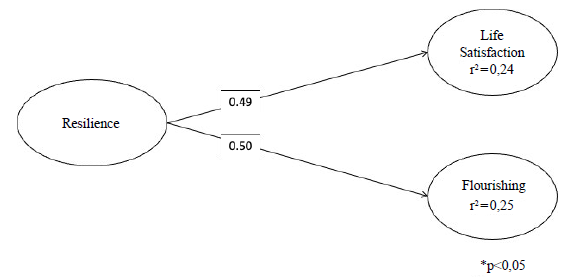
The model showed an acceptable fit (Table 2), with resilience explaining 24 % of the life satisfaction variance and 25 % of the flourishing variance. It should be noted that the direct trajectories of resilience for life satisfaction (ß = 0.49) and flourishing (ß = 0.50) were positive, moderate, weak, and significant (p <0.05), indicating the importance of resilience for life satisfaction and flourishing levels the crisis caused by Covid-19.
Table 2
Fit Indexes of the Measurement Model and the Structural Models with and without Mediation (n = 261)
Indirect effects
Then, a second model was tested, including both positive and negative affects as mediating variables in the association between resilience, life satisfaction, and flourishing. The tested model (Figure 2) presented sufficiently adequate fit indicators [B-SX2 (328) = 698.28; p = 0.001; B-SX2 / df = 2.13; CFI = 0.91; TLI = 0.90; RMSEA = 0.066; p (RMSEA <0.05) = 0.001] and evidenced a mediating effect of positive affect since negative affect did not present significant direct trajectories as to life satisfaction and flourishing (Figure 2), suggesting the importance of university students feeling positive emotions, even during a period of adversity such as the pandemic, to have higher levels of life satisfaction and blossoming.
Figure 2
Structural Equation Modeling for the Mediating role of Positive and Negative Affects in the Association of Resilience with Life Satisfaction and Flourishing among University Students
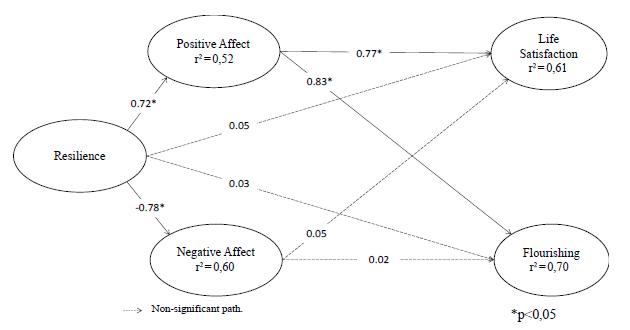
Analyzing the estimates of the bootstrap parameters (Table 3), we found that life satisfaction showed a variation of 61 % explained by resilience and by positive and negative affects, while the flourishing variation of 70 % was explained by resilience and positive and negative affects. In addition, resilience shared a 60 % variance with negative affect and 52 % with positive affect. It is noteworthy that in this model the direct trajectories of resilience for life satisfaction (ß = 0.05; p >0.05) and flourishing (ß = 0.03; p >0.05) were weak and non-significant. However, the mediation of positive and negative affects revealed an independent and high indirect effect both on life satisfaction (ß = 0.52) and flourishing (ß = 0.58). Moreover, resilience had a positive and strong effect on positive affect (ß = 0.72), and a strong and negative effect on negative affect (ß = -0.78). In turn, positive affect had a positive and strong effect on life satisfaction (ß = 0.77) and flourishing (ß = 0.83), while negative affect had no significant effect on either of the variables (ß = 0.05 and ß = 0.02, respectively).
Table 3
Standardized Direct and Indirect Effects for the Structural Model with the Mediation of Positive and Negative Affects
Discussion
Taken altogether, our results confirm the theoretical model that indicates the influence of resilience on life satisfaction and flourishing, a resilience that is mediated by positive affects in university students during the Covid-19 pandemic. Initially, it was possible to observe that in the model with only direct trajectories of resilience for life satisfaction and flourishing (Figure 1), resilience explained 24 % of the variance of life satisfaction and 25 % of the variance of flourishing. However, in the second model (Figure 2), the direct trajectories of resilience for life satisfaction (ß = 0.05; p >0.05) and flourishing (ß = 0.03; p >0.05) were weak and non-significant but, with the mediation of positive affects, there was an independent and high indirect effect on life satisfaction (ß = 0.52) and flourishing (ß = 0.58).
In light of the foregoing, the results corroborate previous studies that have pointed out resilience as a promoter of greater well-being (Diener & Chan, 2011; Gouveia et al., 2019; Zanon et al., 2020) and, above all, greater life satisfaction (Yildirim, 2019; Condori & Martínez, 2019), positive affects (Gouveia et al., 2019; Yildirim, 2019) and flourishing (Fonseca et al., 2015; Yildirim, 2019). They also agree with studies that already show the important role of resilience in preserving people's mental health when it comes to Covid-19 impacts (Killgore et al., 2020; Kimhi et al., 2020). Specifically, regarding university students, the results reported here also corroborate previous studies that evidence the importance of resilience in promoting well-being and reducing anxiety and stress in this population (Lozano-Diaz et al., 2020; Ye et al., 2020).
However, based on the results of the second model, we also verified the fundamental role of positive affects so that this association between resilience, life satisfaction, and flourishing could be maintained in this study. This is consistent with affects being the affective component of SWB and reflecting more immediate emotions concerning the moment experienced by an individual (Diener, 2000; Gouveia et al., 2019), having an impact on the levels of life satisfaction and flourishing of these university students who are going through this crisis caused by Covid-19.
In this sense, these results corroborate Lyubomirsky et al. (2005) findings, who point out that characteristics, resources, and successes related to happiness that arise as a consequence of frequent positive affect experiences, as well as with Gouveia et al. (2019), who found that positive affects were positively correlated with well-being indicators (vitality, positivity, and optimism) and negatively correlated with psychological discomfort indicators (depression, anxiety, and stress).
Regarding our results, it is also important to highlight that university students currently have to deal with worries about their academic and professional future, which seems increasingly uncertain, bearing in mind the delays in academic training and doubts as to the "new" job market (Cao et al., 2020); thus, they are a population that requires special attention, as this crisis can affect their life satisfaction and flourishing, fundamental constructs for the maintenance of mental health since they represent the notion of purpose, meaning of life, and self-fulfillment (Diener et al., 2010; Seligman, 2011; Becalli, 2014). In addition, previous studies report lack of meaning and satisfaction in life as related to suicidal ideation (Santos et al., 2016; Wang et al., 2013), and other studies also point out a higher risk of suicide among young people during the pandemic (Cao et al., 2020; Sun et al., 2020). Thus, resilience, SWB and flourishing can serve as protective factors against mental health problems in university students during and after the pandemic.
Given the above, considering that resilience is a psychological phenomenon present in all individuals that develops and manifests itself throughout life (Oliveira & Nakano, 2018; Yunes, 2011) and has an impact on mental health (Zanon et al., 2020; Yildirim, 2019), based on the findings presented, in which they relate this variable to satisfaction with life and flourishing, the relevance of interventions to increase resilience in university students is highlighted. Therefore, it is considered that this study contributes substantially, in theoretical terms, to increase the understanding of positive psychology variables, especially by indicating the relevant role of resilience in mental health and positive affects in the search for satisfaction with life and flourishing. Regarding practical applications, these findings can be useful for the development of intervention strategies that can help university students increase or maintain their resilience and positive affects, especially during the global Covid-19 crisis.
Conclusions
In this sense, it is possible to observe that the pandemic caused by the new coronavirus brought considerable changes in the routine of thousands of people and students around the world, requiring the latter to adapt to a new type of education, with remote classes, distancing from the university environment (Cao et al., 2020; Usher et al., 2020), and, above all, to adapt to a new perspective for the future, demanding that such students develop psychological resources to deal with this crisis. In this way, we conclude that having resilience and positive affects even during the pandemic can promote higher levels of life satisfaction and blossoming, thus maintaining the mental health of university students and, possibly, their academic performance.
However, some limitations need to be highlighted, such as it not being a study performed with a probabilistic sample, but by convenience, in addition to using self-report measures, which does not allow generalizing the results found here. Therefore, as a suggestion, further studies should consider broader samples to identify whether such a model can be replicated, even in other groups, such as health professionals, who are working on the front lines fighting the new coronavirus. Another suggestion is the possibility of incorporating new variables into this model, such as hope and optimism, which the literature already signaled as important in promoting life satisfaction and flourishing (Yildirim & Arslan, 2020; Zanon et al., 2020).
Finally, it is worth noting that the results found here can be applied to the development of intervention strategies, mainly in universities, with practices to promote resilience, SWB, and blossoming, among other variables related to positive psychology (optimism, hope, gratitude), such as the implementation of extension projects aimed at the development of the psychology of happiness and well-being, so that the academic community and people, in general, can understand their own emotions, thoughts and behaviors, and be able to deal better with possible consequences of the pandemic, such as worries about their academic and professional future, in addition to loss of family members and friends. In this sense, there is great potential for the implementation of disciplines, courses and projects using the variables investigated in the present study for them to be "taught" and promoted as a means for preserving the mental health of university students.
These extension projects can utilize psychoeducation to promote emotional regulation techniques among university students. Moreover, universities can introduce support groups that provide a platform to discuss career-related questions and prospects, thus enhancing satisfaction and general flourishing. However, to implement such initiatives, higher education institutions need to provide financial and institutional support, issuing internal calls for financial aid to enable teachers and researchers to execute these projects and support groups. Additionally, educational institutions can initiate discussions with the academic community to encourage the inclusion of courses that focus on SWB, such as psychology of happiness, in the course curriculum. It is worth noting that some Brazilian universities have already taken steps in this direction.